MCQ
${K_\alpha }$characteristic $X- $ ray refers to the transition
  • $n = 2$ to $n = 1$
  • B
    $n = 3$ to $n = 2$
  • C
    $n = 3$ to $n = 1$
  • D
    $n = 4$ to $n = 2$

Answer

Correct option: A.
$n = 2$ to $n = 1$
a
$K _{ a }$ characteristic X-ray refers to the transition from $n =2$ to $n =1$.

Need a full question paper?

Generate a complete, print-ready paper with questions like this in minutes — across 16+ boards, with answer keys.
Start Generating Free

Similar questions

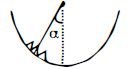
An insect crawls up a hemispherical surface very slowly. The coefficient of friction between the insect and the surface is $1/3$. If the line joining the centre of the hemispherical surface to the insect makes an angle $\alpha $ with the vertical, the maximum possible value of $\alpha $ so that the insect does not slip is given by
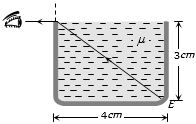
When the rectangular metal tank is filled to the top with an unknown liquid, as observer with eyes level with the top of the tank can just see the corner $E$; a ray that refracts towards the observer at the top surface of the liquid is shown. The refractive index of the liquid will be
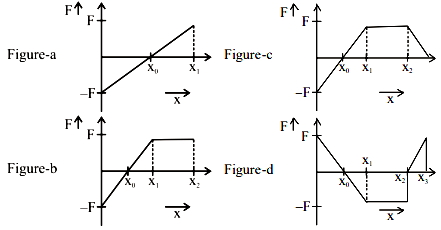
Arrange the four graphs in descending order of total work done; where $W _{1}, W _{2}, W _{3}$ and $W _{4}$ are the work done corresponding to figure $a , b , c$ and d respectively.
A bottle of sodawater is grasped by the neck and swing briskly in a vertical circle. Near which portion of the bottle do the bubbles collect
The power of an achromatic convergent lens of two lenses is $+ 2D$. The power of convex lens is $+ 5D.$ The ratio of dispersive power of convex and concave lens will be
The magnifying glass is made of combination of lenses of power $+20D$ and $-4D$. If the distance of distinct vision is $25\,cm$, calculate the size of an object $2\,cm$ height seen through the magnifying glass 
If mass is written as $\mathrm{m}=\mathrm{kc}^{\mathrm{p}} \mathrm{G}^{-1 / 2} \mathrm{~h}^{1 / 2}$ then the value of $P$ will be : (Constants have their usual meaning with $\mathrm{k}$ a dimensionless constant)
A body cools from a temperature $3T$ to $2T$ in $10$ minutes. The room temperature is $T.$ Assume that Newton's law of cooling is applicable. The temperature of the body at the end of next $10$ minutes will be
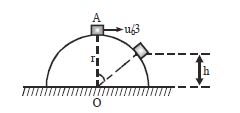
In the given figure for $u\ =\ u_0/3$ , find the height from the ground at which the block leaves the hemisphere [where $u_0\ =\ \sqrt {\frac{{gr}}{3}} ]$
In the disintegration series the $_{92}^{238}U\xrightarrow{\alpha }X\xrightarrow{{\beta  - }}_Z^AY$ values of $Z$ and $A$ respectively will be