MCQ
$K_\alpha$ characteristic $X-$ray refers to the transition
  • $n = 2$ to $n = 1$
  • B
    $n = 3$ to $n = 2$
  • C
    $n = 3$  to $n = 1 $
  • D
    $n = 4$ to $n = 2$

Answer

Correct option: A.
$n = 2$ to $n = 1$
$n = 2$ to $n = 1$

Need a full question paper?

Generate a complete, print-ready paper with questions like this in minutes — across 16+ boards, with answer keys.
Start Generating Free

Similar questions

In Bainbridge mass spectrograph a potential difference of $1000\ V$ is applied between two plates distant $1 \ cm$ apart and magnetic field in $B = 1T.$ The velocity of undeflected positive ions in $m/s$ from the velocity selector is
Consider the following two statements A and B, and identify the correct choice out of given answers
A. Thermo e.m.f. is minimum at neutral temperature of a thermocouple
B. When two junctions made of two different metallic wires are maintained at different temperatures, an electric current is generated in the circuit.(a) A is false and B is true(b) A is true and B is false(c) Both A and B are false(d) Both A and B are true
   
   
Diffraction of light can be explained by the following:
For the same speed, de Broglie wavelength.
The distance of closest approach of an alpha particle is $d$ when it moves with a speed $V$ towards a nucleus.
Another alpha particle is projected with higher energy such that the new distance of the closest approach is $d/2$ . What is the speed of projection of the alpha particle in this case?
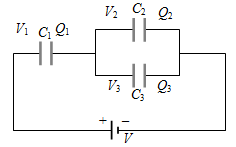
In an adjoining figure are shown three capacitors $C_1, C_2$ and $C _3$ joined to a battery. The correct condition will be $($Symbols have their usual meanings$)$
The kinetic energy of electron in the first Bohr orbit of the hydrogen atom is(a) – 6.5 eV(b) – 27.2 eV(c) 13.6 eV(d) – 13.6 eV
       
Which one of the following device makes use of the electrons to strike certain substances to produce fluorescence?
The surface shown in the figure does not represent:
Image
When a 12 Ω resistor is connected with a moving coil galvanometer then its deflection reduces from 50 divisions to 10 divisions. The resistance of the galvanometer is(a) 24 Ω(b) 36 Ω(c) 48 Ω(d) 60 Ω