MCQ
Karman line is a theoretical construct that separates the earth's atmosphere from outer space. It is defined to be the height at which the lift on an aircraft flying at the speed of a polar satellite $(8 \,km / s )$ is equal to its weight. Taking a fighter aircraft of wing area $30 \,m ^2$, and mass $7500 \,kg$, the height of the Karman line above the ground will be in the range .............. $km$ (assume the density of air at height $h$ above ground to be $\rho( h )=1.2 e ^{\frac{ h }{10}} \,kg / m ^3$ where $h$ is in $km$ and the lift force to be $\frac{1}{2} \rho v^2 A$, where $v$ is the speed of the aircraft and $A$ its wing area).
  • A
    $25-50$
  • $75-100$
  • C
    $125-150$
  • D
    $175-200$

Answer

Correct option: B.
$75-100$
b
(B)

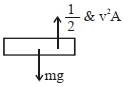
For equilibrium :

$mg ^{\prime}=\frac{1}{2} \rho v ^2 A$

$mg \left(1-\frac{2 h }{ R }\right)=\frac{1}{2} \times 1.2 e ^{-\frac{ h }{10}} v ^2 A$

$\Rightarrow 7500 \times 9.8\left(1-\frac{2 h }{ R }\right)=0.6 e ^{-\frac{ h }{10}}\left(8 \times 10^3\right)^2 \times 30$

$\downarrow$ Neglect this term for a while and we get $h \simeq 95 \,km$

So, with $\left(1-\frac{2 h}{R}\right)$, we will get little lesser value or $h$.

$\therefore(B)$ is the answer.

Need a full question paper?

Generate a complete, print-ready paper with questions like this in minutes — across 16+ boards, with answer keys.

Start Generating Free

Similar questions

The electrostatic energy of $Z$ protons uniformly distributed throughout a spherical nucleus of radius $R$ is given by

$E=\frac{3}{5} \frac{Z(Z-1) e^2}{4 \pi \varepsilon_0 R}$

The measured masses of the neutron, ${ }_1^1 \mathrm{H},{ }_7^{15} \mathrm{~N}$ and ${ }_8^{15} \mathrm{O}$ are $1.008665 \mathrm{u}, 1.007825 \mathrm{u}$, $15.000109 \mathrm{u}$ and $15.003065 \mathrm{u}$, respectively. Given that the radii of both the ${ }_7^{15} \mathrm{~N}$ and ${ }_8^{15} \mathrm{O}$ nuclei are same, $1 \mathrm{u}=931.5 \mathrm{MeV} / \mathrm{c}^2$ ( $c$ is the speed of light) and $e^2 /\left(4 \pi \varepsilon_0\right)=1.44 \mathrm{MeV} \mathrm{fm}$. Assuming that the difference between the binding energies of ${ }_7^{15} \mathrm{~N}$ and ${ }_8^{15} \mathrm{O}$ is purely due to the electrostatic energy, the radius of either of the nuclei is

$\left(1 \mathrm{fm}=10^{-15} \mathrm{~m}\right.$ )

Figure shows two containers $P$ and $Q$ with same base area $A$ and each filled upto same height with same liquid. Select the correct alternative .............
One main scale division of a vernier caliper is equal to $m$ units. If $n ^{\infty}$ division of main scale coincides with $( n +1)^{\text {th }}$ division of vernier scale, the least count of the vernier caliper is:
A uniform wire of $16\,\Omega $ is made into the form of a square. Two opposite corners of the square are connected by a wire of resistance $16\,\Omega $. The effective resistance between the other two opposite corners is ...............  $\Omega$
A copper rod of length $l$ is rotated about one end perpendicular to the magnetic field $B$ with constant angular velocity $\omega $. The induced $e.m.f$. between the two ends is
If the kinetic energy of a moving body becomes four times its initial kinetic energy, then the percentage change in its momentum will be $...\%$
A mass of $10 \,gm$ is suspended by a string and the entire system is falling with a uniform acceleration of $400\,cm/{\sec ^2}.$The tension in the string will be.......... $dyne$ $(g = 980\,cm/{\sec ^2})$
The half life of a radioactive substance is $20$ minutes. The approximate time interval $(t_2 -t_1)$ between the time $t_2$ when $3/4$ of it has decayed and time $t_1$ when $1/4$ of it had decayed is
Which of the following loop is in stable equallibrium
The de-Broglie wavelength associated with a hydrogen molecule moving with a thermal velocity of $3 km/s$ will be ............ $\mathop A\limits^o $