MCQ
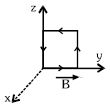
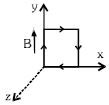
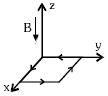
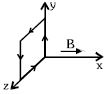
Which of the following loop is in stable equallibrium
  • A

  • B

  • C


Answer

Correct option: D.

d
For stable equilibrium potential energy should be minimum

$\mathrm{U}=-\mathrm{MB} \cos \theta$

$\theta \rightarrow$ angle $\mathrm{b} / \mathrm{w}\,\,\, \overrightarrow{\mathrm{M}}$ and $\overrightarrow{\mathrm{B}}$

$\mathrm{U}_{\min }$ at $\theta=0^{\circ}$

Need a full question paper?

Generate a complete, print-ready paper with questions like this in minutes — across 16+ boards, with answer keys.
Start Generating Free

Similar questions

Two thin long parallel wires, separated by a distance $d$ carry a current of $I$ $amp$ in  the same direction. They will
A particle moving in a circle of radius $R$ with a uniform speed takes a time $T$ to complete one revolution. If this particle were projected with the same speed at an angle ' $\theta$ ' to the horizontal, the maximum height attained by it equals $4 \mathrm{R}$. The angle of projection, $\theta$, is then given by
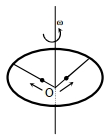
A ring of mass $M$ and radius $R$ is rotating with angular speed $\omega$ about a fixed vertical axis passing through its centre $O$ with two point masses each of mass $\frac{ M }{8}$ at rest at $O$. These masses can move radially outwards along two massless rods fixed on the ring as shown in the figure. At some instant the angular speed of the system is $\frac{8}{9} \omega$ and one of the masses is at a distance of $\frac{3}{5} R$ from $O$. At this instant the distance of the other mass from $O$ is
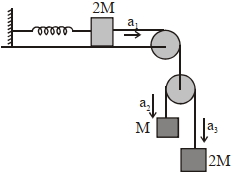
A block of mass $2 M$ is attached to a massless spring with spring-constant $k$. This block is connected to two other blocks of masses $M$ and $2 M$ using two massless pulleys and strings. The accelerations of the blocks are $a_1, a_2$ and $a_3$ as shown in figure. The system is released from rest with the spring in its unstretched state. The maximum extension of the spring is $x _0$. Which of the following option($s$) is/are correct? [g is the acceleration due to gravity. Neglect friction]
The relaxation time in conductors
Experimentally it is found that $12.8\,eV$ energy is required to separate a hydrogen atom into a proton and an electron. So the orbital radius of the electron in a hydrogen atom is $\frac{9}{ x } \times 10^{-10}\,m$. The value of the $x$ is $\left(1\,eV =1.6 \times 10^{-19}\,J , \frac{1}{4 \pi \epsilon_0}=9 \times 10^9\,Nm ^2 / C ^2\right.$ and electronic charge $=1.6 \times 10^{-19}\,J\,C$ )
Half lives of two radioactive substances $A$ and $B$ are respectively $20$ minutes and $40$ minutes. Initially the sample of $A$ and $B$ have equal number of nuclei. After $80$ minutes, the ratio of remaining number of $A$ and $B$ nuclei is
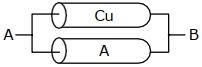
A Copper $(Cu)$ rod of length $25\, {cm}$ and cross- sectional area $3\, {mm}^{2}$ is joined with a similar Aluminium $(Al)$ rod as shown in figure. Find the resistance of the combination between the ends $A$ and $B$ (in ${m} \Omega$)

(Take Resistivity of Copper $=1.7 \times 10^{-8}\, \Omega \,{m}$, Resistivity of Aluminium $=2.6 \times 10^{-8}\, \Omega \,{m}$ )
In an experiment four quantities $a, b, c$ and $d $ are measured with percentage error $1\%, 2\%, 3\%$ and $4\%$ respectively. Quantity $P$ is calculated as follows $P = \frac{{{a^3}{b^2}}}{{cd}}$. $ \%$ error in $P$ is ........ $\%$
A transformer having efficiency of $90\%$ is working on $200\, V$ and $3\, kW$ power supply. If the current in the secondary coil is $6\, A,$ the voltage across the secondary coil and the current in the primary coil respectively are