Question
Kinetic theory of gases provide a base for

Answer

Kinetic theory of gases state that anerage kinetic energy $(KE)$ of the gas molecules is directly proportional to the absolute temperature.

$P V=\frac{1}{3} m n V_{r m s}^{2}=\frac{2}{3} \times \frac{1}{2} m n v_{\text {rms }}^{2}=\frac{2}{3} k T$

Boyle's law state that at constant temperature average $K E$ is constant, So, $v_{\text {rms }}$ Memains unchanged. If volume increases pressure of gas decreases.

i.e., $P V=$ constant .

Charle's law state that if we allow the volume to change to maintain constant pressure the volume will increase with increasing temperature

$\text { i.e., } V=K T$

$\therefore$ Option $(c)$ is correct.

Need a full question paper?

Generate a complete, print-ready paper with questions like this in minutes — across 16+ boards, with answer keys.

Start Generating Free

Similar questions

A beam of light of wavelength $400\,nm$ and power $1.55\,mW$ is directed at the cathode of a photoelectric cell. If only $10 \%$ of the incident photons effectively produce photoelectron, then find current due to these electrons $...........\mu A$

[given, $hc =1240\,eV - nm , e =1.6 \times 10^{-{ }^{19}\,C }$ )
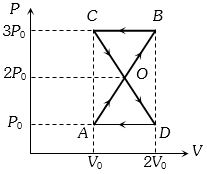
A thermodynamic system undergoes cyclic process $ABCDA $ as shown in figure. The work done by the system in the cycle is
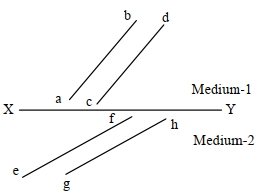
The figure shows a surface $XY$ separating two transparent media, medium -$1$ and medium -$2$. The lines $a b$ and cd represent wavefronts of a light wave travelling in medium-$1$ and incident on $XY$. The lines ef and gh represent wavefronts of the light wave in medium-$2$ after refraction.

$Image$

$1.$  Light travels as a

$(A)$ parallel beam in each medium

$(B)$ convergent beam in each medium

$(C)$ divergent beam in each medium

$(D)$ divergent beam in one medium and convergent beam in the other medium.

$2.$  The phases of the light wave at $\mathrm{c}, \mathrm{d}, \mathrm{e}$ and $\mathrm{f}$ are $\phi_{\mathrm{c}}, \phi_{\mathrm{d}}, \phi_{\mathrm{e}}$ and $\phi_{\mathrm{f}}$ respectively. It is given that $\phi_{\mathrm{c}} \neq \phi_{\mathrm{f}}$

$(A)$ $\phi_{\mathrm{c}}$ cannot be equal to $\phi_{\mathrm{d}}$

$(B)$ $\phi_{\mathrm{a}}$ can be equal to $\phi_{\mathrm{e}}$

$(C)$ $\left(\phi_{\mathrm{d}}-\phi_t\right)$ is equal to $\left(\phi_{\mathrm{c}}-\phi_{\mathrm{e}}\right)$

$(D)$ $\left(\phi_{\mathrm{d}}-\phi_c\right)$ is not equal to $\left(\phi_{\mathrm{f}}-\phi_e\right)$

$3.$  Speed of the light is

$(A)$ the same in medium-$1$ and medium-$2$

$(B)$ larger in medium-$1$ than in medium-$2$

$(C)$ larger in medium-$2$ than in medium-$1$

$(D)$ different at $\mathrm{b}$ and $\mathrm{d}$

Give the answer question $1, 2$ and $3.$
A leak proof cylinder of length $1 \;\mathrm{m},$ made of a metal which has very low coefficient of expansion is floating vertically in water at $0^{\circ} \mathrm{C}$ such that its height above the water surface is $20\; \mathrm{cm} .$ When the temperature of water is increased to $4^{\circ} \mathrm{C},$ the height of the cylinder above the water surface becomes $21 \;\mathrm{cm} .$ The density of water at $\mathrm{T}=4^{\circ} \mathrm{C},$ relative to the density at $\mathrm{T}=0^{\circ} \mathrm{C}$ is close to
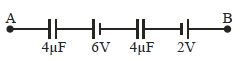
A part of circuit is given here, if $V_A-V_B = 4V$ then find charge on $4\,\mu F$ capacitor.....$\mu C$
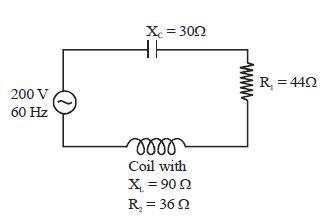
As given in the figure, a series circuit connected across a $200\, V$, $60\, Hz$ line consists of a capacitor of capacitive reactance $30\,\Omega $, a non-inductive resistor of $44\,\Omega $, and a coil of inductive reactance $90\,\Omega $ and resistance $36\,\Omega $. The power dissipated in the coil is......$W$
In a $YDSE$ setup the intensity due to two coherent beams differ from each other by $1\%.$ If one of the beam has intensity $I,$ then intensity of minima is
The mean kinetic energy of a gas at $300\, K$ is $100\, J.$ The mean energy of the gas at $450\, K$ is equal to ...... $J$
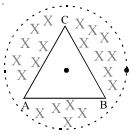
$A$ triangular wire frame (each side $= 2m$) is placed in a region of time variant magnetic field having $dB/dt = \sqrt 3 \,T/s$. The magnetic field is perpendicular to the plane of the triangle. The base of the triangle $AB$ has a resistance $1 \Omega$ while the other two sides have resistance $2\Omega$ each. The magnitude of potential difference between the points $A$ and $B$ will be....$V$
A transistor is used in common-emitter mode in an amplifier circuit. When a signal of $10\, mV$ is added to the base-emitter voltage, the base current changes by $10 \mu A$ and the collector current changes by $1.5 \,mA$. The load resistance is $5 \,k \Omega$. The voltage gain of the transistor will be