MCQ
Kirchhoff ’s junction rule is a reflection of:
  • A
    Conservation of current density vector.
  • B
    Conservation of charge.
  • C
    The fact that the momentum with which a charged particle approaches a junction is unchanged (as a vector) as the charged particle leaves the junction.
  • D
    The fact that there is no accumulation of charges at a junction.

Answer

  1. Conservation of charge.
  1. The fact that there is no accumulation of charges at a junction.

Solution:

Key concept: Junction rule: At any junction, the sum of the currents entering the junction is equal to the sum of currents leaving the junction.
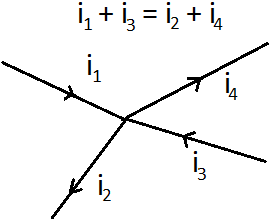
Or
Algebraic sum of the currents flowing towards any point in an electric network is zero, i.e., charges are conserved in an electric network.

The proof of this rule follows from the fact that when currents are steady, there is no accumulation of charges at any junction or at any point in a line.

Thus, the total current flowing in, (which is the rate at which charge flows into the junction), must equal the total current flowing out.

Kirchhoffs junction rule is also known as Kirchhoff’s current law.

So, Kirchhoffs junction rule is the reflection of conservation of charge

Important point: Sign convention of current from a junction: We are taking outgoing current from a junction as negative. And we are taking incoming current towards a junction as positive.

Need a full question paper?

Generate a complete, print-ready paper with questions like this in minutes — across 16+ boards, with answer keys.

Start Generating Free

Similar questions

A uniformly charged conducting sphere of 2.4 m diameter has a surface che density of $80 \mu C m ^{-2}$. The charge on the sphere is mC .
The capacitance of an air capacitor is $5 \mu F$. If mica is completely used in place of air in the same capacitor, then the capacitance becomes $30 \mu F$, the dielectric constant of mica will be:

What will be the ratio of de-Broglie wavelengths of proton and α - particle of same energy

(a) 2 : 1

(b) 1 : 2

(c) 4 : 1

(d) 1 : 4

A mixer of $100\Omega$ resistance is connected to an A.C. source of 200V and 50 cycles/ sec. The value of average potential difference across the mixer will be:

Work function of a metal is 2.1 eV. Which of the waves of the following wavelengths will be able to emit photoelectrons from its surface

(a) 4000 Å, 7500 Å

(b) 5500 Å, 6000 Å

(c) 4000 Å, 6000 Å

(d) None of these

Resistivity of a semiconductor depends on

(a) Shape of semiconductor

(b) Atomic nature of semiconductor

(c) Length of semiconductor

(d) Shape and atomic nature of semiconductor

An LCR series circuit with $100\Omega$ resistance is connected to an ac source of 200V and of frequency of $\frac{300 \text{rad}}{\text{s}}$. When only the capacitance is removed, the current lags behind the voltage by 600. When only the inductance is removed, the current leads the voltage by 60° the current through the circuit is:
The Electric field at a point is:

What is the angle between the electric dipole moment and the electric field strength due to it on the equatorial line

(a) 0o

(b) 90o

(c) 180o   

(d) None of these

A metallic block carrying current I is subjected to a uniform magnetic induction  as shown in the figure. The moving charges experience a force  given by ........... which results in the lowering of the potential of the face ........ Assume the speed of the carriers to be v

(a) eVB, ABCD

(b) eVB, EFGH

(c) -eVB, ABCD

(d) -eVB, EFGH