MCQ
The Electric field at a point is:
- AAlways continuous.
- BContinuous if there is no charge at that point.
- CDiscontinuous only if there is a negative charge at that point.
- DDiscontinuous if there is a charge at that point.
(b, d) We cannot define electric field at the position of a charge, so we cannot say that electric field is always continuous.
Hence option (a) is ruled out and option (d) is the correct choice.
The electric field due to any charge will be continuous, if there is no other charge in the medium. It will be discontinuous if there is a charge at the point under consideration, hence option (b) is correct.
Generate a complete, print-ready paper with questions like this in minutes — across 16+ boards, with answer keys.
An electron initially at rest, is accelerated through a potential difference of 200 volt, so that it acquires a velocity 8.4  . The value of e/m of electron will be
|
(a) 2.76 |
(b) 1.76 |
(c) 0.76 |
(d) None of these |
A glass slab is placed in the path of beam of convergent light. The point of convergence of light:
Two capacitors  and
and  in series, are connected in parallel to a third capacitor
 . This arrangement is then connected to a battery of e.m.f. = 2V, as shown in the figure. How much energy is lost by the battery in charging the capacitors
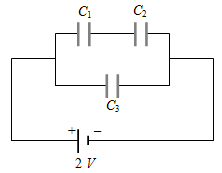
|
(a) 22 |
(b) 11 |
(c) |
(d) |
A radioactive nucleus undergoes a series of decay according to the scheme A 
 If the mass number and atomic number of A are 180 and 72 respectively, then what are these number for A4
|
(a) 172 and 69 |
(b) 174 and 70 |
(c) 176 and 69 |
(d) 176 and 70 |
The first excited state of hydrogen atom is 10.2 eV above its ground state. The temperature is needed to excite hydrogen atoms to first excited level, is
(a) 7.9 
|
(b) 3.5
|
(c) 5.8
|
(d) 14
|
An achromatic combination of lenses is formed by joining
|
(a) 2 convex lenses |
(b) 2 concave lenses |
|
(c) 1 convex lens and 1 concave lens |
(d) Convex lens and plane mirror |
A coil of resistance 10 W and an inductance 5H is connected to a 100 volt battery. Then energy stored in the coil is
|
(a) 125 erg |
(b) 125 J |
(c) 250 erg |
(d) 250 J |


