Question
Kyra has a rectangular painting canvas having a total area of $24\ ft^2$ which includes a border of $0.5\ ft.$ on the left right and a border of $0.75\ ft.$ on the bottom, top inside it.
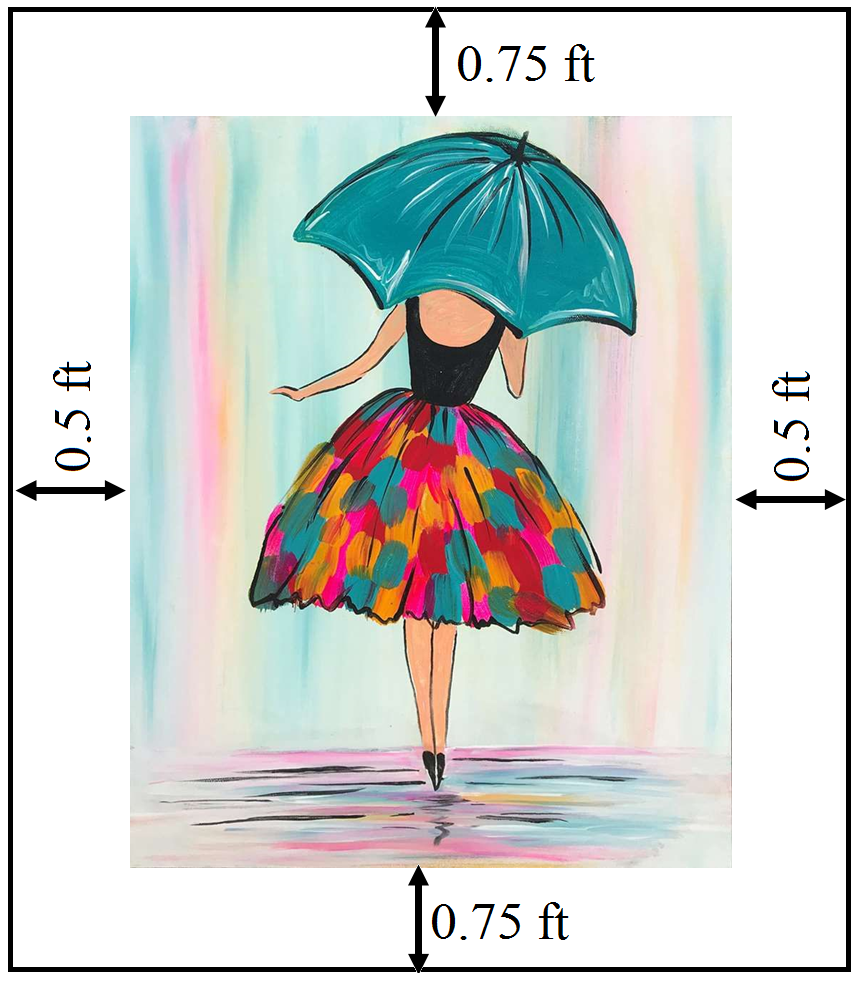
Based on the above information, answer the following questions.

  1. If Kyra wants to paint in the maximum area, then she needs to maximize.
  1. Area of outer rectangle.
  2. Area of inner rectangle.
  3. Area of top border.
  4. None of these.
  1. If x is the length of the outer rectangle, then area of inner rectangle in terms of $x$ is.
  1. $(\text{x}+3)\Big(\frac{24}{\text{x}}-2\Big)$
  2. $(\text{x}-1)\Big(\frac{24}{\text{x}}+1.5\Big)$
  3. $(\text{x}-1)\Big(\frac{24}{\text{x}}-1.5\Big)$
  4. $(\text{x}-1)\Big(\frac{24}{\text{x}}\Big)$
  1. Find the range of $x.$
  1. $(1, \infty)$
  2. $(1, 16)$
  3. $(-\infty, 16)$
  4. $(-1, 16)$
  1. If area of inner rectangle is maximum, then x is equal to.
  1. $2$ ft.
  2. $3$ ft.
  3. $4$ ft.
  4. $5$ ft.
  1. If area of inner rectangle is maximum, then length and breadth of this rectangle are respectively.
  1. $3$ ft, $4.5$ ft.
  2. $4.5$ ft, $5$ ft.
  3. $1$ ft, $2$ ft.
  4. $2$ ft, $4$ ft.

Answer

  1. (b) Area of inner rectangle
Solution:
In order to paint in the maximum area, Kyra needs to maximize the area of inner rectangle.
  1. (c) $(\text{x}-1)\Big(\frac{24}{\text{x}}-1.5\Big)$
Solution:
Let x be the length and y be the breadth of outer rectangle.
$\therefore$ Length of inner rectangle $= x - 1$
and breadth of inner rectangle $= y - 1.5$
$\therefore A(x) = (x - 1)(y - 1.5) [ \therefore  xy = 24 ($given$)$
$=\big(\text{x}-1\big)\bigg(\frac{24}{\text{x}}-1.5\bigg)$
  1. (b) $(1, 16)$
Solution:
Dimensions of rectangle (outer/inner) should be positive.
$\therefore\text{x}-1>0\text{ and }\frac{24}{\text{x}}-1.5>0$
$\therefore\text{x}>1\text{ and }{\text{x}}<16$
$\therefore$ Range of $x$ is $(1, 16)$
  1. (c) $4$ ft
Solution:
We have $\text{A}'\text{(x)}=(\text{x}-1)\bigg(\frac{24}{\text{x}}-1.5\bigg)$
$\Rightarrow\text{A}'(\text{x)}=(\text{x}-1)\Big(\frac{-24}{\text{x}^2}\Big)+\bigg(\frac{24}{\text{x}}-1.5\bigg)$
$=\frac{24}{\text{x}^2}-1.5\ \text{and}\ \text{A}''(\text{x})=\frac{-48}{\text{x}^3}$
For $A(x)$ to be maximum or minimum, $A'(x) = 0$
$\Rightarrow-1.5+\frac{24}{\text{x}^2}=0$
$\Rightarrow\text{x}^2=16$
$\Rightarrow\text{x}=\pm4$
$\therefore\text{x}=4$ [Since, length can't be negative]
Also, $\text{A}''(4)=\frac{-48}{4^3}<0$
Thus, at $x = 4$, area is maximum.
  1. (a) $3$ ft, $4.5$ ft.
Solution:
If area of inner rectangle is maximum, then Length of inner rectangle $= x - 1 = 4 - 1 = 3$ ft.
And breadth of inner rectangle $=\text{y}-1.5=\frac{24}{\text{x}}-1.5$
$=\frac{24}{4}-1.5=6-1.5=4.5\ \text{ft}$

Need a full question paper?

Generate a complete, print-ready paper with questions like this in minutes — across 16+ boards, with answer keys.

Start Generating Free

Similar questions

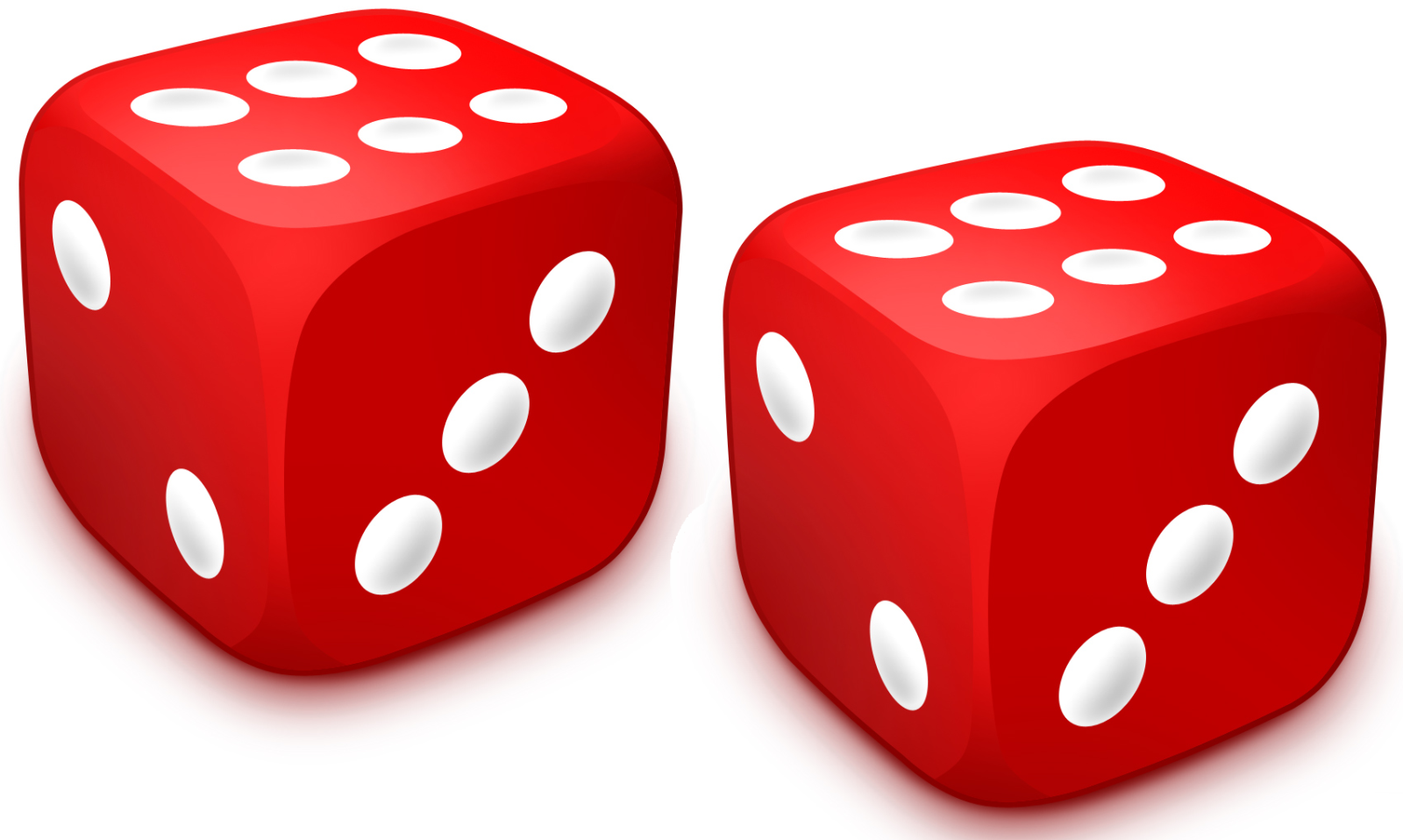
Varun and Jsha decided to play with dice to keep themselves busy at home as their schools are closed due to coronavirus pandemic. Varun throw a dice repeatedly until a six is obtained. He denote the number of throws required by X.
Based on the above information, answer the following questions.
  1. The probability that X = 2 equals.
  1. $\frac{1}{6}$
  2. $\frac{5}{6^2}$
  3. $\frac{5}{3^6}$
  4. $\frac{1}{6^3}$
  1. The probability that X = 4 equals.
  1. $\frac{1}{6^4}$
  2. $\frac{1}{6^6}$
  3. $\frac{5^3}{6^4}$
  4. $\frac{5}{6^4}$
  1. The probability that $\text{X}\geq2$ equals.
  1. $\frac{25}{216}$
  2. $\frac{1}{36}$
  3. $\frac{5}{6}$
  4. $\frac{25}{36}$
  1. The value of $\text{P}(\text{X}\geq6)$ is:
  1. $\frac{5^5}{6^5}$
  2. $1-\frac{5^3}{6^5}$
  3. $\frac{5^3\times61}{6^5}$
  4. $\frac{5^3}{6^4}$
  1. The probability that X > 3 equals.
  1. $\frac{36}{25}$
  2. $\frac{5^2}{6^2}$
  3. $\frac{5}{6}$
  4. $\frac{5^3}{6^3}$
Read the following text carefully and answer the questions that follow:
To teach the application of probability a maths teacher arranged a surprise game for $5$ of his students namely Govind, Girish, Vinod, Abhishek and Ankit. He took a bowl containing tickets numbered $1$ to $50$ and told the students go one by one and draw two tickets simultaneously from the bowl and replace it after noting the numbers.
Image
$i.$ Teacher ask Govind, what is the probability that tickets are drawn by Abhishek, shows a prime number on one ticket and a multiple of $4$ on other ticket? $(1)$
$ii$. Teacher ask Girish, what is the probability that tickets drawn by Ankit, shows an even number on first ticket and an odd number on second ticket? $(1)$
$iii$. Teacher asks Abhishek, what is the probability that tickets drawn by Vinod, shows a multiple of $4$ on one ticket and a multiple $5$ on other ticket? $(2)$
OR
Teacher asks Vinod, what is the probability that both tickets drawn by Girish shows odd number? $(2)$
Suman was doing a project on a school survey, on the average number of hours spent on study by students selected at random. At the end of survey, Suman prepared the following report related to the data. Let X denotes the average number of hours spent on study by students. The probability that X can take the values x, has the following form, where k is some unknown constant.$\text{P(X}=\text{x})\begin{cases}0.2,\text{if x}= 0\\\text{kx},\text{if}\text{ x}=1\text{ or }2\\\text{k}(6-\text{x}),\text{if}\text{ x}=3\text{ or }4\\0,\text{odherwise}\end{cases}$
Based on the above information, answer the following questions.

  1. Find the value of k.
  1. 0.1
  2. 0.2
  3. 0.3
  4. 0.05
  1. What is the probability that the average study time of students is not more than 1 hour?
  1. 0.4
  2. 0.3
  3. 0.5
  4. 0.1
  1. What is the probability that the average study time of students is at least 3 hours?
  1. 0.5
  2. 0.9
  3. 0.8
  4. 0.1
  1. What is the probability that the average study time of students is exactly 2 hours?
  1. 0.4
  2. 0.5
  3. 0.7
  4. 0.2
  1. What is the probability that the average study time of students is at least 1 hour?
  1. 0.2
  2. 0.4
  3. 0.8
  4. 0.6
Akash and Prakash appeared for first round of an interview for two vacancies. The probability of Nisha's selection is $\frac{1}{3}$ and that of Ayushi's selection is $\frac{1}{2}$.

Image

(i) Find the probability that both of them are selected.

(ii) The probability that none of them is selected.

Read the following text carefully and answer the questions that follow:
A building contractor undertakes a job to construct 4 flats on a plot along with parking area. Due to strike the probability of many construction workers not being present for the job is 0.65 . The probability that many are not present and still the work gets completed on time is 0.35 . The probability that work will be completed on time when all workers are present is 0.80 .
Let: $E _1$ : represent the event when many workers were not present for the job;
$E _2$ : represent the event when all workers were present; and
E: represent completing the construction work on time.
i. What is the probability that all the workers are present for the job? (1)
ii. What is the probability that construction will be completed on time? (1)
iii. What is the probability that many workers are not present given that the construction work is completed on time? (2)
OR
What is the probability that all workers were present given that the construction job was completed on time?(2)
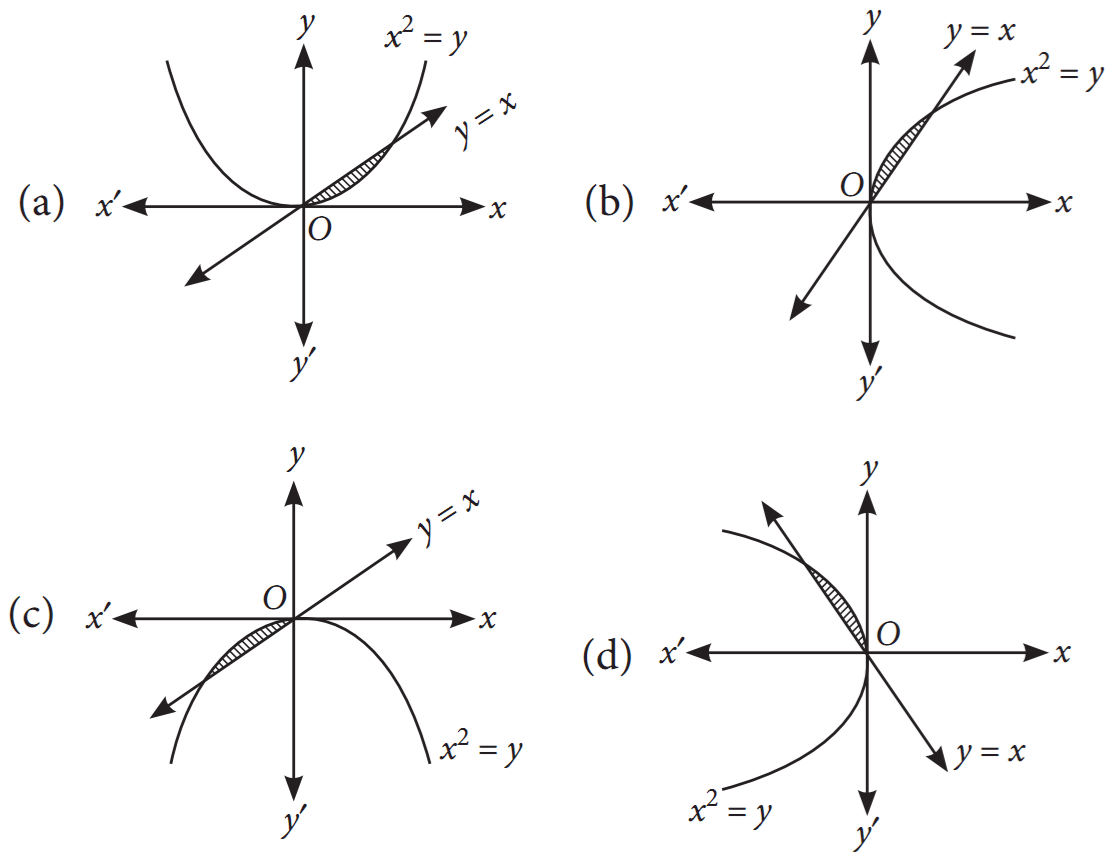
Consider the following equations of curves $x^2 = y$ and $y = x.$
On the basis of above information, answer the following questions.
  1. The point(s) of intersection of both the curves is (are).
  1. $(0, 0)(2, 2)$
  2. $(0, 0)(1, 1)$
  3. $(0, 0)(-1, -1)$
  4. $(0, 0)(-2, -2)$
  1. Area bounded by the curves is represented by which of the following graph?
  1. The value of the integral $\int\limits_{1}^{0}\text{x}\ \text{dx}$ is.
  1. $\frac{1}{4}$
  2. $\frac{1}{3}$
  3. $\frac{1}{2}$
  4. $1$
  1. The value of the integral $\int\limits_{0}^{1}\text{x}^2\ \text{dx}$ is.
  1. $\frac{1}{4}$
  2. $\frac{1}{3}$
  3. $\frac{1}{2}$
  4. $1$
  1. The value of area bounded by the curves $x^2 = y$ and $x = y$ is.
  1. $\frac{1}{6}\text{ sq}.\text{unit}$
  2. $\frac{1}{3}\text{ sq}.\text{unit}$
  3. $\frac{1}{2}\text{ sq}.\text{unit}$
  4. ${1}\text{ sq}.\text{unit}$
Read the following passage and answer the questions given below.

Image

The temperature of a person during an intestinal illness is given by $f(x)=-0.1 x^2+m x+98.6,0 \leq x \leq 12, \mathrm{~m}$ being a constant, where $\mathrm{f}(\mathrm{x})$ is the temperature in ${ }^{\circ} \mathrm{F}$ at $x$ days.

(i) Is the function differentiable in the interval $(0,12)$ ? Justify your answer.

(ii) If 6 is the critical point of the function, then find the value of the constant $\mathrm{m}$.

(iii) Find the intervals in which the function is strictly increasing/strictly decreasing.
OR
(iii) Find the points of local maximum/local minimum, if any, in the interval (0, 12) as well as the points of absolute maximum/absolute minimum in the interval [0, 12]. Also, find the corresponding local maximum/local minimum and the absolute maximum/absolute minimum values of the function.

Read the following text carefully and answer the questions that follow:
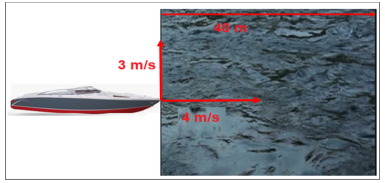
Once Ramesh was going to his native place at a village near Agra. From Delhi and Agra he went by flight, In the way, there was a river. Ramesh reached the river by taxi. Then Ramesh used a boat for crossing the river. The boat heads directly across the river $40 m$ wide at $4 m/s$. The current was flowing downstream at $3 m/s.$
Image
$i.$ What is the resultant velocity of the boat? $(1)$
$ii$. How much time does it take the boat to cross the river? $(1)$
$iii$. How far downstream is the boat when it reaches the other side? $(2)$​​​​​​​
OR
If speeds of boat and current were $1.5 m/s$ and $2.0 m/s$ then what will be resultant velocity? $(2)$
If $a_{1,} b_{1,} c_{1,}$ and $a_{2,}b_{2,} c_2$ are direction ratios of two lines say $L_1$ and $L_2$ respectively. Then $L_1 || L_2$ iff $\frac{\text{a}_1}{\text{a}_2}=\frac{\text{b}_1}{\text{b}_2}=\frac{\text{c}_1}{\text{c}_2}$ and $\text{L}_1\perp\text{L}_2$ iff $a_1a_2 + b_1b_2 + c_1c_2 = 0.$

Based on the above information, answer the following questions.
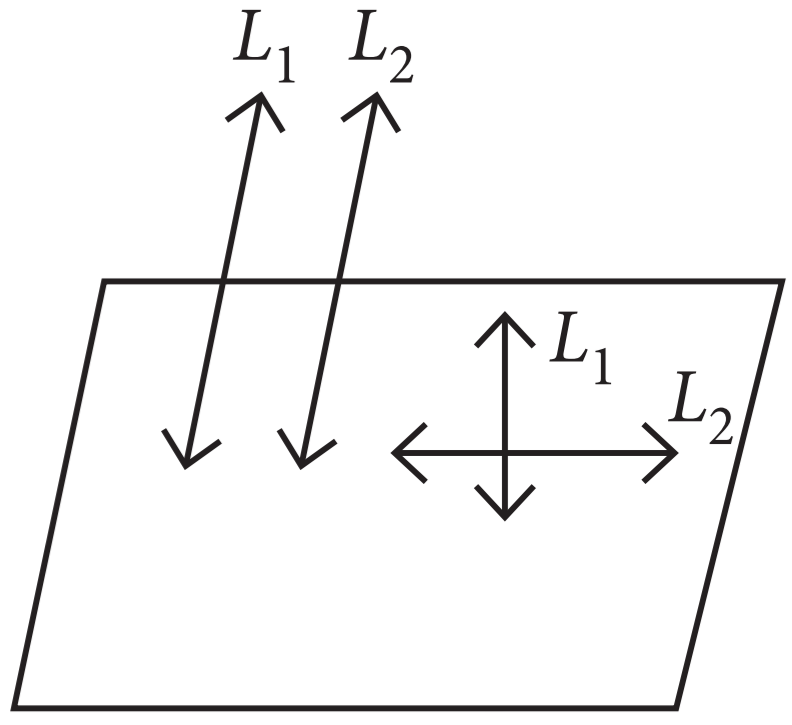
  1. If $l_{1,} m_1, n_{1,}$ and $l_2, m_2, n_2$ are the direction cosines of $L_1$ and $L_2$ respectively, then $L_1$ will be perpendicular to $L_2,$ iff:
  1. $l_1l_2 + m_1m_2 + n_1n_2 = 0$
  2. $l_1m_2 + m_1l_2 + n_1n_2 = 0$
  3. $\frac{\text{l}_1}{\text{l}_2}=\frac{\text{m}_1}{\text{m}_2}=\frac{\text{n}_1}{\text{n}_2}$
  4. None of these
  1. If $l_1, m_1, n_1$ and $l_2, m_2, n_2$ are direction cosines of $L_1$ and $L_2$ respectively, then $L_1$ will be parallel to $L_2,$ iff:
  1. $l_1l_2 + m_1m_2 + n_1n_2 = 0$
  2. $l_1m_2 + m_1l_2 + n_1n_2 = 0$
  3. $\frac{\text{l}_1}{\text{l}_2}=\frac{\text{m}_1}{\text{m}_2}=\frac{\text{n}_1}{\text{n}_2}$
  4. $m_1n_2 + m_2n_2 + l_1l_2 = 0$
  1. The coordinates of the foot of the perpendicular drawn from the point $A(1, 2, 1)$ to the line joining $B(1, 4, 6)$ and $C(5, 4, 4),$ are:
  1. $(1, 2, 1)$
  2. $(2, 4, 5)$
  3. $(3, 4, 5)$
  4. $(3, 4, 5)$
  1. The direction ratios of the line which is perpendicular to the lines with direction ratios proportional to $(1, -2, -2)$ and $(0, 2, 1)$ are:
  1. $< 1, 2, 1 >$
  2. $< 2,-1, 2 >$
  3. $< -1,2, 2 >$
  4. None of these
  1. The lines $\frac{\text{x}-2}{3}=\frac{\text{y}+1}{-2}=\frac{\text{z}-2}{0}$ and $\frac{\text{x}-1}{1}=\frac{\frac{\text{y}+3}{2}}{\frac{3}{2}}=\frac{\text{z}+5}{2}$ are:
  1. Parallel.
  2. Perpendicular.
  3. Skew lines.
  4. Non-intersecting.
Let f(x) be a real valued function, then its
  • Left Hand Derivative (L.H.D.) : $\text{Lf}'(\text{a})=\lim_\limits{\text{h}\rightarrow0}\frac{\text{f}(\text{a}-\text{h})-\text{f}(\text{a})}{-\text{h}}$
  • Right Hand Derivative (R.H.D.) : $\text{Rf}'(\text{a})=\lim_\limits{\text{h}\rightarrow0}\frac{\text{f}(\text{a}+\text{h})-\text{f}(\text{a})}{\text{h}}$
Also, a function f(x) is said to be differentiable at x = a if its L.H.D. and R.H.D. at x = a exist and are equal.
For the function $\text{f}(\text{x})=\begin{cases}|\text{x}-3|,\text{x}\geq1\\\\\frac{\text{x}^2}{4}-\frac{3\text{x}}{2}+\frac{13}{4},\text{x}<1\end{cases},$ answer the following questions.
  1. R.H.D. of f(x) at x = 1 is:
  1. 1
  2. -1
  3. 0
  4. 2
  1. L.H.D. of f(x) at x = 1 is:
  1. 1
  2. -1
  3. 0
  4. 2
  1. f(x) is non-differentiable at:
  1. x = 1
  2. x = 2
  3. x = 3
  4. x = 4
  1. Find the value of f'(2).
  1. 1
  2. 2
  3. 3
  4. -1
  1. The value of f'(-1) is:
  1. 2
  2. 1
  3. -2
  4. -1