Question
Let f(x) be a real valued function, then its
  • Left Hand Derivative (L.H.D.) : $\text{Lf}'(\text{a})=\lim_\limits{\text{h}\rightarrow0}\frac{\text{f}(\text{a}-\text{h})-\text{f}(\text{a})}{-\text{h}}$
  • Right Hand Derivative (R.H.D.) : $\text{Rf}'(\text{a})=\lim_\limits{\text{h}\rightarrow0}\frac{\text{f}(\text{a}+\text{h})-\text{f}(\text{a})}{\text{h}}$
Also, a function f(x) is said to be differentiable at x = a if its L.H.D. and R.H.D. at x = a exist and are equal.
For the function $\text{f}(\text{x})=\begin{cases}|\text{x}-3|,\text{x}\geq1\\\\\frac{\text{x}^2}{4}-\frac{3\text{x}}{2}+\frac{13}{4},\text{x}<1\end{cases},$ answer the following questions.
  1. R.H.D. of f(x) at x = 1 is:
  1. 1
  2. -1
  3. 0
  4. 2
  1. L.H.D. of f(x) at x = 1 is:
  1. 1
  2. -1
  3. 0
  4. 2
  1. f(x) is non-differentiable at:
  1. x = 1
  2. x = 2
  3. x = 3
  4. x = 4
  1. Find the value of f'(2).
  1. 1
  2. 2
  3. 3
  4. -1
  1. The value of f'(-1) is:
  1. 2
  2. 1
  3. -2
  4. -1

Answer

We have, $\text{f}(\text{x})=\begin{cases}\text{x}-3&,\text{x}\geq3\\3-\text{x}&,1\leq\text{x}<3\\\\\frac{\text{x}^2}{4}-\frac{3\text{x}}{2}+\frac{13}{4}&,\text{x}<1\end{cases}$
  1. (b) -1
Solution:

$\text{Rf}'(1)=\lim\limits_{\text{h}\rightarrow0}\frac{\text{f}(1+\text{h})-\text{f}(1)}{\text{h}}$

$\lim\limits_{\text{h}\rightarrow0}\frac{3-(1+\text{h})-2}{\text{h}}=\lim\limits_{\text{h}\rightarrow0}-\frac{\text{h}}{\text{h}}=-1$
  1. (b) -1
Solution:

$\text{Lf}'(1)=\lim\limits_{\text{h}\rightarrow0}\frac{\text{f}(1-\text{h})-\text{f}(1)}{-\text{h}}$

$=\lim\limits_{\text{h}\rightarrow0}\frac{-1}{\text{h}}\Big[\frac{(1-\text{h})^2}{4}-\frac{3(1-\text{h})}{2}+\frac{13}{4}-2\Big]$

$=\lim\limits_{\text{h}\rightarrow0}\frac{-1}{\text{h}}\Big(\frac{1+\text{h}^2-2\text{h}-6+6\text{h}+13-8}{-4\text{h}}\Big)$

$=\lim\limits_{\text{h}\rightarrow0}\Big(\frac{\text{h}^2+4\text{h}}{-4\text{h}}\Big)=-1$
  1. (c) x = 3
Solution:

Since, R.H.D. at x = 3 is 1

and L.H.D. at x = 3 is - 1

$\therefore$ f(x) is non-differentiable at x = 3.
  1. (d) -1
  1. (c) -2
Solution:

From above, we have

$\text{f}'(\text{x})=\frac{\text{x}}{2}-\frac{3}{2},\text{x}<1$

$\therefore\text{f}'(-1)=\frac{-1}{2}-\frac{3}{2}=-2$

Need a full question paper?

Generate a complete, print-ready paper with questions like this in minutes — across 16+ boards, with answer keys.

Start Generating Free

Similar questions

Read the following text carefully and answer the questions that follow:
The relation between the height of the plant$ (y$ in $\ cm)$ with respect to exposure to sunlight is governed by the following equation $y=4 x-\frac{1}{2} x^2$ where x is the number of days exposed to sunlight.
Image
$i.$ Find the rate of growth of the plant with respect to sunlight. $(1)$
$ii.$ What is the number of days it will take for the plant to grow to the maximum height? $(1)$
$iii.$ Verify that height of the plant is maximum after four days by second derivative test and find the maximum height of plant. $(2)$
OR
What will be the height of the plant after $2$ days? $(2)$
In an office three employees Vinay, Sonia and Iqbal process incoming copies of a certain form. Vinay process 50% of the forms, Sonia processes 20% and Iqbal the remaining 30% of the forms. Vinay has an error rate of 0.06, Sonia has an error rate of 0.04 and Iqbal has an error rate of 0.03.

Based on the above information, answer the following questions.

  1. The conditional probability that an error is committed in processing given that Sonia processed the form is:
  1. 0.0210
  2. 0.04
  3. 0.47
  4. 0.06
  1. The probability that Sonia processed the form and committed an error is:
  1. 0.005
  2. 0.006
  3. 0.008
  4. 0.68
  1. The total probability of committing an error in processing the form is:
  1. 0
  2. 0.047
  3. 0.234
  4. 1
  1. The manager of the company wants to do a quality check. During inspection he selects a form at random from the days output of processed forms. If the form selected at random has an error, the probability that the form is NOT processed by Vinay is:
  1. $1$
  2. $\frac{30}{47}$
  3. $\frac{20}{47}$
  4. $\frac{17}{47}$
  1. Let A be the event of committing an error in processing the form and let $E_1, E_2$ and $E_3$ be the events that Vinay, Sonia and Iqbal processed the form. The value of $\sum\limits^3_\text{i=1}\ \text{P}(\text{E}_\text{i}\ |\ \text{A})$ is:
  1. 0
  2. 0.03
  3. 0.06
  4. 1
Three car dealers, say A, B and C, deals in three types of cars, namely Hatchback cars, Sedan cars, SUV cars. The sales figure of 2019 and 2020 showed that dealer A sold 120 Hatchback, 50 Sedan, 10 SUV cars in 2019 and 300 Hatchback, 150 Sedan, 20 SUV cars in 2020; dealer B sold 100 Hatchback, 30 Sedan, 5 SUV cars in 2019 and 200 Hatchback, 50 Sedan, 6 SUV cars in 2020; dealer C sold 90 Hatchback, 40 Sedan, 2 SUV cars in 2019 and 100 Hatchback, 60 Sedan, 5 SUV cars in 2020.

Image

(i) Write the matrix summarizing sales data of 2019 and 2020.

(ii) Find the matrix summarizing sales data of 2020.

(iii) Find the total number of cars sold in two given years, by each dealer?

OR

If each dealer receives a profit of ₹ 50000 on sale of a Hatchback, ₹100000 on sale of a Sedan and ₹200000 on sale of an SUV, then find the amount of profit received in the year 2020 by each dealer.

Linear programming is a method for finding the optimal values (maximum or minimum) of quantities subject to the constraints when relationship is expressed as linear equations or inequations.
Based on the above information, answer the following questions.

  1. The optimal value of the objective function is attained at the points:
  1. On X-axis.
  2. On Y-axis.
  3. Which are comer points of the feasible region.
  4. None of these.
  1. The graph of the inequality 3x + 4y < 12 is:
  1. Half plane that contains the origin.
  2. Half plane that neither contains the origin nor the points of the line 3x + 4y = 12.
  3. Whole XOY-plane excluding the points on line 3x + 4y = 12.
  4. None of these.
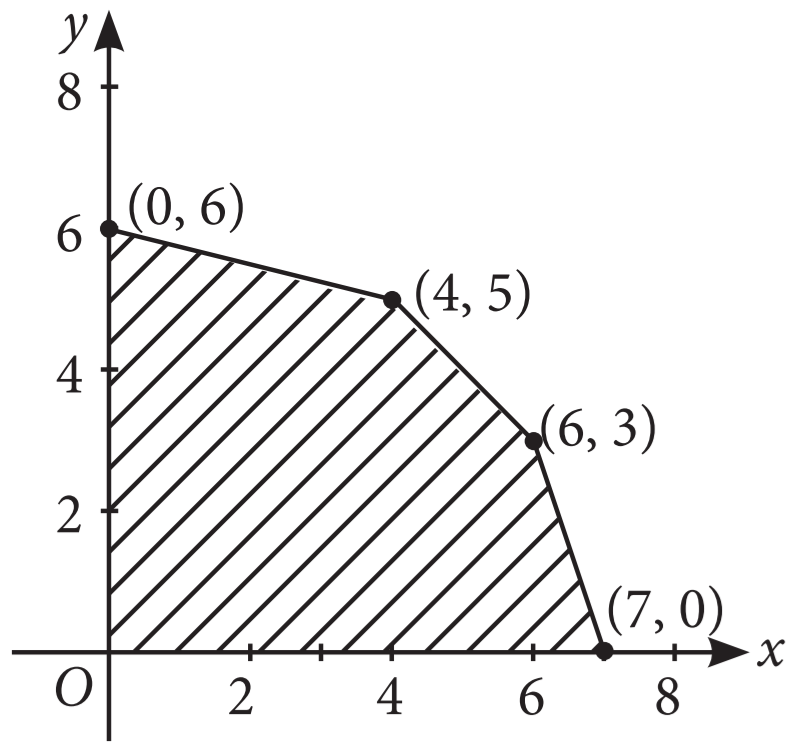
  1. The feasible region for an LPP is shown in the figure. Let Z = 2x + 5y be the objective function. Maximum of Z occurs at:
  1. (7, 0)
  2. (6, 3)
  3. (0, 6)
  4. (4, 5)
  1. The corner points of the feasible region determined by the system of linear constraints are (0, 10), (5, 5), (15, 15), (0, 20). Let Z = px + qy, where p, q > 0. Condition on p and q so that the maximum of Z occurs at both the points ( 15, 15) and (0, 20) is:
  1. p = q
  2. p = 2q
  3. q = 2p
  4. q = 3p
  1. The comer points of the feasible region determined by the system of linear constraints are (0, 0), (0, 40), (20, 40), (60, 20), (60, 0). The objective function is Z = 4x + 3y.
Compare the quantity in Column A and Column B
Column A
Column B
Maximum of Z
325
  1. The quantity in column A is greater.
  2. The quantity in column Bis greater.
  3. The two quantities are equal.
  4. The relationship cannot be determined on the basis of the information supplied.
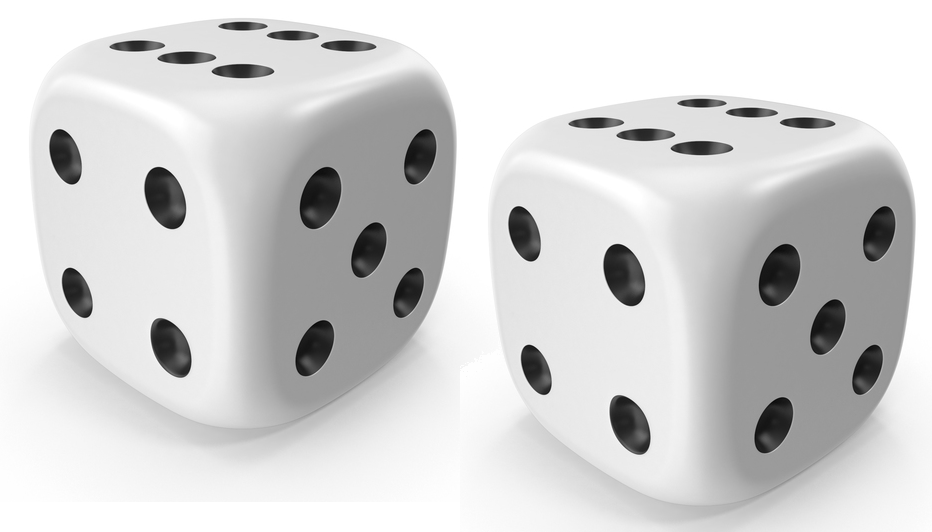
Three friends A, Band Care playing a dice game. The numbers rolled up by them in their first three chances were noted and given by A= {1, 5}, B = {2, 4, 5} and C = {1, 2, 5} as A reaches the cell 'SKIP YOUR NEXT TURN' in second throw. Based on the above information, answer the following questions.
  1. P(A | B) =
  1. $\frac{1}{6}$
  2. $\frac{1}{3}$
  3. $\frac{1}{2}$
  4. $\frac{2}{3}$
  1. P(B | C) =
  1. $\frac{2}{3}$
  2. $\frac{1}{12}$
  3. $\frac{1}{9}$
  4. $0$
  1. $\text{P}(\text{A}\cap\text{B}|\text{C})=$
  1. $\frac{1}{6}$
  2. $\frac{1}{2}$
  3. $\frac{1}{12}$
  4. $\frac{1}{3}$
  1. P(A | C)
  1. $\frac{1}{4}$
  2. $1$
  3. $\frac{2}{3}$
  4. None of these.
  1. $\text{P}(\text{A}\cup\text{B}|\text{C})=$
  1. 0
  2. $\frac{1}{2}$
  3. $\frac{2}{3}$
  4. 1
In pre-board examination of class XII, commerce stream with Economics and Mathematics of a particular school, 50% of the students failed in Economics, 35% failed in Mathematics and 25% failed in both Economics and Mathematics. A student is selected at random from the class. Based on the above information, answer the following questions.
  1. The probability that the selected student has failed in Economics, if it is known that he has failed in Mathematics, is:
  1. $\frac{3}{10}$
  2. $\frac{12}{25}$
  3. $\frac{1}{4}$
  4. $\frac{5}{7}$
  1. The probability that the selected student has failed in Mathematics, if it is known that he has failed in Economics, is:
  1. $\frac{22}{25}$
  2. $\frac{12}{25}$
  3. $\frac{1}{2}$
  4. $\frac{3}{25}$
  1. The probability that the selected student has passed in at least one of the two subjects, is:
  1. $\frac{1}{4}$
  2. $\frac{1}{2}$
  3. $\frac{3}{4}$
  4. None of these.
  1. The probability that the selected student has failed in at least one of the two subjects, is:
  1. $\frac{3}{5}$
  2. $\frac{22}{25}$
  3. $\frac{2}{5}$
  4. $\frac{43}{100}$
  1. The probability that the selected student has passed in Mathematics, if it is known that he has failed in Economics, is:
  1. $\frac{2}{5}$
  2. $\frac{3}{4}$
  3. $\frac{1}{3}$
  4. $\frac{1}{2}$
Three friends Ravi, Raju and Rohit were doing buying and selling of stationery items in a market. The price of per dozen of pen, notebooks and toys are Rupees $\mathrm{x}, \mathrm{y}$ and $\mathrm{z}$ respectively.Ravi purchases $4$ dozen of notebooks and sells $2$ dozen of pens and $5$ dozen of toys. Raju purchases $2$ dozen of toy and sells $3$ dozen of pens and $1$ dozen of notebooks. Rohit purchases one dozen of pens and sells $3$ dozen of notebooks and one dozen of toys.
In the process, Ravi, Raju and Rohit earn $₹\ 1500, ₹\ 10$0 and $₹ \ 400$ respectively.
Image
$(i)$ Write the above information in terms of matrix Algebra.
$(ii)$ What is the total price of one dozen of pens and one dozen of notebooks?
$(iii)$ What is the sale amount of Ravi?
$OR$
What is the amount of purchases and sales made by all three friends?
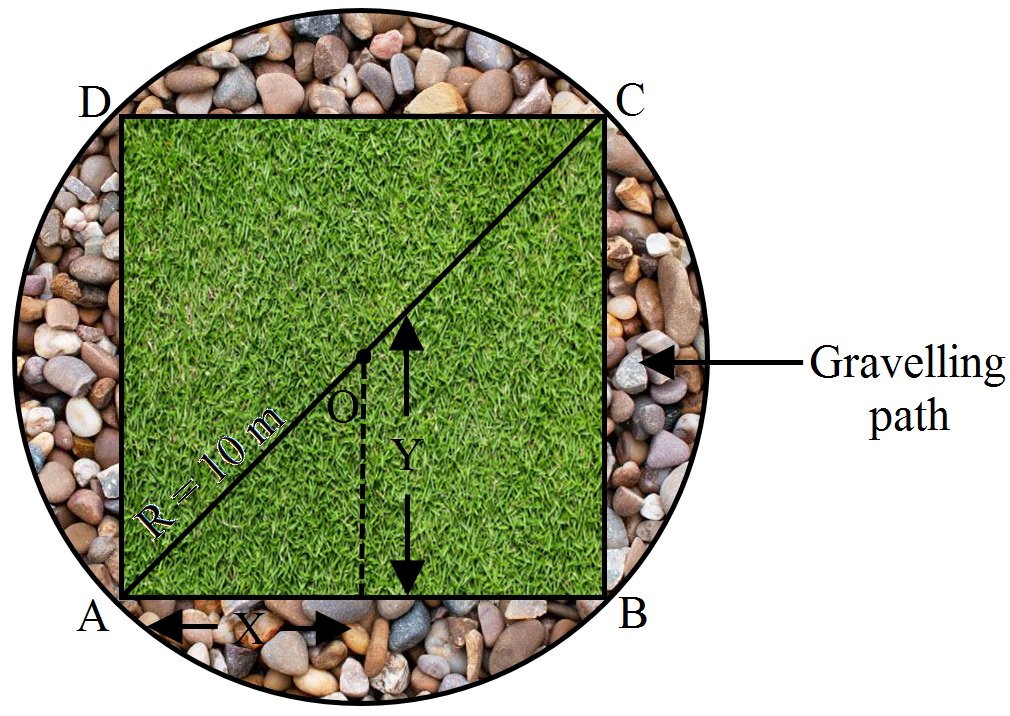
In a society there is a garden in the shape of rectangle inscribed in a circle of radius 10m as shown in given figure.

Based on the above information, answer the following questions.
  1. If $2x$ and $2y$ denotes the length and breadth in metres, of the rectangular part, then the relation between the variables is.
  1. $x^2 - y^2 = 10$
  2. $x^2 + y^2 = 10$
  3. $x^2 + y^2 = 100$
  4. $x^2 - y^2 = 100$
  1. The area $(A)$ of green grass, in terms of $x,$ is given by.
  1. $2\text{x}\sqrt{100-\text{x}^2}$
  2. $4\text{x}\sqrt{100-\text{x}^2}$
  3. $2\text{x}\sqrt{100+\text{x}^2}$
  4. $4\text{x}\sqrt{100+\text{x}^2}$
  1. The maximum value of $A$ is.
  1. $100\text{m}^2$
  2. $200\text{m}^2$
  3. $400\text{m}^2$
  4. $1600\text{m}^2$
  1. The value of length of rectangle, when $A$ is maximum, is.
  1. $10\sqrt{2}\text{m}$
  2. $20\sqrt{2}\text{m}$
  3. $20\text{m}$
  4. $5\sqrt{2}\text{m}$
  1. The area of gravelling path is.
  1. $100(\pi+2)\text{m}^2$
  2. $100(\pi-2)\text{m}^2$
  3. $200(\pi+2)\text{m}^2$
  4. $200(\pi-2)\text{m}^2$
Read the following text carefully and answer the questions that follow:
If two vectors are represented by the two sides of a triangle taken in order, then their sum is represented by the third side of the triangle taken in opposite order and this is known as triangle law of vector addition
$i$. If $\vec{p}, \vec{q}, \vec{r}$ are the vectors represented by the sides of a triangle taken in order, then find $\vec{q}+\vec{r}. (1)$
$ii$. If $\text{ABCD}$ is a parallelogram and $A C$ and $B D$ are its diagonals, then find the value of $\overrightarrow{A C}+\overrightarrow{B D}$.
$iii$. If $\text{ABCD}$ is a parallelogram, where $\overrightarrow{A B}=2 \vec{a}$ and $\overrightarrow{B C}=2 \vec{b}$, then find the value of $\overrightarrow{A C}-\overrightarrow{B D}. (2)$
OR
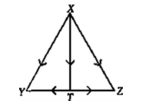
If $T$ is the mid point of side $YZ$ of $\triangle XYZ,$ then what is the value of $\overrightarrow{X Y}+\overrightarrow{X Z}. (2)$
Image
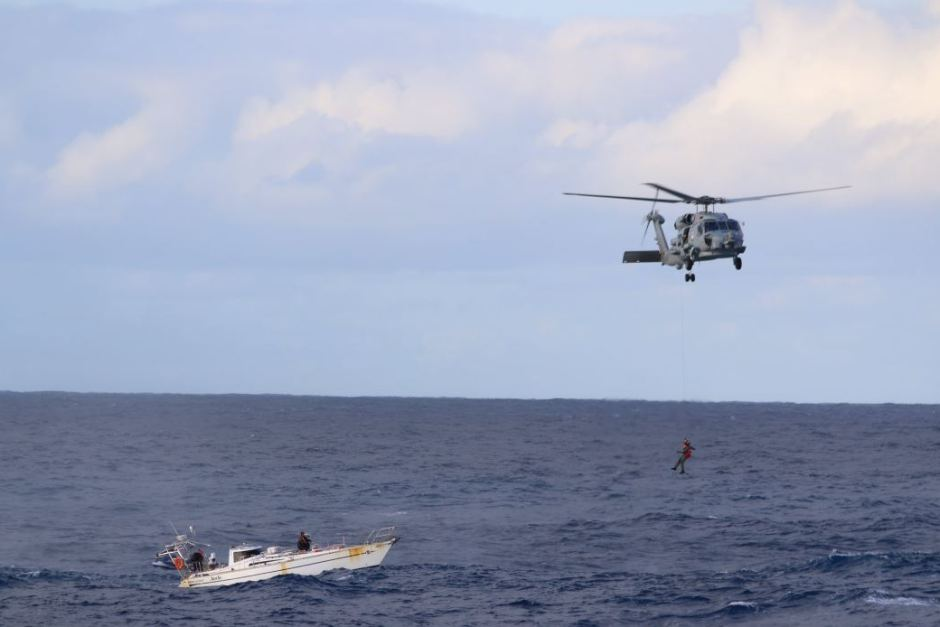
The Indian Coast Guard (ICG) while patrolling, saw a suspicious boat with four men. They were nowhere looking like fishermen. The soldiers were closely observing the movement of the boat for an opportunity to seize the boat. They observe that the boat is moving along a planar surface. At an instant of time, the coordinates of the position of coast guard helicopter and boat are (2, 3, 5) and (1, 4, 2) respectively. Based on the above information, answer the following questions.
  1. If the line joining the positions of the helicopter and boat is perpendicular to the plane in which boat moves, then equation of plane is:
  1. x - y + 3z = 2
  2. x + y + 3z = 2
  3. x - y + 3z = 3
  4. x + y + 3z = 3
  1. If the soldier decides to shoot the boat at given instant of time, where the distance measured in metres then what is the distance that bullet has to travel?
  1. $\sqrt{5}\text{m}$
  2. $\sqrt{8}\text{m}$
  3. $\sqrt{10}\text{m}$
  4. $\sqrt{11}\text{m}$
  1. If the speed of bullet is 30m/ sec, then how much time will the bullet take to hit the boat after the shot is fired?
  1. 30 seconds
  2. 1 second
  3. $\frac{1}{2}\text{second}$
  4. $\frac{\sqrt{11}}{30}\text{seconds}$
  1. At the given instant of time, the equation of line passing through the positions of helicopter and boat is:
  1. $\frac{\text{x}}{1}=\frac{\text{y}}{-1}=\frac{\text{z}}{3}$
  2. $\frac{\text{x}-1}{1}=\frac{\text{y}-4}{-1}=\frac{\text{z}-2}{3}$
  3. $\frac{\text{x}}{1}=\frac{\text{y}}{1}=\frac{\text{z}}{-3}$
  4. $\frac{\text{x}-1}{1}=\frac{\text{y}-4}{1}=\frac{\text{z}-2}{-3}$
  1. At a different instant of time, the boat moves to a different position along the planar surface. What should be the coordinates of the location of the boat for the bullet to hit the boat if soldier shoots the bullet along the line whose equation is $\frac{\text{x}-1}{1}=\frac{\text{y}-1}{-2}=\frac{\text{z}-2}{3}?$
  1. $\Big(\frac{1}{2},\frac{1}{2},\frac{1}{2}\Big)$
  2. $\Big(\frac{3}{4},\frac{3}{2},\frac{5}{4}\Big)$
  3. $\Big(\frac{1}{3},\frac{1}{4},\frac{1}{5}\Big)$
  4. None of these