MCQ
Lactose on hydrolysis gives
  • A
    Two glucose molecules
  • B
    Two galactose molecules
  • C
    A galactose molecule and a fructose molecule
  • A galactose molecule and a glucose molecule

Answer

Correct option: D.
A galactose molecule and a glucose molecule
d
Lactose is composed of $\beta$-D galactose and $\beta$-D glucose. Hence, on hydrolysis it gives $\beta$-D galactose and $\beta$ - $D$ glucose

Need a full question paper?

Generate a complete, print-ready paper with questions like this in minutes — across 16+ boards, with answer keys.

Start Generating Free

Similar questions

$4-$ carbohydrate glucose, lactose , sucrose, starch are present. Different test is carried out with $4-$ carbohydratcs separately. Following observation takes place. 

$(a)$ Heated : it is charred

$(b)$ $I_2$ solution : no violet colour

$(c)$ Fehling solution : reddish brown ppt. is observed

$(d)$ It does not reduce copper$(II)$ acetate to $Cu_2O$ . No red precipiated is observed in $5/ min$ 

The carboxylate which satisfy all the above observation 

Ethyl acetate at room temperature is a
The number of electrons involved in redox reactions when a Faraday of electricity is passed through an electrolyte in solution is
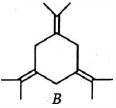
Compound $A$ was treated with a large excess of $CH_3MgBr$. The resulting  product was exposed to $POCl_3$ /pyridine to give compound $B$, as one of  many products

Which of the following compounds can be $A$ ?
One mole of an organic compound $ 'A \ '$ with the formula $\ce{C_3H_8O}$ reacts completely with two moles of $\ce{HI}$ to form $X$ and $Y.$ When $' \ Y \ '$ is boiled with aqueous alkali forms $\text{Z. Z}$ answers the iodoform test. The compound $'A \ '$ is $.......$
Boiling point of chloroform was raised by $ 0.323\,K$, when $0.5143\,g$ of anthracene was dissolved in $35\,g$ of chloroform. Molecular mass of anthracene is ....... $g/mol$. (${K_b}$ for $CHC{l_3}$ $= 3.9 \,\,kg\, mol^{-1}$)
Correct statement for $CeO_2$ is/are

$(1)$  It is Diamagnetic in nature

$(2)$  It is a good oxidising agen

$(3)$  It is colourless compound
Which of the following is responsible for controlling the genetic properties of the cell :
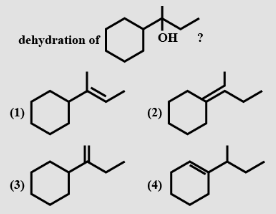
Which of the following can not be the product of this reaction?
If solubility of $NaCl$ at ${20\,^o}C$ is $35\,gm$ per $ 100\,gm$ of water. Then on adding $50\,gm$ of $NaCl$ to the same volume at same temperature the salt remains undissolved is .......... $gm$.