MCQ
Large aperture of telescope are used for
  • A
    Large image
  • Greater resolution
  • C
    Reducing lens aberration
  • D
    Ease of manufacture

Answer

Correct option: B.
Greater resolution
b
(b) Resolving power $\propto$ Aperture

Need a full question paper?

Generate a complete, print-ready paper with questions like this in minutes — across 16+ boards, with answer keys.
Start Generating Free

Similar questions

$A$ smooth sphere is moving on a horizontal surface with a velocity vector $(\,2\,\hat i + 2\,\hat j\,)$ $m/s$ immediately before it hit a vertical wall. The wall is parallel to vector $\hat j$ and coefficient of restitution between the sphere and the wall is $e = 1/2$ . The velocity of the sphere after it hits the wall is
The ratio of frequencies of two pendulums are $2 : 3$, then their length are in ratio
In $YDSE$, the intensity of central bright fringe is $8\, mW/m^2$. What will be the intensity at $\frac{\lambda }{6}$ path difference?
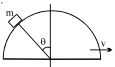
$A$ hemisphere of mass $3m$ and radius $R$ is free to slide with its base on a smooth horizontal table. $A$ particle of mass $m$ is placed on the top of the hemisphere. If particle is displaced with a negligible velocity, then find the angular velocity of the particle relative to the centre of the hemisphere at an angular displacement $\theta$ , when velocity of hemisphere is $v$.
Three bodies $A, B$ and $C$ of masses $m, m$ and $\sqrt 3\,m$ respectively are supplied heat at a constant rate. The change in temperature $\theta $ versus time $t$ graph for $A, B$ and $C$ are shown by $I, II$ and $III$ respectively. If their specific heat capacities are $S_A, S_B$ and $S_C$ respectively then which of the following relation is correct ? (Initial temperature of body is $0\,^oC$ )
Function of rectifier is
A non-conducting ring of radius $0.5\,m$ carries a total charge of $1.11 \times {10^{ - 10}}\,C$ distributed non-uniformly on its circumference producing an electric field $\vec E$ everywhere in space. The value of the line integral $\int_{l = \infty }^{l = 0} {\, - \overrightarrow E .\overrightarrow {dl} } \,(l = 0$ being centre of the ring) in volt is
A bubble has surface tension $S$. The ideal gas inside the bubble has ratio of specific heats $\gamma=\frac{5}{3}$. The bubble is exposed to the atmosphere and it always retains its spherical shape. When the atmospheric pressure is $P_{a 1}$, the radius of the bubble is found to be $r_1$ and the temperature of the enclosed gas is $T_1$. When the atmospheric pressure is $P_{a 2}$, the radius of the bubble and the temperature of the enclosed gas are $r_2$ and $T_2$, respectively.

Which of the following statement($s$) is(are) correct?

$(A)$ If the surface of the bubble is a perfect heat insulator, then $\left(\frac{r_1}{r_2}\right)^5=\frac{P_{a 2}+\frac{2 S}{r_2}}{P_{a 1}+\frac{2 S}{r_1}}$

$(B)$ If the surface of the bubble is a perfect heat insulator, then the total internal energy of the bubble including its surface energy does not change with the external atmospheric pressure.

$(C)$ If the surface of the bubble is a perfect heat conductor and the change in atmospheric temperature is negligible, then $\left(\frac{r_1}{r_2}\right)^3=\frac{P_{a 2}+\frac{4 S}{r_2}}{P_{a 1}+\frac{4 S}{r_1}}$.

$(D)$ If the surface of the bubble is a perfect heat insulator, then $\left(\frac{T_2}{T_1}\right)^{\frac{5}{2}}=\frac{P_{a 2}+\frac{4 S}{r_2}}{P_{a 1}+\frac{4 S}{r_1}}$.
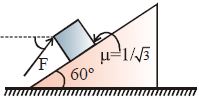
The minimum value of $‘F’$ so that block is in equilibrium is
An electromagnetic wave, going through vacuum is described by $E = {E_0}\sin (kx - \omega \,t)$. Which of the following is independent of wavelength