MCQ
Large aperture of telescope are used for
  • A
    Large image
  • Greater resolution
  • C
    Reducing lens aberration
  • D
    Ease of manufacture

Answer

Correct option: B.
Greater resolution
b
(b) Resolving power $\propto$ Aperture

Need a full question paper?

Generate a complete, print-ready paper with questions like this in minutes — across 16+ boards, with answer keys.

Start Generating Free

Similar questions

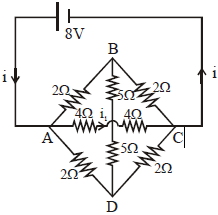
The value of current $i_{1}$ flowing from $A$ to $C$ in the circuit diagram is$.......A$
When a $p-n$ diode is reverse biased, then
Two protons move parallel to each other, keeping distance $r$ between them, both moving with same  velocity $\vec V\,$. Then the ratio of the electric and magnetic force of interaction between them is
In Millikan's oil drop experiment, what is viscous force acting on an uncharged drop of radius $2.0 \times 10^{-5}\, {m}$ and density $1.2 \times 10^{3} \,{kgm}^{-3}$ ? Take viscosity of liquid $=1.8 \times 10^{-5}\, {Nsm}^{-2} .$ (Neglect buoyancy due to air).
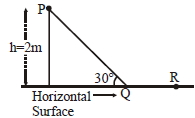
A point particle of mass, moves along the uniformly rough track $PQR$ as shown in the figure. The coefficient of friction, between the particle and the rough track equals $\mu$. The particle is released, from rest, from the point $P$ and it comes to rest at a point $R$. The energies, lost by the ball, over the parts, $PQ$ and $PR$, of the track, are equal to each other, and no energy is lost when particle changes direction from $PQ$ to $QR$. The values of the coefficient of friction $\mu$ and the distance $x(=QR)$ are, respecitvely close to
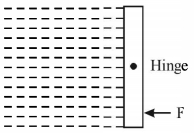
A square gate of size $1\,m \times 1\,m$ is hinged at its mid-point. A fluid of density $\rho$ fills the space to the left of the gate. The force F required to hold the gate stationary is
$\begin{matrix}
   \,\,\,\,\,O\,\,\,\,\,\,\,\,\,\,\,\,\,\,\,\,\,\,\,\,\,\,\,\,C{{H}_{3}}  \\
   ||\,\,\,\,\,\,\,\,\,\,\,\,\,\,\,\,\,\,\,\,\,\,\,\,\,\,\,\,|\,  \\
   C{{H}_{3}}-C-C{{H}_{2}}-C-CHO  \\
   \,\,\,\,\,\,\,\,\,\,\,\,\,\,\,\,\,\,\,\,\,\,\,\,\,\,\,\,\,\,\,|  \\
   \,\,\,\,\,\,\,\,\,\,\,\,\,\,\,\,\,\,\,\,\,\,\,\,\,\,\,\,\,\,\,\,\,\,\,\,C{{H}_{3}}  \\
\end{matrix}\xrightarrow{KOH,{{H}_{2}}O}(A);$ Product $A$ is
A small bulb is placed at the bottom of a tank containing water to a depth of $\sqrt{7} \; m$. The refractive index of water is $\frac{4}{3}$. The area of the surface of water through which light from the bulb can emerge out is $x \,\pi m ^{2}$. The value of $x$ is ...............
The radii of curvature of the faces of a double convex lens are $10\,\, cm$ and $15\,\, cm$. Its focal length is $12\,\, cm$. What is the refractive index of glass
A condenser of capacity $C$ is charged to a potential difference of $V_1$ . The plates of the condenser are then connected to an ideal inductor of inductance $L$. The current through the inductor when the potential difference across the condenser reduces to $V_2$ is