Question
Laser is/are

Answer

(d)

All the above facts are true for a laser.

Need a full question paper?

Generate a complete, print-ready paper with questions like this in minutes — across 16+ boards, with answer keys.
Start Generating Free

Similar questions

A solid sphere rolls down without slipping on an inclined plane, then percentage of rotational kinetic energy of total energy will be ........ $\%.$
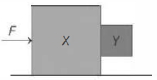
Consider the system shown below. A horizontal force $F$ is applied to a block $X$ of mass $8 \,kg$, such that the block $Y$ of mass $2 \,kg$ adjacent to it does not slip downwards under gravity. There is no friction between the horizontal plane and the base of the block $X$. The coefficient of friction between the surfaces of blocks $X$ and $Y$ is $0.5$. The minimum value of $F$ is ............ $N$ (take, acceleration due to gravity to be $10 \,ms ^{-2}$ )
If e is the electronic charge, $c$ is the speed of light in free space and $h$ is Planck's constant, the quantity $\frac{1}{4 \pi \varepsilon_{0}} \frac{| e |^{2}}{h c}$ has dimensions of .......
A planet of radius $R =\frac{1}{10} \times$ (radius of Earth) has the same mass density as Earth. Scientists dig a well of depth $\frac{R}{5}$ on it and lower a wire of the same length and of linear mass density $10^{-3} \ kgm ^{-1}$ into it. If the wire is not touching anywhere, the force applied at the top of the wire by a person holding it in place is (take the radius of Earth $=6 \times 10^6 \ m$ and the acceleration due to gravity on Earth is $10 \ ms ^{-2}$ )
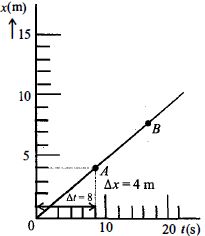
The graph of an object's motion $($along the $x-$ axis$)$ is shown in the figure. The instantaneous velocity of the object at points $A$ and $B$ are $v_A$ and $v_B$ respectively. Then
Degree of freedom for an ideal gas is $n$ and ratio of molar specific heat at constant pressure and constant volumeis $\gamma$ then
A body is in simple harmonic motion with time period half second $(T\, = 0.5\, s)$ and amplitude one $cm\, (A\,= 1\, cm)$. Find the average velocity in the interval in which it moves form equilibrium position to half of its amplitude .... $cm/s$
Match List$-I$ with List$-II$.

List$-I$ List$-II$
$(A)$ Angular momentum $(I)$ $\left[ ML ^2 T ^{-2}\right]$
$(B)$ Torque $(II)$ $\left[ ML ^{-2} T ^{-2}\right]$
$(C)$ Stress $(III)$ $\left[ ML ^2 T ^{-1}\right]$
$(D)$ Pressure gradient $(IV)$ $\left[ ML ^{-1} T ^{-2}\right]$

Choose the correct answer from the options given below:

A certain stable nucleide, after absorbing a neutron, emits $\beta$-particle and the new nucleide splits spontaneously into two $\alpha$-particles. The nucleide is
The Bulk Modulus for an incompressible liquid is