MCQ
Le-Chatelier’s principle is applicable only to a
  • System in equilibrium
  • B
    Irreversible reaction
  • C
    Homogeneous reaction
  • D
    Heterogeneous reaction

Answer

Correct option: A.
System in equilibrium
a
It’s Obvious

Need a full question paper?

Generate a complete, print-ready paper with questions like this in minutes — across 16+ boards, with answer keys.
Start Generating Free

Similar questions

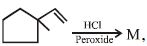
$M$  is
A buffer solution has equal volumes of $0.2\,M\,N{H_4}OH$ and $0.02\,M\,N{H_4}Cl$. The $p{K_b}$ of the base is $5$. The $pH$ is
Consider the following pairs of electrons

$(A)$ $(a)$ $n=3,1=1, m_{l}=1, m_{s}=+\frac{1}{2}$

$\quad (b)$ $n =3,1=2, m _{l}=1, m _{s}=+\frac{1}{2}$

$(B)$ $(a)$ $n =3,1=2, m _{l}=-2, m _{s}=-\frac{1}{2}$

$\quad (b)$ $n =3,1=2, m _{l}=-1, m _{s}=-\frac{1}{2}$

$(C)$ $(a)$ $n=4,1=2, m_{l}=2, m_{s}=+\frac{1}{2}$

$\quad (b)$ $n =3,1=2, m _{l}=2, m _{s}=+\frac{1}{2}$

The pairs of electron present in degenerate orbitals is/are...... .

Determine enthalpy of formation for $H_2O_2(\ell ),$  using listed enthalpies of reaction

${N_2}{H_4}(l)\,+\,2{H_2}{O_2}(l)\,\, \to \,{N_2}(g)\,\, + \,4{H_2}O(l);\,\,{\Delta _r}H_1^o\, = \, - 818\,\,kJ/mol$

${N_2}{H_4}(l)\,\, + {O_2}(g)\,\, \to \,{N_2}(g)\,\, + \,2{H_2}O(l);\,\,{\Delta _r}H_2^o\, = \, - 622\,\,kJ/mol$

${H_2}(g)\,\, + 1/2{O_2}(g)\,\, \to \,{H_2}O(l);\,\,{\Delta _r}H_3^o\, = \, - 285\,\,kJ/mol$

......$kJ/mol$

To which block is related an element having electronic configuration $1{s^2}2{s^2}2{p^6}3{s^2}3{p^6}3{d^{10}}4{s^1}$ in the periodic table
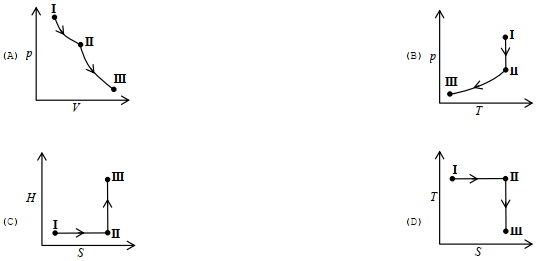
An ideal gas undergoes a reversible isothermal expansion from state $I$ to state $II$ followed by a reversible adiabatic expansion from state $II$ to state $III$. The correct plot($s$) representing the changes from state $I$ to state $III$ is(are)

( $p$ : pressure, $V$ : volume, $T$ : temperature, $H$ : enthalpy, $S$ : entropy)
The product obtained when silica reacts with hydrogen fluoride is
In the process $BC{l_3} + P{H_3} \to BC{l_3}:P{H_3}$ The Lewis acid is
Energy hidden in a definite quantity of substance is:
From the ground state electronic configuration of the elements given below, pick up the one with highest value of second ionisation energy.