MCQ
Lead is soluble in
  • A
    $C{H_3}COOH$
  • B
    ${H_2}S{O_4}$
  • C
    $HCl$
  • $HN{O_3}$

Answer

Correct option: D.
$HN{O_3}$
d
(d) Lead is soluble in dil. $HN{O_3}$. However, it becomes passive towards conc. $HN{O_3}$.

Need a full question paper?

Generate a complete, print-ready paper with questions like this in minutes — across 16+ boards, with answer keys.
Start Generating Free

Similar questions

$\,$
Choose the correct statements from the following

$A$. All group $16$ elements form oxides of general formula $\mathrm{EO}_2$ and $\mathrm{EO}_3$ where $\mathrm{E}=\mathrm{S}, \mathrm{Se}, \mathrm{Te}$ and Po. Both the types of oxides are acidic in nature.

$B$. $\mathrm{TeO}_2$ is an oxidising agent while $\mathrm{SO}_2$ is reducing in nature.

$C$. The reducing property decreases from $\mathrm{H}_2 \mathrm{~S}$ to $\mathrm{H}_2 \mathrm{Te}$ down the group.

$D$. The ozone molecule contains five lone pairs of electrons.

Choose the correct answer from the options given below:
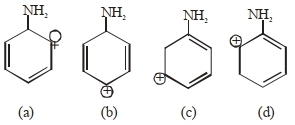
The most stable carbocation for the following is:
$C_8H_{18}$ ($A$) on mono chlorination forms only one type of $C_8H_{17}Cl\ \  (B)$ Hence ($A$) can be
The ionic radii of $\mathrm{F}^{-}$ and $O^{2-}$ respectively are $1.33\, A^o$ and $1.4\, A^o$, while the covalent radius of $\mathrm{N}$ is $0.74\,A^o$ 

The correct statement for the ionic radius of $\mathrm{N}^{3-}$ from the following is :

The ‘epimerisation’ involves
If reaction is started with $NH_4COONH_2(s)$ and equilibrium mixture has pressure of $3\, atm$ then $K_P$ for $NH_4COONH_2(s)  \rightleftharpoons  2NH_3(g) + CO_2(g)$ is .....$atm^3$
The entropy change when $2\, moles$ of ideal monoatomic gas is heated from $200\,^oC$ to $300\,^oC$ and isochorically
Methyl acetate and propionic acid are
Calculate $\Lambda _{HOAc}^\infty $ using appropriate molar conductances of the electrolytes listed above at infinite dilution in ${H_2}O$ at $25\,^o\, C$

Electrolyte :

$KCl$

$KNO_3$

$HCl$

$NaOAc$

$NaCl$

$\Lambda ^\infty (Scm^2mol^{-1}) $:

$149.9$

$145.0$

$426.2$

$91.0$

$126.5$