MCQ
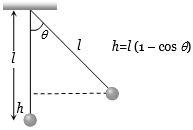
Length of a simple pendulum is $l$ and its maximum angular displacement is $\theta$, then its maximum $K.E.$ is
  • A
    $mgl\sin \theta $
  • B
    $mgl(1 + \sin \theta )$
  • C
    $mgl(1 + \cos \theta )$
  • $mgl(1 - \cos \theta )$

Answer

Correct option: D.
$mgl(1 - \cos \theta )$
d
(d) Kinetic energy will be maximum at mean position.
From law of conservation of energy maximum kinetic energy at mean position = Potential energy at displaced position
==> ${K_{\max }} = mgh = mgl(1 - \cos \theta )$

Need a full question paper?

Generate a complete, print-ready paper with questions like this in minutes — across 16+ boards, with answer keys.
Start Generating Free

Similar questions

A particle of mass $m$ is moving in a circular path of constant radius $I$ such that its centripetal acceleration $(a)$ is varying with time $t$ as $a=k^{2} rt^{2}$. where $k$ is a constant. The power delivered to the particle by the force acting on it is given as
A rod of mass $M$ and length $L$ is placed in a horizontal plane with one end hinged about the vertical axis. A horizontal force of $F=\frac {Mg}{2}$ applied at a distance $\frac {5L}{6}$ from the hinged end. The angular acceleration of the rod will be
A certain object is projected vertically from the surface of the earth of radius $R$ with a velocity equal to half the escape velocity. The maximum height attained by the object will be
If pulleys shown in the diagram are smooth and massless and $a_1$ and $a_2$ are acceleration of blocks of mass $4 \,kg$ and $8 \,kg$ respectively, then
$A$ horizontal force $F = mg/3$ is applied on the upper surface of a uniform cube of mass $‘m’$ and side $‘a’$ which is resting on a rough horizontal surface having $\mu_S = 1/2$. The distance between lines of action of $‘mg’$ and normal reaction $‘N’$ is :
A far off planet is estimated to be at a distance $D$ from the earth. If its diametrically opposite extremes subtend an angle $\theta$ at an observatory situated on the earth, the approximate diameter of the planet is ............. 
The factor not needed to calculate heat lost or gained when there is no change of state is
The value of $\gamma\left(=\frac{\mathrm{C}_{\mathrm{p}}}{\mathrm{C}_{\mathrm{v}}}\right),$ for hydrogen, hellium and another ideal diatomic gas $X$(whose molecules are not rigid but have an additional vibrational mode), are respectively equal to 
In a vessel, the gas is at pressure $P_0$. If the mass of all the molecules is halved and their speed is doubled, then the resultant pressure will be 
A simple pendulum with bob of mass $m$ and length $x$ is held in position at an angle $\theta_1$ and then angle $\theta_2$ with the vertical. When released from these positions, speeds with which it passes the lowest positions are $v_1$ and $v_2$ respectively. Then, $\frac{v_1}{v_2}$ is .............