Prove the result that the velocity v of translation of a rolling body (like a ring, disc, cylinder or sphere) at the bottom of an inclined plane of a height h is given by $\text{v}^2=\frac{2\text{gh}}{\Big(\frac{1+\text{k}^2}{\text{R}^2}\Big)}$ using dynamical consideration (i.e. by consideration of forces and torques).
Note: k is the radius of gyration of the body about its symmetry axis, and R is the radius of the body. The body starts from rest at the top of the plane.
Note: k is the radius of gyration of the body about its symmetry axis, and R is the radius of the body. The body starts from rest at the top of the plane.
Exercise
Download our app for free and get started
A body rolling on an inclined plane of height h,is shown in the following figure:
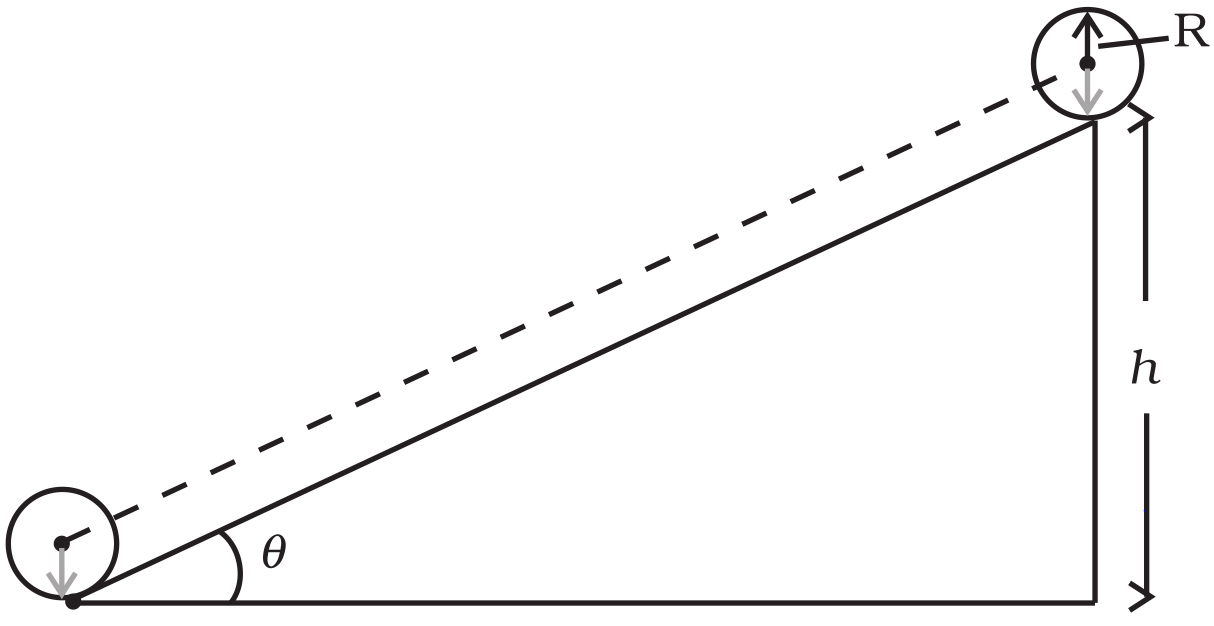
m = Mass of the body. R = Radius of the body. K = Radius of gyration of the body. v = Translational velocity of the body. h =Height of the inclined plane. g = Acceleration due to gravity. Total energy at the top of the plane, $E_1= mgh$ Total energy at the bottom of the plane,$ E_b = KE_{rot} + KE_{trans}$ $=\frac{1/2}{\omega^2}+\frac{1}{2}\text{mv}^2$ But $I = mk^2$ and $\omega=\frac{\text{v}}{\text{R}}$
$\therefore\ \text{E}_{\text{b}}=\frac{1\text{mk}^2\text{v}^2}{2\text{R}^2}+\frac{1}{2}\text{mv}^2$ From the law of conservation of energy, we have, $\text{E}_{\text{T}}=\text{E}_{\text{b}}$ $\text{mgh}=\Big(\frac{1\text{mv}^21+\text{k}^2}{2\text{R}^2}\Big)$
$\therefore\ \text{v}^2=\frac{2\text{gh}}{\Big(\frac{1+\text{k}^2}{\text{R}^2}\Big)}$ Hence, the given result is proved.
m = Mass of the body. R = Radius of the body. K = Radius of gyration of the body. v = Translational velocity of the body. h =Height of the inclined plane. g = Acceleration due to gravity. Total energy at the top of the plane, $E_1= mgh$ Total energy at the bottom of the plane,$ E_b = KE_{rot} + KE_{trans}$ $=\frac{1/2}{\omega^2}+\frac{1}{2}\text{mv}^2$ But $I = mk^2$ and $\omega=\frac{\text{v}}{\text{R}}$
$\therefore\ \text{E}_{\text{b}}=\frac{1\text{mk}^2\text{v}^2}{2\text{R}^2}+\frac{1}{2}\text{mv}^2$ From the law of conservation of energy, we have, $\text{E}_{\text{T}}=\text{E}_{\text{b}}$ $\text{mgh}=\Big(\frac{1\text{mv}^21+\text{k}^2}{2\text{R}^2}\Big)$
$\therefore\ \text{v}^2=\frac{2\text{gh}}{\Big(\frac{1+\text{k}^2}{\text{R}^2}\Big)}$ Hence, the given result is proved.

Download our appand get started for free
Experience the future of education. Simply download our apps or reach out to us for more information. Let's shape the future of learning together!No signup needed.*
Similar Questions
- 1View SolutionA solid sphere rolls down two different inclined planes of the same heights but different angles of inclination.
- Will it reach the bottom with the same speed in each case?
- Will it take longer to roll down one plane than the other?
- If so, which one and why?
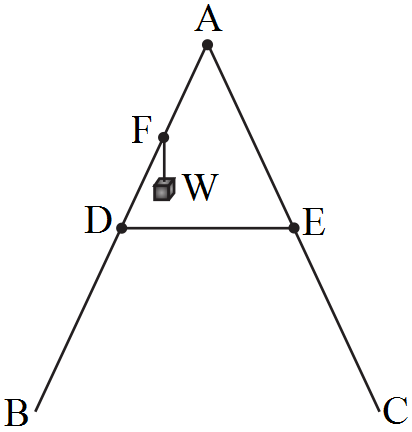
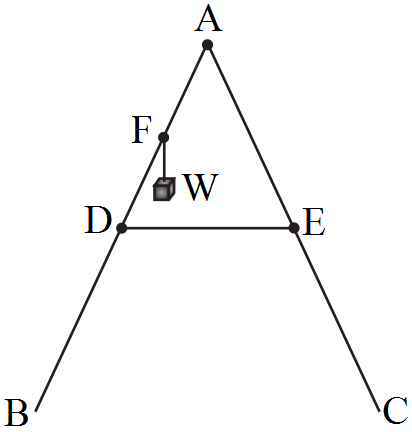
- 2As shown in the two sides of a step ladder BA and CA are $1.6m$ long and hinged at A. A rope DE, $0.5m$ is tied half way up. A weight $40kg$ is suspended from a point F, 1.2m from B along the ladder BA. Assuming the floor to be frictionless and neglecting the weight of the ladder, find the tension in the rope and forces exerted by the floor on the ladder. (Take $g = 9.8m/s^2$) (Hint: Consider the equilibrium of each side of the ladder separately).View Solution
- 3View SolutionA solid sphere rolls down two different inclined planes of the same heights but different angles of inclination.
- Will it reach the bottom with the same speed in each case?
- Will it take longer to roll down one plane than the other?
- If so, which one and why?
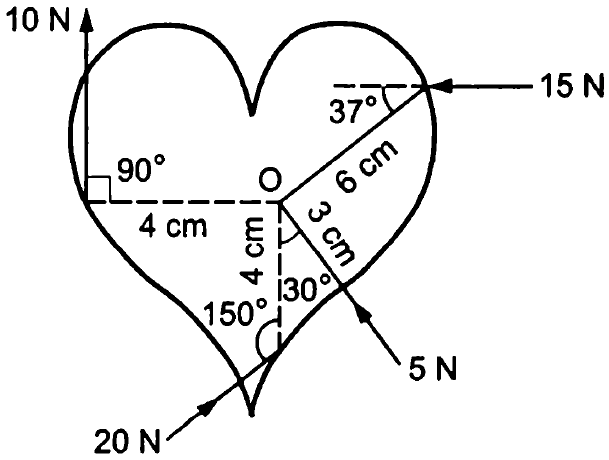
- 4View SolutionCalculate the total torque acting on the body shown in figure about the point O.
- 5View SolutionExplain why friction is necessary to make the disc in roll in the direction indicated.
- Give the direction of frictional force at B, and the sense of frictional torque, before perfect rolling begins.
- What is the force of friction after perfect rolling begins?
- 6View SolutionHow much fraction of the kinetic energy of rolling is purely:
- Translational.
- Rotational.
- 7View SolutionObtain an expression for linear acceleration of a cylinder rolling down an inclined plane and hence find the condition for the cylinder to roll down the inclined plane without slipping.
- 8View SolutionTwo particles, each of mass m and speed v, travel in opposite directions along parallel lines separated by a distance d. Show that the angular momentum vector of the two particle system is the same whatever be the point about which the angular momentum is taken.
- 9View SolutionA hoop of radius 2m weighs 100kg. It rolls along a horizontal floor so that its centre of mass has a speed of 20cm/s. How much work has to be done to stop it?
- 10As shown in the two sides of a step ladder BA and CA are 1.6m long and hinged at A. A rope DE, 0.5m is tied half way up. A weight 40kg is suspended from a point F, 1.2m from B along the ladder BA. Assuming the floor to be frictionless and neglecting the weight of the ladder, find the tension in the rope and forces exerted by the floor on the ladder. (Take $g = 9.8m/s^2$) (Hint: Consider the equilibrium of each side of the ladder separately).View Solution