MCQ
Lenz's law gives:
- AMagnitude of induced emf
- ✓Direction of induced current
- CBoth direction and magnitude of induced current
- DMagnitude of induced current
Generate a complete, print-ready paper with questions like this in minutes — across 16+ boards, with answer keys.
A ray of light of intensity I is incident on a parallel glass-slab at a point A as shown in fig. It undergoes partial reflection and refraction. At each reflection 25% of incident energy is reflected. The rays AB and A'B' undergo interference. The ratio  is
is
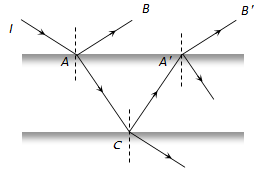
|
(a) 4 : 1 |
(b) 8 : 1 |
(c) 7 : 1 |
(d) 49 : 1 |
The wavelength of maximum energy, released during an atomic explosion, was 2.93 × 10⁻¹⁰ m. Given that the Wien's constant is 2.93 × 10⁻³ m K, the maximum temperature attained must be of the order of
|
(a) 10–7 K |
(b) 107 K |
(c) 10–13 K |
(d) 5.86 × 10⁷ K |
A light bulb is placed between two plane mirrors inclined at an angle of 60°. The number of images formed are
| (a) 6 | (b) 2 | (c) 5 | (d) 4 |
When electron beam passes through an electric field, they gain kinetic energy. If the same beam passes through magnetic field, then
|
(a) Their energy increases |
|
(b) Their momentum increases |
|
(c) Their potential energy increases |
|
(d) Energy and momentum both remains unchanged |
If all the resistors shown have the value 2 ohm each, the equivalent resistance over AB is

|
(a) 2 ohm |
(b) 4 ohm |
(c) 1 |
(d) 2 |
The radii of two metallic spheres P and Q are  and
and  respectively. They are given the same charge. If
  . then on connecting them with a thin wire, the charge will flow
|
(a) From P to Q |
|
(b) From Q to P |
|
(c) Neither the charge will flow from P to Q nor from Q to P |
|
(d) The information is incomplete |
