Question
Let $5$ digit numbers be constructed using the digits $0,2,3,4,7,9$ with repetition allowed, and are arranged in ascending order with serial numbers. Then the serial number of the number $42923$ is $...............$.
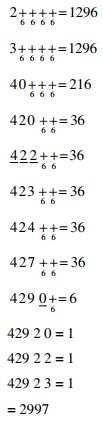
Answer

a

Need a full question paper?

Generate a complete, print-ready paper with questions like this in minutes — across 16+ boards, with answer keys.

Start Generating Free

Similar questions

$\mathop {\lim }\limits_{x \to 0} \frac{{{{(1 + x)}^{1/2}} - {{(1 - x)}^{1/2}}}}{x} = $
Tangents are drawn at points $(x_i,y_i); i = 1,2,3$ lying on $y = x^2$ to enclose a triangle of area $\Delta$.If $x_1,x_2,x_3$ form an increasing $AP$, where $x_1 =-1$ and $y_3 = 9$, then $\Delta$ is .............. $\mathrm{sq. \,units}$
Let $\alpha \in(0, \infty)$ and $A=\left[\begin{array}{lll}1 & 2 & \alpha \\ 1 & 0 & 1 \\ 0 & 1 & 2\end{array}\right]$. If $\operatorname{det}\left(\operatorname{adj}\left(2 \mathrm{~A}-\mathrm{A}^{\mathrm{T}}\right) \cdot \operatorname{adj}\left(\mathrm{A}-2 \mathrm{~A}^{\mathrm{T}}\right)\right)=2^8$, then $(\operatorname{det}(\mathrm{A}))^2$ is equal to :
The number of values of $\theta \in (0,\pi)$ for which the system of linear equations
$x + 3y + 7z = 0$
$-x + 4y + 7z = 0$
$(sin\,3\theta )x + (cos\,2\theta )y + 2z = 0$ has a non-trivial solution, is
The number of real solutions of the equation $2 \sin 3 x+\sin 7 x-3=0$, which lie in the interval $[-2 \pi, 2 \pi]$ is
Let $\log _a b=4, \log _c d=2$, where $a, b, c, d$ are natural numbers. Given that $b-d=7$, the value of $c-a$ is
If $\smallint \frac{{5\tan x}}{{\tan x - 2\;}}dx$$ = x + aln\left| {\sin x - 2\cos x} \right| + k$ then $a $ is equal to
If $^n{P_r} = 840,{\,^n}{C_r} = 35,$ then $n$ is equal to
The number of points of discontinuity of $f(x)$ where $f(x) = \left| {\left| {\left| {x + \left[ x \right]} \right| - 3\left[ x \right]} \right| - 5\left[ x \right]} \right|$ on $[-2 , 2]$ is (where $[ · ]$ denotes greatest integer function)
If $\alpha ,\,\beta ,\,\gamma $ are the roots of the equation ${x^3} + 4x + 1 = 0,$ then ${(\alpha + \beta )^{ - 1}} + {(\beta + \gamma )^{ - 1}} + {(\gamma + \alpha )^{ - 1}} = $