- A$P(A)\, + \,P(\bar B)$
- B$P(\bar A)\, - P(\bar B)$
- ✓$P(\bar A)\, - P(B)$
- D$P(\bar A)\, + P(\bar B)$
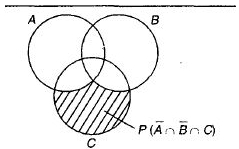
$ = \frac{{P(C) - P(A \cap C - P(B \cap C) + P(A \cap B \cap C))}}{{P(C)}}$
$=1-\frac{P(A) \cdot P(C)+P(B) \cdot P(C)}{P(C)} $
$(\because P(A \cap B \cap C)=0)$
$=1-\mathrm{P}(\mathrm{A})-\mathrm{P}(\mathrm{B})$
$=\mathrm{P}(\bar{A})-\mathrm{P}(\mathrm{B})$
Generate a complete, print-ready paper with questions like this in minutes — across 16+ boards, with answer keys.
where $[t]$ denotes greatest integer $\leq t$. If $m$ is the number of points where $f$ is not continuous and $n$ is the number of points where $f$ is not differentiable, then the ordered pair $( m , n )$ is
$STATEMENT-1$ : If line $\mathrm{L}_1$ is a chord of circle $\mathrm{C}$, then line $\mathrm{L}_2$ is not always a diameter of circle $\mathrm{C}$. and
$STATEMENT-2$ : If line $\mathrm{L}_1$ is a diameter of circle $\mathrm{C}$, then line $\mathrm{L}_2$ is not a chord of circle $\mathrm{C}$.