MCQ
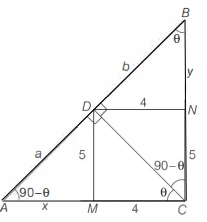
Let $A B C$ be a triangle with $\angle C=90^{\circ}$. Draw $C D$ perpendicular to $A B$. Choose points $M$ and $N$ on sides $A C$ and $B C$ respectively such that $D M$ is parallel to $B C$ and $D N$ is parallel to $A C$. If $D M=5, D N=4$, then $A C$ and $B C$ are respectively equal to
  • $\frac{41}{4}, \frac{41}{5}$
  • B
    $\frac{39}{4}, \frac{39}{5}$
  • C
    $\frac{38}{4}, \frac{38}{5}$
  • D
    $\frac{37}{4}, \frac{37}{5}$

Answer

Correct option: A.
$\frac{41}{4}, \frac{41}{5}$
a
(a)

Given, $A B C$ is right angled triangle

$\angle C=90^{\circ}$

$C D$ is perpendicular on $A B, D N$ and $D M$ are parallel to $A C$ and $B C$, respectively. $D N=4$ and $D M=5$

In $\triangle D M C$ and $\triangle D N B$

$\Delta D M C \sim \Delta D N B$

$\frac{D M}{D N} =\frac{M C}{N B}$

$\frac{5}{4} =\frac{4}{N B} \Rightarrow N B=\frac{16}{5}$

In $\triangle D N C$ and $\triangle D M A$

$\Delta D N C \sim \Delta D M A$

$\frac{D N}{D M} =\frac{N C}{M A}$

$\frac{4}{5} =\frac{5}{M A} \Rightarrow M A=\frac{25}{4}$

$\therefore A C=M C+A M=4+\frac{25}{4}=\frac{41}{4}$

Need a full question paper?

Generate a complete, print-ready paper with questions like this in minutes — across 16+ boards, with answer keys.

Start Generating Free

Similar questions

Let $P = \left[ {\begin{array}{*{20}{c}}
  1&0&0 \\ 
  3&1&0 \\ 
  9&3&1 
\end{array}} \right]$ and $Q = [q_{ij}]$ be two $3\times3$ matrices such that $Q -P^5 = I_3$. Then $\frac{{{q_{21}} + {q_{31}}}}{{{q_{32}}}}$ is equal to
The coefficients $\mathrm{a}, \mathrm{b}, \mathrm{c}$ in the quadratic equation $a x^2+b x+c=0$ are chosen from the set $\{1,2,3,4,5,6,7,8\}$. The probability of this equation having repeated roots is :
Let $S$ be the set of all real values of $k$ for which the system oflinear equations $x +y + z = 2$ ; $2x +y - z = 3$ ; $3x + 2y + kz = 4$ has a unique solution. Then $S$ is
If $x = a{\rm{ }}\left( {\cos t + \log \tan {t \over 2}} \right)\,,y = a\sin t,$ then ${{dy} \over {dx}} = $
The number of ways of dividing $52$ cards amongst four players so that three players have $17$ cards each and the fourth player just one card, is
For every pair of continuous functions $f, g:[0,1] \rightarrow R$ such that $\max \{f(x): x \in[0,1]\}=\max \{g(x): x \in[0,1]\}$, the correct statement$(s)$ is (are) :

$(A)$ $(f(c))^2+3 f(c)=(g(c))^2+3 g(c)$ for some $c \in[0,1]$

$(B)$ $(f(c))^2+f(c)=(g(c))^2+3 g(c)$ for some $c \in[0,1]$

$(C)$ $(f(c))^2+3 f(c)=(g(c))^2+g(c)$ for some $c \in[0,1]$

$(D)$ $(f(c))^2=(g(c))^2$ for some $c \in[0,1]$

The population $P = P ( t )$ at time ${ }^{\prime} t ^{\prime}$ of a certain species follows the differential equation $\frac{ dP }{ dt }=0.5 P -450 .$ If $P (0)=850,$ then the time at which population becomes zero is
For two events $A$ and $B$, if $P(A) = P\left( {\frac{A}{B}} \right) = \frac{1}{4}$ and $P\,\left( {\frac{B}{A}} \right) = \frac{1}{2},$ then
Points $(-2, 4, 7), (3, -6, -8)$ and $(1, -2, -2)$ are
The two circles which passes through $(0,a)$ and $(0, - a)$ and touch the line $y = mx + c$ will intersect each other at right angle, if