MCQ
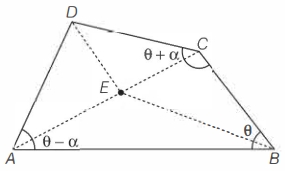
Let $A B C D$ be a quadrilateral such that there exists a point $E$ inside the quadrilateral satisfying $A E=B E=C E=D E$. Suppose $\angle D A B, \angle A B C, \angle B C D$ is an arithmetic progression. Then the median of the set $\{\angle D A B, \angle A B C, \angle B C D\}$ is
  • A
    $\frac{\pi}{6}$
  • B
    $\frac{\pi}{4}$
  • C
    $\frac{\pi}{3}$
  • $\frac{\pi}{2}$

Answer

Correct option: D.
$\frac{\pi}{2}$
d
(d)

Since, $\angle D A B, \angle A B C$ and $\angle B C D$ are in $AP \therefore$ Let $\angle D A B=\theta-\alpha, \angle A B C=\theta$ and $\angle B C D=\theta+\alpha$

$\therefore$ Median of $\angle D A B, \angle A B C$ and $\angle B C D=\theta$

From point $E$ all the vertices are at equal distance.

$\therefore A B C D$ is cyclic.

and $\angle A D C=2 \pi-(\theta-\alpha+\theta+\theta+\alpha)$

$\quad=2 \pi-3 \theta$

and $\angle A D C+\angle A B C=\pi$

$\Rightarrow 2 \pi-3 \theta+\theta=\pi$

$\therefore \quad \theta=\frac{\pi}{2}$

Need a full question paper?

Generate a complete, print-ready paper with questions like this in minutes — across 16+ boards, with answer keys.

Start Generating Free

Similar questions

For $\mathop {Lim}\limits_{x \to 8} \,\,\frac{{\sin \{ x - 10\} }}{{\{ 10 - x\} }}$ (where { } denotes fractional part function)
Two finite sets have m and n elements. The number of elements in the power set of first set is 48 more than the total number of elements in power set of the second set. Then, the values of m and n are:
Let $\alpha $ and $\beta $ are roots of $5{x^2} - 3x - 1 = 0$ , then $\left[ {\left( {\alpha  + \beta } \right)x - \left( {\frac{{{\alpha ^2} + {\beta ^2}}}{2}} \right){x^2} + \left( {\frac{{{\alpha ^3} + {\beta ^3}}}{3}} \right){x^3} -......} \right]$ is
{ (A, B) : A² + B² = 1} on the sets has the following relation.
The coordinates of the point dividing internally the lines joining the points $(4, -2)$ and $(8, 6)$ in the ratio $7 : 5$ will be
The positive integer just greater than $(1+0.0001)^{10000}$ is:
Equation of the circle with centre on the $y$ - axis and passing through the origin and the point $(2,3)$ is:
 
The value of $\tan 81^{\circ}-\tan 63^{\circ}-\tan 27^{\circ}+\tan 9^{\circ}$ is
A boy needs to select five courses from $12$ available courses, out of which $5$ courses are language courses. If he can choose at most two language courses, then the number of ways he can choose five courses is
If the equation ${a_n}{x^n} + {a_{n - 1}}{x^{n - 1}} + .... + {a_1}x = 0$, ${a_1} \ne 0$, $\,n \ge 2$, has a positive root $x = \alpha $, then the equation $n{a_n}{x^{n - 1}} + (n - 1){a_{n - 1}}{x^{n - 2}} + .... + {a_1} = 0$ has a positive root, which is