MCQ 11 Mark
Maximum value of sum of arithmetic progression $50, 48, 46, 44 ........$ is :-
Answerd
For maximum sum $\Rightarrow \mathrm{T}_{\mathrm{n}}=0$
$a+(n-1) d=0$
$\Rightarrow 50+(n-1)(-2)=0 \Rightarrow n=26$
So $S_{26}=\frac{26}{2}[2 \times 50+25 \times(-2)]=650$
View full question & answer→MCQ 21 Mark
Consider a sequence whose sum of first $n$ -terms is given by $S_n = 4n^2 + 6n, n \in N$, then $T_{15}$ of this sequence is -
Answerc
$T_n = S_n -S_{n-1}$
$\Rightarrow T_n = (4n^2 + 6n) -(4(n -1)^2 + 6(n-1))$
$T_n = 8n + 2 \Rightarrow T_{15} = 122$
View full question & answer→MCQ 31 Mark
If $\alpha ,\;\beta ,\;\gamma $ are the geometric means between $ca,\;ab;\;ab,\;bc;\;bc,\;ca$ respectively where $a,\;b,\;c$ are in A.P., then ${\alpha ^2},\;{\beta ^2},\;{\gamma ^2}$ are in
AnswerCorrect option: A. $A.P.$
a
(a) By hypothesis, ${\alpha ^2} = {a^2}bc,\;{\beta ^2} = {b^2}ca,\;{\gamma ^2} = {c^2}ab$ and $2b = a + c$.
.Hence ${2^{n - 1}} > 100$ are in A.P.
View full question & answer→MCQ 41 Mark
Given that $n$ A.M.'s are inserted between two sets of numbers $a,\;2b$and $2a,\;b$, where $a,\;b \in R$. Suppose further that ${m^{th}}$ mean between these sets of numbers is same, then the ratio $a:b$ equals
- A
$n - m + 1:m$
- B
$n - m + 1:n$
- C
$n:n - m + 1$
- ✓
$m:n - m + 1$
AnswerCorrect option: D. $m:n - m + 1$
d
(d) ${m^{th}}$ mean between $a,\;2b$ is $a + \frac{{m(2b - a)}}{{n + 1}}$ ……$(i)$
and ${m^{th}}$ mean between $2a,\;b$ is $2a + \frac{{m(b - 2a)}}{{n + 1}}$......$(ii)$
Accordingly, $a + \frac{{m(2b - a)}}{{n + 1}} = 2a + \frac{{m(b - 2a)}}{{n + 1}}$
$ \Rightarrow $ $m(2b - a) = a(n + 1) + m(b - 2a)$
$ \Rightarrow $ $a(n - m + 1) = bm$
$ \Rightarrow $ $\frac{a}{b} = \frac{m}{{n - m + 1}}$.
View full question & answer→MCQ 51 Mark
$150$ workers were engaged to finish a piece of work in a certain number of days. $4$ workers dropped the second day, $4$ more workers dropped the third day and so on. It takes eight more days to finish the work now. The number of days in which the work was completed is
Answerc
(c) Let the number of days be $n$.
Hence a worker can do ${\left( {\frac{1}{{150n}}} \right)^{th}}$ part of the work in a day.
Accordingly,
$[150 + 146 + 142 + ....... + {\rm{upto}}\;(n + 8)\,{\rm{terms}}] \times \frac{1}{{150n}} = 1$
$ \Rightarrow $$n = 17$
Therefore number of total days in completion $ = 17 + 8 = 25$.
View full question & answer→MCQ 61 Mark
The $A.M.$ of a $50$ set of numbers is $38$. If two numbers of the set, namely $55$ and $45$ are discarded, the $A.M.$ of the remaining set of numbers is
- A
$38.5$
- ✓
$37.5$
- C
$36.5$
- D
$36$
AnswerCorrect option: B. $37.5$
b
(b) Given, $\frac{{\Sigma {x_i}}}{{50}} = 38,\,\,\,\therefore \Sigma {x_i} = 1900$
New value of $\Sigma {x_i} = 1900 - 55 - 45$$ = 1800$, $n = 48$
New mean $ = \frac{{1800}}{{48}}$$ = 37.5$.
View full question & answer→MCQ 71 Mark
If the roots of the equation ${x^3} - 12{x^2} + 39x - 28 = 0$ are in $A.P.$, then their common difference will be
- A
$ \pm 1$
- B
$ \pm 2$
- ✓
$ \pm 3$
- D
$ \pm 4$
AnswerCorrect option: C. $ \pm 3$
c
(c) Let $a -d, a, a + d$ be the roots of the equation ${x^3} - 12{x^2} + 39x - 28 = 0$
Then $(a - d) + a + (a + d) = 12$ and $(a - d)\,a\,(a + d) = 28$
==> $3a = 12$ and $a\,({a^2} - {d^2}) = 28$
==> $a = 4$ and $a\,({a^2} - {d^2}) = 28$
==> $16 - {d^2} = 7$
$\Rightarrow d = \pm \,3$.
View full question & answer→MCQ 81 Mark
If ${a_1},\;{a_2},\,{a_3},......{a_{24}}$ are in arithmetic progression and ${a_1} + {a_5} + {a_{10}} + {a_{15}} + {a_{20}} + {a_{24}} = 225$, then ${a_1} + {a_2} + {a_3} + ........ + {a_{23}} + {a_{24}} = $
Answerd
(d) ${a_1} + {a_5} + {a_{10}} + {a_{15}} + {a_{20}} + {a_{24}} = 225$
$ \Rightarrow $ $({a_1} + {a_{24}}) + ({a_5} + {a_{20}}) + ({a_{10}} + {a_{15}}) = 225$
$ \Rightarrow $ $3({a_1} + {a_{24}}) = 225$
$ \Rightarrow $${a_1} + {a_{24}} = 75$
( In an $A.P.$ the sum of the terms equidistant from the beginning and the end is same and is equal to the sum of first and last term)
${a_1} + {a_2} + ...... + {a_{24}} = \frac{{24}}{2}({a_1} + {a_{24}}) = 12 \times 75 = 900$.
View full question & answer→MCQ 91 Mark
If ${S_1},\;{S_2},\;{S_3},...........{S_m}$ are the sums of $n$ terms of $m$ $A.P.'s$ whose first terms are $1,\;2,\;3,\;...............,m$ and common differences are $1,\;3,\;5,\;...........2m - 1$ respectively, then ${S_1} + {S_2} + {S_3} + .......{S_m} = $
- ✓
$\frac{1}{2}mn(mn + 1)$
- B
$mn(m + 1)$
- C
$\frac{1}{4}mn(mn - 1)$
- D
AnswerCorrect option: A. $\frac{1}{2}mn(mn + 1)$
a
(a) Here $a = 1,\;2,\;3,\,........,m;\;\;\;d = 1,\;3,\;5,........,2m - 1$
and $n = n$, then ${S_1} + {S_2} + ....... + {S_m} = \frac{1}{2}mn(mn + 1)$
$\left[ {{\rm{Using}}\;S\; = \frac{m}{2}(a + l).\;{\rm{Since}}\;{S_1},\;{S_2},\;{S_3},......{S_m}\;{\rm{form}}\;{\rm{an}}\;{\rm{A}}{\rm{.P}}{\rm{.}}} \right]$
View full question & answer→MCQ 101 Mark
Jairam purchased a house in Rs. $15000$ and paid Rs. $5000$ at once. Rest money he promised to pay in annual installment of Rs. $1000$ with $10\%$ per annum interest. How much money is to be paid by Jairam $\mathrm{Rs.}$ ...................
- A
$21555$
- B
$20475$
- ✓
$ 20500$
- D
$ 20700$
AnswerCorrect option: C. $ 20500$
c
(c) It will take $10$ years for Jairam to pay off Rs. $10000$ in $10$ yearly installments.
He pays $10\%$ annual interest on remaining amount
$\therefore $ Money given in first year
$ = 1000 + \frac{{10000 \times 10}}{{100}} = {\rm{Rs}}.2000$
Money given in second year $= 1000 +$ interest of$ (10000 -1000)$ with interest rate $10\%$ per annum $ = 1000 + \frac{{9000 \times 10}}{{100}} = {\rm{Rs}}.\,1900$
Money paid in third year = Rs. $1800$ etc.
So money given by Jairam in $10$ years will be Rs. $2000$, Rs. $1900$, Rs. $1800$, Rs. $1700$,....,
which is in arithmetic progression, whose first term $a = 2000$and $d = - 100$
Total money given in $10$ years = sum of $10$ terms of arithmetic progression
$ = \frac{{10}}{2}[2(2000) + (10 - 1)( - 100)]$= Rs. $15500$
Therefore, total money given by Jairam
$ = 5000 + 15500 = {\rm{Rs}}{\rm{. }}\,{\rm{20500}}{\rm{.}}$
View full question & answer→MCQ 111 Mark
If the angles of a quadrilateral are in $A.P.$ whose common difference is ${10^o}$, then the angles of the quadrilateral are
- A
${65^o},\,{85^o},\,{95^o},\,{105^o}$
- ✓
${75^o},\,{85^o},\,{95^o},\,{105^o}$
- C
${65^o},\,{75^o},\,{85^o},\,{95^o}$
- D
${65^o},\,{95^o},\,{105^o},\,{115^o}$
AnswerCorrect option: B. ${75^o},\,{85^o},\,{95^o},\,{105^o}$
b
(b) Suppose that $\angle A = {x^0}$, then $\angle B = x + {10^o}$,
$\angle C = x + {20^o}$and $\angle D = x + {30^o}$
So, we know that $\angle A + \angle B + \angle C + \angle D = 2\pi $
Putting these values, we get
$({x^o}) + ({x^o} + {10^o}) + ({x^o} + {20^o}) + ({x^o} + {30^o}) = {360^o}$
$ \Rightarrow x = {75^o}$
Hence the angles of the quadrilateral are ${75^o},\;{85^o},\;{95^o},\;{105^o}$.
Trick : In these type of questions, students should satisfy the conditions through options.
Here $(b)$ satisfies both the conditions
$i.e.$ angles are in $A.P.$ with common difference ${10^o}$ and sum of angles is ${360^o}$.
View full question & answer→MCQ 121 Mark
If ${a^2},\,{b^2},\,{c^2}$ be in $A.P.$, then $\frac{a}{{b + c}},\,\frac{b}{{c + a}},\,\frac{c}{{a + b}}$ will be in
AnswerCorrect option: A. $A.P.$
a
(a) Since ${a^2},\;{b^2},\;{c^2}$ be in $A.P.$
Then ${b^2} - {a^2} = {c^2} - {b^2}$
$ \Rightarrow $ $(b - a)(b + a) = (c - b)(c + b)$
==> $\frac{{b - a}}{{c + b}} = \frac{{c - b}}{{b + a}}$
==> $\frac{{(b - a)(a + b + c)}}{{(c + a)(b + c)}} = \frac{{(c - b)(a + b + c)}}{{(a + b)(c + a)}}$
$ \Rightarrow $ $\frac{{{b^2} + bc - ac - {a^2}}}{{(c + a)(b + c)}} = \frac{{{c^2} + ac - ab - {b^2}}}{{(a + b)(c + a)}}$
$ \Rightarrow $ $\frac{b}{{c + a}} - \frac{a}{{b + c}} = \frac{c}{{a + b}} - \frac{b}{{c + a}}$
Hence $\frac{a}{{b + c}},\;\frac{b}{{c + a}},\;\frac{c}{{a + b}}$ be in $A.P.$
View full question & answer→MCQ 131 Mark
If $\frac{a}{b},\frac{b}{c},\frac{c}{a}$ are in $H.P.$, then
- ✓
${a^2}b,\,{c^2}a,\,{b^2}c$ are in $A.P.$
- B
${a^2}b,\,{b^2}c,\,{c^2}a$ are in $H.P.$
- C
${a^2}b,\,{b^2}c,\,{c^2}a$ are in $G.P.$
- D
AnswerCorrect option: A. ${a^2}b,\,{c^2}a,\,{b^2}c$ are in $A.P.$
a
(a) $\frac{b}{a},\frac{c}{b},\frac{a}{c}$ are in $A.P.$
==> $\frac{{2c}}{b} = \frac{b}{a} + \frac{a}{c}$
$ \Rightarrow \frac{{2c}}{b} = \frac{{bc + {a^2}}}{{ac}}$
==> $2a{c^2} = {b^2}c + b{a^2}$
$\therefore \,{a^2}b,\,{c^2}a$ and ${b^2}c$ are in $A.P.$
View full question & answer→MCQ 141 Mark
If $b + c,$ $c + a,$ $a + b$ are in $H.P.$, then $\frac{a}{{b + c}},\frac{b}{{c + a}},\frac{c}{{a + b}}$ are in
AnswerCorrect option: A. $A.P.$
a
(a) Let $\frac{a}{{b + c}},\frac{b}{{c + a}},\frac{c}{{a + b}}$ are in $A.P.$
Add $1$ to each term, we get
$\frac{{a + b + c}}{{b + c}},\frac{{b + c + a}}{{c + a}},\frac{{c + a + b}}{{a + b}}$ are in $A.P.$
Divide each term by $(a + b + c),$
$\frac{1}{{b + c}},\frac{1}{{c + a}},\frac{1}{{a + b}}$ are in $A.P.$
Hence $b + c,\,\,c + a,\,\,a + b$ are in $H.P.$
which is given in question
Therefore, $\frac{a}{{b + c}},\frac{b}{{c + a}},\frac{c}{{a + b}}$ are in $A. P.$
View full question & answer→MCQ 151 Mark
If $x,y,z$ are in $A.P. $ and ${\tan ^{ - 1}}x,{\tan ^{ - 1}}y$ and ${\tan ^{ - 1}}z$ are also in $A.P.$, then
- ✓
$x = y = z$
- B
$x = y = - z$
- C
$x = 1;y = 2;z = 3$
- D
$x = 2;y = 4;z = 6$
AnswerCorrect option: A. $x = y = z$
a
(a) $2{\tan ^{ - 1}}y = {\tan ^{ - 1}}x + {\tan ^{ - 1}}z$
==> ${\tan ^{ - 1}}\left( {\frac{{2y}}{{1 - {y^2}}}} \right) = {\tan ^{ - 1}}\left( {\frac{{x + z}}{{1 - xz}}} \right)$
==> $\frac{{2y}}{{1 - {y^2}}} = \frac{{x + z}}{{1 - xz}}$
But $2y = x + z$
$1 - {y^2} = 1 - xz$
==> ${y^2} = xz$
$xyz$ are both in $G.P. $ and $A.P.$,
$x = y = z$.
View full question & answer→MCQ 161 Mark
If twice the $11^{th}$ term of an $A.P.$ is equal to $7$ times of its $21^{st}$ term, then its $25^{th}$ term is equal to
Answerc
(c) Let the first term of $A.P. $ is a and common difference is $d$.
$11^{th}$ term of $A.P. =$ $a + 10d$
$21^{st}$ term of $A.P. = a+ 20d$
$2(a + 10d) = 7(a + 20d)$
==> $2a + 20d = 7a + 140d$
$5a + 120d = 0$
==> $a + 24d = 0$
Hence $25^{th}$ term is $0.$
View full question & answer→MCQ 171 Mark
Four numbers are in arithmetic progression. The sum of first and last term is $8$ and the product of both middle terms is $15$. The least number of the series is
Answerd
(d) Let ${A_1},{A_2},{A_3}$ and ${A_4}$ are four numbers in $A.P.$
${A_1} + {A_4} = 8$ ..$(i)$
and ${A_2}.\,{A_3} = 15$ ..$(ii)$
The sum of terms equidistant from the beginning and end is constant and is equal to
sum of first and last terms.
Hence, ${A_2} + {A_3} = {A_1} + {A_4} = 8$ ..$(iii)$
From $(ii)$ and $(iii),$
${A_2} + \frac{{15}}{{{A_2}}} = 8$
==> $A_2^2 - 8{A_2} + 15 = 0$
${A_2} = 3\,\,{\rm{or}}\,\,5$ and ${A_3} = 5\,\,\,{\rm{or}}\,\,{\rm{3}}$.
As we know, ${A_2} = \frac{{{A_1} + {A_3}}}{2}$
==> ${A_1} = 2{A_2} - {A_3}$
==> ${A_1} = 2 \times 3 - 5 = 1$ and ${A_4} = 8 - {A_1} = 7$
Hence the series is, $1, 3, 5, 7.$
So that least number of series is $1.$
View full question & answer→MCQ 181 Mark
If $\frac{1}{{p + q}},\;\frac{1}{{r + p}},\;\frac{1}{{q + r}}$ are in $A.P.$, then
- A
$p,\;,q,\;r$ are in $A.P.$
- ✓
${p^2},\;{q^2},\;{r^2}$ are in $A.P.$
- C
$\frac{1}{p},\;\frac{1}{q},\;\frac{1}{r}$ are in $A.P.$
- D
AnswerCorrect option: B. ${p^2},\;{q^2},\;{r^2}$ are in $A.P.$
b
(b) Since $\frac{1}{{p + q}},\;\frac{1}{{r + q}}$ and $\frac{1}{{q + r}}$ are in $A.P.$
$\therefore $ $\frac{1}{{r + q}} - \frac{1}{{p + q}} = \frac{1}{{q + r}} - \frac{1}{{r + p}}$
$ \Rightarrow $ $\frac{{p + q - r - p}}{{(r + p)(p + q)}} = \frac{{r + p - q - r}}{{(q + r)(r + p)}}$
$ \Rightarrow $ $\frac{{q - r}}{{p + q}} = \frac{{p - q}}{{q + r}}$ or ${q^2} - {r^2} = {p^2} - {q^2}$
$\therefore $ $2{q^2} = {r^2} + {p^2}$
Therefore ${p^2},\;{q^2},\;{r^2}$ are in $A.P.$
View full question & answer→MCQ 191 Mark
If $f(x + y,x - y) = xy\,,$ then the arithmetic mean of $f(x,y)$ and $f(y,x)$ is
Answerc
(c) Let $x + y = u,\,\,x - y = v$
==> $x = \frac{{u + v}}{2},y = \frac{{u - v}}{2}$,
$\therefore f(u,v) = \left( {\frac{{u + v}}{2}} \right).\left( {\frac{{u - v}}{2}} \right)$
Now,$\frac{{f(x,y) + f(y,x)}}{2} = \frac{{\left( {\frac{{x + y}}{2}.\frac{{x - y}}{2}} \right) + \left( {\frac{{y + x}}{2}.\frac{{y - x}}{2}} \right)}}{2} = 0$.
View full question & answer→MCQ 201 Mark
Let the sequence ${a_1},{a_2},{a_3},.............{a_{2n}}$ form an $A.P. $ Then $a_1^2 - a_2^2 + a_3^3 - ......... + a_{2n - 1}^2 - a_{2n}^2 = $
- ✓
$\frac{n}{{2n - 1}}(a_1^2 - a_{2n}^2)$
- B
$\frac{{2n}}{{n - 1}}(a_{2n}^2 - a_1^2)$
- C
$\frac{n}{{n + 1}}(a_1^2 + a_{2n}^2)$
- D
AnswerCorrect option: A. $\frac{n}{{2n - 1}}(a_1^2 - a_{2n}^2)$
a
(a) Since ${a_1},\;{a_2},\,{a_3},...........,{a_n}$ form an $A.P.$
therefore, ${a_2} - {a_1} = {a_4} - {a_3} = ....... = {a_{2n}} - {a_{2n - 1}} = d$
Here $a_1^2 - a_2^2 + a_3^2 - a_4^2 +$$ ....... + a_{2n - 1}^2 - a_{2n}^2$
$ = ({a_1} - {a_2})({a_1} + {a_2}) + ({a_3} - {a_4})({a_3} + {a_4}) +$$ ...... + ({a_{2n - 1}} - {a_{2n}})({a_{2n - 1}} + {a_{2n}})$
$ = - d({a_1} + {a_2} + ....... + {a_{2n}}) = - d\left\{ {\frac{{2n}}{2}({a_1} + {a_{2n}})} \right\}$
Also we know ${a_{2n}} = {a_1} + (2n - 1)d$$ \Rightarrow $$d = \frac{{{a_{2n}} - {a_1}}}{{2n - 1}}$
$ \Rightarrow $ $ - d = \frac{{{a_1} - {a_{2n}}}}{{2n - 1}}$.
$\therefore $ Therefore the sum is
= $\frac{{n({a_1} - {a_{2n}}).({a_1} + {a_{2n}})}}{{2n - 1}} = \frac{n}{{2n - 1}}(a_1^2 - a_{2n}^2)$.
View full question & answer→MCQ 211 Mark
If ${a_1},\,{a_2},....,{a_{n + 1}}$ are in $A.P.$, then $\frac{1}{{{a_1}{a_2}}} + \frac{1}{{{a_2}{a_3}}} + ..... + \frac{1}{{{a_n}{a_{n + 1}}}}$ is
- A
$\frac{{n - 1}}{{{a_1}{a_{n + 1}}}}$
- B
$\frac{1}{{{a_1}{a_{n + 1}}}}$
- C
$\frac{{n + 1}}{{{a_1}{a_{n + 1}}}}$
- ✓
$\frac{n}{{{a_1}{a_{n + 1}}}}$
AnswerCorrect option: D. $\frac{n}{{{a_1}{a_{n + 1}}}}$
d
(d) ${a_1},{a_2},{a_3},.......,{a_{n + 1}}$ are in $A.P.$
and common difference $= d$
Let $S = \frac{1}{{{a_1}{a_2}}} + \frac{1}{{{a_2}{a_3}}} + .......... + \frac{1}{{{a_n}{a_{n + 1}}}}$
$⇒$ $S = \frac{1}{d}\,\left\{ {\frac{d}{{{a_1}{a_2}}} + \frac{d}{{{a_2}{a_3}}} + ...... + \frac{d}{{{a_n}\,\,{a_{n + 1}}}}} \right\}$
$⇒$ $S = \frac{1}{d}\,\left\{ {\frac{{{a_2} - {a_1}}}{{{a_1}{a_2}}} + \frac{{{a_3} - {a_2}}}{{{a_2}{a_3}}} + ...... + \frac{{{a_{n + 1}} - {a_n}}}{{{a_n}\,\,\,{a_{n + 1}}}}} \right\}$
$⇒$ $S = \frac{1}{d}\left\{ {\frac{1}{{{a_1}}} - \frac{1}{{{a_2}}} + \frac{1}{{{a_2}}} - \frac{1}{{{a_3}}} + ....... + \frac{1}{{{a_n}}} - \frac{1}{{{a_{n + 1}}}}} \right\}$
$⇒$ $S = \frac{1}{d}\left\{ {\frac{1}{{{a_n}}} - \frac{1}{{{a_{n + 1}}}}} \right\} = \frac{1}{d}\left\{ {\frac{{{a_{n + 1}} - {a_1}}}{{{a_1}{a_{n + 1}}}}} \right\}$
$⇒$ $S = \frac{1}{d}\left( {\frac{{nd}}{{{a_1}{a_{n + 1}}}}} \right) = \frac{n}{{{a_1}{a_{n + 1}}}}$.
Trick: Check for $n = 2$.
View full question & answer→MCQ 221 Mark
The sum of the integers from $1$ to $100$ which are not divisible by $3$ or $5$ is
- A
$2489$
- B
$4735$
- C
$2317$
- ✓
$2632$
AnswerCorrect option: D. $2632$
d
(d) Let $S = 1 + 2 + 3 + ........... + 100$
$ = \frac{{100}}{2}(1 + 100) = 50(101) = 5050$
Let ${S_1} = 3 + 6 + 9 + 12 + ......... + 99$
=$3(1 + 2 + 3 + 4 + ......... + 33)$
=$3.\frac{{33}}{2}(1 + 33) = 99 \times 17 = 1683$
Let ${S_2} = 5 + 10 + 15 + ........ + 100$
= $5(1 + 2 + 3 + ........ + 20)$
= $5.\frac{{20}}{2}(1 + 20) = 50 \times 21 = 1050$
Let ${S_3} = 15 + 30 + 45 + ........ + 90$
= $15(1 + 2 + 3 + ........ + 6)$
= $15.\frac{6}{2}(1 + 6) = 45 \times 7 = 315$
Required sum =$S - {S_1} - {S_2} + {S_3}$
= $5050 - 1683 - 1050 + 315= 2632.$
View full question & answer→MCQ 231 Mark
A series whose $n^{th}$ term is $\left( {\frac{n}{x}} \right) + y,$ the sum of $r$ terms will be
- ✓
$\left\{ {\frac{{r(r + 1)}}{{2x}}} \right\} + ry$
- B
$\left\{ {\frac{{r(r - 1)}}{{2x}}} \right\}$
- C
$\left\{ {\frac{{r(r - 1)}}{{2x}}} \right\} - ry$
- D
$\left\{ {\frac{{r(r + 1)}}{{2y}}} \right\} - rx$
AnswerCorrect option: A. $\left\{ {\frac{{r(r + 1)}}{{2x}}} \right\} + ry$
a
(a) On putting $n = 1,2,3,.....$
First term of the series $a = \frac{1}{x} + y$,
Second term =$\frac{2}{x} + y$
$d = \left( {\frac{2}{x} + y} \right) - \left( {\frac{1}{x} + y} \right) = \frac{1}{x}$
Sum of $r$ terms of the series
$ = \frac{r}{2}\left[ {2\left( {\frac{1}{x} + y} \right) + (r - 1)\frac{1}{x}} \right]$
$ = \frac{r}{2}\left[ {\frac{2}{x} + 2y + \frac{r}{x} - \frac{1}{x}} \right]$
$ = \frac{{{r^2} - r + 2r}}{{2x}} + ry$
$ = \left\{ {\frac{{r{\mkern 1mu} (r + 1)}}{{2x}}} \right\} + ry$.
View full question & answer→MCQ 241 Mark
The solution of ${\log _{\sqrt 3 }}x + {\log _{\sqrt[4]{3}}}x + {\log _{\sqrt[6]{3}}}x + ......... + {\log _{\sqrt[{16}]{3}}}x = 36$ is
- A
$x = 3$
- B
$x = 4\sqrt 3 $
- C
$x = 9$
- ✓
$x = \sqrt 3 $
AnswerCorrect option: D. $x = \sqrt 3 $
d
(d) ${\log _{\sqrt 3 }}x + {\log _{\sqrt[4]{3}}}x + {\log _{\sqrt[6]{3}}}x + ...... + {\log _{\sqrt[{16}]{3}}}x = 36$
$ \Rightarrow $$\frac{1}{{{{\log }_x}\sqrt 3 \,}} + \frac{1}{{{{\log }_x}\sqrt[4]{3}}} + \frac{1}{{{{\log }_x}\sqrt[6]{3}}} + ... + \frac{1}{{{{\log }_x}\sqrt[{16}]{3}}} = 36$
$ \Rightarrow $ $\frac{1}{{(1/2){{\log }_x}3}} + \frac{1}{{(1/4){{\log }_x}3}} + \frac{1}{{(1/6){{\log }_x}3}} + ..... + \frac{1}{{(1/16){{\log }_x}3}} = 36$
$ \Rightarrow $ $({\log _3}x)(2 + 4 + 6 + ..... + 16) = 36$
$ \Rightarrow $ $({\log _3}x)\frac{8}{2}[2 + 16] = 36$
$ \Rightarrow $${\log _3}x = \frac{1}{2}$
$ \Rightarrow $$x = {3^{1/2}}$
$ \Rightarrow x = \sqrt 3 $.
View full question & answer→MCQ 251 Mark
If ${S_n}$ denotes the sum of $n$ terms of an arithmetic progression, then the value of $({S_{2n}} - {S_n})$ is equal to
- A
$2{S_n}$
- B
${S_{3n}}$
- ✓
$\frac{1}{3}{S_{3n}}$
- D
$\frac{1}{2}{S_n}$
AnswerCorrect option: C. $\frac{1}{3}{S_{3n}}$
c
(c) ${S_{2n}} - {S_n} = \frac{{2n}}{2}\{ 2a + (2n - 1)d\} - \frac{n}{2}\{ 2a + (n - 1)d\} $
$ = \frac{n}{2}\{ 4a + 4nd - 2d - 2a - nd + d\} = \frac{n}{2}\{ 2a + (3n - 1)d\} $
$ = \frac{1}{3}.\frac{{3n}}{2}\{ 2a + (3n - 1)d\} = \frac{1}{3}{S_{3n}}$.
View full question & answer→MCQ 261 Mark
The sum of all two digit numbers which, when divided by $4$, yield unity as a remainder is
AnswerCorrect option: C. $1210$
c
(c) The given numbers are $13, 17, ..... 97.$
This is an $AP$ with first term $13$ and common difference $4$.
Let the number of terms be $n$.
Then $97 = 13 + (n - 1)4$
$ \Rightarrow $ $4n = 88$
$ \Rightarrow $ $n = 22$
Therefore the sum of the numbers
$ = \frac{{22}}{2}[13 + 97] = 11(110) = 1210$.
View full question & answer→MCQ 271 Mark
The value of $\sum\limits_{r = 1}^n {\log \left( {\frac{{{a^r}}}{{{b^{r - 1}}}}} \right)} $ is
- A
$\frac{n}{2}\log \left( {\frac{{{a^n}}}{{{b^n}}}} \right)$
- B
$\frac{n}{2}\log \left( {\frac{{{a^{n + 1}}}}{{{b^n}}}} \right)$
- ✓
$\frac{n}{2}\log \left( {\frac{{{a^{n + 1}}}}{{{b^{n - 1}}}}} \right)$
- D
$\frac{n}{2}\log \left( {\frac{{{a^{n + 1}}}}{{{b^{n + 1}}}}} \right)$
AnswerCorrect option: C. $\frac{n}{2}\log \left( {\frac{{{a^{n + 1}}}}{{{b^{n - 1}}}}} \right)$
c
(c) The given series is
$\log a + \log \left( {\frac{{{a^2}}}{b}} \right) + \log \left( {\frac{{{a^3}}}{{{b^2}}}} \right) + \log \left( {\frac{{{a^4}}}{{{b^3}}}} \right) + ...... + \log \left( {\frac{{{a^n}}}{{{b^{n - 1}}}}} \right)$
This is an $A.P.$ with first term $\log a$
and the common difference $\log \left( {\frac{{{a^2}}}{b}} \right) - \log a = \log \left( {\frac{a}{b}} \right)$
Therefore the sum of $n$ terms is
$\frac{n}{2}\left[ {\log a + \log \left( {\frac{{{a^n}}}{{{b^{n - 1}}}}} \right)} \right] = \frac{n}{2}\log \left( {\frac{{{a^{n + 1}}}}{{{b^{n - 1}}}}} \right)$.
Trick : Check for $n = 1,\;2$.
View full question & answer→MCQ 281 Mark
The ratio of sum of $m$ and $n$ terms of an $A.P.$ is ${m^2}:{n^2}$, then the ratio of ${m^{th}}$ and ${n^{th}}$ term will be
- A
$\frac{{m - 1}}{{n - 1}}$
- B
$\frac{{n - 1}}{{m - 1}}$
- ✓
$\frac{{2m - 1}}{{2n - 1}}$
- D
$\frac{{2n - 1}}{{2m - 1}}$
AnswerCorrect option: C. $\frac{{2m - 1}}{{2n - 1}}$
c
(c) Given that $\frac{{\frac{m}{2}[2a + (m - 1)d]}}{{\frac{n}{2}[2a + (n - 1)d]}} = \frac{{{m^2}}}{{{n^2}}}$
$ \Rightarrow $ $\frac{{2a + (m - 1)d}}{{2a + (n - 1)d}} = \frac{m}{n}$
$ \Rightarrow $ $\frac{{a + \frac{1}{2}(m - 1)d}}{{a + \frac{1}{2}(n - 1)d}} = \frac{m}{n}$
$ \Rightarrow $ $an + \frac{1}{2}(m - 1)nd = am + \frac{1}{2}(n - 1)md$
$ \Rightarrow $ $a(n - m) + \frac{d}{2}[mn - n - mn + m] = 0$
$ \Rightarrow $ $a(n - m) + \frac{d}{2}(m - n) = 0$
$ \Rightarrow $ $ a = \frac{d}{2}$ or $d = 2a$
So, required ratio, $\frac{{{T_m}}}{{{T_n}}} = \frac{{a + (m - 1)d}}{{a + (n - 1)d}} = \frac{{a + (m - 1)2a}}{{a + (n - 1)2a}}$
$ = \frac{{1 + 2m - 2}}{{1 + 2n - 2}} = \frac{{2m - 1}}{{2n - 1}}$.
Trick : Replace $m$ by $2m - 1$ and $n$ by $2n - 1$.
Obviously if ${S_m}$ is of degree $2$, then ${T_m}$ is of $1$. $i.e.$ linear.
View full question & answer→MCQ 291 Mark
If ${a_1},\;{a_2},............,{a_n}$ are in $A.P.$ with common difference , $d$, then the sum of the following series is $\sin d(\cos {\rm{ec}}\,{a_1}.co{\rm{sec}}\,{a_2} + {\rm{cosec}}\,{a_2}.{\rm{cosec}}\,{a_3} + ...........$$ + {\rm{cosec}}\;{a_{n - 1}}{\rm{cosec}}\;{a_n})$
- A
$\sec {a_1} - \sec {a_n}$
- ✓
$\cot {a_1} - \cot {a_n}$
- C
$\tan {a_1} - \tan {a_n}$
- D
$c{\rm{osec}}\;{a_1} - {\rm{cosec}}\;{a_n}$
AnswerCorrect option: B. $\cot {a_1} - \cot {a_n}$
b
(b) As given $d = {a_2} - {a_1} = {a_3} - {a_2} = .... = {a_n} - {a_{n - 1}}$
$\therefore $ $\sin d\,\{ co{\rm{sec}}\;{a_1}co{\rm{sec}}\;{a_2} + ..... + {\rm{cosec}}\;{a_{n - 1}}{\rm{cosec}}\;{a_n}\} $
$ = \frac{{\sin ({a_2} - {a_1})}}{{\sin {a_1}.\;\sin {a_2}}} + ...... + \frac{{\sin ({a_n} - {a_{n - 1}})}}{{\sin {a_{n - 1}}\sin {a_n}}}$
$ = (\cot {a_1} - \cot {a_2}) + (\cot {a_2} - \cot {a_3}) + .... + (\cot {a_{n - 1}} - \cot {a_n})$
$ = \cot {a_1} - \cot {a_n}$.
View full question & answer→MCQ 301 Mark
If the ratio of the sum of $n$ terms of two $A.P.'s$ be $(7n + 1):(4n + 27)$, then the ratio of their ${11^{th}}$ terms will be
Answerc
(c) Let ${S_n}$ and $S{'_n}$ be the sums of $n$ terms of two $A.P.'s$ and
${T_{11}}$ and $T{'_{11}}$ be the respective ${11^{th}}$ terms, then
$\frac{{{S_n}}}{{S{'_n}}} = \frac{{\frac{n}{2}[2a + (n - 1)d]}}{{\frac{n}{2}[2a' + (n - 1)d']}} = \frac{{7n + 1}}{{4n + 27}}$
$ \Rightarrow $ $\frac{{a + \frac{{(n - 1)}}{2}d}}{{a' + \frac{{(n - 1)}}{2}d'}} = \frac{{7n + 1}}{{4n + 27}}$
Now put $n = 21$,
we get $\frac{{a + 10d}}{{a' + 10d'}} = \frac{{{T_{11}}}}{{T{'_{11}}}} = \frac{{148}}{{111}} = \frac{4}{3}$.
Note : If ratio of sum of $n$ terms of two $A.P.'s$ are given in terms of $n$ and ratio of their ${p^{th}}$ terms are to be found then put $n = 2p - 1$.
Here we put $n = 11 \times 2 - 1 = 21$.
View full question & answer→MCQ 311 Mark
The sums of $n$ terms of two arithmatic series are in the ratio $2n + 3:6n + 5$, then the ratio of their ${13^{th}}$ terms is
- ✓
$53 : 155$
- B
$27 : 77$
- C
$29 : 83$
- D
$31 : 89$
AnswerCorrect option: A. $53 : 155$
a
(a) We have $\frac{{{S_{{n_1}}}}}{{{S_{{n_2}}}}} = \frac{{2n + 3}}{{6n + 5}}$
==> $\frac{{\frac{n}{2}[2{a_1} + (n - 1){d_1}]}}{{\frac{n}{2}[2{a_2} + (n - 1){d_2}]}} = \frac{{2n + 3}}{{6n + 5}}$
==> $\frac{{2\left[ {{a_1} + \left( {\frac{{n - 1}}{2}} \right)\,{d_1}} \right]}}{{2\left[ {{a_2} + \left( {\frac{{n - 1}}{2}} \right)\,{d_2}} \right]}} = \frac{{2n + 3}}{{6n + 5}}$
==> $\frac{{{a_1} + \left( {\frac{{n - 1}}{2}} \right)\,{d_1}}}{{{a_2} + \left( {\frac{{n - 1}}{2}} \right)\,{d_2}}} = \frac{{2n + 3}}{{6n + 5}}$
Put $n = 25$ then $\frac{{{a_1} + 12{d_1}}}{{{a_2} + 12{d_2}}} = \frac{{2(25) + 3}}{{6(25) + 3}}$
==> $\frac{{{T_{{{13}_1}}}}}{{{T_{{{13}_2}}}}} = \frac{{53}}{{155}}$.
View full question & answer→MCQ 321 Mark
If the sum of $n$ terms of an $A.P.$ is $nA + {n^2}B$, where $A,B$ are constants, then its common difference will be
- A
$A - B$
- B
$A + B$
- C
$2A$
- ✓
$2B$
Answerd
(d) Given that $S_n=nA + {n^2}B$
Putting $n = 1,\;2,\;3,\;.............,$ we get,
${S_1} = A + B,\,{S_2} = 2A + 4B,\,\,{S_3} = 3A + 9B$
Therefore ${T_1} = {S_1} = A + B,\;{T_2} = {S_2} - {S_1} = A + 3B,$
${T_3} = {S_3} - {S_2} = A + 5B$,
Hence the sequence is $(A + B),(A + 3B),\;(A + 5B),...$
Here $a = A + B$ and common difference $d = 2B$.
View full question & answer→MCQ 331 Mark
If ${m^{th}}$ terms of the series $63 + 65 + 67 + 69 + .........$ and $3 + 10 + 17 + 24 + ......$ be equal, then $m = $
Answerc
(c) Given series $63 + 65 + 67 + 69 + ......$ …..$(i)$
and $3 + 10 + 17 + 24 + ......$….. $(ii)$
Now from $(i),$ ${m^{th}}$ term $ = (2m + 61)$
and ${m^{th}}$ term of $(ii)$ series $ = (7m - 4)$
Under condition,
$ \Rightarrow 7m - 4 = 2m + 61$
$\Rightarrow 5m = 65$
$\Rightarrow m = 13$.
View full question & answer→MCQ 341 Mark
If $\tan \,n\theta = \tan m\theta $, then the different values of $\theta $ will be in
AnswerCorrect option: A. $A.P.$
a
(a) We have $\tan n\theta = \tan m\theta $
$ \Rightarrow $$n\theta = N\pi + (m\theta )$
$ \Rightarrow $ $\theta = \frac{{N\pi }}{{n - m}}$,
putting $N = 1,\;2,\;3.........,$ we get
$\frac{\pi }{{n - m}},\;\frac{{2\pi }}{{n - m}},\;\frac{{3\pi }}{{n - m}}.........$
which are obviously in $A.P.$
Since common difference $d = \frac{\pi }{{n - m}}$.
View full question & answer→MCQ 351 Mark
The sum to infinity of the following series $2 + \frac{1}{2} + \frac{1}{3} + \frac{1}{{{2^2}}} + \frac{1}{{{3^2}}} + \frac{1}{{{2^3}}} + \frac{1}{{{3^3}}} + ........$, will be
Answerc
(c) Given series
= $2 + \frac{1}{2} + \frac{1}{3} + \frac{1}{{{2^2}}} + \frac{1}{{{3^2}}} + \frac{1}{{{2^3}}} + \frac{1}{{{3^3}}} + .......\infty $
$ = \left( {1 + \frac{1}{2} + \frac{1}{{{2^2}}} + \frac{1}{{{2^3}}} + ......\infty } \right)$
+ $\left( {1 + \frac{1}{3} + \frac{1}{{{3^2}}} + \frac{1}{{{3^3}}} + ......\infty } \right)$
$ = \left( {\frac{1}{{1 - (1/2)}}} \right) + \left( {\frac{1}{{1 - (1/3)}}} \right) = 2 + \frac{3}{2} = \frac{7}{2}$.
View full question & answer→MCQ 361 Mark
Let $a$ and $b$ be roots of ${x^2} - 3x + p = 0$ and let $c$ and $d$ be the roots of ${x^2} - 12x + q = 0$, where $a,\;b,\;c,\;d$ form an increasing G.P. Then the ratio of $(q + p):(q - p)$ is equal to
- A
$8 : 7$
- B
$11 : 10$
- ✓
$17 : 15$
- D
AnswerCorrect option: C. $17 : 15$
c
(c) $a,\;b$ are roots of ${x^2} - 3x + p = 0$
$\therefore $$a + b = 3,\;ab = p$
$c,\;d$ are roots of ${x^2} - 12x + q = 0$
$\therefore $$c + d = 12,\;cd = q$
$a,\;b,\;c,\;d$ are in GP.
$\therefore $$\frac{b}{a} = \frac{d}{c}$$ \Rightarrow $$\frac{{a + b}}{{a - b}} = \frac{{c + d}}{{c - d}}$
$ \Rightarrow $$\frac{{{{(a - b)}^2}}}{{{{(a + b)}^2}}} = \frac{{{{(c - d)}^2}}}{{{{(c + d)}^2}}}$$ \Rightarrow $$1 - \frac{{4ab}}{{{{(a + b)}^2}}} = 1 - \frac{{4cd}}{{{{(c + d)}^2}}}$
$ \Rightarrow $$\frac{{ab}}{{{{(a + b)}^2}}} = \frac{{cd}}{{{{(c + d)}^2}}}$$ \Rightarrow $$\frac{p}{9} = \frac{q}{{144}}$
$ \Rightarrow $$\frac{p}{1} = \frac{q}{{16}}$$ \Rightarrow $$\frac{p}{q} = \frac{1}{{16}}$$ \Rightarrow $$\frac{{p + q}}{{q - p}} = \frac{{17}}{{15}}$.
Trick : Let $a = 1,\;b = 2,\;c = 4,\;d = 8$, then
$p = 2,\;q = 32$ $ \Rightarrow $ $(q + p):(q - p) = 17:15$.
View full question & answer→MCQ 371 Mark
If $a,\,b,\,c$ are in $A.P.$ and ${a^2},\,{b^2},{c^2}$ are in $H.P.$, then
- A
$a \ne b \ne c$
- B
${a^2} = {b^2} = \frac{{{c^2}}}{2}$
- C
$a,\,b,\,c$ are in $G.P.$
- ✓
$\frac{{ - a}}{2},b,c$are in $G.P$
AnswerCorrect option: D. $\frac{{ - a}}{2},b,c$are in $G.P$
d
(d) $a, b, c$, are in $A.P.$
$⇒$ $2b = a + c,b -a = c -b$
${a^2},{b^2},{c^2}$ are in $H.P.$
$\frac{1}{{{b^2}}} - \frac{1}{{{a^2}}} = \frac{1}{{{c^2}}} - \frac{1}{{{b^2}}}$ $ \Rightarrow \frac{{{a^2} - {b^2}}}{{{a^2}{b^2}}} = \frac{{{b^2} - {c^2}}}{{{b^2}{c^2}}}$
$⇒$ $(a - b)[{c^2}(a + b) - {a^2}(b + c)] = 0$,
$[\because \,(b - c) = (a - b)]$
$⇒$ $a = b$ or ${c^2}a + {c^2}b - {a^2}b - {a^2}c = 0$
$⇒$ ${c^2}a + {c^2}b - {a^2}b - {a^2}c = 0$
$⇒$ $ac\,(c - a) = b\,({a^2} - {c^2})$
$⇒$ $ac = - b\,(c + a)$
$⇒$ $ - ac = b.2b$
$⇒$ ${b^2} = ( - a/2)\,c$,
$\therefore - a/2,b,c$ are in $G.P.$
View full question & answer→MCQ 381 Mark
If $(y - x),\,\,2(y - a)$ and $(y - z)$ are in $H.P.$, then $x - a,$ $y - a,$ $z - a$ are in
AnswerCorrect option: B. $G.P.$
b
(b) $(y - x),\,2(y - a),(y - z)$ are in $H.P.$
==> $\frac{1}{{y - x}},\frac{1}{{2(y - a)}},\frac{1}{{y - z}}$ are in $A.P.$
==> $\frac{1}{{2(y - a)}} - \frac{1}{{(y - x)}} = \frac{1}{{y - z}} - \frac{1}{{2(y - a)}}$
==> $\frac{{y - x - 2y + 2a}}{{(y - x)}} = \frac{{2y - 2a - y + z}}{{(y - a) - (z - a)}}$
$ \Rightarrow \frac{{ - x - y + 2a}}{{(y - x)}} = \frac{{y + z - 2a}}{{(y - z)}}$
$ \Rightarrow \frac{{(x - a) + (y - a)}}{{(x - a) - (y - a)}} = \frac{{(y - a) + (z - a)}}{{(y - a) - (z - a)}}$
==> $\frac{{(x - a)}}{{(y - a)}} = \frac{{(y - a)}}{{(z - a)}}$
$(x - a),(y - a),(z - a)$ are in $G.P.$
View full question & answer→MCQ 391 Mark
If ${G_1}$ and ${G_2}$ are two geometric means and $A$ the arithmetic mean inserted between two numbers, then the value of $\frac{{G_1^2}}{{{G_2}}} + \frac{{G_2^2}}{{{G_1}}}$is
Answerc
(c) Let the two numbers be $p$ and $q$.
$\therefore \,\,{G_1} = {p^{2/3}}\,\,{q^{1/3}},\,\,{G_2} = {p^{1/3}}\,\,\,{q^{2/3}}$
$\therefore \,\frac{{G_1^2}}{{{G_2}}} + \frac{{G_2^2}}{{{G_1}}} = \frac{{{p^{4/3}}\,\,{q^{2/3}}}}{{{p^{1/3}}\,\,{q^{2/3}}}} + \frac{{{p^{2/3}}\,{q^{4/3}}}}{{{p^{2/3}}\,{q^{1/3}}}}$
$ = p + q = 2 \times \,\left( {\frac{{p + q}}{2}} \right)\, = 2A$.
View full question & answer→MCQ 401 Mark
An $A.P.$, a $G.P.$ and a $H.P.$ have the same first and last terms and the same odd number of terms. The middle terms of the three series are in
AnswerCorrect option: B. $G.P.$
b
(b) Let $a$ and $b$ be the same first and last terms of the three progressions, each having $(2n + 1)$ terms.
Then the middle term of the $A.P.$ is $\frac{{a + b}}{2}$.
The middle term of the $G.P.$ is $\sqrt {ab} $.
The middle term of the $H.P.$ is $\frac{{2ab}}{{a + b}}$.
Obviously, these terms are in $G.P.$
View full question & answer→MCQ 411 Mark
If ${p^{th}},\;{q^{th}},\;{r^{th}}$ and ${s^{th}}$ terms of an $A.P.$ be in $G.P.$, then $(p - q),\;(q - r),\;(r - s)$ will be in
AnswerCorrect option: A. $G.P.$
a
(a) If $a$ and $d$ be the first term and common difference of the $A.P.$
Then ${T_p} = a + (p - 1)d,\;$
${T_q} = a + (q - 1)d$
and ${T_r} = a + (r - 1)d$.
If ${T_p},\;{T_q},\;{T_r}$ are in $G.P.$
Then its common ratio $R = \frac{{{T_q}}}{{{T_p}}} = \frac{{{T_r}}}{{{T_q}}} = \frac{{{T_q} - {T_r}}}{{{T_p} - {T_q}}}$
$ = \frac{{[a + (q - 1)d] - [a + (r - 1)d]}}{{[a + (p - 1)d] - [a + (q - 1)d]}} = \frac{{q - r}}{{p - q}}$
Similarly, we can show that $R = \frac{{q - r}}{{p - q}} = \frac{{r - s}}{{q - r}}$
Hence $(p - q),\;(q - r),\;(r - s)$ be in $G.P.$
View full question & answer→MCQ 421 Mark
If ${a^2} + a{b^2} + 16{c^2} = 2(3ab + 6bc + 4ac)$, where $a,b,c$ are non-zero numbers. Then $a,b,c$ are in
Answerb
(b) $(a + 2b + 2c)$$(a - 2b + 2c) = {a^2} + 4{c^2}$
$⇒$ ${(a + 2c)^2} - {(2b)^2} = {a^2} + 4{c^2}$
$⇒$ ${a^2} + 4ac + 4{c^2} - 4{b^2} = {a^2} + 4{c^2}$
$⇒$ $4ac - 4{b^2} = 0$
$⇒$ ${b^2} = ac$
Hence $a, b, c$ are in $G.P.$
View full question & answer→MCQ 431 Mark
The value of $\overline {0.037} $ where, $\overline {.037} $ stands for the number $0.037037037........$ is
- A
$\frac{{37}}{{1000}}$
- B
$\frac{1}{{27}}$
- C
$\frac{1}{{37}}$
- ✓
$\frac{{37}}{{999}}$
AnswerCorrect option: D. $\frac{{37}}{{999}}$
d
(d) Given series $0.037037037……$
$= 0.037+0.000037+0.0000000037+…….$
= $\frac{{37}}{{{{10}^3}}} + \frac{{37}}{{{{10}^6}}} + \frac{{37}}{{{{10}^9}}} + ......$
= $37\left[ {\frac{1}{{{{10}^3}}} + \frac{1}{{{{10}^6}}} + \frac{1}{{{{10}^9}}} + ....} \right]$
= $37\left[ {\frac{{1/{{10}^3}}}{{1 - 1/{{10}^3}}}} \right] $
$= 37\left[ {\frac{1}{{{{10}^3}}}.\frac{{{{10}^3}}}{{999}}} \right]$ = $\frac{{37}}{{999}}$.
View full question & answer→MCQ 441 Mark
$0.5737373...... = $
- A
$\frac{{284}}{{497}}$
- B
$\frac{{283}}{{495}}$
- ✓
$\frac{{568}}{{990}}$
- D
$\frac{{567}}{{990}}$
AnswerCorrect option: C. $\frac{{568}}{{990}}$
c
(c) Given series $0.5737373……$
$= 0.5 + 0.073 + 0.00073$
$= 0.5 +$ $\frac{{73}}{{1000}} + \frac{{73}}{{100000}} + ....$
= $0.5 + 73\left[ {\frac{1}{{1000}} + \frac{1}{{100000}} + .....} \right]$
= $0.5 + 73\left[ {\frac{{1/1000}}{{1 - \frac{1}{{100}}}}} \right]$
= $0.5 + \frac{{73}}{{1000}}.\frac{{100}}{{99}} = \frac{5}{{10}} + \frac{{73}}{{990}}$
= $\frac{{495 + 73}}{{990}} = \frac{{568}}{{990}}$.
View full question & answer→MCQ 451 Mark
If sum of infinite terms of a $G.P.$ is $3$ and sum of squares of its terms is $3$, then its first term and common ratio are
- ✓
$3/2, 1/2$
- B
$1, 1/2$
- C
$3/2, 2$
- D
AnswerCorrect option: A. $3/2, 1/2$
a
(a) $\frac{a}{{1 - r}} = 3$ …..(i)
and $\frac{{{a^2}}}{{1 - {r^2}}} = 3$ .....(ii)
From (i) and (ii), $\frac{a}{{1 + r}} = 1$
$\Rightarrow a = 1 + r$
From (i), $\frac{{1 + r}}{{1 - r}} = 3 $
$\Rightarrow r = \frac{1}{2}$ , from (i), $ a = 3/2$
So, first term $= 3/2$ and common ratio $= 1/2.$
View full question & answer→MCQ 461 Mark
The value of ${a^{{{\log }_b}x}}$, where $a = 0.2,\;b = \sqrt 5 ,\;x = \frac{1}{4} + \frac{1}{8} + \frac{1}{{16}} + .........$to $\infty $ is
- A
$1$
- B
$2$
- C
$\frac{1}{2}$
- ✓
$4$
Answerd
(d) $x = \frac{{1/4}}{{1 - (1/2)}} = \frac{1}{2}$
$\therefore $${\left( {\frac{1}{5}} \right)^{{{\log }_{\sqrt 5 }}\left( {\frac{1}{2}} \right)}} = {\left( {\frac{1}{5}} \right)^{{{\log }_5}\left( {\frac{1}{4}} \right)}} = {5^{ - {{\log }_5}{4^{ - 1}}}} = {5^{{{\log }_5}4}} = 4$.
View full question & answer→MCQ 471 Mark
The sum of an infinite geometric series is $3$. A series, which is formed by squares of its terms, have the sum also $3$. First series will be
- ✓
$\frac{3}{2},\frac{3}{4},\frac{3}{8},\frac{3}{{16}},.....$
- B
$\frac{1}{2},\frac{1}{4},\frac{1}{8},\frac{1}{{16}},.....$
- C
$\frac{1}{3},\frac{1}{9},\frac{1}{{27}},\frac{1}{{81}},.....$
- D
$1, - \frac{1}{3},\,\frac{1}{{{3^2}}}, - \frac{1}{{{3^3}}},.....$
AnswerCorrect option: A. $\frac{3}{2},\frac{3}{4},\frac{3}{8},\frac{3}{{16}},.....$
a
(a) ${({S_1})_\infty } = \frac{a}{{1 - r}} = 3$ or $a = 3\,(\,1 - r)$ …..$(i)$
${({S_2})_\infty } = \frac{{{a^2}}}{{1 - {r^2}}} = 3$
or ${a^2} = 3\,(1 - {r^2})$ or $9\,{(1 - r)^2} = 3\,(1 - {r^2})$ [by $(i)$]
or $3\,(1 - 2r + {r^2}) = 1 - {r^2}$ or $2{r^2} - 3r + 1 = 0$
or $(r - 1)\,(2r - 1) = 0$,
$\therefore $$r = 1,\frac{1}{2}$
If $r = 1,$ then $a = 3(1 - 1) = 0$ which is impossible.
If $r = \frac{1}{2},$then $a = 3\,\left( {1 - \frac{1}{2}} \right) = 3/2$
So first series is $3/2, 3/4, 3/8, 3/16,.....$
View full question & answer→MCQ 481 Mark
$0.14189189189….$ can be expressed as a rational number
- A
$\frac{7}{{3700}}$
- B
$\frac{7}{{50}}$
- C
$\frac{{525}}{{111}}$
- ✓
$\frac{{21}}{{148}}$
AnswerCorrect option: D. $\frac{{21}}{{148}}$
d
(d) $0.14189189189....$
$ = 0.14 + 0.00189 + 0.00000189 + .......$
$ = \frac{{14}}{{100}} + 189\left[ {\frac{1}{{{{10}^5}}} + \frac{1}{{{{10}^8}}} + ....\infty } \right]$
$ = \frac{7}{{50}} + 189\,\left[ {\frac{{1/{{10}^5}}}{{1 - (1/{{10}^3})}}} \right]$$ = \frac{7}{{50}} + 189\,\left[ {\frac{1}{{{{10}^5}}} \times \frac{{{{10}^3}}}{{999}}} \right]$
$ = \frac{7}{{50}} + \frac{{189}}{{999 \times 100}}$
$ = \frac{7}{{50}} + \frac{7}{{3700}} = \frac{7}{{50}} + \frac{7}{{25 \times 148}}$$ = \frac{{21}}{{148}}$.
View full question & answer→MCQ 491 Mark
The sum of infinite terms of a $G.P.$ is $x$ and on squaring the each term of it, the sum will be $y$, then the common ratio of this series is
- A
$\frac{{{x^2} - {y^2}}}{{{x^2} + {y^2}}}$
- B
$\frac{{{x^2} + {y^2}}}{{{x^2} - {y^2}}}$
- ✓
$\frac{{{x^2} - y}}{{{x^2} + y}}$
- D
$\frac{{{x^2} + y}}{{{x^2} - y}}$
AnswerCorrect option: C. $\frac{{{x^2} - y}}{{{x^2} + y}}$
c
(c) We have $\frac{a}{{1 - r}} = x$ …..$(i)$
and $\frac{{{a^2}}}{{1 - {r^2}}} = \frac{a}{{1 - r}}.\frac{a}{{1 + r}} = y$ …..$(ii)$
$ \Rightarrow $ $y = x.\frac{a}{{1 + r}} = x.\frac{{x(1 - r)}}{{1 + r}}$
$ \Rightarrow $$\frac{y}{{{x^2}}} = \frac{{1 - r}}{{1 + r}}$
$ \Rightarrow $ $\frac{{{x^2}}}{y} = \frac{{1 + r}}{{1 - r}}$
$ \Rightarrow $$\frac{{{x^2}}}{y}(1 - r) = 1 + r$
$\Rightarrow r[1+ \frac{{x^2}}{{y}}] = -1 + \frac{{x^2}}{{y}}$
$\Rightarrow r=\frac{{{x^2} + y}}{{{x^2} - y}}$
View full question & answer→MCQ 501 Mark
If $y = x - {x^2} + {x^3} - {x^4} + ......\infty $, then value of $x$ will be
- A
$y + \frac{1}{y}$
- B
$\frac{y}{{1 + y}}$
- C
$y - \frac{1}{y}$
- ✓
$\frac{y}{{1 - y}}$
AnswerCorrect option: D. $\frac{y}{{1 - y}}$
d
(d) $y = x - {x^2} + {x^3} - {x^4} + ........\infty $
then $xy = {x^2} - {x^3} + {x^4} - ......\infty $
Adding, $y + xy = x + 0 + 0...... + 0$
$ \Rightarrow $$x - xy = y $
$\Rightarrow x(1 - y) = y$
$\Rightarrow x = \frac{y}{{1 - y}}$.
Aliter : $y = \frac{x}{{1 - ( - x)}} $
$\Rightarrow y = \frac{x}{{1 + x}}$
$ \Rightarrow $$y + yx = x$
$\Rightarrow x = \frac{y}{{1 - y}}$.
View full question & answer→MCQ 511 Mark
The first term of a $G.P.$ whose second term is $2$ and sum to infinity is $8$, will be
Answerc
(c) We have $ar = 2$ and ${S_\infty } = 8 = \frac{a}{{1 - r}}$
$ \Rightarrow $ $8 = \frac{2}{{r(1 - r)}}\left( {\;a = \frac{2}{r}} \right)$
$ \Rightarrow $ $4r(1 - r) = 1 $
$\Rightarrow 4r - 4{r^2} - 1 = 0$
$ \Rightarrow $ $4{r^2} - 4r + 1 = 0$
$\Rightarrow \left( {r - \frac{1}{2}} \right)(4r - 2) = 0$
$\Rightarrow r = \frac{1}{2}$
So first term $a = 4$.
View full question & answer→MCQ 521 Mark
$x = 1 + a + {a^2} + ....\infty \,(a < 1)$ $y = 1 + b + {b^2}.......\infty \,(b < 1)$ Then the value of $1 + ab + {a^2}{b^2} + ..........\infty $ is
- ✓
$\frac{{xy}}{{x + y - 1}}$
- B
$\frac{{xy}}{{x + y + 1}}$
- C
$\frac{{xy}}{{x - y - 1}}$
- D
$\frac{{xy}}{{x - y + 1}}$
AnswerCorrect option: A. $\frac{{xy}}{{x + y - 1}}$
a
(a) Since the series are $G.P.$, therefore
$x = \frac{1}{{1 - a}}$
$\Rightarrow a = \frac{{x - 1}}{x}$ and $y = \frac{1}{{1 - b}}$
$\Rightarrow b = \frac{{y - 1}}{y}$
$\therefore $$1 + ab + {a^2}{b^2} + ..........\infty = \frac{1}{{1 - ab}}$
$ = \frac{1}{{1 - \frac{{x - 1}}{x}.\frac{{y - 1}}{y}}} = \frac{{xy}}{{x + y - 1}}$.
View full question & answer→MCQ 531 Mark
If $A = 1 + {r^z} + {r^{2z}} + {r^{3z}} + .......\infty $, then the value of $r$ will be
AnswerCorrect option: B. ${\left( {\frac{{A - 1}}{A}} \right)^{1/z}}$
b
(b) $A = 1 + {r^z} + {r^{2z}} + {r^{3z}} + ........\infty $
$A = 1 + [{r^z} + {r^{2z}} + {r^{3z}} + ........\infty ]$
We know that sum of infinite $G.P.$ is
${S_\infty } = \frac{a}{{1 - r}}( - 1 < r < 1)$
Therefore, $A = 1 + \left[ {\frac{{{r^z}}}{{1 - {r^z}}}} \right]$
$\Rightarrow A = \frac{{1 - {r^z} + {r^z}}}{{1 - {r^z}}}$
$\therefore $ $A = \frac{1}{{1 - {r^z}}}$
$\Rightarrow 1 - {r^z} = \frac{1}{A} $
$\Rightarrow {r^z} = \frac{{A - 1}}{A}$
Hence $r = {\left[ {\frac{{A - 1}}{A}} \right]^{1/z}}$.
View full question & answer→MCQ 541 Mark
If the product of three consecutive terms of $G.P.$ is $216$ and the sum of product of pair-wise is $156$, then the numbers will be
- A
$1, 3, 9$
- ✓
$2, 6, 18$
- C
$3, 9, 27$
- D
$2, 4, 8$
AnswerCorrect option: B. $2, 6, 18$
b
(b) Let numbers are $\frac{a}{r},\;a,\;ar$
Under conditions, we get $\frac{a}{r}\;.\;a\;.\;ar = 216$
$ \Rightarrow $ $a = 6$
And sum of product pair wise $ = 156$
$ \Rightarrow $ $\frac{a}{r}\;.\;a + \frac{a}{r}\;.\;ar + a\;.\;ar = 156$
$ \Rightarrow $ $r = 3$
Hence numbers are $2, 6, 18.$
Trick : Since $2 \times 6 \times 18 = 216$ (as given) and no other option gives the value.
View full question & answer→MCQ 551 Mark
The sum of the series $3 + 33 + 333 + ... + n$ terms is
- A
$\frac{1}{{27}}({10^{n + 1}} + 9n - 28)$
- ✓
$\frac{1}{{27}}({10^{n + 1}} - 9n - 10)$
- C
$\frac{1}{{27}}({10^{n + 1}} + 10n - 9)$
- D
AnswerCorrect option: B. $\frac{1}{{27}}({10^{n + 1}} - 9n - 10)$
b
(b) Series $3 + 33 + 333 +…......+ n$ terms
Given series can be written as,
$ = \frac{1}{3}[9 + 99 + 999 + ........ + n\,\,{\rm{terms]}}$
$ = \frac{1}{3}\left[ {(10 - 1) + ({{10}^2} - 1) + ({{10}^3} - 1) + .... + n\,{\rm{terms}}} \right]$
$ = \frac{1}{3}\left[ {10 + {{10}^2} + .... + {{10}^n}} \right]$$ - \frac{1}{3}\left[ {1 + 1 + 1 + .... + n\,{\rm{terms}}} \right]$
$ = \frac{1}{3}\,.\,\frac{{10\,({{10}^n} - 1)}}{{10 - 1}} - \frac{1}{3}.n\,$ $ = \frac{1}{3}\left[ {\frac{{{{10}^{n + 1}} - 10}}{9} - n} \right]$
$ = \frac{1}{3}\,\left[ {\frac{{{{10}^{n\, + \,1}} - 9n - 10}}{9}} \right]$ $ = \frac{1}{{27}}[{10^{n\, + \,1}} - 9n - 10]$.
View full question & answer→MCQ 561 Mark
The number $111..............1$ ($91$ times) is a
Answerc
(c) $S = 1 + 10 + {10^2} + ...... + {10^{90}}$ ($91$ terms)
$ = \frac{{1.({{10}^{91}} - 1)}}{{10 - 1}} = \frac{{{{({{10}^{13}})}^7} - 1}}{{{{10}^{13}} - 1}} \times \frac{{{{10}^{13}} - 1}}{{10 - 1}}$
$ = [{({10^{13}})^6} + {({10^{13}})^5} + {({10^{13}})^4} + ......1]$
$({10^{12}} + {10^{11}} + ...... + 1)$
It is the product of two integers and hence not prime.
View full question & answer→MCQ 571 Mark
If the sum of $n$ terms of a $G.P.$ is $255$ and ${n^{th}}$ terms is $128$ and common ratio is $2$, then first term will be
Answera
(a) Given that $\frac{{a({r^n} - 1)}}{{r - 1}} = 255$ $(\because \;\;r > 1)$ …..$(i)$
$a{r^{n - 1}} = 128$ …..$(ii)$
and common ratio $r = 2$ …..$(iii)$
From $(iii), (i)$ and $(ii)$
we get $a{2^{n - 1}} = 128$ …..$(iv)$
and $\frac{{a({2^n} - 1)}}{{2 - 1}} = 255$ .....$(v)$
Dividing $(v)$ by $(iv)$
we get $\frac{{{2^n} - 1}}{{{2^{n - 1}}}} = \frac{{255}}{{128}}$
$ \Rightarrow $$2 - {2^{ - n + 1}} = \frac{{255}}{{128}}$
$ \Rightarrow $${2^{ - n}} = {2^{ - 8}}$
$ \Rightarrow $$n = 8$
Putting $n = 8$ in equation $(iv),$
we have $a\;.\;{2^7} = 128 = {2^7}$or $a = 1$.
View full question & answer→MCQ 581 Mark
If every term of a $G.P.$ with positive terms is the sum of its two previous terms, then the common ratio of the series is
AnswerCorrect option: D. $\frac{{\sqrt 5 + 1}}{2}$
d
(d) Let first term and common ratio of $G.P.$ are respectively $a$ and $r$,
then under condition,
${T_n} = {T_{n - 1}} + {T_{n - 2}}$
$ \Rightarrow $ $a{r^{n - 1}} = a{r^{n - 2}} + a{r^{n - 3}}$
$ \Rightarrow $ $a{r^{n - 1}} = a{r^{n - 1}}{r^{ - 1}} + a{r^{n - 1}}{r^{ - 2}}$
$ \Rightarrow $ $1 = \frac{1}{r} + \frac{1}{{{r^2}}}$
$ \Rightarrow $ ${r^2} - r - 1 = 0$
$ \Rightarrow $ $r = \frac{{1 \pm \sqrt {1 + 4} }}{2} = \frac{{1 + \sqrt 5 }}{2}$
Taking only $(+)$ sign . $(\because \;r > 1)$
View full question & answer→MCQ 591 Mark
The value of $0.\mathop {234}\limits^{\,\,\, \bullet \,\, \bullet } $ is
- ✓
$\frac{{232}}{{990}}$
- B
$\frac{{232}}{{9990}}$
- C
$\frac{{232}}{{900}}$
- D
$\frac{{232}}{{9909}}$
AnswerCorrect option: A. $\frac{{232}}{{990}}$
a
(a) $0.\mathop {234}\limits^{\,\,\, \bullet \,\, \bullet } = 0.2343434.....$
= $0.2 + 0.034 + 0.00034 + 0.0000034 +.............$
= $0.2 + \frac{{34}}{{1000}} + \frac{{34}}{{100000}} + \frac{{34}}{{10000000}} + .....\infty $
$ = \frac{2}{{10}} + 34\left[ {\frac{1}{{{{10}^3}}} + \frac{1}{{{{10}^5}}} + \frac{1}{{{{10}^7}}} + ........\infty } \right]$
$ = \frac{2}{{10}} + 34\left[ {\frac{{1/{{10}^3}}}{{1 - 1/1000}}} \right] = \frac{2}{{10}} + 34 \times \frac{1}{{1000}} \times \frac{{100}}{{99}}$
$ = \frac{2}{{10}} + \frac{{34}}{{990}} = \frac{{232}}{{990}}$.
View full question & answer→MCQ 601 Mark
The sum of $100$ terms of the series $.9 + .09 + .009.........$ will be
- ✓
$1 - {\left( {\frac{1}{{10}}} \right)^{100}}$
- B
$1 + {\left( {\frac{1}{{10}}} \right)^{100}}$
- C
$1 - {\left( {\frac{1}{{10}}} \right)^{106}}$
- D
$1 + {\left( {\frac{1}{{10}}} \right)^{106}}$
AnswerCorrect option: A. $1 - {\left( {\frac{1}{{10}}} \right)^{100}}$
a
(a) Series is a $G.P.$ with $a = 0.9 = \frac{9}{{10}}$ and $r = \frac{1}{{10}} = 0.1$
$\therefore $${S_{100}} = a\left( {\frac{{1 - {r^{100}}}}{{1 - r}}} \right) = \frac{9}{{10}}\left( {\frac{{1 - \frac{1}{{{{10}^{100}}}}}}{{1 - \frac{1}{{10}}}}} \right) = 1 - \frac{1}{{{{10}^{100}}}}$.
View full question & answer→MCQ 611 Mark
The terms of a $G.P.$ are positive. If each term is equal to the sum of two terms that follow it, then the common ratio is
AnswerCorrect option: A. $\frac{{\sqrt 5 - 1}}{2}$
a
(a) Under condition ${T_n} = {T_{n + 1}} + {T_{n + 2}}$
$ \Rightarrow a{r^{n - 1}} = a{r^n} + a{r^{n + 1}} $
$\Rightarrow {r^{n - 1}} = {r^n}(1 + r)$
$ \Rightarrow $ ${r^2} + r - 1 = 0$
$ \Rightarrow r = \frac{{ - 1 \pm \sqrt {1 + 4} }}{2} = \frac{{ - 1 \pm \sqrt 5 }}{2}$
Since, each term is $ + ve$.
Hence common ratio is $\frac{{\sqrt 5 - 1}}{2}$.
View full question & answer→MCQ 621 Mark
If ${(p + q)^{th}}$ term of a $G.P.$ be $m$ and ${(p - q)^{th}}$ term be $n$, then the ${p^{th}}$ term will be
- A
$m/n$
- ✓
$\sqrt {mn} $
- C
$mn$
- D
$0$
AnswerCorrect option: B. $\sqrt {mn} $
b
(b) Given that $m = a{r^{p + q - 1}}$ and $n = a{r^{p - q - 1}}$
${r^{p + q - 1 - p + q + 1}} = \frac{m}{n}$
$\Rightarrow r = {\left( {\frac{m}{n}} \right)^{1/(2q)}}$
and $a = \frac{m}{{{{\left( {\frac{m}{n}} \right)}^{(p + q - 1)/2q}}}}$
Now ${p^{th}}$ term $ = a{r^{p - 1}} = \frac{m}{{{{\left( {\frac{m}{n}} \right)}^{(p + q - 1)/2q}}}}{\left( {\frac{m}{n}} \right)^{(p - 1)/2q}}$
$ = m{\left( {\frac{m}{n}} \right)^{(p - 1)/2q - (p + q - 1)/(2q)}} = m{\left( {\frac{m}{n}} \right)^{ - 1/2}} = {m^{1 - 1/2}}{n^{1/2}}$
$ = {m^{1/2}}{n^{1/2}} = \sqrt {mn} $.
Aliter : As we know each term in a $G.P.$ is geometric mean of the terms equidistant from it.
Here ${(p + q)^{th}}$and ${(p - q)^{th}}$ terms are equidistant from ${p^{th}}$ term
$i.e.$ at a distance of $q$.
Therefore, ${p^{th}}$ term will be $G.M.$ of ${(p + q)^{th}}$ and ${(p - q)^{th}}$
$i.e.$ $\sqrt {mn} $.
View full question & answer→MCQ 631 Mark
If $a,\,b,\,c$ are in $G.P.$, then
- A
$a({b^2} + {a^2}) = c({b^2} + {c^2})$
- ✓
$a({b^2} + {c^2}) = c({a^2} + {b^2})$
- C
${a^2}(b + c) = {c^2}(a + b)$
- D
AnswerCorrect option: B. $a({b^2} + {c^2}) = c({a^2} + {b^2})$
b
(b) If $a,\;b,\;c$ are in $G.P.$ Then ${b^2} = ac$
$ \Rightarrow $ ${b^2}(a - c) = ac(a - c)$
$ \Rightarrow $${b^2}a - {b^2}c = {a^2}c - a{c^2}$
$ \Rightarrow $ $a({b^2} + {c^2}) = c({a^2} + {b^2})$.
Trick : Put $a = 1,\;b = 2,\;c = 4$ and check the alternates.
View full question & answer→MCQ 641 Mark
Let ${a_1},{a_2},{a_3}$ be any positive real numbers, then which of the following statement is not true
- A
$3{a_1}{a_2}{a_3} \le a_1^3 + a_2^3 + a_3^3$
- B
$\frac{{{a_1}}}{{{a_2}}} + \frac{{{a_2}}}{{{a_3}}} + \frac{{{a_3}}}{{{a_1}}} \ge 3$
- C
$({a_1} + {a_2} + {a_3})\,\left( {\frac{1}{{{a_1}}} + \frac{1}{{{a_2}}} + \frac{1}{{{a_3}}}} \right) \ge 9$
- ✓
$({a_1} + {a_2} + {a_3})\,{\left( {\frac{1}{{{a_1}}} + \frac{1}{{{a_2}}} + \frac{1}{{{a_3}}}} \right)^3} \le 27$
AnswerCorrect option: D. $({a_1} + {a_2} + {a_3})\,{\left( {\frac{1}{{{a_1}}} + \frac{1}{{{a_2}}} + \frac{1}{{{a_3}}}} \right)^3} \le 27$
d
(d) $G.M$ $ \ge $ $H.M.$
==> ${({a_1}.{a_2}.{a_3})^{1/3}} \ge \frac{3}{{(1/{a_1} + 1/{a_2} + 1/{a_3})}}$
==> $({a_1}.\,{a_2}.{a_3})\, \ge \,\frac{{27}}{{{{\left( {1/{a_1} + 1/{a_2} + 1/{a_3}} \right)}^3}}}$
$({a_1}.\,{a_2}.{a_3})\,{\left( {\frac{1}{{{a_1}}} + \frac{1}{{{a_2}}} + \frac{1}{{{a_3}}}} \right)^3}$$ \ge 27$.
View full question & answer→MCQ 651 Mark
Two sequences $\{ {t_n}\} $ and $\{ {s_n}\} $ are defined by ${t_n} = \log \left( {\frac{{{5^{n + 1}}}}{{{3^{n - 1}}}}} \right)\,,\,\,{s_n} = {\left[ {\log \left( {\frac{5}{3}} \right)} \right]^n}$, then
- ✓
$\{ {t_n}\} $ is an $A.P.$, $\{ {s_n}\} $ is a $G.P.$
- B
$\left\{ {{t_n}} \right\}$ and $\{ {s_n}\} $ are both $G.P.$
- C
$\{ {t_n}\} $ and $\{ {s_n}\} $are both $A.P.$
- D
$\left\{ {{s_n}} \right\}$ is a $G.P.$, $\left\{ {{t_n}} \right\}$ is neither $A.P.$ nor $G.P$
AnswerCorrect option: A. $\{ {t_n}\} $ is an $A.P.$, $\{ {s_n}\} $ is a $G.P.$
a
(a) ${t_n} = \log \left( {\frac{{{5^{n + 1}}}}{{{3^{n - 1}}}}} \right)$ ; ${s_n} = \left[ {\log (5/3)} \right]{\,^n}$
${t_1} = \log 25$; ${s_1} = {\left[ {\log \,\,5/3} \right]^1}$
${t_2} = \log \frac{{125}}{3}$; ${s_2} = {\left[ {\log \,5/3} \right]^2}$
${t_3} = \log \frac{{625}}{9}$; ${s_3} = {\left[ {\log \,5/3} \right]^3}$
Clearly ${t_n}$ is an $A.P.$ and ${s_n}$ is $G.P.$
View full question & answer→MCQ 661 Mark
The sum of three consecutive terms in a geometric progression is $14$. If $1$ is added to the first and the second terms and $1$ is subtracted from the third, the resulting new terms are in arithmetic progression. Then the lowest of the original term is
Answerb
(b) Let the numbers be $a,\,\,ar,\,\,a{r^2}$
$a + ar + a{r^2} = 14$$ \Rightarrow a\,(1 + r + {r^2}) = 14$ …..$(i)$
and $2\,(ar + 1) = (a + 1) + (a{r^2} - 1)$
$a\,({r^2} - 2r + 1) = 2$ ….. $(ii)$
Put the value of a from $(i)$ to $(ii),$
==> $2{r^2} - 5r + 2 = 0$
==> $r = 2,\frac{1}{2}\,\,{\rm{and}}\,\,a = 2,8$
$\therefore $ Numbers are $2, 4, 8$ or $8, 4, 2$. So lowest term in series is $2$.
View full question & answer→MCQ 671 Mark
If $a$ be the arithmetic mean of $b$ and $c$ and ${G_1},\;{G_2}$ be the two geometric means between them, then $G_1^3 + G_2^3 = $
- A
${G_1}{G_2}a$
- ✓
$2{G_1}{G_2}a$
- C
$3{G_1}{G_2}a$
- D
AnswerCorrect option: B. $2{G_1}{G_2}a$
b
(b) Trick : Put $b = 1$ and $c = 8$ so that $a = 4.5$ and ${G_1} = 2,\;{G_2} = 4$
Now $G_1^3 + G_2^3 = 72$.
Also option $(b)$ gives this value
$i.e.$ $2 \times 2 \times 4 \times \frac{9}{2} = 72$.
View full question & answer→MCQ 681 Mark
If the $A.M.$ and $G.M.$ of roots of a quadratic equations are $8$ and $5$ respectively, then the quadratic equation will be
- A
${x^2} - 16x - 25 = 0$
- B
${x^2} - 8x + 5 = 0$
- ✓
${x^2} - 16x + 25 = 0$
- D
${x^2} + 16x - 25 = 0$
AnswerCorrect option: C. ${x^2} - 16x + 25 = 0$
c
(c) Given that $A.M. = 8$ and $G.M. = 5$,
if $\alpha ,\;\beta $ are roots of quadratic equation, then quadratic equation is
${x^2} - x(\alpha + \beta ) + \alpha \beta = 0$ ......$(i)$
$A.M. = \frac{{\alpha + \beta }}{2} = 8$
$ \Rightarrow $$\alpha + \beta = 16$ ......$(ii)$
and $G.M. = \sqrt {\alpha \beta } = 5$
$ \Rightarrow $$\alpha \beta = 25$ ......$(iii)$
So the required quadratic equation will be ${x^2} - 16x + 25 = 0$.
View full question & answer→MCQ 691 Mark
If the $A.M.$ of two numbers is greater than $G.M.$ of the numbers by $2$ and the ratio of the numbers is $4:1$, then the numbers are
AnswerCorrect option: C. $16, 4$
c
(c) Suppose that required numbers are $a$ and $b$.
Now $A.M.$$ = \frac{{a + b}}{2}$
and $G.M.$$ = \sqrt {ab} $
Under conditions,
$A.M.=G.M.+ 2$
$ \Rightarrow $$\frac{{a + b}}{2} = \sqrt {ab} + 2$ ......$(i)$
and $\frac{a}{b} = \frac{4}{1}$
$ \Rightarrow $$a = 4b$ .....$(ii)$
From $(ii)$ and $(i),$ we get $a = 16$ and $b = 4$.
View full question & answer→MCQ 701 Mark
In a $G.P.$ the sum of three numbers is $14$, if $1 $ is added to first two numbers and subtracted from third number, the series becomes $A.P.$, then the greatest number is
Answera
(a) Let three numbers in $G.P.$ are $\frac{a}{r},\;a,\;ar$.
Condition $I$ : $\frac{a}{r} + a + ar = 14 $
$\Rightarrow a\left( {\frac{1}{r} + 1 + r} \right) = 14$..(i)
Condition $II$ : $\frac{a}{r} + 1,\;a + 1$ and $ar - 1$ will be in $A.P.$,
then $2(a + 1) = \frac{a}{r} + 1 + ar - 1 = \frac{a}{r}(1 + {r^2})$ ......(ii)
From (i) and (ii), we get $a = 4$ and $r = 2$.
So, required numbers are $2, 4, 8.$
Hence greatest number is $8.$
View full question & answer→MCQ 711 Mark
If $a,\;b,\;c$ are the positive integers, then $(a + b)(b + c)(c + a)$ is
- A
$ < 8abc$
- ✓
$ > 8abc$
- C
$ = 8abc$
- D
AnswerCorrect option: B. $ > 8abc$
b
(b) Since $A.M. > G.M.$, we have
$\frac{{a + b}}{2} > \sqrt {ab} ,\;\frac{{b + c}}{2} > \sqrt {bc} $
and $\frac{{a + c}}{2} > \sqrt {ac} $.
Multiplying these inequalities, we get
$(a + b)(b + c)(c + a) > 8abc$.
View full question & answer→MCQ 721 Mark
If $A.M$ and $G.M$ of $x$ and $y$ are in the ratio $p : q$, then $x : y$ is
- A
$p - \sqrt {{p^2} + {q^2}} $:$p + \sqrt {{p^2} + {q^2}} $
- ✓
$p + \sqrt {{p^2} - {q^2}} $:$p - \sqrt {{p^2} - {q^2}} $
- C
$p:q$
- D
$p + \sqrt {{p^2} + {q^2}} $:$p - \sqrt {{p^2} + {q^2}} $
AnswerCorrect option: B. $p + \sqrt {{p^2} - {q^2}} $:$p - \sqrt {{p^2} - {q^2}} $
b
(b) $\frac{{\frac{{x + y}}{2}}}{{\sqrt {xy} }} = \frac{p}{q}$
$\frac{{x + y}}{{2(\sqrt {xy} )}} = \frac{p}{q}$…..$(i)$
$\frac{{{x^2} + {y^2} + 2xy}}{{4xy}} = \frac{{{p^2}}}{{{q^2}}}$
$\frac{{{x^2} + {y^2} + 2xy - 4xy}}{{4xy}} = \frac{{{p^2} - {q^2}}}{{{q^2}}}$
$\frac{{{{(x - y)}^2}}}{{4xy}} = \frac{{{p^2} - {q^2}}}{{{q^2}}}$
$\frac{{x - y}}{{2\sqrt {xy} }} = \frac{{\sqrt {{p^2} - {q^2}} }}{q}$…..$(ii)$
Equation $(i)$ is divided by $(ii),$
Then $\frac{{x + y}}{{x - y}} = \frac{p}{{\sqrt {{p^2} - {q^2}} }}$;
$\frac{x}{y} = \frac{{p + \sqrt {{p^2} - {q^2}} }}{{p - \sqrt {{p^2} - {q^2}} }}$.
View full question & answer→MCQ 731 Mark
The common difference of an $A.P.$ whose first term is unity and whose second, tenth and thirty fourth terms are in $G.P.$, is
- A
$\frac{1}{5}$
- ✓
$\frac{1}{3}$
- C
$\frac{1}{6}$
- D
$\frac{1}{9}$
AnswerCorrect option: B. $\frac{1}{3}$
b
(b) First term of an $A.P. = 1$, let Common difference $= d$
$\therefore {T_2} = a + d,\,\,$
${T_{10}} = a + 9d,$
${T_{34}} = a + 33d$
$\therefore {(a + 9d)^2} = (a + d)(a + 33d)$
==> ${a^2} + 81{d^2} + 18ad = {a^2} + ad + 33ad + 33{d^2}$
Put $a = 1$
$ \Rightarrow 1 + 81{d^2} + 18d = 1 + d + 33d + 33{d^2}$
==> $48{d^2} - 16d = 0$
$ \Rightarrow 16d(3d - 1) = 0$
==> $d = 0,\,\,d = 1/3$.
View full question & answer→MCQ 741 Mark
The sum of three decreasing numbers in $A.P.$ is $27$. If $ - 1,\, - 1,\,3$ are added to them respectively, the resulting series is in $G.P.$ The numbers are
- A
$5, 9, 13$
- B
$15, 9, 3$
- C
$13, 9, 5$
- ✓
$17, 9, 1$
AnswerCorrect option: D. $17, 9, 1$
d
(d) Let the three terms of the series is $a + d,\,\,a,\,\,a - d.$
$a + d + a + a - d = 27$
==> $3a = 27$
==> $a = 9$
Now, $(a + d - 1),(a - 1),(a - d + 3)$are in $G.P.$
$ \Rightarrow $${(a - 1)^2} = (a + d - 1)(a - d + 3)$
$ \Rightarrow 64 = (8 + d)(12 - d)$
$ \Rightarrow 64 = - {d^2} + 4d + 96$
$ \Rightarrow {d^2} - 4d - 32 = 0$
$ \Rightarrow {d^2} - 8d + 4d - 32 = 0$
==> $(d - 8)(d + 4) = 0$,
$\therefore d = - 4,\,8$
Series is $5, 9, 13$ (for $d = -4$) and $17, 9, 1$ (for $d = 8$)
Decreasing $A.P.$ is $17, 9, 1.$
View full question & answer→MCQ 751 Mark
Three non-zero real numbers form an $A.P.$ and the squares of these numbers taken in the same order form a $G.P.$ Then the number of all possible common ratios of the $G.P.$ is
Answerc
(c) Let the numbers be $a - d,\;a,\;a + d$.
Then ${(a - d)^2},\;{a^2},\;{(a + d)^2}$ are in $G.P.$
$\therefore $${a^4} = {(a - d)^2}{(a + d)^2}$
$ \Rightarrow $${d^4} - 2{a^2}{d^2} = 0$
$ \Rightarrow $$d = 0,\; \pm \sqrt 2 a$
Hence $d$ has three values.
View full question & answer→MCQ 761 Mark
If the product of three terms of $G.P.$ is $512$. If $8$ added to first and $6$ added to second term, so that number may be in $A.P.$, then the numbers are
- A
$2, 4, 8$
- ✓
$4, 8, 16$
- C
$3, 6, 12$
- D
AnswerCorrect option: B. $4, 8, 16$
b
(b) Let three terms of a $G.P.$ are $\frac{a}{r},\;a,\;ar$
So $\frac{a}{r}.\;a.\;ar = 512$
$ \Rightarrow $${a^3} = {8^3}$
$ \Rightarrow $$a = 8$
From second condition, we get $\frac{a}{r} + 8,\;a + 6,\;ar$ will be in $A.P.$
$ \Rightarrow $ $2(a + 6) = \frac{a}{r} + 8 + ar$
$ \Rightarrow $$28 = 8\left\{ {\frac{1}{r} + 1 + r} \right\}$
$ \Rightarrow $ $\frac{1}{r} + r + 1 = \frac{7}{2}$
$ \Rightarrow $$\frac{1}{r} + r - \frac{5}{2} = 0$
$ \Rightarrow $ ${r^2} - \frac{5}{2}r + 1 = 0$
$ \Rightarrow $$2{r^2} - 5r + 2 = 0$
$ \Rightarrow $ $(2r - 1)(r - 2) = 0$
$ \Rightarrow $$r = \frac{1}{2},\;r = 2$ $(\because \;r > 1)$
$ \Rightarrow $ $r = 2$.
Hence required numbers are $4,\;8,\;16$.
Trick : Check for $(a)$ $2 + 8,\;4 + 6,\;8$ are not in $A.P.$
$(b)$ $4 + 8,\;8 + 6,\;16\;i.e.\;12,\;14,\;16$ are in $A.P.$
View full question & answer→MCQ 771 Mark
If $\frac{{a + bx}}{{a - bx}} = \frac{{b + cx}}{{b - cx}} = \frac{{c + dx}}{{c - dx}}(x \ne 0)$, then $a,\;b,\;c,\;d$ are in
AnswerCorrect option: B. $G.P.$
b
(b) $\frac{{a + bx}}{{a - bx}} = \frac{{b + cx}}{{b - cx}} = \frac{{c + dx}}{{c - dx}}$
Applying componendo and dividendo, we get
$\frac{{2a}}{{2bx}} = \frac{{2b}}{{2cx}} = \frac{{2c}}{{2dx}}$
$ \Rightarrow $${b^2} = ac$ and ${c^2} = bd$
$ \Rightarrow $$a,\;b,\;c$ and $b,\;c,\;d$ are in $G.P.$
Therefore, $a,\;b,\;c,\;d$ are in $G.P.$
View full question & answer→MCQ 781 Mark
If ${\log _x}y,\;{\log _z}x,\;{\log _y}z$ are in $G.P.$ $xyz = 64$ and ${x^3},\;{y^3},\;{z^3}$ are in $A.P.$, then
Answerd
(d) ${\log _x}y,\;{\log _z}x,\;{\log _y}z$ are in $G.P.$
$ \Rightarrow $${({\log _z}x)^2} = {\log _x}y \times {\log _y}z = {\log _x}z = \frac{1}{{{{\log }_z}x}}$
$ \Rightarrow $${({\log _z}x)^3} = 1$
$ \Rightarrow $$z = x$
Also, we can show $z = x = y = 4$.
View full question & answer→MCQ 791 Mark
If the $A.M.$ is twice the $G.M.$ of the numbers $a$ and $b$, then $a:b$ will be
- A
$\frac{{2 - \sqrt 3 }}{{2 + \sqrt 3 }}$
- ✓
$\frac{{2 + \sqrt 3 }}{{2 - \sqrt 3 }}$
- C
$\frac{{\sqrt 3 - 2}}{{\sqrt 3 + 2}}$
- D
$\frac{{\sqrt 3 + 2}}{{\sqrt 3 - 2}}$
AnswerCorrect option: B. $\frac{{2 + \sqrt 3 }}{{2 - \sqrt 3 }}$
b
(b) Given $A.M.$$ = 2$($G.M.$)
or $\frac{1}{2}(a + b) = 2\sqrt {ab} $
or $\frac{{a + b}}{{2\sqrt {ab} }} = \frac{2}{1}$
$ \Rightarrow $$\frac{{a + b + 2\sqrt {ab} }}{{a + b - 2\sqrt {ab} }} = \frac{{2 + 1}}{{2 - 1}} = \frac{3}{1}$
$ \Rightarrow $ $\frac{{{{(\sqrt a + \sqrt b )}^2}}}{{{{(\sqrt a - \sqrt b )}^2}}} = \frac{3}{1}$
$ \Rightarrow $ $\frac{{\sqrt a + \sqrt b }}{{\sqrt a - \sqrt b }} = \frac{{\sqrt 3 }}{1}$
$ \Rightarrow $ $\frac{a}{b} = {\left( {\frac{{\sqrt 3 + 1}}{{\sqrt 3 - 1}}} \right)^2}$
$ \Rightarrow $ $\frac{a}{b} = \frac{{2 + \sqrt 3 }}{{2 - \sqrt 3 }}$
or $a:b = (2 + \sqrt 3 ):(2 - \sqrt 3 )$.
View full question & answer→MCQ 801 Mark
If $a,\;b,\;c$ are in $G.P.$ and $x,\,y$ are the arithmetic means between $a,\;b$ and $b,\;c$ respectively, then $\frac{a}{x} + \frac{c}{y}$ is equal to
- A
$0$
- B
$1$
- ✓
$2$
- D
$\frac{1}{2}$
Answerc
(c) Given that $a,\;b,\;c$ are in $G.P.$
So, ${b^2} = ac$…..(i)
$x = \frac{{a + b}}{2}$…..(ii)
$y = \frac{{b + c}}{2}$…..(iii)
Now $\frac{a}{x} + \frac{c}{y} = \frac{{2a}}{{a + b}} + \frac{{2c}}{{b + c}} = \frac{{2(ab + bc + 2ca)}}{{ab + ac + {b^2} + bc}}$
$ = \frac{{2(ab + bc + 2ca)}}{{(ab + ac + ac + bc)}} = 2$,$\left\{ {\because \;{b^2} = ac} \right\}$.
Trick : Let $a = 1,\;b = 2,\;c = 4,$ then obviously $x = \frac{3}{2}$
and $y = 3$, then $\frac{1}{{3/2}} + \frac{4}{3} = 2$.
View full question & answer→MCQ 811 Mark
If the arithmetic and geometric means of $a$ and $b$ be $A$ and $G$ respectively, then the value of $A - G$ will be
AnswerCorrect option: C. ${\left[ {\frac{{\sqrt a - \sqrt b }}{{\sqrt 2 }}} \right]^2}$
c
(c) Arithmetic mean of $a$ and $b = A = \frac{{a + b}}{2}$
and geometric mean $G = \sqrt {ab} $
Then $A - G = \frac{{a + b}}{2} - \sqrt {ab} $$ = \frac{{a + b - 2\sqrt {ab} }}{2}$
$ = \frac{{{{(\sqrt a )}^2} + {{(\sqrt b )}^2} - 2(\sqrt a )(\sqrt b )}}{2} = {\left[ {\frac{{\sqrt a - \sqrt b }}{{\sqrt 2 }}} \right]^2}$
View full question & answer→MCQ 821 Mark
The product of $n$ positive numbers is unity. Their sum is
Answerd
(d) Given ${x_1}.{x_2}.{x_3}..........{x_n} = 1$
${\rm{A}}{\rm{.M}}{\rm{.}}\, \ge {\rm{G}}{\rm{.M}}{\rm{.}}$
$\left( {\frac{{{x_1} + {x_2} + {x_3} + ...... + {x_n}}}{n}} \right)\, \ge \,{({x_1}.{x_2}.{x_3}.......{x_n})^{\frac{1}{n}}}$
$ = {(1)^{\frac{1}{n}}} = 1$
${x_1} + {x_2} + {x_3} + ........ + {x_n} \ge n$
${x_1} + {x_2} + {x_3} + ....... + {x_n}$ can never be less than $n$.
View full question & answer→MCQ 831 Mark
The sum to $n$ terms of the infinite series ${1.3^2} + {2.5^2} + {3.7^2} + .......$ is
AnswerCorrect option: A. $\frac{n}{6}(n + 1)(6{n^2} + 14n + 7)$
a
(a) This is an $A.G.$ series whose ${n^{th}}$ term is equal to ,
${T_n} = n{(2n + 1)^2} = 4{n^3} + 4{n^2} + n$
$\therefore $ ${S_n} = \sum\limits_1^n {{T_n}} = \sum\limits_1^n {(4{n^3} + 4{n^2} + n)} $
$ = 4\sum\limits_1^n {{n^3}} + 4\sum\limits_1^n {{n^2}} + \sum\limits_1^n n $
$ = 4{\left\{ {\frac{n}{2}(n + 1)} \right\}^2} + \frac{4}{6}n(n + 1)(2n + 1) + \frac{n}{2}(n + 1)$
$ = \frac{n}{6}(n + 1)(6{n^2} + 14n + 7)$.
View full question & answer→MCQ 841 Mark
The sum of $1 + \frac{2}{5} + \frac{3}{{{5^2}}} + \frac{4}{{{5^3}}} + ...........$ upto $n$ terms is
- ✓
$\frac{{25}}{{16}} - \frac{{4n + 5}}{{16 \times {5^{n - 1}}}}$
- B
$\frac{3}{4} - \frac{{2n + 5}}{{16 \times {5^{n + 1}}}}$
- C
$\frac{3}{7} - \frac{{3n + 5}}{{16 \times {5^{n - 1}}}}$
- D
$\frac{1}{2} - \frac{{5n + 1}}{{3 \times {5^{n + 2}}}}$
AnswerCorrect option: A. $\frac{{25}}{{16}} - \frac{{4n + 5}}{{16 \times {5^{n - 1}}}}$
a
(a) Given series, let ${S_n} = 1 + \frac{2}{5} + \frac{3}{{{5^2}}} + \frac{4}{{{5^3}}} + ......... + \frac{n}{{{5^{n - 1}}}}$
$\frac{1}{5}{S_n} = {\rm{ }}\frac{1}{5} + \frac{2}{{{5^2}}} + \frac{3}{{{5^3}}} + ....... + \frac{n}{{{5^n}}}$
Subtracting,
$\left( {1 - \frac{1}{5}} \right){S_n} = 1 + \frac{1}{5} + \frac{1}{{{5^2}}} + \frac{1}{{{5^3}}} + ...... + {\rm{upto}}\;n\;{\rm{terms}}\; - \frac{n}{{{5^n}}}$
$ \Rightarrow $$\frac{4}{5}{S_n} = \frac{{1 - \frac{1}{{{5^n}}}}}{{\frac{4}{5}}} - \frac{n}{{{5^n}}}$
$ \Rightarrow $${S_n} = \frac{{25}}{{16}} - \frac{{4n + 5}}{{16 \times {5^{n - 1}}}}$.
View full question & answer→MCQ 851 Mark
${n^{th}}$ term of the series $2 + 4 + 7 + 11 + .......$ will be
- A
$\frac{{{n^2} + n + 1}}{2}$
- B
${n^2} + n + 2$
- ✓
$\frac{{{n^2} + n + 2}}{2}$
- D
$\frac{{{n^2} + 2n + 2}}{2}$
AnswerCorrect option: C. $\frac{{{n^2} + n + 2}}{2}$
c
(c) Let $S = 2 + 4 + 7 + 11 + 16 + ........ + {T_n}$
$S = 2 + 4 + 7 + 11 + 16 + ........{T_{n - 1}} + {T_n}$
Subtracting, we get
$0 = 2 + \left\{ {2 + 3 + 4 + ........ + ({T_n} - {T_{n - 1}})} \right\} - {T_n}$
$ \Rightarrow $${T_n} = 1 + (1 + 2 + 3 + 4 + ......{\rm{upto}}\;n\;{\rm{terms}})$
$ \Rightarrow $$1 + \frac{1}{2}n(n + 1) = \frac{{2 + {n^2} + n}}{2} $
$= \frac{{{n^2} + n + 2}}{2}$.
View full question & answer→MCQ 861 Mark
Sum of $n$ terms of series $12 + 16 + 24 + 40 + .....$ will be
- A
$2\,({2^n} - 1) + 8n$
- B
$2({2^n} - 1) + 6n$
- C
$3({2^n} - 1) + 8n$
- ✓
$4({2^n} - 1) + 8n$
AnswerCorrect option: D. $4({2^n} - 1) + 8n$
d
(d) Let $n^{th}$ term of series is ${T_n}$then
${S_n} = 12 + 16 + 24 + 40 + ..... + {T_n}$
Again ${S_n} = \,12 + 16 + 24 + ...... + {T_n}$
On subtraction
$0 = (12 + 4 + 8 + 16 + ...$+ upto $n$ terms) -${T_n}$
or ${T_n} = 12 + [4 + 8 + 16 + ... + {\rm{upto }}(n - 1)$ terms]
$ = 12 + \frac{{4({2^{n - 1}} - 1)}}{{2 - 1}} = {2^{n + 1}} + 8$
On putting $n = 1,\,2,\,3......$
${T_1} = {2^2} + 8$, ${T_2} = {2^3} + 8$, ${T_3} = {2^4} + 8......etc.$
${S_n} = {T_1} + {T_2} + {T_3} + .... + {T_n}$
$ = ({2^2} + {2^3} + {2^4} + ....{\rm{upto}}\,\,\,n\,\,\,{\rm{terms)}}$
$ + (8 + 8 + 8 + ......$upto $n$ terms)
$ = \frac{{{2^2}({2^n} - 1)}}{{2 - 1}} + 8n = 4({2^n} - 1) + 8n.$
View full question & answer→MCQ 871 Mark
$2 + 4 + 7 + 11 + 16 + ......$to $n$ terms =
- A
$\frac{1}{6}({n^2} + 3n + 8)$
- ✓
$\frac{n}{6}({n^2} + 3n + 8)$
- C
$\frac{1}{6}({n^2} - 3n + 8)$
- D
$\frac{n}{6}({n^2} - 3n + 8)$
AnswerCorrect option: B. $\frac{n}{6}({n^2} + 3n + 8)$
b
(b) We have $S = 2 + 4 + 7 + 11 + 16 + ..... + {T_n}$
Again $S = {\rm{ }}2 + 4 + 7 + 11 + ....... + {T_{n - 1}} + {T_n}$
Subtracting, we get
$0 = 2 + \left\{ {2 + 3 + 4 + 5 + .....({T_n} - {T_{n - 1}})} \right\} - {T_n}$
${T_n} = 2 + \frac{1}{2}(n - 1)(4 + \{ n - 2)1\} = \frac{1}{2}({n^2} + n + 2)$
Now $S = \Sigma {T_n} = \frac{1}{2}\Sigma ({n^2} + n + 2) $
$= \frac{1}{2}(\Sigma {n^2} + \Sigma n + 2\Sigma \,1)$
$ = \frac{1}{2}\left\{ {\frac{1}{6}n(n + 1)(2n + 1) + \frac{1}{2}n(n + 1) + 2n} \right\}$
$ = \frac{n}{{12}}\left\{ {(n + 1)(2n + 1 + 3) + 12} \right\}$
= $\frac{n}{6}\left\{ {(n + 1)(n + 2) + 6} \right\} $
$= \frac{n}{6}({n^2} + 3n + 8)$.
View full question & answer→MCQ 881 Mark
The sum of the series $1 + 3x + 6{x^2} + 10{x^3} + ........\infty $ will be
- A
$\frac{1}{{{{(1 - x)}^2}}}$
- B
$\frac{1}{{1 - x}}$
- C
$\frac{1}{{{{(1 + x)}^2}}}$
- ✓
$\frac{1}{{{{(1 - x)}^3}}}$
AnswerCorrect option: D. $\frac{1}{{{{(1 - x)}^3}}}$
d
(d) Let $S = 1 + 3x + 6{x^2} + 10{x^3} + .....\infty $
$ \Rightarrow $$x.S = x + 3{x^2} + 6{x^3} + .......\infty $
Subtracting $S(1 - x) = 1 + 2x + 3{x^2} + 4{x^3} + .......\infty $
$ \Rightarrow $$x(1 - x)S = x + 2{x^2} + 3{x^3} + .......\infty $
Again subtracting,
$ \Rightarrow $$S[(1 - x) - x(1 - x)] = 1 + x + {x^2} + {x^3} + ........\infty $
$ \Rightarrow $$S[(1 - x)(1 - x)] = \frac{1}{{1 - x}} $
$\Rightarrow S = \frac{1}{{{{(1 - x)}^3}}}$
View full question & answer→MCQ 891 Mark
The sum of infinite terms of the following series $1 + \frac{4}{5} + \frac{7}{{{5^2}}} + \frac{{10}}{{{5^3}}} + .........$ will be
- A
$\frac{3}{{16}}$
- B
$\frac{{35}}{8}$
- C
$\frac{{35}}{4}$
- ✓
$\frac{{35}}{{16}}$
AnswerCorrect option: D. $\frac{{35}}{{16}}$
d
(d) Let the sum to infinity of the arithmetico-geometric series be $S = 1 + 4.\frac{1}{5} + 7.\frac{1}{{{5^2}}} + 10.\frac{1}{{{5^3}}} + ........$
$ \Rightarrow $ $\frac{1}{5}S = {\rm{ }}\frac{1}{5} + 4.\frac{1}{{{5^2}}} + 7.\frac{1}{{{5^3}}} + .........$
Subtracting $\left( {1 - \frac{1}{5}} \right)S = 1 + 3.\frac{1}{5} + 3.\frac{1}{{{5^2}}} + 3.\frac{1}{{{5^3}}} + ........$
$ = 1 + 3\left( {\frac{1}{5} + \frac{1}{{{5^2}}} + ......} \right)$
$ \Rightarrow $$\frac{4}{5}.S = 1 + 3.\frac{1}{5}\left( {\frac{1}{{1 - \frac{1}{5}}}} \right) = 1 + \frac{3}{4} = \frac{7}{4} \Rightarrow S = \frac{{35}}{{16}}$.
Aliter : Use direct formula ${S_\infty } = \frac{{ab}}{{1 - r}} + \frac{{dbr}}{{{{(1 - r)}^2}}}$
Here $a = 1,\;b = 1,\;d = 3,\;r = \frac{1}{5}$, therefore
${S_\infty } = \frac{1}{{1 - \frac{1}{5}}} + \frac{{3 \times 1 \times \frac{1}{5}}}{{{{\left( {1 - \frac{1}{5}} \right)}^2}}} = \frac{5}{4} + \frac{{\frac{3}{5}}}{{\frac{{16}}{{25}}}} = \frac{5}{4} + \frac{{15}}{{16}} = \frac{{35}}{{16}}$.
Aliter : Use $S = \left[ {1 + \frac{r}{{1 - r}} \times {\rm{diff}}{\rm{.}}\;{\rm{of}}\;{\rm{A}}{\rm{.P}}{\rm{.}}} \right]\frac{1}{{1 - r}}$
View full question & answer→MCQ 901 Mark
The odd numbers are divided as follows
$\begin{array}{*{20}{c}}\,\,\,\,\,\,\,\,\,\,\,\,\,\,\,\,\,\,\,\,\,\,\,\,1&3\end{array}$
$\begin{array}{*{20}{c}}\,\,\,\,\,\,\,\,\,\,\,\,\,\,\,\,5&7&9&{11}\end{array}$
$\begin{array}{*{20}{c}}{13}&{15}&{17}&{19}&{21}&{23}\\.&.&.&.&.&.\\.&.&.&.&.&.\\.&.&.&.&.&.\end{array}$
Then the sum of ${n^{th}}$ row is
AnswerCorrect option: D. $4{n^3}$
d
(d) The first row contains $2$ numbers, the second row $4$, the third row $6$ and so on ${n^{th}}$ row contains $2n$ numbers whose first term ${(n - 1)^2} + {n^2}$ and $d = 2$.
Hence sum of $2n$ terms is
$n$.
View full question & answer→MCQ 911 Mark
${\rm{If}}\,|\alpha |,|\beta |\, < 1,\,\,1 - \alpha + {\alpha ^2} - {\alpha ^3} + ...\infty = {s_1},$ $1 - \beta + {\beta ^2} - {\beta ^3} + ....\infty = {s_2},$ then $1 - \alpha \beta + {a^2}{\beta ^2} - {a^3}{\beta ^3} + ....\infty \,\,{\rm{equals}}$
- A
${s_1}{s_2}$
- B
$\frac{{{s_1}{s_2}}}{{1 + {s_1}{s_2}}}$
- ✓
$\frac{{{s_1}{s_2}}}{{1 - {s_1} - {s_2} + 2{s_1}{s_2}}}$
- D
$\frac{1}{{1 + {s_1}{s_2}}}$
AnswerCorrect option: C. $\frac{{{s_1}{s_2}}}{{1 - {s_1} - {s_2} + 2{s_1}{s_2}}}$
c
(c) ${s_1} = \frac{1}{{1 + \alpha }},{s_2} = \frac{1}{{1 + \beta }}$
Let $s = 1 - \alpha \beta + {\alpha ^2}{\beta ^2}.......$
==> $s = \frac{1}{{1 + \alpha \beta }}$
$\alpha = \frac{1}{{{s_1}}} - 1,\,\,\beta = \frac{1}{{{s_2}}} - 1$;
$\therefore s = \frac{1}{{1 + \left( {\frac{1}{{{s_1}}} - 1} \right)\,\left( {\frac{1}{{{s_2}}} - 1} \right)}}$.
$s = \frac{{{s_1}{s_2}}}{{2{s_1}{s_2} + 1 - {s_1} - {s_2}}}$.
View full question & answer→MCQ 921 Mark
The sum of the series $\frac{1}{{\sqrt 1 + \sqrt 2 }} + \frac{1}{{\sqrt 2 + \sqrt 3 }} + \frac{1}{{\sqrt 3 + \sqrt 4 }} + ... + \frac{1}{{\sqrt {{n^2} - 1} + \sqrt {{n^2}} }}$ equals
- A
$\frac{{(2n + 1)}}{{\sqrt n }}$
- B
$\frac{{\sqrt n + 1}}{{\sqrt n + \sqrt {n - 1} }}$
- C
$\frac{{(n + \sqrt {{n^2} - 1} )}}{{2\sqrt n }}$
- ✓
$n - 1$
AnswerCorrect option: D. $n - 1$
d
(d) $\frac{1}{{\sqrt 2 + \sqrt 1 }} + \frac{1}{{\sqrt 3 + \sqrt 2 }} + \frac{1}{{\sqrt 4 + \sqrt 3 }} + .... + \frac{1}{{\sqrt {{n^2}} + \sqrt {{n^2} - 1} }}$
Rationalization of ${D^r}$
$\therefore S = (\sqrt 2 - \sqrt 1 ) + \left( {\sqrt 3 - \sqrt 2 } \right) + ... + \left( {\sqrt {{n^2}} - \sqrt {{n^2} - 1} } \right)$
$S = n -1.$
View full question & answer→MCQ 931 Mark
$\frac{{\frac{1}{2}.\frac{2}{2}}}{{{1^3}}} + \frac{{\frac{2}{2}.\frac{3}{2}}}{{{1^3} + {2^3}}} + \frac{{\frac{3}{2}.\frac{4}{2}}}{{{1^3} + {2^3} + {3^3}}} + .....n$ terms =
- A
${\left( {\frac{n}{{n + 1}}} \right)^2}$
- B
${\left( {\frac{n}{{n + 1}}} \right)^3}$
- ✓
$\left( {\frac{n}{{n + 1}}} \right)$
- D
$\left( {\frac{1}{{n + 1}}} \right)$
AnswerCorrect option: C. $\left( {\frac{n}{{n + 1}}} \right)$
c
(c) ${T_n} = \frac{{\frac{{n(n + 1)}}{{2.\,2}}}}{{{1^3} + {2^3} + {3^3} + ..... + {n^3}}}$
$= \frac{{\frac{{n(n + 1)}}{4}}}{{{{\left( {\frac{{n(n + 1)}}{2}} \right)}^2}}} $
$= \frac{1}{{n(n + 1)}} = \frac{1}{n} - \frac{1}{{n + 1}}$
${S_n} = \sum\limits_{}^{} {\left( {\frac{1}{n} - \frac{1}{{n + 1}}} \right)} $
$ = \left( {1 - \frac{1}{2}} \right) + \left( {\frac{1}{2} - \frac{1}{3}} \right) + \left( {\frac{1}{3} - \frac{1}{4}} \right) + ....... + \left( {\frac{1}{n} - \frac{1}{{n + 1}}} \right)$
$ = 1 - \frac{1}{{n + 1}} = \frac{n}{{n + 1}}$.
View full question & answer→MCQ 941 Mark
The sum to $n$ terms of $(2n - 1) + 2\,(2n - 3)$ $ + 3\,(2n - 5) + .....$ is
AnswerCorrect option: D. $n\,(n + 1)\,(2n + 1)/6$
d
(d) $S = (2n - 1) + 2(2n - 3) + 3(2n - 5) + ....$
$S = [2n + 2.2n + 3.2n + ...... + n.2n] - $
$[1 + 2.3 + 3.5 + .... + n.(2n - 1)]$
Let,${S_1} = 2n(1 + 2 + 3 + .... + n)$
= $\frac{{2n.n(n + 1)}}{2} = {n^2}(n + 1)$
and ${S_2} = 1 + 2.3 + 3.5 + ..... + n.(2n - 1)$
${T_n} = n(2n - 1) = 2{n^2} - n$
$\therefore {S_2} = \sum (2{n^2} - n)$
$ = 2\sum ({n^2}) - \sum (n)$
$ = \frac{{2n(n + 1)(2n + 1)}}{6} - \frac{{n(n + 1)}}{2}$
$\therefore S = {S_1} - {S_2} = {n^2}(n + 1) - \frac{{2n(n + 1)(2n + 1)}}{6} + \frac{{n(n + 1)}}{2}$
$ = n\,(n + 1)\left[ {n - \frac{{2n + 1}}{3} + \frac{1}{2}} \right]$
$ = n\,(n + 1)\left[ {\frac{{6n - 4n - 2 + 3}}{6}} \right]$
$ = \frac{{n\,(n + 1)(2n + 1)}}{6}$.
View full question & answer→MCQ 951 Mark
${11^3} + {12^3} + .... + {20^3}$
- A
Is divisible by $5$
- ✓
Is an odd integer divisible by $5$
- C
Is an even integer which is not divisible by $5$
- D
Is an odd integer which is not divisible by $5$
AnswerCorrect option: B. Is an odd integer divisible by $5$
b
(b) $\sum\limits_{n = 1}^{20} {({n^3})} - \sum\limits_{n = 1}^{10} {({n^3})} $
$= \left[ {\frac{{n(n + 1)}}{2}} \right]_{n = 20}^2 - \left[ {\frac{{n(n + 1)}}{2}} \right]_{n = 10}^2$
$= 44100 -3025 = 41075.$
View full question & answer→MCQ 961 Mark
The sum of $n$ terms of the following series $1.2 + 2.3 + 3.4 + 4.5 + .........$ shall be
- A
${n^3}$
- ✓
$\frac{1}{3}n\,(n + 1)(n + 2)$
- C
$\frac{1}{6}n\,(n + 1)(n + 2)$
- D
$\frac{1}{3}n\,(n + 1)(2n + 1)$
AnswerCorrect option: B. $\frac{1}{3}n\,(n + 1)(n + 2)$
b
(b) The first factors of the terms of the given series $1,\;2,\;3,\;4,\;........n$
and second factors of the terms of the given series $2,\;3,\;4,,\;........(n + 1)$
${n^{th}}$term of the given series $ = n(n + 1) = {n^2} + n$
Hence sum = $\Sigma {n^2} + \Sigma n = \frac{1}{6}n(n + 1)(2n + 1) + \frac{n}{2}(n + 1)$
$ = \frac{1}{6}n(n + 1)(2n + 1 + 3) = \frac{1}{3}n(n + 1)(n + 2)$.
View full question & answer→MCQ 971 Mark
$\sum\limits_{m = 1}^n {{m^2}} $ is equal to
AnswerCorrect option: C. $\frac{{n(n + 1)(2n + 1)}}{6}$
c
(c) It is nothing but $\sum n^2$ $= \frac{{n(n + 1)(2n + 1)}}{{6}}$
View full question & answer→MCQ 981 Mark
Sum of the series $\frac{2}{3} + \frac{8}{9} + \frac{{26}}{{27}} + \frac{{80}}{{81}} + .....$ to $n$ terms is
- A
$n - \frac{1}{2}({3^n} - 1)$
- B
$n + \frac{1}{2}({3^n} - 1)$
- C
$n + \frac{1}{2}(1 - {3^{ - n}})$
- ✓
$n + \frac{1}{2}({3^{ - n}} - 1)$
AnswerCorrect option: D. $n + \frac{1}{2}({3^{ - n}} - 1)$
d
(d) ${T_n} = \frac{{{3^n} - 1}}{{{3^n}}} = 1 - {\left( {\frac{1}{3}} \right)^n}$
${S_n} = n - \sum\limits_{n = 1}^n {{{\left( {\frac{1}{3}} \right)}^n}} $
$ = n - \frac{{\frac{1}{3}\left[ {1 - {{\left( {\frac{1}{3}} \right)}^n}} \right]}}{{\left( {1 - \frac{1}{3}} \right)}}$
$ = n - \frac{1}{2}(1 - {3^{ - n}}) = n + \frac{1}{2}({3^{ - n}} - 1)$.
View full question & answer→MCQ 991 Mark
The sum of the series $1.3.5 + .2.5.8 + 3.7.11 + .........$ upto $'n'$ terms is
- ✓
$\frac{{n\,(n + 1)(9{n^2} + 23n + 13)}}{6}$
- B
$\frac{{n\,(n - 1)(9{n^2} + 23n + 12)}}{6}$
- C
$\frac{{(n + 1)(9{n^2} + 23n + 13)}}{6}$
- D
$\frac{{n\,(9{n^2} + 23n + 13)}}{6}$
AnswerCorrect option: A. $\frac{{n\,(n + 1)(9{n^2} + 23n + 13)}}{6}$
a
(a) Given series is,
$1\;.\;3\;.\;5 + 2\;.\;5\;.\;8 + 3\;.\;7\;.\;11 + ....... + n(2n + 1)(3n + 2)\;$
So, ${T_n} = n(2n + 1)(3n + 2) = n\,[6{n^2} + 4n + 3n + 2]$
${T_n} = 6{n^3} + 7{n^2} + 2n$
Now, sum $ = 6\Sigma {n^3} + 7\Sigma {n^2} + 2\Sigma n$
$ = 6{\left[ {\frac{1}{2}n(n + 1)} \right]^2} + 7\left[ {\frac{1}{6}n(n + 1)(2n + 1)} \right] + 2\left[ {\frac{1}{2}n(n + 1)} \right]$
$ = \frac{1}{6}n(n + 1)[9n\,(n + 1) + 7(2n + 1) + 6]$
$ = \frac{1}{6}n\,(n + 1)[9{n^2} + 9n + 14n + 7 + 6]$
$ = \frac{{n\,(n + 1)(9{n^2} + 23n + 13)}}{6}$.
View full question & answer→MCQ 1001 Mark
Sum of the $n$ terms of the series $\frac{3}{{{1^2}}} + \frac{5}{{{1^2} + {2^2}}} + \frac{7}{{{1^2} + {2^2} + {3^2}}}\, + ...\,\,{\rm{is}}$
- A
$\frac{{2n}}{{n + 1}}$
- B
$\frac{{4n}}{{n + 1}}$
- ✓
$\frac{{6n}}{{n + 1}}$
- D
$\frac{{9n}}{{n + 1}}$
AnswerCorrect option: C. $\frac{{6n}}{{n + 1}}$
c
(c) ${T_n} = \frac{{(2n + 1)}}{{n(n + 1)(2n + 1)/6}} = \frac{6}{{n(n + 1)}}$
${S_n} = \Sigma ({T_n}) = \Sigma \,6\,\left[ {\frac{1}{n} - \frac{1}{{n + 1}}} \right]$$ = 6\left[ {1 - \frac{1}{{n + 1}}} \right]$
${S_n} = \frac{{6n}}{{n + 1}}$.
View full question & answer→MCQ 1011 Mark
The sum of all the products of the first $n$ natural numbers taken two at a time is
- ✓
$\frac{1}{{24}}n(n - 1)(n + 1)(3n + 2)$
- B
$\frac{{{n^2}}}{{48}}(n - 1)(n - 2)$
- C
$\frac{1}{6}n(n + 1)(n + 2)(n + 5)$
- D
AnswerCorrect option: A. $\frac{1}{{24}}n(n - 1)(n + 1)(3n + 2)$
a
(a) We know that
${\left\{ {\frac{n}{2}(n + 1)} \right\}^2} = {(1 + 2 + ...... + n)^2} = \sum\limits_1^n {{r^2}} + 2\sum\limits_{s < t} {st} $
$ \Rightarrow $$\sum\limits_{s < t} {st} = \frac{1}{2}\left\{ {\frac{{{n^2}{{(n + 1)}^2}}}{4} - \frac{{n(n + 1)(2n + 1)}}{6}} \right\}$
$ = \frac{n}{{24}}(n - 1)(n + 1)(3n + 2)$.
Trick : ${S_n} = 1\;.\;2 + 2\;.\;3 + 3\;.\;4 + ........ + (n - 1)\;.\;n$
Check by putting $(n - 1) = 1,\;2\;$
$i.e.,\;n = 2,\;3$ in the options.
View full question & answer→MCQ 1021 Mark
The ${n^{th}}$ term of series $\frac{1}{1} + \frac{{1 + 2}}{2} + \frac{{1 + 2 + 3}}{3} + .......$ will be
- ✓
$\frac{{n + 1}}{2}$
- B
$\frac{{n - 1}}{2}$
- C
$\frac{{{n^2} + 1}}{2}$
- D
$\frac{{{n^2} - 1}}{2}$
AnswerCorrect option: A. $\frac{{n + 1}}{2}$
a
(a) Given series $\frac{1}{1} + \frac{{1 + 2}}{2} + \frac{{1 + 2 + 3}}{3} + ......$
So ${n^{th}}$ term of series is given by
${T_n} = \frac{{1 + 2 + 3 + ....... + n}}{n} = \frac{{\frac{1}{2}n(n + 1)}}{n} = \frac{{n + 1}}{2}$
View full question & answer→MCQ 1031 Mark
The sum of the series $1.2.3 + 2.3.4 + 3.4.5 + .......$ to $n$ terms is
AnswerCorrect option: C. $\frac{1}{4}n(n + 1)(n + 2)(n + 3)$
c
(c) ${T_n} = n\,(n + 1)\,(n + 2)$ $ = n\,({n^2} + 3n + 2) = {n^3} + 3{n^2} + 2n$
$\therefore $${S_n} = \Sigma ({n^3}) + \Sigma (3{n^2}) + \Sigma (2n)$
${S_n} = {\left[ {\frac{{n\,(n + 1)}}{2}} \right]^2} + \frac{{3.n\,(n + 1)(2n + 1)}}{6} + \frac{{2.n\,(n + 1)}}{2}$
${S_n} = \frac{1}{4}n\,(n + 1)\,(n + 2)(n + 3)$.
View full question & answer→MCQ 1041 Mark
If $\sum\limits_{i = 1}^n {i = \frac{{n(n + 1)}}{2}} $, then $\sum\limits_{i = 1}^n {(3i - 2) = } $
- ✓
$\frac{{n(3n - 1)}}{2}$
- B
$\frac{{n(3n + 1)}}{2}$
- C
$n(3n + 2)$
- D
$\frac{{n(3n + 1)}}{4}$
AnswerCorrect option: A. $\frac{{n(3n - 1)}}{2}$
a
(a) $\sum\limits_{i = 1}^n {} = 3\sum\limits_{i = 1}^n i - 2\sum\limits_{i = 1}^n 1 = 3\frac{{n\,(n + 1)}}{2} - 2n = \frac{{n\,(3n - 1)}}{2}$.
View full question & answer→MCQ 1051 Mark
The sum of the series $3.6 + 4.7 + 5.8 + ........$ upto $(n - 2)$ terms
AnswerCorrect option: B. $\frac{1}{6}(2{n^3} + 12{n^2} + 10n - 84)$
b
(b) $S = 3\;.\;6 + 4\;.\;7 + .......$ upto $n - 2$ terms
$ = (1\;.\;4 + 2\;.\;5 + 3\;.\;6 + 4\;.\;7 + .........$upto $n$ terms) $-14$
$ = \Sigma n(n + 3) - 14 = \frac{1}{6}(2{n^3} + 12{n^2} + 10n) - 14$
$ = \left( {\frac{{2{n^3} + 12{n^2} + 10n - 84}}{6}} \right),\;$
where $n = 3,\;4,\;5.......$
Trick : ${S_1} = 18,\;{S_2} = 46$
Now put in options $(n - 2) = 1,\;2\;\;i.e.\;\;n = 3,\;4$
Obviously $(b)$ gives the values.
View full question & answer→MCQ 1061 Mark
$\frac{1}{{1.2}} + \frac{1}{{2.3}} + \frac{1}{{3.4}} + ........ + .......\frac{1}{{n.(n + 1)}}$ equals
- A
$\frac{1}{{n(n + 1)}}$
- ✓
$\frac{n}{{n + 1}}$
- C
$\frac{{2n}}{{n + 1}}$
- D
$\frac{2}{{n(n + 1)}}$
AnswerCorrect option: B. $\frac{n}{{n + 1}}$
b
(b) $\left( {\frac{1}{1} - \frac{1}{2}} \right) + \left( {\frac{1}{2} - \frac{1}{3}} \right) + \left( {\frac{1}{3} - \frac{1}{4}} \right) + ......... + \left( {\frac{1}{n} - \frac{1}{{n + 1}}} \right)$
$ = 1 - \frac{1}{{n + 1}} = \frac{n}{{n + 1}}$.
View full question & answer→MCQ 1071 Mark
The sum of the series $1 + (1 + 2) + (1 + 2 + 3) + ............$ upto $n$ terms, will be
AnswerCorrect option: D. $\frac{{n(n + 1)(n + 2)}}{6}$
d
(d) Here ${T_n} = \frac{{n(n + 1)}}{2}$
Therefore ${S_n} = \frac{1}{2}\left\{ {\Sigma {n^2} + \Sigma n} \right\}$
$ = \frac{{n(n + 1)(n + 2)}}{6}$.
View full question & answer→MCQ 1081 Mark
The sum to $n$ terms of the series ${2^2} + {4^2} + {6^2} + ...........$ is
- A
$\frac{{n(n + 1)(2n + 1)}}{3}$
- ✓
$\frac{{2n(n + 1)(2n + 1)}}{3}$
- C
$\frac{{n(n + 1)(2n + 1)}}{6}$
- D
$\frac{{n(n + 1)(2n + 1)}}{9}$
AnswerCorrect option: B. $\frac{{2n(n + 1)(2n + 1)}}{3}$
b
(b) ${2^2} + {4^2} + {6^2} + ........ + {(2n)^2}$
$ = {2^2}({1^2} + {2^2} + {3^2} + ....... + {n^2})$
$ = \frac{{4n(n + 1)(2n + 1)}}{6} = \frac{{2n(n + 1)(2n + 1)}}{3}$.
View full question & answer→MCQ 1091 Mark
The sum of $(n - 1)$ terms of $1 + (1 + 3) + $ $(1 + 3 + 5) + .......$ is
- A
$\frac{{n\,(n + 1)\,(2n + 1)}}{6}$
- B
$\frac{{{n^2}(n + 1)}}{4}$
- ✓
$\frac{{n\,(n - 1)\,(2n - 1)}}{6}$
- D
${n^2}$
AnswerCorrect option: C. $\frac{{n\,(n - 1)\,(2n - 1)}}{6}$
c
(c) Let ${T_n}$ be the $n^{th}$ term of the series ${T_n} = 2\sum n - \sum 1 $
==> ${T_n} = \frac{{2n(n + 1)}}{2} - n = {n^2}$
$\therefore {S_n} = \sum\limits_{k = 1}^n {({k^2})} = \frac{{n(n + 1)(2n + 1)}}{6}$
Hence sum of $(n - 1)$ terms ${S_{n - 1}} = \frac{{(n - 1)\,n\,(2n - 1)}}{6}$.
View full question & answer→MCQ 1101 Mark
The sum of $(n + 1)$ terms of $\frac{1}{1} + \frac{1}{{1 + 2}} + \frac{1}{{1 + 2 + 3}} + ......\,\,{\rm{is }}$
AnswerCorrect option: D. $\frac{{2\,(n + 1)}}{{n + 2}}$
d
(d) ${T_n} = \frac{1}{{\left[ {\frac{{n(n + 1)}}{2}} \right]}} = 2\left[ {\frac{1}{n} - \frac{1}{{n + 1}}} \right]$
Put $n = 1,\,2,\,3,....,(n + 1)$
${T_1} = 2\,\left[ {\frac{1}{1} - \frac{1}{2}} \right]\,,\,\,{T_2} = 2\,\left[ {\frac{1}{2} - \frac{1}{3}} \right]\,,........,$
${T_{n + 1}} = 2\left[ {\frac{1}{{n + 1}} - \frac{1}{{n + 2}}} \right]$
Hence sum of $(n + 1)$ terms $ = \sum\limits_{k = 1}^{n + 1} {{T_k}} $
$ \Rightarrow {S_{n + 1}} = 2\left[ {1 - \frac{1}{{n + 2}}} \right]$
$ \Rightarrow {S_{n + 1\,}}\, = \frac{{2(n + 1)}}{{(n + 2)}}$.
View full question & answer→MCQ 1111 Mark
If $\cos 2B = \frac{{\cos (A + C)}}{{\cos (A - C)}}$, then $\tan A,\;\tan B,\;\tan C$ are in
AnswerCorrect option: B. $G.P.$
b
(b) $\cos 2B = \frac{{\cos (A + C)}}{{\cos (A - C)}}$
$= \frac{{\cos A\cos C - \sin A\sin C}}{{\cos A\cos C + \sin A\sin C}}$
==> $\frac{{1 - {{\tan }^2}B}}{{1 + {{\tan }^2}B}} $
$= \frac{{1 - \tan A\tan C}}{{1 + \tan A\tan C}}$
==> $1 + {\tan ^2}B - \tan A\tan C - \tan A\tan C{\tan ^2}B$
$ = 1 - {\tan ^2}B + \tan A\tan C - \tan A\tan C{\tan ^2}B$
==> $2{\tan ^2}B = 2\tan A\tan C $
$\Rightarrow {\tan ^2}B = \tan A\tan C$
Hence, $\tan A, \tan B$ and $\tan C$ will be in $G.P.$
View full question & answer→MCQ 1121 Mark
Suppose we have an arithmetic progression $a_1, a_2, \ldots a_n, \ldots$ with $a_1=1, a_2-a_1=5$. The median of the finite sequence $a_1, a_2, \ldots, a_k$, where $a_k \leq 2021$ and $a_{k+1} > 2021$ is
- ✓
$1011$
- B
$1011.5$
- C
$1013.5$
- D
$1016$
AnswerCorrect option: A. $1011$
a
(a)
$a_1, a_2, a_3, \ldots a_n$ are in A.P.
$a_1=2, a_2-a_1=5=d$
$a_k \leq 2021$
$a_1+(k-1) d \leq 2021$
$k \leq 405$
median of $a_1, a_2, \ldots, a_{405}$
is $a_{203}=a_1+(203-1) d=1011$
View full question & answer→MCQ 1131 Mark
A contractors has two teams of workers, team $A$ and team B. Team $A$ can complete a project $P$ in $12$ days and team $B$ can complete $P$ in $36$ days. Team $A$ starts working on $P$ and team $B$ joins team $A$ after four days. Team $A$ is withdrawn after another two days and team $B$ is asked to double its efficiency. The number of additional days required for team $B$ to complete $P$ is
Answerb
(b)
Work done by Team A in one day $=\frac{1}{12}$
work done by Team $B$ in one day $=\frac{1}{36}$
$\left(\frac{4}{12}\right)+2\left(\frac{1}{12}+\frac{1}{36}\right)+ n \times \frac{2}{36}=1$ $\frac{4}{12}+\frac{2}{12}+\frac{2}{36}+\frac{ n }{18}=1$
$\frac{1}{2}+\frac{2}{36}+\frac{ n }{18}=1$
$\frac{ n }{18}=1-\frac{20}{36}=\frac{16}{36}$
$n=8$
View full question & answer→MCQ 1141 Mark
Suppose that the sides $a,b, c$ of a triangle $A B C$ satisfy $b^2=a c$. Then the set of all possible values of $\frac{\sin A \cot C+\cos A}{\sin B \cot C+\cos B}$ is
- A
$(0, \infty)$
- B
$\left(0, \frac{\sqrt{5}+1}{2}\right)$
- ✓
$\left(\frac{\sqrt{5}-1}{2}, \frac{\sqrt{5}+1}{2}\right)$
- D
$\left(\frac{\sqrt{5}-1}{2}, \infty\right)$
AnswerCorrect option: C. $\left(\frac{\sqrt{5}-1}{2}, \frac{\sqrt{5}+1}{2}\right)$
c
(c)
$\frac{\sin A \frac{\cos C}{\sin C}+\cos A}{\sin B \frac{\cos C}{\sin C}+\cos B}=\frac{\frac{\sin A \cos C+\sin C \cos A}{\sin C}}{\frac{\sin B \operatorname{Cos} C+\cos B \sin C}{\sin C}}$
$=\frac{\sin (A+C)}{\sin (B+C)}=\frac{b}{a}$
a, b, c $\rightarrow$ G.P.
$b =a r ; c =a r ^2$
$C-I$ If $r > 1$ then
$a+a r > a r^2 \Rightarrow r^2-r-1 < 0$
$r \in\left(\frac{1-\sqrt{5}}{2}, \frac{1+\sqrt{5}}{2}\right)$ but $r > 1$
Hence $r \in\left(1, \frac{1+\sqrt{5}}{2}\right) \quad \ldots .( I ) \ldots$
$C-II$ $0 < r < 1$
$a r+a r^2 > a \Rightarrow r^2+r-1 > 0$
$r \in\left(-\infty, \frac{-1-\sqrt{5}}{2}\right) \cup\left(\frac{-1+\sqrt{5}}{2}, \infty\right)$
but $r \in(0,1)$
$r \in\left(\frac{\sqrt{5}-1}{2}, 1\right) \quad \ldots (II) ....$
$C-III$ when $r=1$ then $\Delta$ is equilateral
Hence $r \in\left(\frac{\sqrt{5}-1}{2}, \frac{\sqrt{5}+1}{2}\right)$
View full question & answer→MCQ 1151 Mark
Let $p =99$ and $q =101$. Define $p _1=\log \left(\frac{ p + q }{2}\right)$ and $q _1=\frac{1}{2}(\log p+\log q)$ and $p _2=\log \left(\frac{ p _1+ q _1}{2}\right), \quad q _2=\frac{1}{2}\left(\log p _1+\log q _1\right).$ Where all logarithms have base $10$ . Then
- ✓
$\log p _1 > p _2 > q _2 > \log q _1$
- B
$\log p _1 > q _2 > p _2 > \log q _1$
- C
$\log q _1 > p _2 > q _2 > \log p _1$
- D
$\log q _1 > q _2 > p _2 > \log p _1$
AnswerCorrect option: A. $\log p _1 > p _2 > q _2 > \log q _1$
a
(a)
$p =99 \quad q =101$
$p _1=\log \left(\frac{ p + q }{2}\right)=\log _{10} 100=2$
$q _1=\frac{1}{2}(\log p +\log q )=\frac{1}{2} \log 99 \times 101$
$=\log \sqrt{ pq }$
$\frac{ p + q }{2} \geq \sqrt{ pq }$
$\log _{10}\left(\frac{p+q}{2}\right) > \frac{1}{2} \log (p q)$
$p _1 > q _1 \quad \ldots . .( a )$
$\frac{ p _1+ q _1}{2}>\sqrt{ p _1 q _1}$
$\log \left(\frac{ p _1+ q _1}{2}\right) > \log \sqrt{ p _1 q _1}$
$p _2 > q _2$
so option $A$ is correct.
View full question & answer→MCQ 1161 Mark
Integers $1,2,3, \ldots \ldots, n,(n \geq 3)$ are written on a black board and an integer $k (1 < k < n )$ is erased. The average of the remaining numbers is $16$ . Then $n + k$ is
Answerc
(c)
$1,2,3, \ldots . n$
$\frac{\frac{ n ( n +1)}{2}- k }{ n -1}=16$
$n ( n +1)-2 k =32( n -1)$
$n ^2+ n -2 k =32 n -32$
$n^2-31 n-2 k=-32$
$n ^2-31 n +32=2 k$
$k =\frac{ n ^2-31 n +32}{2}$
$1 \leq \frac{ n ^2-31 n +32}{2} \leq n$
$n ^2-31 n +30 \geq 0 \quad \quad n ^2-33 n +32 \leq 0$
$( n -30)( n -1) \geq 0 \quad \quad ( n -32)( n -1) \leq 0$
$n =31$
$k =\frac{ n ^2-31 n +32}{2}$
$k =\frac{(31)^2-(31)^2+32}{2}=16$
$k =16, n =31$
$n + k =47$
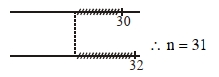
View full question & answer→MCQ 1171 Mark
Let $A B C D$ be a quadrilateral such that there exists a point $E$ inside the quadrilateral satisfying $A E=B E=C E=D E$. Suppose $\angle D A B, \angle A B C, \angle B C D$ is an arithmetic progression. Then the median of the set $\{\angle D A B, \angle A B C, \angle B C D\}$ is
- A
$\frac{\pi}{6}$
- B
$\frac{\pi}{4}$
- C
$\frac{\pi}{3}$
- ✓
$\frac{\pi}{2}$
AnswerCorrect option: D. $\frac{\pi}{2}$
d
(d)
Since, $\angle D A B, \angle A B C$ and $\angle B C D$ are in $AP \therefore$ Let $\angle D A B=\theta-\alpha, \angle A B C=\theta$ and $\angle B C D=\theta+\alpha$
$\therefore$ Median of $\angle D A B, \angle A B C$ and $\angle B C D=\theta$
From point $E$ all the vertices are at equal distance.
$\therefore A B C D$ is cyclic.
and $\angle A D C=2 \pi-(\theta-\alpha+\theta+\theta+\alpha)$
$\quad=2 \pi-3 \theta$
and $\angle A D C+\angle A B C=\pi$
$\Rightarrow 2 \pi-3 \theta+\theta=\pi$
$\therefore \quad \theta=\frac{\pi}{2}$
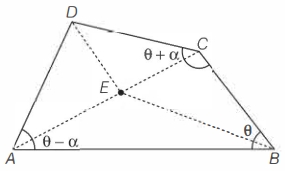
View full question & answer→MCQ 1181 Mark
Let $M=2^{30}-2^{15}+1$, and $M^2$ be expressed in base $2$.The number of $1$'s in this base $2$ representation of $M^2$ is
Answerb
(b)
Given,
$\begin{aligned} M^2=& 2^{66}-2^{46}+2^{32}+2^{30}-2^{16}+1 \\ M^2=& 2^{46}\left[\frac{2^{14}-1}{2-1}\right]+2^{32}+2^{16}\left[\frac{2^{14}-1}{2-1}\right]+1 \\ M^2=& 2^{46}\left[1+2+2^2+\ldots+2^{13}\right] \\ & \quad+2^{32}+2^{16}\left[1+2+2^2+\ldots+2^{13}\right]+1 \\ M^2=& \frac{2^{59}+2^{58}+\ldots+2^{46}}{14 \text { terms }}+2^{32} \end{aligned}$
$\underbrace{+2^{29}+2^{28}+\ldots+2^{16}}_{14 \text { terms }}+2^0$
Therefore, on base $2$ representation of $M^2$, there will be $30$ times digit $1$ .
View full question & answer→MCQ 1191 Mark
$\left[\frac{2^{2020}+1}{2^{2018}+1}\right]+\left[\frac{3^{2020}+1}{3^{2018}+1}\right]+\left[\frac{4^{2020}+1}{4^{2018}+1}\right] +\left[\frac{5^{2020}+1}{5^{2018}+1}\right] + \left[\frac{6^{2020}+1}{6^{2018}+1}\right]$ is
Answerb
(b)
$\frac{1+x^{2020}}{1+x^{2018}}=\frac{x^2\left(1+x^{2018}\right)+1-x^2}{1+x^{2018}}$
$=x^2+\frac{1-x^2}{1+x^{2018}}$
Put $x=2 \therefore\left[4+\frac{(-3)}{1+2^{2018}}\right]=3$
Put $x=3 \therefore\left[9-\frac{8}{1+3^{2018}}\right]=8$
Similarly for $x=4,\left[16-\frac{15}{1+4^{2018}}\right]=15$
For $x=5,\left[25-\frac{24}{1+5^{2018}}\right]=24$
For $x=6,\left[36-\frac{35}{1+6^{2018}}\right]=35$
$\therefore$ Required sum
$=3+8+15+24+35=85$
View full question & answer→MCQ 1201 Mark
Let $\alpha =\sum_{n=101}^{200} 2^n \sum_{k=101}^n \frac{1}{k !}$ and $b=\sum_{n=101}^{200} \frac{2^{201}-2^n}{n !}$ Then, $\frac{a}{b}$ is
- ✓
$1$
- B
$\frac{3}{2}$
- C
$2$
- D
$\frac{5}{2}$
Answera
(a)
Given,
$a= 2^{101}\left(\frac{1}{101 !}\right)+2^{102}\left(\frac{1}{101 !}+\frac{1}{102 !}\right)$ $+2^{103}\left(\frac{1}{101 !}+\frac{1}{102 !}+\frac{1}{103 !}\right)$
$\quad\quad\quad\quad\quad\quad\quad+ \ldots+2^{200}\left(\frac{1}{101 !}+\frac{1}{102 !}+\ldots+\frac{1}{200 !}\right)$
$a= \frac{1}{101 !}\left(2^{101}+2^{102}+\ldots+2^{200}\right)$
$\quad\quad\quad\quad\quad\quad+\frac{1}{102 !}\left(2^{102}+2^{103}+\ldots+2^{200}\right)$
$\quad\quad\quad\quad\quad\quad\quad\quad\quad\quad\quad+\ldots+\frac{1}{200 !}\left(2^{200}\right)$
$a=\sum_{n=101}^{200} \frac{1}{n !}\left(2^n+2^{n+1}+\ldots \ldots+2^{200}\right)$
$a= \sum_{n=101}^{200} \frac{1}{n !}\left(\frac{2^n\left(2^{201-n}-1\right)}{2-1}\right)$
$= \sum_{n=101}^{200} \frac{2^{201}-2^n}{n !}$
$a= b \Rightarrow \frac{ a }{b}=1$
View full question & answer→MCQ 1211 Mark
Let $a_n, n \geq 1$, be an arithmetic progression with first term $2$ and common difference $4$ . Let $M_n$ be the average of the first $n$ terms. Then the sum $\sum \limits_{n=1}^{10} M_n$ is
- ✓
$110$
- B
$335$
- C
$770$
- D
$1100$
Answera
(a)
The sum of first $n, n \geq 1$ terms of arithmetic progression with first term $2$ and common difference $4$, is
$S_n=\frac{n}{2}[4+(n-1) 4]=2 n^2$
So, the average of the first $n$ terms
$M_n=\frac{S_n}{n}=2 n$
Now, $\sum\limits_{n=1}^{10} M_n=2 \sum\limits_{n=1}^{10} n$
$=2 \times\left(\frac{10 \times 11}{2}\right)=110$
View full question & answer→MCQ 1221 Mark
Suppose the sum of the first $m$ terms of an arithmetic progression is $n$ and the sum of its first $n$ terms is $m$, where $m \neq n$. Then, the sum of the first $(m+n)$ terms of the arithmetic progression is
- A
$1-m n$
- B
$m n-5$
- ✓
$-(m+n)$
- D
$m+n$
AnswerCorrect option: C. $-(m+n)$
c
(c)
Given, $S_m=n$ and $S_n=m$
$S_m=\frac{m}{2}[2 a+(m-1) d]=n$
$S_n=\frac{n}{2}(2 a+(n-1) d)=m \text { (i) }$
On subtracting Eq.$(ii)$ from Eq.$(i)$, we get
$(m-n) a+(m-n)(m+n-1) \frac{d}{2}$
$=-(m-n)$
$2 a+(m+n-1) d=-2 \quad[m \neq n]$
$S_{m+n}=\frac{m+n}{2}(2 a+(m+n-1) d)$
$=\frac{m+n}{2}(-2)=-(m+n)$
View full question & answer→MCQ 1231 Mark
The number of different possible values for the sum $x+y+z$, where $x, y, z$ are real number such that $x^4+4 y^4+16 z^4+64=32 x y z$ is
Answerc
(c)
We have,
$x^4+4 y^4+16 z^4+64=32 x y z$
We know $\quad AM \geq GM$
$\Rightarrow \frac{x^4+4 y^4+16 z^4+64}{4}$
$\geq\left(x^4 \times 4 y^4 \times 16 z^4 \times 64\right)^{1 / 4}$
$\Rightarrow \quad x^4+4 y^4+16 z^4+64 \geq 32 x y z$
$\Rightarrow \quad x=\pm 2 \sqrt{2}, y=\pm 2, z=\pm \sqrt{2}$
For $x, y, z$
For $x^4+4 y^4+16 z^4+64=32 x y z$
Either each of $x, y, z$ is positive $\rightarrow 1$ case
or two of $x, y, z$ are negative $\rightarrow 3$ cases
$\therefore 4$ cases of different $(x, y, z)$ triplets
$4$ possible $x+y+z$ values $(x \neq y \neq z)$.
View full question & answer→MCQ 1241 Mark
Let $x_k$ be real numbers such that $x_k \geq k^4+k^2+1$ for $1 \leq k \leq$ 2018. Denote $N=\sum_{k=1}^{2018} k$. Consider the following inequalities.
$I$. $\left(\sum_{k=1}^{2018} k x_k\right)^2 \leq N\left(\sum_{k=1}^{2018} k x_k^2\right)$
$II$. $\left(\sum_{k=1}^{2018} k x_k\right)^2 \leq N\left(\sum_{k=1}^{2018} k^2 x_k^2\right)$ Then,
- ✓
both $I$ and $Il$ are true
- B
$I$ is true and $II$ is false
- C
$I$ is false and $II$ is true
- D
both $I$ and $II$ are false
AnswerCorrect option: A. both $I$ and $Il$ are true
a
(a)
We have,
$x_k \geq k^4+k^2+1, \forall k \in[1,2018]$
$N \sum \limits_{k=1}^{2018} k$
I. I $\left(\sum \limits_{k=1}^{2018} k x_k\right)^2 \leq N\left(\sum \limits_{k=1}^{2018} k x_k^2\right)$
We know
$\left(\frac{x_1+x_2+x_3+\ldots+x_n}{n}\right) \leq \frac{x_1^2+x_2^2+x_3^2+\ldots+x_n^2}{n}$
$\therefore\left[\begin{array}{c}x_1+\left(x_2+x_2\right)+\left(x_3+x_3+x_3\right) \\ +\ldots\left(x_{2018}+x_{2018 \ldots \ldots} 2018 \text { times }\right) \\ \hline 1+2+3+4+\ldots+2018\end{array}\right]^2$
$\leq \frac{x_1^2+\left(x_2^2+x_2^2\right)+\left(x_3^2+x_3^2+x_3^2\right) \ldots}{1+2+3+4+\ldots+2018}$
$\Rightarrow\left(\frac{x_1+2 x_2+3 x_3+\ldots+2018 x_{2018}}{1+2+3+4+\ldots+2018}\right)$
$\leq \frac{x_1^2+2 x_2^2+\ldots+2018 x_{2018}^2}{1+2+3+\ldots+2018}$
$\Rightarrow \frac{\left(\sum \limits_{k=1}^{2018} k x_k\right)^2}{\left(\sum \limits_{k=1}^{2018} k\right)^2} \leq \frac{\sum \limits_{k=1}^{2018} k x_k^2}{\sum \limits_{k=1}^{2018} k}=\left(\sum_{k=1}^{2018} k x_k\right)^2 \leq N \sum_{k=1}^{2018} k x_k^2$
Hence, $I$ is true.
II. $\left(\sum \limits_{k=1}^{2018} k x_k\right)^2 \leq N\left(\sum \limits_{k=1}^{2018} k^2 x_k^2\right)$
Similarly for $1$
$\left(\frac{x_1+2 x_2+3 x_3+\ldots+2018 x_{2018}}{2018}\right)^2$
$\leq\left(\frac{x_1^2+\left(2 x_1\right)+\ldots\left(2018 x_{2018}\right)}{2018}\right)$
$\Rightarrow \frac{\left(\sum \limits_{k=1}^{2018} k x_k\right)^2}{(2018)^2} \leq \frac{\sum \limits_{k=1}^{2018} k^2 x_k 2}{2018}$
$=\left(\sum \limits_{k=1}^{2018} k x_k\right)^2 \leq 2018 \sum \limits_{k=1}^{2018} k^2 x_k$
$N=\sum \limits_{k=1}^{2018} k=\frac{2018 \times 2019}{2}$
$\because\left(\sum \limits_{k=1}^{2018} k x_k\right)^2$ is always less than or equal to
$2018 \sum \limits_{k=1}^{2018} k^2 x_k^2$
$\therefore$ It will always be less than $N\left(\sum \limits_{h=1}^{2018} k^2 x_k\right)$ Hence,$I$ and $II$ both are true.
View full question & answer→MCQ 1251 Mark
The number of $5 -$tuples $(a, b, c, d, e)$ of positive integers such that
$I.$ $a, b, c, d, e$ are the measures of angles of a convex pentagon in degrees
$II$. $a \leq b \leq c \leq d \leq e$
$III.$ $a, b, c, d, e$ are in arithmetic progression is
Answerb
(b)
We have,
$I$. $a, b,, c, d, e$ are angle of convex pentagon in degree.
$II$. $a \leq b \leq c \leq d \leq e$
$IIl$. $a, b, c, d, e$ are in $AP$
$a + b + c + d + e=540^{\circ}$
Let $a=\alpha$, common difference $=D$
$\therefore \quad \frac{5}{2}(2 a+4 D)=540^{\circ}$
$a+2 D=108$ and $a+4 D<180^{\circ}$
$[\because$ interior angle of polygon is
less than $\left.180^{\circ}\right]$
$\therefore \quad 108^{\circ}-2 D+4 D < 180^{\circ}$
$2 D < 180^{\circ}-108^{\circ}$
$0 < D < 36$
$\therefore$ Total 36 types are possible.
View full question & answer→MCQ 1261 Mark
Let $a_1, a_2, a_3, a_4$ be real numbers such that $a_1+a_2+a_3+a_4=0$ and $a_1^2+a_2^2+a_3^2+a_4^2=1$. Then, the smallest possible value of the expression $\left(a_1-a_2\right)^2+\left(a_2-a_3\right)^2+\left(a_3-a_4\right)+\left(a_4-a_1\right)^2$ lies in the interval
- A
$(0,1.5)$
- ✓
$(1.5,2.5)$
- C
$(2.5,3)$
- D
$(3,3.5)$
AnswerCorrect option: B. $(1.5,2.5)$
b
(b)
Given, $a_1+a_2+a_3+a_4=0$ and $\quad a_1^2+a_2^2+a_3^2+a_4^2=1$
It is possible only
when, $a_1=a_2=\frac{1}{2}$ and $a_3=a_4=-\frac{1}{2}$ $\therefore\left(a_1-a_2\right)^2+\left(a_2-a_3\right)^2+\left(a_3-a_4\right)^2 +\left(a_4-a_1\right)^2$
$\left(\frac{1}{2}-\frac{1}{2}\right)^2+\left(\frac{1}{2}+\frac{1}{2}\right)^2+\left(-\frac{1}{2}+\frac{1}{2}\right)^2+\left(-\frac{1}{2}-\frac{1}{2}\right)^2$
$0+1+0+1=2$
The value lies between $(1.5,2.5)$.
View full question & answer→MCQ 1271 Mark
Let $a_1=i+\frac{1}{i}$ for $i=1,2, \ldots, 20$. Put $p=\frac{1}{20}\left(a_1+a_2+\ldots+a_{20}\right)$ and $q=\frac{1}{20}\left(\frac{1}{a_1}+\frac{1}{a_2}+\ldots+\frac{1}{a_{20}}\right)$ Then,
- ✓
$q \in\left(0, \frac{22-p}{21}\right) \quad$
- B
$q \in \frac{22-p}{21},\frac{2(22-p)}{21}$
- C
$q \in \frac{2(22-p)}{21},\frac{22-p}{7}$
- D
$q \in \frac{22-p}{7},\frac{4(22-p)}{21}$
AnswerCorrect option: A. $q \in\left(0, \frac{22-p}{21}\right) \quad$
a
(a)
Given $a_1=i+\frac{1}{i}$ for $i=1,2,3, \ldots, 20$
$p=\frac{1}{20}\left(a_1+a_2+a_3+\ldots+a_{20}\right)$
$q=\frac{1}{20}\left(\frac{1}{a_1}+\frac{1}{a_2}+\frac{1}{a_3} \ldots+\frac{1}{a_{20}}\right)$
Clearly, $q > 0$.
Let $\quad q < \frac{22-p}{21}$
To prove $q+\frac{p}{21}<\frac{22}{21}$
$\therefore q+\frac{p}{21}=\frac{1}{20}\left[\frac{1}{\alpha_1}+\frac{1}{a_2}+\frac{1}{\alpha_3} \ldots \frac{1}{a_2}\right] +\frac{1}{20} \frac{1}{21}\left[a_1+a_2+a_3 \ldots a_{20}\right]$
$=\frac{1}{20}\left[\sum \frac{i}{i^2+1}+\frac{1}{21}\left(\sum i+\sum \frac{1}{i}\right)\right]$
$=\frac{1}{20}\left[\frac{1}{2}+\sum \limits_{i=2}^{20} \frac{i}{i+1}+\frac{20 \times 21}{2}+\sum \limits_{i=1}^{20} \frac{1}{21}\right]$
$=\frac{1}{2}+\frac{1}{20}\left[\frac{1}{2}+\sum_{i=2}^{20} \frac{i}{i^2+1}+\frac{1}{21}+\sum \limits_{i=1}^{20} \frac{1}{i}\right]$
$ < \frac{1}{2}+\frac{1}{20}\left[\frac{1}{2}+\frac{2}{5} \sum \limits_{i=2}^{20} 1+\frac{1}{21} \sum \limits_{i=1}^{20}\right]$
$ < \frac{1}{2}+\frac{1}{20}\left[\frac{1}{2}+\frac{2}{5} \times 19+\frac{1}{21} \times 20\right]$
$ < \frac{1}{2}+\frac{1}{20}[1+8+1] < \frac{1}{2}+\frac{1}{2} < 1 < \frac{22}{21}$
$\because q \in\left(0, \frac{22-p}{21}\right)$
View full question & answer→MCQ 1281 Mark
Let $S$ be the infinite sum given by $S=\sum \limits_{n=0}^{\infty} \frac{a_n}{10^{2 n}}$ where $\left(a_n\right)_{n \geq 0}$ is a sequence defined by $a_0=a_1=1$ and $a_j=20 a_{j-1}-108 a_{j-2}$ for $j \geq 2$. If $S$ is expressed in the form $\frac{a}{b}$, where $a, b$ are coprime positive integers, then $a$ equals
- A
$2017$
- B
$2020$
- C
$2023$
- ✓
$2025$
AnswerCorrect option: D. $2025$
d
(d)
We have, $S=\sum \limits_{n=0}^{\infty} \frac{ c _n}{10^{2 n}}$
$a_{0}=a_1=1$ and $a_j=20 a_{j-1}-108 a_{j-2}, j \geq 2$
$a_n=20 a_{n-1}-108 a_{n-2}$
$\frac{a_n}{10^{2 n}}=\frac{20 a_{n-1}}{10^{2 n}}-\frac{108 a_{n-2}}{10^{2 n}}$
$=\frac{20}{100} \frac{a_{n-1}}{10^{2(n-1)}}-\frac{108}{10^4}-\frac{a_{n-2}}{10^{2(n-2)}}$
$\sum \limits_{n=2}^{\infty} \frac{a_n}{10^{2 n}}=\frac{1}{51 a_{n-1}^{2(n-1)}}-\frac{27}{2500}-\frac{\Sigma a_{n-2}}{10^{2(n-2)}}$
$S-1-\frac{1}{10}=\frac{1}{5}(S-1)-\frac{27}{2500} S$
$S\left(1-\frac{1}{5}+\frac{27}{2500}\right)=1+\frac{1}{100}-\frac{1}{5}$
$S\left(\frac{2500-500+27}{2500}\right)=\frac{100+1-20}{100}$
$S=\frac{81 \times 25}{2027}$
$S=\frac{2025}{2027}$
$a=2025$
View full question & answer→MCQ 1291 Mark
The number of triples $(x, y, z)$ of real numbers satisfying the equation $x^4+y^4+z^4+1=4 x y z$ is
- A
$0$
- ✓
$4$
- C
$8$
- D
more than $8$
Answerb
(b)
We have,
$x^4+y^4+z^4+1=4 x y z$
$AM \geq GM$
$\therefore \frac{x^4+y^4+z^4+1}{4} \geq\left(x^4 \cdot y^4 \cdot z^4 \cdot 1\right)^{1 / 4}$
$\Rightarrow \quad \frac{4 x y z}{4} \geq|x y z| \Rightarrow x y z > 0$
$\text { It is possible }(1,1,1)(-1,-1,1)(-1,1,-1)$
$(1,-1,-1)$
So number of triplet $(x, y, z)=4$
View full question & answer→MCQ 1301 Mark
Let $S_1$ be the sum of areas of the squares whose sides are parallel to coordinate axes. Let $S_2$ be the sum of areas of the slanted squares as shown in the figure. Then, $\frac{S_1}{S_2}$ is equal to
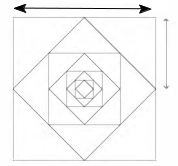
- ✓
$2$
- B
$\sqrt{2}$
- C
$1$
- D
$\frac{1}{\sqrt{2}}$
Answera
(a)
Here,
$S_1=a^2+\left(\frac{a}{2}\right)^2+\left(\frac{a}{4}\right)^2+\ldots$
$S_2=\left(\frac{a}{\sqrt{2}}\right)^2+\left(\frac{a}{2 \sqrt{2}}\right)^2+\ldots$
$S_1=a^2+\frac{a^2}{4}+\frac{a^2}{16}+\ldots=\frac{a^2}{1-\frac{1}{4}}=\frac{4 a^2}{3}$
$S_2=\frac{a^2}{2}+\frac{a^2}{8}+\frac{a^2}{32}+\ldots=\frac{a^2 / 2}{1-\frac{1}{4}}=\frac{4 a^2}{6}$
$\therefore \quad \frac{S_1}{S_2}=\frac{\frac{4 a^2}{3}}{4 a^2 / 6}=2$
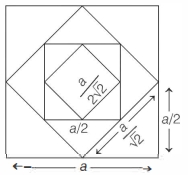
View full question & answer→MCQ 1311 Mark
The remainder when the polynomial $1+x^2+x^4+x^6+\ldots+x^{22}$ is divided by $1+x+x^2+x^3+\ldots+x^{11}$ is
AnswerCorrect option: D. $2\left(1+x^2+x^4+\ldots+x^{10}\right)$
d
(d)
Let,$P(x)=1+x^2+x^4+x^6+\ldots+x^{22}$
$Q(x)=1+x+x^2+x^3+\ldots+x^{11}$
$P(x)=\frac{x^{24}-1}{x^2-1}$
$\left[\because a+a r+a r^2+\ldots+a r^{n-1}=\frac{a\left(r^n-1\right)}{r-1}\right]$
Similarly, $Q(x)=\frac{x^{12}-1}{x-1}$
$\therefore \quad \frac{P(x)}{Q(x)}=\left(\frac{x^{24}-1}{x^2-1}\right)\left(\frac{x-1}{x^{12}-1}\right)=\frac{x^{12}+1}{x+1}$
Now, $\left(1+x^{12}\right)$ is divided by $(x+1)$, then by remainder theorem remainder is $2$
Now, $P(x)$ is divided by $Q(x)$, then
remainder $=2\left(1+x^2\right)\left(1+x^4+x^8\right)$
$=2\left(1+x^2+x^4+\ldots+x^{10}\right)$
View full question & answer→MCQ 1321 Mark
Let $a_1, a_2, \ldots, a_{100}$ be non-zero real numbers such that $a_1+a_2+\ldots+a_{100}=0$ Then,
- ✓
$\sum \limits_{i=1}^{100} a_i 2^{a_i} > 0$ and $\sum \limits_{i=1}^{100} a_i 2^{-a_i} < 0$
- B
$\sum \limits_{i=1}^{100} a_i 2^{a_i} \geq 0$ and $\sum \limits_{i=1}^{100} a_i 2^{-a_i} \geq 0$
- C
$\sum \limits_{i=1}^{100} a_i 2^{a_i} \leq 0$ and $\sum \limits_{i=1}^{100} a_i 2^{-a i} \leq 0$
- D
The sign of $\sum \limits_{i=1}^{100} a_i 2^{a_i}$ or $\sum \limits_{i=1}^{100} a_i 2^{-a_i}$ depends on the choice of $a_i^{\prime} s$
AnswerCorrect option: A. $\sum \limits_{i=1}^{100} a_i 2^{a_i} > 0$ and $\sum \limits_{i=1}^{100} a_i 2^{-a_i} < 0$
a
(a)
We have, $a_1, a_2, a_3, \ldots, a_{100}$ be non-zero real number and
$a_1+a_2+a_3+\ldots+a_{100}=0$
$a_i \cdot 2^{a_i} > a_i$ and $a_i \cdot 2^{-a_i} < a_i$
$\therefore \sum \limits_{i=1}^{100} a_1 \cdot 2^{a i} > \sum \limits_{i=1}^{100} a_i \text { and } \sum \limits_{i=1}^{100} a_1 \cdot 2^{-a_i} < \sum \limits_{i=1}^{100} a_i$
$\Rightarrow \sum \limits_{i=1}^{100} a_1 \cdot 2^{a_i} > 0 \text { and } \sum \limits_{i=1}^{100} a_1 \cdot 2^{-a_i} < 0$
Hence, option $(a)$ is correct.
View full question & answer→MCQ 1331 Mark
If $n$ is the smallest natural number such that $n+2 n+3 n+\ldots+99 n$ is a perfect square, then the number of digits of $n^2$ is
- A
$1$
- B
$2$
- ✓
$3$
- D
more than $3$
Answerc
(c)
We have,
$n+2 n+3 n+\ldots+99 n$ is a perfect square
$n(1+2+\ldots+99), \frac{n \times 99 \times 100}{2}$
$n \times 11 \times 9 \times 2 \times 25$
$=(3)^2 \times(5)^2 \times 2 \times 11 \times n$ is a perfect square
$\therefore n$ must be 22 .
$\therefore \quad n^2=(22)^2=484$
Number of digit of $n^2$ is $3 .$
View full question & answer→MCQ 1341 Mark
The houses on one side of a road are numbered using consecutive even numbers. The sum of the numbers of all the houses in that row is $170$ . If there are at least $6$ houses in that row and $a$ is the number of the sixth house, then
- A
$2 \leq a \leq 6$
- B
$8 \leq a \leq 12$
- ✓
$14 \leq a \leq 20$
- D
$22 < a \leq 30$
AnswerCorrect option: C. $14 \leq a \leq 20$
c
(c)
Let the number of houses be $x, x+2, x+4, x+6, x+8, x+10, \ldots$ 6 th number of house is $a$.
$\because x+10=a \Rightarrow x=a-10$
$\therefore x > 10$
Now, $\quad S_n=\frac{n}{2}(2 x+(n-1) 2)$
$S_n=n(x+n-1)$
$\Rightarrow 170=n(a-10+n-1)$
$\Rightarrow n^2+(a-11) n-170=0$
$\Rightarrow n=-(a-11) \pm \sqrt{(a-11)^2+680}$
$\Rightarrow \quad n=\frac{(11-a) \pm \sqrt{(a-11)^2+680}}{2}$
$n \geq 6$
$\Rightarrow \quad n=\frac{(11-a) \pm \sqrt{(a-11)^2+680}}{2} \geq 6$
$\Rightarrow \quad a \leq \frac{800}{24} \leq 33.33$
$\because \quad 12 \leq a \leq 32$
$a=12,14,16,18, \ldots$
When, $a=18, n=10$, then $S_n=170$ $\because \quad a=18$
View full question & answer→MCQ 1351 Mark
Let $n \geq 3$ and let $C_1, C_2, \ldots, C_n$, be circles with radii $r_1, r_2, \ldots, r_n$, respectively. Assume that $C_i$ and $C_{i+1}$ touch externally for $1 \leq i \leq n-1$. It is also given that the $X$-axis and the line $y=2 \sqrt{2} x+10$ are tangential to each of the circles. Then, $r_1, r_2, \ldots, r_n$ are in
- A
an arithmetic progression with common difference $3+\sqrt{2}$
- B
a geometric progression with common ratio $3+\sqrt{2}$
- C
an arithmetic progression with common difference $2+\sqrt{3}$
- ✓
a geometric progression with common ratio $2+\sqrt{3}$
AnswerCorrect option: D. a geometric progression with common ratio $2+\sqrt{3}$
d
(d)
We have,
$C_1, C_2, C_3, \ldots, C_n$ be circle with radii
$r_1, r_2, \ldots, r_n$ respectively. $C_i$ and $C_{i+1}$ touch externally $X$-axis and $y=2 \sqrt{2} x+10$ are tangent of each circle.
Slope of line $y=2 \sqrt{2} x+10$ is $2 \sqrt{2}$
$\therefore \quad \tan 2 \theta =2 \sqrt{2}$
$\frac{2 \tan \theta}{1-\tan ^2 \theta} =2 \sqrt{2}$
$\sqrt{2} \tan ^2 \theta+\tan \theta-\sqrt{2}=0$
$(\sqrt{2} \tan \theta-1)(\tan \theta+\sqrt{2}) =0$
$\tan \theta=\frac{1}{\sqrt{2}} \tan \theta \neq-\sqrt{2}$
$\sin \theta=\frac{1}{\sqrt{3}}$
$\operatorname{In} \Delta P Q M, \sin \theta=\frac{Q M}{P Q}$
$\Rightarrow \quad P Q=\sqrt{3} Q M \Rightarrow P Q=\sqrt{3} r_1$
$\operatorname{In} \triangle P R N$,
$\sin \theta=\frac{R N}{P R}=\frac{r_2}{P Q+r_1+r_2}=\frac{r_2}{\sqrt{3} r_1+r_1+r_2}$
$\Rightarrow \quad \frac{1}{\sqrt{3}}=\frac{r_2}{(\sqrt{3}+1) r_1+r_2}$
$\Rightarrow r_2+(\sqrt{3}+1) r_1=\sqrt{3}-r_2$
$\Rightarrow \quad \frac{r_2}{r_1}=\frac{\sqrt{3}+1}{\sqrt{3}-1}$
$r_1, r_2, r_3$ a geometric progression with common ratio $2+\sqrt{3}$.
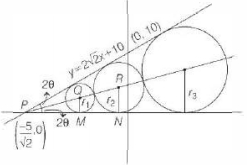
View full question & answer→MCQ 1361 Mark
Let $C_0$ be a circle of radius $I$ . For $n \geq 1$, let $C_n$ be a circle whose area equals the area of a square inscribed in $C_{n-1} .$ Then, $\sum \limits_{i=0}^{\infty}$ Area $\left(C_i\right)$ equals
- A
$\pi^2$
- B
$\frac{\pi-2}{\pi^2}$
- C
$\frac{1}{\pi^2}$
- ✓
$\frac{\pi^2}{\pi-2}$
AnswerCorrect option: D. $\frac{\pi^2}{\pi-2}$
d
(d)
We have, $C_0$ be a circle of radius $1.$ $C_n$ be a circle whose area equals the area of a square inscribed in $C_{n-1}$.
Let $a_0, a_1, a_2, a_3, \ldots, a_n$ be the length of sides of square inscribed in circle $C_0, C_1, C_2, \ldots, C_n$ and $r_0, r_1, r_2, \ldots, r_n$ be radius of circle.
$2 a_0^2 =4$
$a _0^2 =2$
$\pi r_1^2 =a_0^2$
$r_1^2 =\frac{2}{\pi}$
$2 a _1^2 =\left(2 r_1\right)^2=4 r_1^2$
$a _1^2 =\frac{4}{\pi}$
$\pi r_2^2 = c _1^2$
$\Rightarrow r_2^2=\frac{4}{\pi^2}$
Similarly, $r_n^2=\frac{2^2}{\pi^n}$
Now, $\sum \limits_{i=0}^{\infty}$ Area $\left(C_{i j}\right)$
$=\pi\left(-1+\frac{2}{\pi}+\frac{2^2}{\pi^2}+\frac{2^3}{\pi^3}+\ldots\right)$
$=\pi\left(\frac{1}{1-\frac{2}{\pi}}\right)$
$\left[S_{\infty}=1+r+r^2+\ldots=\frac{1}{1-r}\right]$
$=\frac{\pi^2}{\pi-2}$
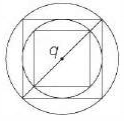
View full question & answer→MCQ 1371 Mark
Let $n \geq 3$ be an integer. For a permutation $\sigma=\left(a_1, a_2, \ldots, a_n\right)$ of $(1,2, \ldots, n)$ we let $f_\sigma(x)=a_n x^{n-1}+a_{n-1} x^{n-2}+\ldots a_2 x+a_1$. Let $S_\sigma$ be the sum of the roots of $f_\sigma(x)=0$ and let $S$ denote the sum over all permutations $\sigma$ of $(1,2, \ldots, n)$ of the numbers $S_\sigma$. Then,
- ✓
$S < -n !$
- B
$-n$ ! $ < S < 0$
- C
$0 < S < n !$
- D
$n ! < S$
AnswerCorrect option: A. $S < -n !$
a
(a)
We have,
$f_\sigma(x) =a_n x^{n-1}+a_{n-1} x^{n-2}+\ldots+a_2 x+a_1$
$\sigma =\left(a_1, a_2, a_3, \ldots, a_n\right) \text { of }(1,2,3, \ldots, n)$
$S_\sigma=$ Sum of roots of $f_\sigma(x)=0$
$S=\Sigma S_\sigma$
$S=-\left[\frac{\lambda-a_n}{a_n}+\frac{\lambda-a_{n-1}}{a_{n-1}}+\ldots+\frac{\lambda- a _1}{ \alpha _1}\right]$
$\forall \lambda=a_1+a_2+a_3+\ldots+a_n$
$S=-\left[\left(a_1+a_2+a_3+\ldots+a_n\right)\right.$
$\left.\left(\frac{1}{a_1}+\frac{1}{a_2}+\ldots+\frac{1}{a_n}\right)-n\right]$
$S=n-\left[\begin{array}{r}\left(a_1+a_2+a_3+\ldots+a_n\right) \\ \left.\left(\frac{1}{a_1}+\frac{1}{a_2}+\ldots+\frac{1}{a_n}\right)\right]\end{array}\right.$
From $AM \geq HM$
$\frac{ a _1+a_2+ a _3+\ldots+a_n}{n} \geq \frac{n}{\frac{1}{a_1}+\frac{1}{a_2}+\ldots+\frac{1}{a_n}}$
$\Rightarrow\left(a_1+a_2+a_3+\ldots+a_n\right)$
$\left(\frac{1}{a_1}+\frac{1}{a_2}+\ldots+\frac{1}{a_n}\right) \geq n^2$
$S \leq-n(n-1)$
$\therefore \quad S \leq-n !$
View full question & answer→MCQ 1381 Mark
The sum of all positive integers $n$ for which $\frac{1^3+2^3+\ldots+(2 n)^3}{1^2+2^2+\ldots+n^2}$ is also an integers is
Answera
(a)
Given, $\frac{1^3+2^3+3^3+\ldots+(2 n)^3}{1^2+2^2+3^2+\ldots+n^2}$
$=\frac{\frac{4 n^2(2 n+1)^2}{n(n+1)(2 n+1)}}{6}=\frac{6 n(2 n+1)}{n+1}$
$=\frac{12 n^2+6 n}{n+1}=(12 n-6)+\frac{6}{n+1}$
$\because \frac{6}{n+1} \text { is an integer if } n+1 \text { is factor of } 6$
$\because n+1=1,2,3,6 \Rightarrow n=1,2,5$
Sum of $n=1+2+5=8$
View full question & answer→MCQ 1391 Mark
If $a, b$ are positive real numbers such that the lines $a x+9 y=5$ and $4 x+b y=3$ are parallel, then the least possible value of $a +b$ is
Answerb
(b)
We have, $a x+9 y=5$ and $4 x+b y=3$ are parallel. $\therefore \quad \frac{a}{4}=\frac{9}{b} \Rightarrow a b=36$
$AM \geq GM$
$\therefore \quad \frac{a+b}{2} \geq \sqrt{a b}$
$a+b \geq 2 \sqrt{36}$
$a+b \geq 12$
Hence, least possible value of $a+b=12$.
View full question & answer→MCQ 1401 Mark
Let $a, b, c, d, e$ be natural numbers in an arithmetic progression such that $a+b+c+d+e$ is the cube of an integer and $b+c+d$ is square of an integer. The least possible value of the number of digits of $c$ is
Answerb
(b)
We have,
$a, b, c, d, e$ are natural number and in AP.
Let $D$ is common difference of $AP$.
$\therefore$ Let $c=C$
$a =C-2 D$
$b =C-D$
$d =C+D$
$e =C+2 D$
$a+b+c+d+e=5 C$
and $b+c+d=3 C$
Given, $a+b+c+d+e$ is a cube of number
$\therefore 5 C=\lambda^3$
and $b+c+d$ is a square of number
$\therefore 3 C=u^2$
From Eqs.$(i)$ and $(ii)$, we get
$\frac{\lambda^3}{5}=\frac{u^2}{3}$
$\lambda^3$ and $u^2$ is a multiple of 15
$\therefore$ Smallest possible value of $\lambda=15$ and $u=45$
$\therefore \quad c=\frac{u^2}{3}=\frac{(45)^2}{3}=675$
$\therefore$ Number of digits $=3$
View full question & answer→MCQ 1411 Mark
Let $x, y, z$ be three non-negative integers such that $x+y+z=10$. The maximum possible value of $x y z+x y+y z+z x$ is
Answerc
(c)
We have, $x+y+z=10$
Let three number $x+1, y+1, z+1$
$AM \geq GM$
$\quad \frac{(x+1)+(y+1)+(z+1)}{3} \geq [(x+1)(y+1)(z+1)]^{1 / 3}$
$\Rightarrow \frac{x+y+z+3}{3} \geq (x y z+x y+y z+x z+x+y+z+1)^{1 / 3}$
$\Rightarrow \quad\left(\frac{13}{3}\right)^3 \geq x y z+x y+y z+x z+11$
$\Rightarrow \quad \quad(y+1)(z+1)]^{1 / 3}$
Now, $x, y, z$ are integer.
$\therefore x y z+x y+y z+x z+11$ is also integer.
$\therefore\left(\frac{13}{3}\right)^3$ is also integer.
$\therefore \quad\left[\left(\frac{13}{3}\right)^3\right]=81\left[\because\left(\frac{13}{3}\right)^3=8137\right]$
$\therefore x y z+x y+y z+x z+11 \leq 81$
$\Rightarrow \quad x y z+x y+y z+x z \leq 70$
$\therefore$ Maximum value of $x y z+x y+y z+x z$ is
View full question & answer→MCQ 1421 Mark
Let $a, b, c, d$ be real numbers such that $\sum \limits_{k=1}^n\left(a k^3+b k^2+c k+d\right)=n^4$, for every natural number $n$. Then, $|a|+|b|+|c|+|d|$ is equal to
Answera
(a)
We have,
$\sum \limits_{k=1}^n\left(a k^3+b k^2+d k+d\right)=n^4, n \in N$
$a\left(\frac{n(n+1)}{2}\right)^2+b \frac{n(n+1)(2 n+1)}{6}$
$+c \frac{n(n+1)}{2}+d n=n^4$
$\Rightarrow \frac{a}{4} n^4+\left(\frac{2 a}{4}+\frac{2 b}{6}\right) n^3+\left(\frac{a}{4}+\frac{3 b}{6}+\frac{c}{2}\right)$
$n^2+\left(\frac{b}{6}+\frac{c}{2}+d\right) n=n^4$
$\therefore \frac{a}{4}=1, \frac{2 a}{4}+\frac{2 b}{6}=0, \frac{a}{4}+\frac{3 b}{6}+\frac{c}{2}=0$
$\frac{b}{6}+\frac{c}{2}+d=0$
On solving these equations, we get
$a=4, b=-6, c=4, d=-1$
$\therefore|a|+|b|+|d|+|d|=4+6+4+1=15$
View full question & answer→MCQ 1431 Mark
The sides of a triangle are distinct positive integers in an arithmetic progression. If the smallest side is $10$, the number of such triangles is
Answerb
(b)
Let the sides be $a, b, c$ which are in A.P. with $c$ as the smallest.
$\therefore c =10$
$\therefore a , b > 10$
$\therefore 2 b = a + c = a +10$
$\therefore b + c > a$
$\Rightarrow b +10 > a$
From eq $(1)$ and $(2)$:
$\Rightarrow b +10 > 2 b -10$
$\Rightarrow b < 20$
$\therefore 10 < b < 20$
$\therefore$ No. of possible values of $b=9$
$\therefore$ No. of triangles possible $=9$
View full question & answer→MCQ 1441 Mark
For $\frac{2^2+4^2+6^2+\ldots+(2 n)^2}{1^2+3^2+5^2+\ldots+(2 n-1)^2}$ to exceed $1.01$, the maximum value of $n$ is
Answerd
(d)
We have,
$\frac{2^2+4^2+6^2+\ldots+(2 n)^2}{1^2+3^2+5^2+\ldots+(2 n-1)^2} > 101$
$\frac{\Sigma(2 n)^2}{\Sigma(2 n-1)^2}>\frac{101}{100}$
$\frac{4 \Sigma n^2}{\Sigma\left(4 n^2-4 n+1\right)} > \frac{101}{100}$
$\frac{4 \Sigma n^2}{4 \Sigma n^2-4 \Sigma n+\Sigma 1} > \frac{101}{100}$
$\frac{\frac{4(n)(n+1)(2 n+1)}{6}}{\frac{4 n(n+1)(2 n+1)}{6}-\frac{4 n(n+1)}{2}+n} > \frac{101}{100}$
$\frac{4 n(n+1)(2 n+1)}{n\left[4\left(2 n^2+3 n+1\right)-12 n-12+6\right]} > \frac{101}{100}$
$\frac{4(n+1)(2 n+1)}{8 n^2-2} > \frac{101}{100}$
$\frac{4(2 n+1)(n+1)}{2(2 n+1)(2 n-1)} > \frac{101}{100}$
$\frac{2 n+2}{2 n-1} > \frac{101}{100}$
$200 n+200 > 202 n-101$
$2 n < 301$
$n < \frac{301}{2}$
$\therefore$ Maximum value of $n=150$
View full question & answer→MCQ 1451 Mark
Suppose $a_1, a_2, a_3, \ldots, a_{2012}$ are integers arranged on a circle. Each number is equal to the average of its two adjacent numbers. If the sum of all even indexed numbers is $3018$ , what is the sum of all numbers?
- A
$0$
- B
$1509$
- C
$3018$
- ✓
$6036$
AnswerCorrect option: D. $6036$
d
(d)
Given,
$a_2=\frac{ a _1+ a _i}{2}$
$a_3=\frac{a_2+a_4}{2}$
$a_4=\frac{a_3+u_5}{2}$
$a_{2012}=\frac{a_{2011}+a_1}{2}$
$a_2+a_4+a_6+\ldots+a_{2012}=3018 \ldots$ (i)
$2 a_2+2 a_4+2 a_6+\ldots+2 a_{2012}=6036$
$\left(a_1+a_3\right)+\left(a_3+ a _5\right)+\left( a _5+a_7\right)+\ldots$
$+\left(a_{2011}+a_1\right)=6036$
$2\left(a_1+a_3+a_5+\ldots+a_{2011}\right)=6036$
$a_1+a_3+a_5+\ldots+a_{2011}=3018$
On adding Eqs.$(i)$ and $(ii)$,
$a_1+a_2+a_3+a_4+\ldots+a_{2011}+a_{2012}$
$=6036$
View full question & answer→MCQ 1461 Mark
Suppose $\log _a b+\log _b a=c$. The smallest possible integer value of $c$ for all $a, b>1$ is
Answerc
(c)
We have,
$\log _a b+\log _b a =c$
$AM \geq GM$
$\therefore \quad \frac{\log _a b+\log _b a}{2} \geq \sqrt{\log _a b \log _b a}$
$\Rightarrow \frac{c}{2} \geq \sqrt{\frac{\log b}{\log a} \times \frac{\log a}{\log b}} \Rightarrow \frac{c}{2} \geq 1 \Rightarrow c \geq 2$
$\therefore$ Smallest positive integer value of $c=2$.
View full question & answer→MCQ 1471 Mark
The arithmetic mean and the geometric mean of two distinct 2-digit numbers $x$ and $y$ are two integers one of which can be obtained by reversing the digits of the other (in base 10 representation). Then, $x+y$ equals
Answerc
(c)
We have,
Let two-digits numbers are $10 a+b$.
Given, $10 a+b$ is AM of $x$ and $y$
and $10 b+a$ is GM of $x$ and $y$.
$\therefore \quad \frac{x+y}{2}=10 a+b$
$\Rightarrow \quad \sqrt{x y}=10 b+a$
$\Rightarrow \quad x y=(10 b+a)^2$
$\Rightarrow(x+y)^2-(x-y)^2=4 x y$
$\therefore \quad(x-y)^2=(x+y)^2-4 x y$
$\Rightarrow \quad(x-y)^2=4(10 a+b)^2-4(10 b+a)^2$
$\Rightarrow \quad(x-y)^2=4(10 a+b+10 b+a)$
$(10 a+b-10 b-a)$
$\Rightarrow \quad(x-y)^2=4(11)(a+b) \cdot 9(a-b)$
$\Rightarrow \quad(x-y)^2=4 \times 11 \cdot(a+b) \cdot 9(a-b)$
$4 \times 11(a+b) \times 9(a-b)$ must be a perfect
square.
$\therefore \quad a+b=11, a-b=1$
On solving these equations, we get
$\therefore a=6, b=5$
$\therefore \quad x+y=2(10 a+b)$
$\Rightarrow \quad x+y=2(60+5)$
$\Rightarrow \quad x+y=130$
View full question & answer→MCQ 1481 Mark
Suppose $n$ is a natural number such that $\left|i+2 i^2+3 i^3+\ldots n i^n\right|=18 \sqrt{2}$, where $i$ is the square root of $-1$. Then, $n$ is
Answerc
(c)
Let $S_n=i+2 i^2+3 i^3+\ldots+n i^n \ldots$ (i) $i S_n=i^2+2 i^2+\ldots(n-1) i^n+n i^{n+1} \ldots$ (ii)
On subtracting Eq. (ii) from Eq. (i), we get
$S_n(1-i)=i+i^2+i^3+\ldots+i^n-n i^{n+1}$
$\Rightarrow S_n(1-i)=\frac{i\left(1-i^n\right)}{1-i}-n i^{n+1}$
$\Rightarrow \quad S_n=\frac{i\left(1-i^n\right)}{-2 i}-\frac{n i^{n+1}}{1-i}$
$\Rightarrow \quad S_n=\frac{1-i^n}{-2}-\frac{n i^{n+i}(1+i)}{2}$.
Let $Z_1=\frac{1-i^n}{-2}$ and $Z_2=\frac{n i^{n+1}(1+i)}{2}$
$\therefore \quad\left|Z_1\right|=\frac{1}{\sqrt{2}}$ or 0 and $\left|Z_2\right|=\frac{n}{2} \sqrt{2}$
$\therefore \quad \frac{n}{2} \sqrt{2}=18 \sqrt{2} \Rightarrow n=36$
View full question & answer→MCQ 1491 Mark
The expression $\frac{2^2+1}{2^2-1}+\frac{3^2+1}{3^2-1}+\frac{4^2+1}{4^2-1}+\ldots+\frac{(2011)^2+1}{(2011)^2-1}$ lies in the interval
- A
$\left(2010,2010 \frac{1}{2}\right)$
- B
$\left(2011-\frac{1}{2011}, 2011-\frac{1}{2012}\right)$
- ✓
$\left(2011,2011 \frac{1}{2}\right)$
- D
$\left(2012,2012 \frac{1}{2}\right)$
AnswerCorrect option: C. $\left(2011,2011 \frac{1}{2}\right)$
c
(c)
Let
$S=\frac{2^2+1}{2^2-1}+\frac{3^2+1}{3^2-1}+\frac{4^2+1}{4^2-1}+\ldots+\frac{(2011)^2+1}{(2011)^2-1}$
Here, $\quad T_r=\frac{r^2+1}{r^2-1}$
$T_r =\frac{r^2-1+2}{r^2-1}$
$=1+\frac{2}{r^2-1}=1+\frac{2}{(r-1)(r+1)}$
$T_r =1+\frac{1}{r-1}-\frac{1}{r+1}$
$S =\sum \limits_{r=2}^{2011} T_r$
$=\sum \limits_{r=2}^{2011}\left[1+\frac{1}{r-1}-\frac{1}{r+1}\right]$
$S=T_2+T_3+T_4+\ldots+T_{2011}$
$S =\left(1+\frac{1}{1}-\frac{1}{3}\right)+\left(1+\frac{1}{2}-\frac{1}{4}\right)$
$+\left(1+\frac{1}{3}-\frac{1}{5}\right)+\ldots+\left(1+\frac{1}{2010}-\frac{1}{2012}\right)$
$S =2010+1+\frac{1}{2}-\frac{1}{2012}-\frac{1}{2011}$
$S =2011+\frac{1}{2}-\left[\frac{1}{2011}+\frac{1}{2012}\right]$
$S$ is lie between $\left(2011,2011 \frac{1}{2}\right)$
View full question & answer→MCQ 1501 Mark
Consider an incomplete pyramid of balls on a square base having $18$ layers, and having $13$ balls on each side of the top layer. Then, the total number $N$ of balls in that pyramid satisfies
- A
$9000 < N < 10000$
- ✓
$8000 < N < 9000$
- C
$7000 < N < 8000$
- D
$10000 < N < 12000$
AnswerCorrect option: B. $8000 < N < 9000$
b
(b)
Given, square base pyramid is incomplete.
The top layer $=13$ balls
There are $18$ layer completed.
So, total number of balls
$N=13^2+14^2+15^2+16^2+\ldots+30^2$
$N=\left(1^2+2^2+3^2+4^2+\ldots+30^2\right)$
$\Rightarrow N=5 \times 31 \times 61-2 \times 13 \times 25$
$=9455-650$
$=8805$
$\therefore \quad 8000 < N < 9000$
View full question & answer→MCQ 1511 Mark
The minimum value of $n$ for which $\frac{2^2+4^2+6^2+\ldots+(2 n)^2}{1^2+3^2+5^2+\ldots+(2 n-1)^2} < 1.01$ is
Answerc
(c)
We have,
$\frac{2^2+4^2+6^2+\ldots+(2 n)^2}{1^2+3^2+5^2+\ldots+(2 n-1)^2} < 1.01$
$=\frac{\Sigma 4 n^2}{\sum\left(4 n^2-4 n+1\right)} < 1.01$
$= \frac{4 \frac{n(n+1)(2 n+1)}{6}}{4 \frac{n(n+1)(2 n+1)}{6}-4 \frac{n(n)(n+1)}{2}+n}$
$= \frac{4 \frac{n(n+1)(2 n+1)}{6}}{\frac{n(2 n+1)(2 n-1)}{3}}<101=\frac{2(n+1)}{2 n-1} < \frac{101}{100}$
$= 200 n+200 < 202 n-101$
$\Rightarrow 2 n > 301 \Rightarrow n > \frac{301}{2}=150.5$
$\therefore n > 151$
View full question & answer→MCQ 1521 Mark
The sum of $\left(1^2-1+1\right)(1 !)+\left(2^2-2+1\right)(2 !)$ $+\ldots+\left(n^2-n+1\right)(n !)$ is
- A
$(n+2) !$
- ✓
$(n-1)((n+1) !)+1$
- C
$(n+2) !-1$
- D
$n((n+1) !)-1$
AnswerCorrect option: B. $(n-1)((n+1) !)+1$
b
(b)
Let
$S_n=\left(1^2-1+1\right)(1 !)+ \left(2^2-2+1\right)(2 !)$
$+\ldots+\left(n^2-n+1\right)(n !)$
Here, $T_r=\left(r^2-r+1\right)(r !)$
$T_r=\left(r^2-1-r+2\right)(r !)$
$T_r=\left(r^2-1\right) r !-(r-2) r !$
$T_r=(r-1)(r+1) !-(r-2) r !$
$S_n= T_1+T_2+T_3+\ldots+T_n$
$S_n= (1-0)+(3 !-0)+(2 \cdot 4 !-1 \cdot 3 !)$
$\quad\quad+(3 \cdot 5 !-2 \cdot 4 !)+(4 \cdot 6 !)-3 \cdot 5 ! \ldots$
$\quad\quad+[(n-1)(n+1) !-(n-2)(n !)]$
$S_n= 1+(n-1)(n+1) !$
$S_n=(n-1)(n+1) !+1$
View full question & answer→MCQ 1531 Mark
The number of positive integers $n$ in the set $\{1,2,3$, $\ldots \ldots . ., 100\}$ for which the number $\frac{1^2+2^2+3^2+\ldots .+n^2}{1+2+3+\ldots+n}$ is an integer is
Answerb
(b)
We have,
$\frac{1^2+2^2+3^2+4^2+\ldots+n^2}{1+2+3+4+\ldots+n}$
$=\frac{\frac{n(n+1)(2 n+1)}{6}}{n(n+1)}$
$=\frac{2 n+1}{2}=k(l \text { let })$
$\Rightarrow \quad n=\frac{3 k-1}{2}$
$\text { Now, } 1 \leq \frac{3 k-1}{2} \leq 100$
$\Rightarrow \quad 2 \leq 3 k-1 \leq 200$
$\Rightarrow \quad 2+1 \leq 3 k \leq 200+1$
$\Rightarrow \quad 3 \leq 3 k \leq 201$
$\Rightarrow \quad 1 \leq k \leq 201$
$\Rightarrow \quad 1 \leq k \leq 67$
Number of odd integer $=34$
View full question & answer→MCQ 1541 Mark
The number of natural number $n$ in the interval $[1005, 2010]$ for which the polynomial. $1+x+x^2+x^3+\ldots+x^{n-1}$ divides the polynomial $1+x^2+x^4+x^6+\ldots+x^{2010}$ is
Answerc
(c)
Let $P(x)=1+x^2+x^4+\ldots+x^{2010}$
${c}P(x)=\frac{1-x^{2012}}{1-x^2}$
$P(x)=\frac{\left(1-x^{1006}\right)\left(1+x^{1006}\right)}{(1-x)(1+x)}$$P(x)=\left(1+x^{1006}\right)\left(\frac{1-x^{503}}{1-x}\right)\left(\frac{1+x^{503}}{1+x}\right)$
$\left.P(x)=\left(1+x^{1006}\right) 1+x+x^2+x^3+\ldots+x^{502}\right)$
$\left(1-x+x^2-x^3+\ldots+x^{502}\right)$
Thus, $P(x)$ is divisible by $1+x+x^2+\ldots x^{n-1}$
If $n-1=502 \Rightarrow n=503$
View full question & answer→MCQ 1551 Mark
Suppose the sides of a triangle form a geometric progression with common ratio $r$. Then, $r$ lies in the interval
- A
$\left(0, \frac{-1+\sqrt{5}}{2}\right)$
- B
$\left(\frac{1+\sqrt{5}}{2}, \frac{2+\sqrt{5}}{2}\right)$
- ✓
$\left(\frac{1+\sqrt{5}}{2}, \frac{2+\sqrt{5}}{2}\right]$
- D
$\left(\frac{2+\sqrt{5}}{2}, \infty\right)$
AnswerCorrect option: C. $\left(\frac{1+\sqrt{5}}{2}, \frac{2+\sqrt{5}}{2}\right]$
c
(c)
Let the sides of triangle are
$a, a r, a r^2 . \quad[\because$ sides of triangle in $GP ]$
Case I $r > 1$
We know sum of two sides is greater than third side.
$\therefore a+a r>a r^2 \Rightarrow r^2-r-1<0$
$\begin{array}{ll} \Rightarrow & r=\frac{1 \pm \sqrt{5}}{2} \\\Rightarrow & 1 < r < \frac{\sqrt{5}+1}{2}, r > 1\end{array}$
Case $II$ $0 < r < 1$
$\therefore a r^2+a r > a \Rightarrow r^2+r-1 > 0$
$\Rightarrow \quad r=\frac{-1 \pm \sqrt{5}}{2}$
$\Rightarrow \quad 1 > r > \frac{\sqrt{5}-1}{2}, 0 < r < 1$
$\therefore \quad r \in\left(\frac{\sqrt{5}-1, \sqrt{5}+1}{2}, \frac{2}{2}\right)$
View full question & answer→MCQ 1561 Mark
Ten trucks, numbered $1$ to $10$ , are carrying packets of sugar. Each packet weights either $999\,g$ or $1000\,g$ and each truck carries only the packets equal weights. The combined weight of $1$ packet selected from the first truck,$2$ packets from the second,$4$ packets from the third, and so on, and $2^9$ packet from the tenth truck is $1022870\,g$. The trucks that have the lighter bags are
- A
$1,3,5$
- B
$2,4,5$
- C
$1,9$
- ✓
$2,8$
Answerd
(d)
If all trucks had packets of $1000\,g$, then total weight is
$1000(1+2 \left.+2^2+\ldots+2^9\right)$
$=1000\left(2^{10}-1\right)$
$=1000(1024-1)=1023000$
We have given total weight is $1022870$.
$\therefore 1022870 < 1023000$
Extra amount of weight
$=1023000-1022870$
$=130$
$130 =2^7+2^1=128+2$
$\therefore$ The trucks have the lighter bags are $2,8$
View full question & answer→MCQ 1571 Mark
Suppose the sequence $a_1, a_2, a_3, \ldots$ is a n arithmetic progression of distinct numbers such that the sequence $a_1, a_2, a_4, a_8, \ldots$ is a geometric progression. The common ratio of the geometric progression is
Answera
(a)
We have, $a_1, a_2, a_3, \ldots, a_n$ in an $AP$ and $a_1, a_2, a_4, a_8$ in GP.
Let $a_1=a, a_2=a+d, a _3=a+2 d$ and $a_1$, $a_2, a_4, a_8$ are in $GP$.
Let common ratio is $r$.
$\therefore \quad a_1=a, a_2=a r, a_4=a r^2, a_8=a r^3$
$\therefore a+ d =a r, a+3 d=a r^2, a+7 d=a r^3$
$\Rightarrow \quad 2 d =a r(r-1), 4 d=a r^2(r-1)$
$\Rightarrow \quad r=2$
View full question & answer→MCQ 1581 Mark
Let $S_n$ be the sum of all integers $k$ such that $2^n < k < 2^{n+1}$, for $n \geq 1$. Then,$9$ divides $S_n$ if and only if
AnswerCorrect option: C. $n$ is even
c
(c)
We have, $2^n < k < 2^{n+1}, k \in N$
Number of integer between $2^n$ and $2^{n+1}$ is i.e $k=2^{n+1}-2^n-1$
First term $=2^n+1$
Last term $=2^{n+1}-1$
$\therefore S_n=\frac{2^{n+1}-2^n-1}{2}\left[2^n+1+2^{n+1}-1\right]$
$S_n=\frac{2^{n+1}-2^n-1}{2}\left(2^n\right)(1+2)$
$S_n=\frac{\left(2^n-1\right)\left(2^n\right) \cdot 3}{2}$
But $S_n=9 m, m \in I$
$\therefore \quad \frac{\left(2^n-1\right) 2^n \cdot 3}{2}=9 m$
$\Rightarrow \quad\left(2^n-1\right) 2^{n-1}=3\,m$
$\Rightarrow \quad 2^n\left(2^n-1\right)=6\,m$
It is possible when, $n$ is even.
View full question & answer→MCQ 1591 Mark
Let $P(x)=1+x+x^2+x^3+x^4+x^5$. What is the remainder when $P\left(x^{12}\right)$ is divided by $P(x)$ ?
- A
$0$
- ✓
$6$
- C
$1+x$
- D
$1+x+x^2+x^3+x^4$
Answerb
(b)
We have,
$P(x)=1+x+x^2+x^3+x^4+x^5$
$P(x)=\frac{1-x^6}{1-x}$
${\left[\because a+a r+a r^2+\ldots+a r^n=\frac{a\left(-r^n\right)}{1-r}\right]}$
It has $5$ roots let $\alpha_1, \alpha_2, \alpha_3, \alpha_4, \alpha_5$ they are $6$ th roots of unity
Now,
$P\left(x^{12}\right)=1+x^{12}+x^{24}+x^{36}+x^{48}+x^{60}$
$\therefore P\left(x^{12}\right) =P(x) \cdot Q(x)+R(x)$
Here, $R(x)$ is a polynomial of maximum degree $4 .$
Put $x=\alpha_1, \alpha_2, \alpha_3, \alpha_4, \alpha_5$; we get
$R\left(\alpha_1\right)=6=R\left(\alpha_2\right) =R\left(\alpha_3\right)$
$=R\left(\alpha_4\right)=R\left(\alpha_5\right)$
$\therefore R(x)-6=0$ has 6 roots, which contradicts that $R(x)$ is maximum of degree $4 .$
$\therefore$ So it is an identity.
$\because \quad R(x)=6$
View full question & answer→MCQ 1601 Mark
Let $a, b, c$ be the sides of a triangle. If $t$ denotes the expression $\frac{\left(a^2+b^2+c^2\right)}{(a b+b c+c a)}$, the set of all possible values of $t$ is
- A
$\{x \in R \mid x>1\}$
- B
$\{x \in R \mid 1 < x < 2\}$
- ✓
$\{x \in R \mid 1 \leq x<2\}$
- D
$\{x \in R \mid 1 \leq x \leq 2\}$
AnswerCorrect option: C. $\{x \in R \mid 1 \leq x<2\}$
c
(c)
Let $a, b, c$ be the sides of a triangle.
$\therefore \quad a^2+b^2 \geq 2 a b \quad[\because AM \geq GM ]$
Similarly, $b^2+c^2 \geq 2 b c$
$c^2+a^2 \geq 2 a c$
$\Rightarrow 2\left(a^2+b^2+c^2\right) \geq 2(a b+b c+c a)$
$\Rightarrow \quad \frac{a^2+b^2+c^2}{a b+b c+a c} \geq 1$
$t \geq 1 \quad\left[\because \frac{a^2+b^2+c^2}{a b+b c+a c}=t\right]$
$\because a, b, c$ be the side of a triangle.
$\begin{aligned} a+b>c \\ & \quad|a|>|c-b| \\ a \end{aligned}$
$\Rightarrow \quad a^2 > (c-b)^2$
$\Rightarrow \quad a^2 > c^2+b^2-2 b c$
$\Rightarrow \quad b^2+c^2-a^2<2 b c$
Similarly, $a^2+b^2-c^2 < 2 a b$
and $\quad c^2+a^2-b^2 < 2 a c$
On adding Eqs.$(i), (ii)$ and $(iii)$, we get
$a^2+b^2+c^2 < 2(a b+b c+c a)$
$\Rightarrow \quad \frac{a^2+b^2+c^2}{a b+b c+c a} < 2$
$\therefore \quad t < 2$
$\therefore \quad\{x \in R \mid 1 \leq x < 2\}$
View full question & answer→MCQ 1611 Mark
The sum of all absolute values of the difference of the numbers $1,2,3, \ldots, n$, taken two at a time, i.e. $\sum \limits_{j \leq i \leq n}|i-j|$ equals:
- A
${ }^{n-1} C_3$
- B
${ }^{n} C_3$
- ✓
${ }^{n+1} C_3$
- D
${ }^{n+2} C_3$
AnswerCorrect option: C. ${ }^{n+1} C_3$
c
(c)
If we fix $j=1$, then $i$ range, we get $1+2+3+\ldots+(n-1)$
if we fix $j=2$, then $i$ range, we get $1+2+3+\ldots+(n-2)$
Similarly, we fix $j=n-1$, then $i$ range, We gret
if we put them all together we get a total of ( $n-1)$ numbers $1^{\prime}$ s,$(n-2)$ number of $2^{\prime} s . \ldots .1$ number of $(n-1)^{\prime}$ sthen sum equals
$\sum \limits_{k=1}^{n-1} k(n-k)=n \sum \limits_{k=1}^{n-1} k-\sum \limits_{k=1}^{n-1} k^2$
$=\frac{n(n)(n-1) \quad n(n-1)(2 n-1)}{2}$
$\left.=\frac{n(n-1)\left[n-\frac{2 n-1}{2}[n\right.}{3}\right]$
$=\frac{n(n-1)(n+1)}{2 \cdot 3}={ }^{n+1} C_3$
View full question & answer→MCQ 1621 Mark
Let $S_n$ denote the sum of first $n$ terms an arithmetic progression. If $S_{20}=790$ and $S_{10}=145$, then $S_{15}-$ $S_5$ is:
Answera
$\mathrm{S}_{20}=\frac{20}{2}[2 \mathrm{a}+19 \mathrm{~d}]=790 $
$ 2 \mathrm{a}+19 \mathrm{~d}=79$ $.............(1)$
$ \mathrm{~S}_{10}=\frac{10}{2}[2 \mathrm{a}+9 \mathrm{~d}]=145 $
$ 2 \mathrm{a}+9 \mathrm{~d}=29$ $................(2)$
From $(1)$ and $(2)$ a $=-8, d=5$
$ S_{15}-S_5=\frac{15}{2}[2 a+14 d]-\frac{5}{2}[2 a+4 d] $
$ =\frac{15}{2}[-16+70]-\frac{5}{2}[-16+20] $
$ =405-10 $
$ =395$
View full question & answer→MCQ 1631 Mark
Let $\alpha$ and $\beta$ be the roots of the equation $\mathrm{px}^2+\mathrm{qx}-$ $r=0$, where $p \neq 0$. If $p, q$ and $r$ be the consecutive terms of a non-constant G.P and $\frac{1}{\alpha}+\frac{1}{\beta}=\frac{3}{4}$, then the value of $(\alpha-\beta)^2$ is :
- ✓
$\frac{80}{9}$
- B
$9$
- C
$\frac{20}{3}$
- D
$8$
AnswerCorrect option: A. $\frac{80}{9}$
a
$ p x^2+q x-r=0 < \beta $
$ p=A, q=A R, r=A R^2$
$ A x^2+A R x-A R^2=0$
$ x^2+R x-R^2=0 < \beta $
$ \because \frac{1}{\alpha}+\frac{1}{\beta}=\frac{3}{4} $
$ \therefore \frac{\alpha+\beta}{\alpha \beta}=\frac{3}{4} \Rightarrow \frac{-R}{-R^2}=\frac{3}{4} \Rightarrow R=\frac{4}{3} $
$ (\alpha-\beta)^2=(\alpha+\beta)^2-4 \alpha \beta=R^2-4\left(-R^2\right)=5\left(\frac{16}{9}\right) $
$ =80 / 9$
View full question & answer→MCQ 1641 Mark
Let three real numbers $a, b, c$ be in arithmetic progression and $\mathrm{a}+1, \mathrm{~b}, \mathrm{c}+3$ be in geometric progression. If $\mathrm{a}>10$ and the arithmetic mean of $\mathrm{a}, \mathrm{b}$ and $\mathrm{c}$ is $8$ , then the cube of the geometric mean of $a, b$ and $c$ is
Answera
$ 2 b=a+c, b^2=(a+1)(c+3) $
$ \frac{a+b+c}{3}=8 \rightarrow b=8, a+c=16 $
$ 64=(a+1)(19-a)=19+18 a-a^2 $
$ a^2-18 a-45=0 \rightarrow(a-15)(a+3)=0,(a>10) $
$ a=15, c=1, b=8 $
$ \left((a b c)^{1 / 3}\right)^3=a b c=120$
View full question & answer→MCQ 1651 Mark
If $8=3+\frac{1}{4}(3+p)+\frac{1}{4^2}(3+2 p)+\frac{1}{4^3}(3+3 p)+\ldots \infty,$ then the value of $p$ is
Answera
$8=\frac{3}{1-\frac{1}{4}}+\frac{p \cdot \frac{1}{4}}{\left(1-\frac{1}{4}\right)^2}$
(sum of infinite terms of A.G.P $=\frac{\mathrm{a}}{1-\mathrm{r}}+\frac{\mathrm{dr}}{(1-\mathrm{r})^2}$ )
$\Rightarrow \frac{4 p}{9}=4 \Rightarrow p=9$
View full question & answer→MCQ 1661 Mark
A software company sets up $m$ number of computer systems to finish an assignment in $17$ days. If $4$ computer systems crashed on the start of the second day, $4$ more computer systems crashed on the start of the third day and so on, then it took $8$ more days to finish the assignment. The value of $m$ is equal to :
Answerb
$ 17 \mathrm{~m}=\mathrm{m}+(\mathrm{m}-4)+(\mathrm{m}-4 \times 2) \ldots+\ldots(\mathrm{m}-4 \times 24) $
$ 17 \mathrm{~m}=25 \mathrm{~m}-4(1+2 \ldots 24) $
$ 8 \mathrm{~m}=\frac{4 \cdot 24 \cdot 25}{2}=150$
View full question & answer→MCQ 1671 Mark
If in a $G.P.$ of $64$ terms, the sum of all the terms is $7$ times the sum of the odd terms of the $G.P,$ then the common ratio of the $G.P$. is equal to
Answerd
$ a+a r+a r^2+a r^3+\ldots+a r^{63} $
$=7\left(a+a r^2+a r^4 \ldots+a r^{62}\right) $
$\Rightarrow \frac{a\left(1-r^{64}\right)}{1-r}=\frac{7 a\left(1-r^{64}\right)}{1-r^2}$
$r=6$
View full question & answer→MCQ 1681 Mark
For $\mathrm{x} \geq 0$, the least value of $\mathrm{K}$, for which $4^{1+\mathrm{x}}+4^{1-\mathrm{x}}$, $\frac{\mathrm{K}}{2}, 16^{\mathrm{x}}+16^{-\mathrm{x}}$ are three consecutive terms of an $A.P.$ is equal to :
Answera
$ \mathrm{k}=4\left(4^{\mathrm{x}}+\frac{1}{4^{\mathrm{x}}}\right)+\left(4^{2 \mathrm{x}}+\frac{1}{4^{2 \mathrm{x}}}\right) $
$ \quad \geq 2 \quad \geq 2 $
$ \mathrm{k} \geq 10$
View full question & answer→MCQ 1691 Mark
Let $a_1, a_2, a_3, \ldots$ be in an arithmetic progression of positive terms.
Let $\mathrm{A}_{\mathrm{k}}=\mathrm{a}_1{ }^2-\mathrm{a}_2{ }^2+\mathrm{a}_3{ }^2-\mathrm{a}_4{ }^2+\ldots+\mathrm{a}_{2 \mathrm{k}-1}{ }^2-\mathrm{a}_{2 \mathrm{k}}{ }^2$.
If $\mathrm{A}_3=-153, \mathrm{~A}_5=-435$ and $\mathrm{a}_1{ }^2+\mathrm{a}_2{ }^2+\mathrm{a}_3{ }^2=66$, then $\mathrm{a}_{17}-\mathrm{A}_7$ is equal to....................
Answerc
$ \mathrm{d} \rightarrow \text { common diff. } $
$ \mathrm{A}_{\mathrm{k}}=-\mathrm{kd}[2 \mathrm{a}+(2 \mathrm{k}-1) \mathrm{d}] $
$ \mathrm{A}_3=-153 $
$ \Rightarrow 153=13 \mathrm{~d}[2 \mathrm{a}+5 \mathrm{~d}] $
$ 51=\mathrm{d}[2 \mathrm{a}+5 \mathrm{~d}] $
$ \mathrm{A}_5=-435 $
$ 435=5 \mathrm{~d}[2 \mathrm{a}+9 \mathrm{~d}] $
$ 87=\mathrm{d}[2 \mathrm{a}+9 \mathrm{~d}] $
$ (2)-(1) $
$ 36=4 \mathrm{~d}^2$
$ \mathrm{~d}=3, \mathrm{a}=1 $
$ \mathrm{a}_{17}-\mathrm{A}_7=49-[-7.3[2+39]]=910$
View full question & answer→MCQ 1701 Mark
Let $S_n$ denote the sum of the first $n$ terms of an arithmetic progression. If $\mathrm{S}_{10}=390$ and the ratio of the tenth and the fifth terms is $15: 7$, then $S_{15}-S_5$ is equal to:
Answerc
$ \mathrm{S}_{10}=390 $
$ \frac{10}{2}[2 \mathrm{a}+(10-1) \mathrm{d}]=390 $
$ \Rightarrow 2 \mathrm{a}+9 \mathrm{~d}=78 $ $......(1)$
$ \frac{\mathrm{t}_{10}}{\mathrm{t}_5}=\frac{15}{7} \Rightarrow \frac{\mathrm{a}+9 \mathrm{~d}}{\mathrm{a}+4 \mathrm{~d}}=\frac{15}{7} \Rightarrow 8 \mathrm{a}=3 \mathrm{~d} $ $......(2)$
$ \text { From }(1) \&(2) \quad \mathrm{a}=3 \& \mathrm{~d}=8 $
$ \mathrm{~S}_{15}-\mathrm{S}_5=\frac{15}{2}(6+14 \times 8)-\frac{5}{2}(6+4 \times 8) $
$ =\frac{15 \times 118-5 \times 38}{2}=790$
View full question & answer→MCQ 1711 Mark
Let $3,7,11,15, \ldots, 403$ and $2,5,8,11, \ldots, 404$ be two arithmetic progressions. Then the sum, of the common terms in them, is equal to.....................
- A
$6696$
- B
$6697$
- C
$668$
- ✓
$6699$
AnswerCorrect option: D. $6699$
d
$3,7,11,15, \ldots ., 403$
$2,5,8,11, \ldots ., 404$
$\operatorname{LCM}(4,3)=12$
$11,23,35, \ldots . \text { let }(403)$
$403=11+(n-1) \times 12$
$\frac{392}{12}=n-1$
$33 \cdot 66=n$
$n=33$
$\operatorname{Sum} \frac{33}{2}(22+32 \times 12)$
$=6699$
View full question & answer→MCQ 1721 Mark
Let $S_n$ be the sum to n-terms of an arithmetic progression $3,7,11, \ldots \ldots$. . If $40<\left(\frac{6}{\mathrm{n}(\mathrm{n}+1)} \sum_{\mathrm{k}=1}^{\mathrm{n}} \mathrm{S}_{\mathrm{k}}\right)<42$, then $\mathrm{n}$ equals
Answera
$S_n= 3+7+11+............ n $ terams
${n}{2}(6+(n-1) 4)=3 n+2 n^2-2 n $
$ =2 n^2+n $
$ \sum_{k=1}^n S_k=2 \sum_{k=1}^n K^2+\sum_{k=1}^n K $
$ =2 \cdot \frac{n(n+1)(2 n+1)}{6}+\frac{n(n+1)}{2} $
$=n(n+1)\left[\frac{2 n+1}{3}+\frac{1}{2}\right]$
$=\frac{n(n+1)(4 n+5)}{6} $
Rightarrow $40<\frac{6}{n(n+1)} \sum_{k=1}^n S_k<42 $
$ 40<4 n+5<42 $
$ 35<4 n<37 $
$ n=9$
View full question & answer→MCQ 1731 Mark
If $\log _e \mathrm{a}, \log _e \mathrm{~b}, \log _e \mathrm{c}$ are in an $A.P.$ and $\log _e \mathrm{a}-$ $\log _e 2 b, \log _e 2 b-\log _e 3 c, \log _e 3 c-\log _e a$ are also in an $A.P,$ then $a: b: c$ is equal to
- ✓
$9: 6: 4$
- B
$16: 4: 1$
- C
$25: 10: 4$
- D
$6: 3: 2$
AnswerCorrect option: A. $9: 6: 4$
a
$\log _e a, \log _e b, \log _e c$ are in $ A.P.$
$\therefore \mathrm{b}^2=\mathrm{ac}$
Also
$\log _{\circ}\left(\frac{a}{2 b}\right), \log _{\circ}\left(\frac{2 b}{3 c}\right), \log _{\circ}\left(\frac{3 c}{a}\right)$ are in $A.P.$
$\left(\frac{2 b}{3 \mathrm{c}}\right)^2=\frac{\mathrm{a}}{2 \mathrm{~b}} \times \frac{3 \mathrm{c}}{\mathrm{a}} $
$ \frac{\mathrm{b}}{\mathrm{c}}=\frac{3}{2}$
Putting in eq. $(i)$ $b^2=a \times \frac{2 b}{3}$
$ \frac{a}{b}=\frac{3}{2}$
$ a: b: c=9: 6: 4$
View full question & answer→MCQ 1741 Mark
The $20^{\text {th }}$ term from the end of the progression $20,19 \frac{1}{4}, 18 \frac{1}{2}, 17 \frac{3}{4}, \ldots .,-129 \frac{1}{4}$ is :-
- A
$-118$
- B
$-110$
- ✓
$-115$
- D
$-100$
AnswerCorrect option: C. $-115$
c
$20,19 \frac{1}{4}, 18 \frac{1}{2}, 17 \frac{3}{4}, \ldots \ldots,-129 \frac{1}{4}$
This is $A.P$. with common difference
$ d_1=-1+\frac{1}{4}=-\frac{3}{4} $
$ -129 \frac{1}{4}, \ldots \ldots \ldots . . ., 19 \frac{1}{4}, 20$
This is also $A.P.$ $a=-129 \frac{1}{4}$ and $d=\frac{3}{4}$
Required term $=$
$ -129 \frac{1}{4}+(20-1)\left(\frac{3}{4}\right)$
$ =-129-\frac{1}{4}+15-\frac{3}{4}=-115$
View full question & answer→MCQ 1751 Mark
The number of common terms in the progressions $4,9,14,19, \ldots \ldots$, up to $25^{\text {th }}$ term and $3,6,9,12$, up to $37^{\text {th }}$ term is :
Answerc
$4,9,14,19, \ldots$, up to $25^{\text {th }}$ term
$\mathrm{T}_{25}=4+(25-1) 5=4+120=124$
$3,6,9,12, \ldots$, up to $37^{\text {th }}$ term
$\mathrm{T}_{37}=3+(37-1) 3=3+108=111$
Common difference of $\mathrm{I}^{\text {st }}$ series $\mathrm{d}_{\mathrm{l}}=5$
Common difference of $\mathrm{In}^{\text {nd }}$ series $\mathrm{d}_2=3$
First common term $=9$, and
their common difference $=15\left(\mathrm{LCM}\right.$ of $\mathrm{d}_1$ and $\mathrm{d}_2$ )
then common terms are
$9,24,39,54,69,84,99$
View full question & answer→MCQ 1761 Mark
Let $a, a r, a r^2, \ldots . . .$. be an infinite $G.P.$ If $\sum_{n=0}^{\infty} a^n=57$ and $\sum_{n=0}^{\infty} a^3 r^{3 n}=9747$, then $a+18 r$ is equal to :
Answerd
$ \sum_{\mathrm{n}=0}^{\infty} \mathrm{ar}^{\mathrm{n}}=57 $
$ \mathrm{a}+\mathrm{ar}+\mathrm{ar}^2+\infty=57 $
$ \frac{\mathrm{a}}{1-\mathrm{r}}=57 \ldots \ldots \ldots \ldots .(\mathrm{I}) $
$ \sum_{\mathrm{n}=0}^{\infty} \mathrm{a}^3 \mathrm{r}^{3 \mathrm{n}}=9747 $
$ \mathrm{a}^3+\mathrm{a}^3 \cdot \mathrm{r}^3+\mathrm{a}^3 \cdot \mathrm{r}^6+\ldots \ldots \ldots \infty=9746 $
$ \frac{\mathrm{a}^3}{1-\mathrm{r}^3}=9746 \ldots \ldots \ldots \ldots(\mathrm{II}) $
$ \frac{(\mathrm{I})^3}{(\mathrm{II})} \Rightarrow \frac{\mathrm{a}^3}{\frac{(1-\mathrm{r})^3}{\mathrm{a}^3}}=\frac{57^3}{9717}=19 $
$ \text { On solving, } \mathrm{r}=\frac{2}{3} \text { and } \mathrm{r}=\frac{3}{2}(\text { rejected) } $
$ \mathrm{a}=19 $
$ \therefore \mathrm{a}+18 \mathrm{r}=19+18 \times \frac{2}{3}=31$
View full question & answer→MCQ 1771 Mark
In an increasing geometric progression ol positive terms, the sum of the second and sixth terms is $\frac{70}{3}$ and the product of the third and fifth terms is $49$. Then the sum of the $4^{\text {th }}, 6^{\text {th }}$ and $8^{\text {th }}$ terms is :-
Answerb
$ \mathrm{T}_2+\mathrm{T}_6=\frac{70}{3} $
$ \mathrm{ar}+\mathrm{ar}^5=\frac{70}{3} $
$ \mathrm{~T}_3 \cdot \mathrm{T}_5=49 $
$ \mathrm{ar}^2 \cdot \mathrm{ar}^4=49 $
$ \mathrm{a}^2 \mathrm{r}^6=49 $
$ \mathrm{ar}^3=+7, \mathrm{a}=\frac{7}{\mathrm{r}^3} $
$ \mathrm{ar}\left(1+\mathrm{r}^4\right)=\frac{70}{3} $
$ \frac{7}{\mathrm{r}^2}\left(1+\mathrm{r}^4\right)=\frac{70}{3}, \mathrm{r}^2=\mathrm{t} $
$ \frac{1}{\mathrm{t}}\left(1+\mathrm{t}^2\right)=\frac{10}{3} $
$ 3 \mathrm{t}^2-10 \mathrm{t}+3=0 $
$ \mathrm{t}=3, \frac{1}{3}$
Increasing $G.P$. $\mathrm{r}^2=3, \mathrm{r}=\sqrt{3}$
$ \mathrm{T}_4+\mathrm{T}_6+\mathrm{T}_8 $
$ =\mathrm{ar}^3+\mathrm{ar}^5+\mathrm{ar}^7 $
$ =\mathrm{ar}^3\left(1+\mathrm{r}^2+\mathrm{r}^4\right) $
$ =7(1+3+9)=91$
View full question & answer→MCQ 1781 Mark
If the range of $f(\theta)=\frac{\sin ^4 \theta+3 \cos ^2 \theta}{\sin ^4 \theta+\cos ^2 \theta}, \theta \in \mathbb{R}$ is $[\alpha, \beta]$, then the sum of the infinite $G.P.$, whose first term is $64$ and the common ratio is $\frac{\alpha}{\beta}$, is equal to...........
Answerb
$ f(\theta)=\frac{\sin ^4 \theta+3 \cos ^2 \theta}{\sin ^4 \theta+\cos ^2 \theta} $
$ f(\theta)=1+\frac{2 \cos ^2 \theta}{\sin ^4 \theta+\cos ^2 \theta} $
$ f(\theta)=\frac{2 \cos ^2 \theta}{\cos ^4 \theta-\cos ^2 \theta+1}+1 $
$ f(\theta)=\frac{2}{\cos ^2 \theta+\sec ^2 \theta-1}+1 $
$ \left.f(\theta)\right|_{\min .}=1 $
$ f(\theta)_{\max }=3 $
$ S=\frac{64}{1-1 / 3}=96$
View full question & answer→MCQ 1791 Mark
Let $\mathrm{ABC}$ be an equilateral triangle. A new triangle is formed by joining the middle points of all sides of the triangle $\mathrm{ABC}$ and the same process is repeated infinitely many times. If $\mathrm{P}$ is the sum of perimeters and $Q$ is be the sum of areas of all the triangles formed in this process, then:
- ✓
$\mathrm{P}^2=36 \sqrt{3} \mathrm{Q}$
- B
$\mathrm{P}^2=6 \sqrt{3} \mathrm{Q}$
- C
$P=36 \sqrt{3} Q^2$
- D
$\mathrm{P}^2=72 \sqrt{3} \mathrm{Q}$
AnswerCorrect option: A. $\mathrm{P}^2=36 \sqrt{3} \mathrm{Q}$
a
Area of first $\Delta=\frac{\sqrt{3} \mathrm{a}^2}{4}$
Area of second $\Delta=\frac{\sqrt{3} a^2}{4} \frac{a^2}{4}=\frac{\sqrt{3} a^2}{16}$
Area of third $\Delta=\frac{\sqrt{3} \mathrm{a}^2}{64}$
sum of area $=\frac{\sqrt{3} a^2}{4}\left(1+\frac{1}{4}+\frac{1}{16} \ldots\right)$
$\mathrm{Q}=\frac{\sqrt{3} \mathrm{a}^2}{4} \frac{1}{\frac{3}{4}}=\frac{\mathrm{a}^2}{\sqrt{3}}$
perimeter of $1^{\text {st }} \Delta=3 \mathrm{a}$
perimeter of $2^{\text {nd }} \Delta=\frac{3 a}{2}$
perimeter of $3^{\text {rd }} \Delta=\frac{3 \mathrm{a}}{4}$
$ \mathrm{P}=3 \mathrm{a}\left(1+\frac{1}{2}+\frac{1}{4}+\ldots\right) $
$ \mathrm{P}=3 \mathrm{a} \cdot 2=6 \mathrm{a} $
$ \mathrm{a}=\frac{\mathrm{P}}{6} $
$ \mathrm{Q}=\frac{1}{\sqrt{3}} \cdot \frac{\mathrm{P}^2}{36} $
$ \mathrm{P}^2=36 \sqrt{3} \mathrm{Q}$
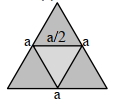
View full question & answer→MCQ 1801 Mark
If three successive terms of a$G.P.$ with common ratio $r(r>1)$ are the lengths of the sides of a triangle and $[\mathrm{r}]$ denotes the greatest integer less than or equal to $r$, then $3[r]+[-r]$ is equal to :
Answera
$\text { a, ar, } a r^2 \rightarrow \text { G.P. }$
Sum of any two sides $>$ third side
$ a+a r>a r^2, a+a r^2>a r, a r+a r^2>a $
$ r^2-r-1<0 $
$ r \in\left(\frac{1-\sqrt{5}}{2}, \frac{1+\sqrt{5}}{2}\right) $
$ r^2-r+1>0$ $............(1)$
always true
$ \mathrm{r}^2+\mathrm{r}-1>0 $
$ \mathrm{r} \in\left(-\infty,-\frac{1-\sqrt{5}}{2}\right) \cup\left(\frac{-1+\sqrt{5}}{2}, \infty\right)$ $...............(2)$
Taking intersection of $(1)$, $(2)$
$\mathrm{r} \in\left(\frac{-1+\sqrt{5}}{2}, \frac{1+\sqrt{5}}{2}\right)$
As $\mathrm{r}>1$
$ r \in\left(1, \frac{1+\sqrt{5}}{2}\right) $
$ {[r]=1[-r]=-2} $
$ 3[r]+[-r]=1$
View full question & answer→MCQ 1811 Mark
For $0<\mathrm{c}<\mathrm{b}<\mathrm{a}$, let $(\mathrm{a}+\mathrm{b}-2 \mathrm{c}) \mathrm{x}^2+(\mathrm{b}+\mathrm{c}-2 \mathrm{a}) \mathrm{x}$ $+(c+a-2 b)=0$ and $\alpha \neq 1$ be one of its root. Then, among the two statements
$(I)$ If $\alpha \in(-1,0)$, then $\mathrm{b}$ cannot be the geometric mean of $\mathrm{a}$ and $\mathrm{c}$
$(II)$ If $\alpha \in(0,1)$, then $\mathrm{b}$ may be the geometric mean of $a$ and $c$
AnswerCorrect option: A. Both $(I)$ and $(II) $are true
a
$\mathrm{f}(\mathrm{x})=(\mathrm{a}+\mathrm{b}-2 \mathrm{c}) \mathrm{x}^2+(\mathrm{b}+\mathrm{c}-2 \mathrm{a}) \mathrm{x}+(\mathrm{c}+\mathrm{a}-2 \mathrm{~b}) $
$ \mathrm{f}(\mathrm{x})=\mathrm{a}+\mathrm{b}-2 \mathrm{c}+\mathrm{b}+\mathrm{c}-2 \mathrm{a}+\mathrm{c}+\mathrm{a}-2 \mathrm{~b}=0$
$ \mathrm{f}(1)=0 $
$\therefore \alpha \cdot 1=\frac{\mathrm{c}+\mathrm{a}-2 \mathrm{~b}}{\mathrm{a}+\mathrm{b}-2 \mathrm{c}} $
$ \alpha=\frac{\mathrm{c}+\mathrm{a}-2 \mathrm{~b}}{\mathrm{a}+\mathrm{b}-2 \mathrm{c}} $
$ \text { If, }-1<\alpha<0 $
$ -1<\frac{\mathrm{c}+\mathrm{a}-2 \mathrm{~b}}{\mathrm{a}+\mathrm{b}-2 \mathrm{c}}<0$
$\mathrm{b}+\mathrm{c}<2 \mathrm{a} \text { and } \mathrm{b}>\frac{\mathrm{a}+\mathrm{c}}{2}$
therefore, $\mathrm{b}$ cannot be G.M. between $\mathrm{a}$ and $\mathrm{c}$.
If, $0<\alpha<1$
$0<\frac{\mathrm{c}+\mathrm{a}-2 \mathrm{~b}}{\mathrm{a}+\mathrm{b}-2 \mathrm{c}}<1$
$\mathrm{b}>\mathrm{c}$ and $\mathrm{b}<\frac{\mathrm{a}+\mathrm{c}}{2}$
Therefore, $\mathrm{b}$ may be the $G.M.$ between $\mathrm{a}$ and $\mathrm{c}$.
View full question & answer→MCQ 1821 Mark
Let $\mathrm{a}$ and $\mathrm{b}$ be be two distinct positive real numbers. Let $11^{\text {th }}$ term of a $GP$, whose first term is $a$ and third term is $b$, is equal to $p^{\text {th }}$ term of another $GP$, whose first term is $a$ and fifth term is $b$. Then $\mathrm{p}$ is equal to
Answerc
$ 1^{\text {st }} G P \Rightarrow t_1=a, t_3=b=a r^2 \Rightarrow r^2=\frac{b}{a} $
$ t_{11} =a r^{10}=a\left(r^2\right)^5=a \cdot\left(\frac{b}{a}\right)^5 $
$2^{\text {nd }} \text { G.P. } \Rightarrow T_1=a, T_5=a r^4=b $
$\Rightarrow r^4 =\left(\frac{b}{a}\right) \Rightarrow r=\left(\frac{b}{a}\right)^{1 / 4} $
$ T_p =a r^{p-1}=a\left(\frac{b}{a}\right)^{\frac{p-1}{4}} $
$ t_{11} =T_p \Rightarrow a\left(\frac{b}{a}\right)^5=a\left(\frac{b}{a}\right)^{\frac{p-1}{4}} $
$ \Rightarrow 5 =\frac{p-1}{4} \Rightarrow p=21$
View full question & answer→MCQ 1831 Mark
Let the range of the function
$f(x)=\frac{1}{2+\sin 3 x+\cos 3 x}, x \in \operatorname{IR} \text { be }[a, b] .$ If $\alpha$ and $\beta$ are respectively the $A.M.$ and the $G.M.$ of a and $b$, then $\frac{\alpha}{\beta}$ is equal to :
- ✓
$\sqrt{2}$
- B
$2$
- C
$\sqrt{\pi}$
- D
$\pi$
AnswerCorrect option: A. $\sqrt{2}$
a
$ f(x) \frac{1}{2+\sin 3 x+\cos 3 x} $
$ {\left[\frac{1}{2+\sqrt{2}}, \frac{1}{2-\sqrt{2}}\right]} $
$ \frac{\alpha}{\beta}=\frac{a+b}{2 \sqrt{a b}}=\frac{1}{2}\left(\sqrt{\frac{a}{b}}+\sqrt{\frac{b}{a}}\right) $
$ =\frac{1}{2}\left(\sqrt{\frac{2-\sqrt{2}}{2+\sqrt{2}}}+\sqrt{\frac{2+\sqrt{2}}{2-\sqrt{2}}}\right) $
$ =\frac{(2-\sqrt{2})+(2+\sqrt{2})}{2 \times \sqrt{2}}=\sqrt{2}$
View full question & answer→MCQ 1841 Mark
Let the first three terms $2, p$ and $q$, with $q \neq 2$, of a $G.P.$ be respectively the $7^{\text {th }}, 8^{\text {th }}$ and $13^{\text {th }}$ terms of an $A.P.$ If the $5^{\text {th }}$ term of the $G.P.$ is the $\mathrm{n}^{\text {th }}$ term of the $A.P.$, then $\mathrm{n}$ is equal to
Answerd
$ 2=a+6 d \quad \ldots(\text { i) } $
$ p=a+7 d \quad \ldots \text { (ii) } $
$ q=a+12 d \quad \ldots \text { (iii) } $
$ p-2=d $ $((ii)-(i))$
$ q-p=5 d $ $((iii)-(ii))$
$ q-p=5(p-2) $
$ q=6 p-10 $
$ p^2=2(6 p-10) $
$ p^2-12 p+20=0 $
$ p=10,2 $
$ p=10 ; q=50 $
$ d=8 $
$ a=-46 $
$ 2,10,50,250,1250 $
$ a^4=a+(n-1) d $
$ 1250=-46+(n-1) 8 $
$ n=163$
View full question & answer→MCQ 1851 Mark
Let $3, a, b, c$ be in $A.P.$ and $3, a-1, b+1, c+9$ be in $G.P.$ Then, the arithmetic mean of $a, b$ and $c$ is :
Answerd
$3, \mathrm{a}, \mathrm{b}, \mathrm{c} \rightarrow \mathrm{A} . \mathrm{P} \quad \Rightarrow 3,3+\mathrm{d}, 3+2 \mathrm{~d}, 3+3 \mathrm{~d}$
$3, \mathrm{a}-1, \mathrm{~b}+1, \mathrm{c}+9 \rightarrow \mathrm{G} . \mathrm{P} \Rightarrow 3,2+\mathrm{d}, 4+2 \mathrm{~d}, 12+3 \mathrm{~d}$
$\mathrm{a}=3+\mathrm{d}$ $(2+d)^2=3(4+2 d)$
$\mathrm{b}=3+2{~d}$ ${~d}=4,-2$
${c}=3+3{~d}$
$\text { If } \mathrm{d}=4 \quad \text { G.P } \Rightarrow 3,6,12,24$
$\mathrm{a}=7$
$\mathrm{~b}=11$
$\mathrm{c}=15$
$\frac{a+b+c}{3}=11$
View full question & answer→MCQ 1861 Mark
Let $2^{\text {nd }}, 8^{\text {th }}$ and $44^{\text {th }}$, terms of a non-constant $A.P.$ be respectively the $1^{\text {st }}, 2^{\text {nd }}$ and $3^{\text {rd }}$ terms of $G.P.$ If the first term of $A.P.$ is $1$ then the sum of first $20$ terms is equal to-
Answerd
$1+d, \quad 1+7 d, 1+43 d \text { are in GP } $
$ (1+7 d)^2=(1+d)(1+43 d) $
$ 1+49 d^2+14 d=1+44 d+43 d^2 $
$ 6 d^2-30 d=0 $
$ d=5 $
$ S_{20}=\frac{20}{2}[2 \times 1+(20-1) \times 5] $
$=10[2+95] $
$=970$
View full question & answer→MCQ 1871 Mark
If each term of a geometric progression $a_1, a_2, a_3, \ldots$ with $a_1=\frac{1}{8}$ and $a_2 \neq a_1$, is the arithmetic mean of the next two terms and $S_n=a_1+a_2+\ldots+a_n$, then $\mathrm{S}_{20}-\mathrm{S}_{18}$ is equal to
- A
$2^{ \mathrm{15}}$
- B
$-2^{18}$
- C
$2^{18}$
- ✓
$-2^{15}$
AnswerCorrect option: D. $-2^{15}$
d
Let $r^{\prime}$ th term of the GP be $a r^{n-1}$. Given,
$ 2 a_r=a_{r+1}+a_{r+2} $
$2 a r^{n-1}=a r^n+a r^{n-1} $
$ \frac{2}{r}=1+r $
$ r^2+r-2=0$
Hence, we get, $r=-2($ as $r \neq 1)$
So, $\mathrm{S}_{20}-\mathrm{S}_{18}=$ (Sum upto $20$ terms) - (Sum upto
$18$ terms )$=\mathrm{T}_{19}+\mathrm{T}_{20} $
$ \mathrm{~T}_{19}+\mathrm{T}_{20}=\mathrm{ar}^{18}(1+\mathrm{r})$
Putting the values $\mathrm{a}=\frac{1}{8}$ and $\mathrm{r}=-2$;
we get $T_{19}+T_{20}=-2^{15}$
View full question & answer→MCQ 1881 Mark
If $\left(\frac{1}{\alpha+1}+\frac{1}{\alpha+2}+\ldots+\frac{1}{\alpha+1012}\right) $ $ -\left(\frac{1}{2 \cdot 1}+\frac{1}{4 \cdot 3}+\frac{1}{6 \cdot 5}+\ldots+\frac{1}{2024 \cdot 2023}\right) $
$ =\frac{1}{2024}, $ then $\alpha$ is equal to-
- A
$1367$
- B
$1058$
- C
$1056$
- ✓
$1011$
AnswerCorrect option: D. $1011$
d
$ \left(\frac{1}{\alpha+1}+\frac{1}{\alpha+2}+\ldots+\frac{1}{\alpha+2012}\right) $ - $ \left\{\left(\frac{1}{1}-\frac{1}{2}\right)+\left(\frac{1}{3}-\frac{1}{4}\right)+\ldots+\left(\frac{1}{2023}-\frac{1}{2024}\right)\right\}=\frac{1}{2024} $
$\Rightarrow $ $ \left(\frac{1}{\alpha+1}+\frac{1}{\alpha+2}+\ldots+\frac{1}{\alpha+2012}\right) $ $ -\left\{\left(\frac{1}{1}+\frac{1}{2}+\frac{1}{3}+\frac{1}{4}\right)+\ldots+\frac{1}{2023}\right. $ $ \left.-\frac{1}{2024}-2\left(\frac{1}{2}+\frac{1}{4}+\ldots+\frac{1}{2022}\right)\right\}=\frac{1}{2024} $
$\Rightarrow $ $ \left(\frac{1}{\alpha+1}+\frac{1}{\alpha+2}+\ldots+\frac{1}{\alpha+2012}\right) $ $ -\left(\frac{1}{1}+\frac{1}{2}+\ldots+\frac{1}{2023}\right) $ $ \frac{1}{2024}+\left(\frac{1}{1}+\frac{1}{2}+\ldots+\frac{1}{1011}\right)=\frac{1}{2024} $
$\Rightarrow $ $ \frac{1}{\alpha+1}+\frac{1}{\alpha+2}+\ldots+\frac{1}{\alpha+2012} $ = $ \frac{1}{1012}+\frac{1}{1013}+\ldots+\frac{1}{2023} $
$\Rightarrow $ $ \alpha=1011$
View full question & answer→MCQ 1891 Mark
If the sum of series $\frac{1}{1 \cdot(1+d)}+\frac{1}{(1+d)(1+2 d)}+\ldots \ldots+\frac{1}{(1+9 d)(1+10 d)}$ is equal to $5$ , then $50 \mathrm{~d}$ is equal to :
Answerb
$ \frac{1}{1 \cdot(1+d)}+\frac{1}{(1+d)(1+2 d)}+\ldots \ldots $ $ \frac{1}{(1+9 d)(1+10 d)}=5$
$ \frac{1}{d}\left[\frac{(1+d)-1}{1 \cdot(1+d)}+\frac{(1+2 d)-(1-d)}{(1+d)(1+2 d)}\right]+\ldots . . . . $ $ \frac{(1+10 d)-(1+9 d)}{(1+9 d)(1+10 d)}=5 $
$ \frac{1}{d}\left[\left(1-\frac{1}{1+d}\right)+\left(\frac{1}{1+d}-\frac{1}{1+2 d}\right)+ . . .\right. $ $ \left.\left(\frac{1}{1+9 d}-\frac{1}{1+10 d}\right)\right]=5 $
$ \frac{1}{d}\left[1-\frac{1}{(1+10 d)}\right]=5 $
$ \frac{10 d}{1+10 d}=5 d $
$ 50 d=5$
View full question & answer→MCQ 1901 Mark
An arithmetic progression is written in the following way $Image$ The sum of all the terms of the $10^{\text {th }}$ row is..........
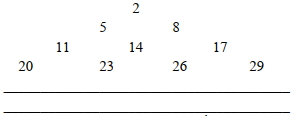
- ✓
$1505$
- B
$1078$
- C
$1045$
- D
$1548$
AnswerCorrect option: A. $1505$
a
$ 2,5,11,20, \ldots . . $
$ \text { General term }=\frac{3 n^2-3 n+4}{2} $
$ \mathrm{T}_{10}=\frac{3(100)-3(10)+4}{2} $
$=137 $
$ 10 \text { terms with c.d. }=3$
sum $ =\frac{10}{2}(2(137)+9(3))$
$ =1505$
View full question & answer→MCQ 1911 Mark
Let the positive integers be written in the form :
$Image$
If the $\mathrm{k}^{\text {th }}$ row contains exactly $\mathrm{k}$ numbers for every natural number $\mathrm{k}$, then the row in which the number $5310$ will be, is.........
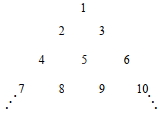
Answera
$ \mathrm{S}=1+2+4+7+\ldots \ldots+\mathrm{T}_{\mathrm{n}} $
$ \mathrm{S}=1+2+4+\ldots \ldots $
$ \mathrm{Tn}=1+1+2+3+\ldots \ldots+\left(\mathrm{T}_{\mathrm{n}}-\mathrm{T}_{\mathrm{n}-1}\right) $
$ \mathrm{T}_{\mathrm{n}}=1+\left(\frac{\mathrm{n}-1}{2}\right)[2+(\mathrm{n}-2) \times 1] $
$ \mathrm{T}_{\mathrm{n}}=1+1+\frac{\mathrm{n}(\mathrm{n}-1)}{2} $
$ \mathrm{n}=100 \quad \mathrm{~T}_{\mathrm{n}}=1+\frac{100 \times 99}{2}=4950+1 $
$ \mathrm{n}=101 \quad \mathrm{~T}_{\mathrm{n}}=1+\frac{101 \times 100}{2}=5050+1=5051 $
$ \mathrm{n}=102 \quad \mathrm{~T}_{\mathrm{n}}=1+\frac{102 \times 101}{2}=5151+1=5152 $
$ \mathrm{n}=103 \quad \mathrm{~T}_{\mathrm{n}}=1+\frac{103 \times 102}{2}=5254 $
$ \mathrm{n}=104 \quad \mathrm{~T}_{\mathrm{n}}=1+\frac{104 \times 103}{2}=5357$
View full question & answer→MCQ 1921 Mark
$ \text { If } S(x)=(1+x)+2(1+x)^2+3(1+x)^3+\ldots . $
$ +60(1+x)^{60}, x \neq 0 \text {, and }(60)^2 S(60)=a(b)^b+b$ where $a, b N$, then $(a+b)$ equal to...............
- A
$3214$
- B
$1495$
- ✓
$3660$
- D
$3654$
AnswerCorrect option: C. $3660$
c
$ S(x)=(1+x)+2(1+x)^2+3(1+x)^3+. .+60(1+x)^{60} $
$(1+x) S=(1+x)^2+\ldots \ldots . . \quad 59(1+x)^{60}+60(1+x)^{61} $
$-x S=\frac{(1+x)(1+x)^{60}-1}{x}-60(1+x)^{61}$
Put $\mathrm{x}=60$
$-60 \mathrm{~S}=\frac{61\left((61)^{60}-1\right)}{60}-60(61)^{61}$
on solving $3660$
View full question & answer→MCQ 1931 Mark
Let the first term of a series be $T_1=6$ and its $\mathrm{r}^{\text {th }}$ term $T_r=3 T_{r-1}+6^r, r=2,3, \ldots . ., n$. If the sum of the first $\mathrm{n}$ terms of this series is $\frac{1}{5}\left(n^2-12 n+39\right)$ $\left(4.6^n-5.3^n+1\right)$. Then $n$ is equal to ...........
Answerc
$ \mathrm{T}_{\mathrm{r}}=3 \mathrm{~T}_{\mathrm{r}-1}+6^{\mathrm{r}}, \mathrm{r}=2,3,4, \ldots \mathrm{n} $
$ \mathrm{T}_2=3 \cdot \mathrm{T}_1+6^2 $
$ \mathrm{~T}_2=3 \cdot 6+6^2 $ ................($1$)
$ \mathrm{~T}_3=3 \mathrm{~T}_2+6^3 $
$ \mathrm{~T}_3=3 \mathrm{~T}_2+6^3 $
$ \mathrm{~T}_3=3\left(3 \cdot 6+6^2\right)+6^3 $
$ \mathrm{~T}_3=3^2 \cdot 6+3 \cdot 6^2+6^3 \quad \ldots(2) $ ...............($2$)
$ \mathrm{T}_{\mathrm{r}}=3^{\mathrm{r}-1} \cdot 6+3^{\mathrm{r}-2} \cdot 6^2+\ldots+6^{\mathrm{r}} $
$ \mathrm{T}_{\mathrm{r}}=3^{\mathrm{r}-1} \cdot 6\left[1+\frac{6}{3}+\left(\frac{6}{3}\right)^2+\ldots+\left(\frac{6}{3}\right)^{\mathrm{r}-1}\right] $
$ \mathrm{T}_{\mathrm{r}}=3^{\mathrm{r}-1} \cdot 6\left(1+2+2^2+\ldots+2^{\mathrm{r}-1}\right) $
$ \mathrm{T}_{\mathrm{r}}=6 \cdot 3^{\mathrm{r}-1} 1 \cdot \frac{\left(1-2^{\mathrm{r}}\right)}{(-1)} $
$ \mathrm{T}_{\mathrm{r}}=6 \cdot 3^{\mathrm{r}-1} \cdot\left(2^{\mathrm{r}}-1\right) $
$ \mathrm{T}_{\mathrm{r}}=\frac{6 \cdot 3^{\mathrm{r}}}{3} \cdot\left(2^{\mathrm{r}}-1\right)$
$ \mathrm{T}_{\mathrm{r}}=2 \cdot\left(6^{\mathrm{T}}-3^{\mathrm{r}}\right) $
$ \mathrm{S}_{\mathrm{n}}=2 \Sigma\left(6^{\mathrm{r}}-3^{\mathrm{r}}\right) $
$ \mathrm{S}_{\mathrm{n}}=2 \cdot\left[\frac{6 \cdot\left(6^{\mathrm{n}}-1\right)}{5}-\frac{3 \cdot\left(3^{\mathrm{n}}-1\right)}{2}\right] $
$ \mathrm{S}_{\mathrm{n}}=2\left[\frac{12\left(6^{\mathrm{n}}-1\right)-15\left(3^{\mathrm{n}}-1\right)}{10}\right] $
$ \mathrm{S}_{\mathrm{n}}=\frac{3}{5}\left[4 \cdot 6^4-5 \cdot 3^{\mathrm{n}}+1\right] $
$ \therefore \mathrm{n}^2-12 \mathrm{n}+39=3 $
$ \mathrm{n}^2-12 \mathrm{n}+36=0 $
$ \mathrm{n}=6$
View full question & answer→MCQ 1941 Mark
If $1+\frac{\sqrt{3}-\sqrt{2}}{2 \sqrt{3}}+\frac{5-2 \sqrt{6}}{18}+\frac{9 \sqrt{3}-11 \sqrt{2}}{36 \sqrt{3}}+\frac{49-20 \sqrt{6}}{180}+\ldots$
upto $\infty=2\left(\sqrt{\frac{b}{a}}+1\right) \log _e\left(\frac{a}{b}\right)$, where $a$ and $b$ are integers with $\operatorname{gcd}(a, b)=1$, then $11 a+18 b$ is equal to ...............
Answera
$ S=1+\frac{x}{2 \sqrt{3}}+\frac{x^2}{18}+\frac{x^3}{36 \sqrt{3}}+\frac{x^4}{180}+\ldots \infty $
$ \text { Put } \frac{x}{\sqrt{3}}=t \text {, where } x=\sqrt{3}-\sqrt{2} $
$ S=1+\frac{t}{2}+\frac{t^2}{6}+\frac{t^3}{12}+\frac{t^4}{20}+\ldots $
$ S=1+t\left(1-\frac{1}{2}\right)+t^2\left(\frac{1}{2}-\frac{1}{3}\right)+t^3\left(\frac{1}{3}-\frac{1}{4}\right)+t^4\left(\frac{1}{4}-\frac{1}{5}\right) $
$ S=\left(1+t+\frac{t^2}{2}+\frac{t^3}{3}+\frac{t^3}{4}+\ldots\right)-\left(\frac{t}{2}+\frac{t^2}{3}+\frac{t^3}{4}+\frac{t^4}{5}+\ldots\right) $
$ S=\left(t+\frac{t^2}{2}+\ldots\right)-\frac{1}{t}\left(t+\frac{t^2}{2}+\frac{t^3}{3}+\ldots\right)+2 $
$ S=2+\left(1-\frac{1}{t}\right)(-\log (1-t))=\left(\frac{1}{t}-1\right) \log (1-t)+2 $
$ S=2+\left(\frac{\sqrt{3}}{\sqrt{3}-\sqrt{2}}-1\right) \log \left(1-\frac{\sqrt{3}-\sqrt{2}}{\sqrt{3}}\right) $
$ S=2+\left(\frac{\sqrt{2}}{\sqrt{3}-\sqrt{2}}\right) \log e \frac{\sqrt{2}}{\sqrt{3}} $
$ S=2+\frac{(\sqrt{6}+2)}{2} \log e \frac{2}{3}=2+\left(\sqrt{\frac{3}{2}}+1\right) \log e \frac{2}{3} $
$ a=2, b=3 $
$ 11 a+18 b=11 \times 2+18 \times 3=76$
View full question & answer→MCQ 1951 Mark
The value of $\frac{1 \times 2^2+2 \times 3^2+\ldots+100 \times(101)^2}{1^2 \times 2+2^2 \times 3+\ldots+100^2 \times 101}$ is
- A
$\frac{306}{305}$
- ✓
$\frac{305}{301}$
- C
$\frac{32}{31}$
- D
$\frac{31}{30}$
AnswerCorrect option: B. $\frac{305}{301}$
b
$ \frac{1 \times 2^2+2 \times 3^2+\ldots+100 \times(101)^2}{1^2 \times 2+2^2 \times 3+\ldots+100^2 \times 101}=\frac{\sum_{\mathrm{r}=1}^{100} \mathrm{r}(\mathrm{r}+1)^2}{\sum_{\mathrm{r}=1}^{100} \mathrm{r}^2(\mathrm{r}+1)} $
$ =\frac{\sum_{\mathrm{r}=1}^{100}\left(\mathrm{r}^3+2 \mathrm{r}^2+\mathrm{r}\right)}{\sum_{\mathrm{r}=1}^{100}\left(\mathrm{r}^3+\mathrm{r}^2\right)}=\frac{\left(\frac{\mathrm{n}(\mathrm{n}+1)^2}{2}\right)+\frac{2 \mathrm{n}(\mathrm{n}+1)(2 \mathrm{n}+1)}{6}+\frac{\mathrm{n}(\mathrm{n}+1)}{2}}{\left(\frac{\mathrm{n}(\mathrm{n}+1)}{2}\right)^2+\frac{\mathrm{n}(\mathrm{n}+1)(2 \mathrm{n}+1)}{6}} $
$ =\frac{\frac{\mathrm{n}(\mathrm{n}+1)}{2}\left[\frac{\mathrm{n}(\mathrm{n}+1)}{2}+\frac{2}{3} \cdot(2 \mathrm{n}+1)+1\right]}{\frac{\mathrm{n}(\mathrm{n}+1)}{2}\left[\frac{\mathrm{n}(\mathrm{n}+1)}{2}+\frac{(2 \mathrm{n}+1)}{3}\right]} ; \text { Put } \mathrm{n}=100 $
$ \frac{\frac{100(101)}{2}+\frac{2}{3}(201)+1}{\frac{100 \times 101}{2}+\frac{201}{3}}=\frac{5185}{5117}=\frac{305}{301}$
View full question & answer→MCQ 1961 Mark
The sum of the series $\frac{1}{1-3 \cdot 1^2+1^4}+$ $\frac{2}{1-3 \cdot 2^2+2^4}+\frac{3}{1-3 \cdot 3^2+3^4}+\ldots$. up to $10$ terms is
- A
$\frac{45}{109}$
- B
$-\frac{45}{109}$
- C
$\frac{55}{109}$
- ✓
$-\frac{55}{109}$
AnswerCorrect option: D. $-\frac{55}{109}$
d
General term of the sequence,
$\mathrm{T}_{\mathrm{r}}=\frac{\mathrm{r}}{1-3 \mathrm{r}^2+\mathrm{r}^4}$
$\mathrm{~T}_{\mathrm{r}}=\frac{\mathrm{r}}{\mathrm{r}^4-2 \mathrm{r}^2+1-\mathrm{r}^2}$
$\mathrm{~T}_{\mathrm{r}}=\frac{\mathrm{r}}{\left(\mathrm{r}^2-1\right)^2-\mathrm{r}^2} $
$\mathrm{~T}_{\mathrm{r}}=\frac{\mathrm{r}}{\left(\mathrm{r}^2-\mathrm{r}-1\right)\left(\mathrm{r}^2+\mathrm{r}-1\right)}$
$\mathrm{T}_{\mathrm{r}}=\frac{\frac{1}{2}\left[\left(\mathrm{r}^2+\mathrm{r}-1\right)-\left(\mathrm{r}^2-\mathrm{r}-1\right)\right]}{\left(\mathrm{r}^2-\mathrm{r}-1\right)\left(\mathrm{r}^2+\mathrm{r}-1\right)}$
$=\frac{1}{2}\left[\frac{1}{\mathrm{r}^2-\mathrm{r}-1}-\frac{1}{\mathrm{r}^2+\mathrm{r}-1}\right]$
Sum of $10$ terms,
$\sum_{\mathrm{r}=1}^{10} \mathrm{~T}_{\mathrm{r}}=\frac{1}{2}\left[\frac{1}{-1}-\frac{1}{109}\right]=\frac{-55}{109}$
View full question & answer→MCQ 1971 Mark
Let $\alpha=1^2+4^2+8^2+13^2+19^2+26^2+\ldots \ldots$ upto 10 terms and $\beta=\sum_{n=1}^{10} n^4$. If $4 \alpha-\beta=55 k+40$, then $\mathrm{k}$ is equal to____________.
Answerb
$\alpha=1^2+4^2+8^2 \ldots . $
$t_n=a^2+b n+c$
$ 1=a+b+c$
$ 4=4 a+2 b+c $
$ 8=9 a+3 b+c$
On solving we get, $\mathrm{a}=\frac{1}{2}, \mathrm{~b}=\frac{3}{2}, \mathrm{c}=-1$
$ \alpha=\sum_{n=1}^{10}\left(\frac{n^2}{2}+\frac{3 n}{2}-1\right)^2 $
$ 4 \alpha=\sum_{n=1}^{10}\left(n^2+3 n-2\right)^2, \beta=\sum_{n=1}^{10} n^4 $
$ 4 \alpha-\beta=\sum_{n=1}^{10}\left(6 n^3+5 n^2-12 n+4\right)=55(353)+40$
View full question & answer→MCQ 1981 Mark
If a function $f$ satisfies $f(m+n)=f(m)+f(n)$ for all $\mathrm{m}, \mathrm{n} \in \mathrm{N}$ and $\mathrm{f}(1)=1$, then the largest natural number $\lambda$ such that $\sum_{\mathrm{k}=1}^{2022} \mathrm{f}(\lambda+\mathrm{k}) \leq(2022)^2$ is equal to ..........
- ✓
$1010$
- B
$1015$
- C
$1678$
- D
$1345$
AnswerCorrect option: A. $1010$
a
$ \mathrm{f}(\mathrm{m}+\mathrm{n})=\mathrm{f}(\mathrm{m})+\mathrm{f}(\mathrm{n}) $
$ \Rightarrow \mathrm{f}(\mathrm{x})=\mathrm{kx} $
$ \Rightarrow \mathrm{f}(1)=1 $
$ \Rightarrow \mathrm{k}=1 $
$ \mathrm{f}(\mathrm{x})=\mathrm{x}$
Now
$ \sum_{\mathrm{k}=1}^{2022} \mathrm{f}(\lambda+\mathrm{k}) \leq(2022)^2 $
$ \Rightarrow \sum_{\mathrm{k}=1}^{2022}(\lambda+\mathrm{k}) \leq(2022)^2 $
$ \Rightarrow 2022 \lambda+\frac{2022 \times 2023}{2} \leq(2022)^2$
$ \Rightarrow \lambda \leq 2022-\frac{2023}{2} $
$ \Rightarrow \lambda \leq 1010.5$
$\therefore$ largest natural no. $\lambda$ is $1010$ .
View full question & answer→MCQ 1991 Mark
If $\frac{1}{\sqrt{1}+\sqrt{2}}+\frac{1}{\sqrt{2}+\sqrt{3}}+\ldots+\frac{1}{\sqrt{99}+\sqrt{100}}=m$ and $\frac{1}{1 \cdot 2}+\frac{1}{2 \cdot 3}+\ldots+\frac{1}{99 \cdot 100}=\mathrm{n}$, then the point $(\mathrm{m}, \mathrm{n})$ lies on the line
- A
$11(x-1)-100(y-2)=0$
- B
$11(x-2)-100(y-1)=0$
- C
$11(x-1)-100 y=0$
- ✓
$11 x-100 y=0$
AnswerCorrect option: D. $11 x-100 y=0$
d
$ \frac{1}{\sqrt{1}+\sqrt{2}}+\frac{1}{\sqrt{2}+\sqrt{3}}+\ldots+\frac{1}{\sqrt{99}+\sqrt{100}}=\mathrm{m} $
$ \frac{\sqrt{1}-\sqrt{2}}{-1}+\frac{\sqrt{2}-\sqrt{3}}{-1} \ldots \frac{\sqrt{99}-\sqrt{100}}{-1}=\mathrm{m}$
$ \sqrt{100}-1=\mathrm{m} \Rightarrow \mathrm{m}=9 $
$ \frac{1}{1 \cdot 2}+\frac{1}{2 \cdot 3}+\ldots \frac{1}{99 \cdot 100}=\mathrm{n} $
$ \frac{1}{1}-\frac{1}{2}+\frac{1}{2}-\frac{1}{3} \ldots \frac{1}{99}-\frac{1}{100}=\mathrm{n} $
$ 1-\frac{1}{100}=\mathrm{n} $
$ \frac{99}{100}=\mathrm{n} $
$ (\mathrm{m}, \mathrm{n})=\left(9, \frac{99}{100}\right) $
$ \Rightarrow 11(9)-100\left(\frac{99}{100}\right) $
$ =99-99=0$
Ans. option ($4$) $11 x-100 y=0$
View full question & answer→MCQ 2001 Mark
If $2 \tan ^2 \theta-5 \sec \theta=1$ has exactly $7$ solutions in the interval $\left[0, \frac{n \pi}{2}\right]$, for the least value of $n \in N$ then $\sum_{\mathrm{k}=1}^{\mathrm{n}} \frac{\mathrm{k}}{2^{\mathrm{k}}}$ is equal to :
- A
$\frac{1}{2^{15}}\left(2^{14}-14\right)$
- B
$\frac{1}{2^{14}}\left(2^{15}-15\right)$
- C
$1-\frac{15}{2^{13}}$
- ✓
$\frac{1}{2^{13}}\left(2^{14}-15\right)$
AnswerCorrect option: D. $\frac{1}{2^{13}}\left(2^{14}-15\right)$
d
$2 \tan ^2 \theta-5 \sec \theta-1=0 $
$ \Rightarrow 2 \sec ^2 \theta-5 \sec \theta-3=0 $
$ \Rightarrow(2 \sec \theta+1)(\sec \theta-3)=0 $
$ \Rightarrow \sec \theta=-\frac{1}{2}, $
$ \Rightarrow \cos \theta=-2, \frac{1}{3} $
$ \Rightarrow \cos \theta=\frac{1}{3}$
For $7$ solutions $n=13$
$ \text { So, } \sum_{\mathrm{k}=1}^{13} \frac{\mathrm{k}}{2^{\mathrm{k}}}=\mathrm{S} \text { (say) } $
$ \mathrm{S}=\frac{1}{2}+\frac{2}{2^2}+\frac{3}{2^j}+\ldots .+\frac{13}{2^{13}} $
$ \frac{1}{2} \mathrm{~S}=\frac{1}{2^2}+\frac{1}{2^3}+\ldots . .+\frac{12}{2^{13}}+\frac{13}{2^{14}} $
$ \Rightarrow \frac{\mathrm{S}}{2}=\frac{1}{2} \cdot \frac{1-\frac{1}{2^{13}}}{1-\frac{1}{2}}-\frac{13}{2^{14}} \Rightarrow \mathrm{S}=2 \cdot\left(\frac{2^{13}-1}{2^{13}}\right)-\frac{13}{2^{13}}$
View full question & answer→MCQ 2011 Mark
Let $a_1=8, a_2, a_3, \ldots a_n$ be an $A.P.$ If the sum of its first four terms is $50$ and the sum of its last four terms is $170$ , then the product of its middle two terms is
Answerc
$a_1+a_2+a_3+a_4=50$
$\Rightarrow 32+6 d=50$
$\Rightarrow d=3$
and, $a_{n-3}+a_{n-2}+a_{n-1}+a_n=170$
$\Rightarrow 32+(4 n -10) \cdot 3=170$
$\Rightarrow n =14$
$a _7=26, a _8=29$
$\Rightarrow a _7 \cdot a _8=754$
View full question & answer→MCQ 2021 Mark
The $8^{\text {th }}$ common term of the series $S _1=3+7+11+15+19+\ldots . .$ ; $S _2=1+6+11+16+21+\ldots .$ is $.......$.
Answerb
$T _8=11+(8-1) \times 20$
$=11+140=151$
View full question & answer→MCQ 2031 Mark
Let $s _1, s _2, s _3, \ldots \ldots, s _{10}$ respectively be the sum to 12 terms of 10 A.P.s whose first terms are $1,2,3, \ldots, 10$ and the common differences are $1,3,5, \ldots, 19$ respectively. Then $\sum \limits_{i=1}^{10} s _{ i }$ is equal to
- A
$7380$
- B
$7220$
- C
$7360$
- ✓
$7260$
AnswerCorrect option: D. $7260$
d
$S _{ k }=6(2 k +(11)(2 k -1))$
$S _{ k }=6(2 k +22 k -11)$
$S _{ k }=144 k -66$
$\sum \limits_1^{10} S _{ k }=144 \sum \limits_{ k =1}^{10} k -66 \times 10$
View full question & answer→MCQ 2041 Mark
Let the digits $a, b, c$ be in $A.P.$ Nine-digit numbers are to be formed using each of these three digits thrice such that three consecutive digits are in $A.P.$ at least once. How many such numbers can be formed?
- A
$1261$
- B
$1262$
- C
$1263$
- ✓
$1260$
AnswerCorrect option: D. $1260$
d
$\frac{{ }^7 C _1 \times 2 \times 6 !}{2 ! 2 ! 2 !}=1260$
View full question & answer→MCQ 2051 Mark
Let $x _1, x _2 \ldots ., x _{100}$ be in an arithmetic progression, with $x _1=2$ and their mean equal to $200$ . If $y_i=i\left(x_i-i\right), 1 \leq i \leq 100$, then the mean of $y _1, y _2$, $y _{100}$ is
- A
$10101.50$
- B
$10051.50$
- ✓
$10049.50$
- D
$10100$
AnswerCorrect option: C. $10049.50$
c
$\text { Mean }=200$
$\Rightarrow \frac{\frac{100}{2}(2 \times 2+99 d)}{100}=200$
$\Rightarrow 4+99 d =400$
$\Rightarrow d=4$
$y_i=i(x i-i)$
$=i(2+(i-1) 4-i)=3 i^2-2 i$
$\text { Mean }=\frac{\sum y_i}{100}$
$=\frac{1}{100} \sum \limits_{i=1}^{100} 3 i^2-2 i$
$=\frac{1}{100}\left\{\frac{3 \times 100 \times 101 \times 201}{6}-\frac{2 \times 100 \times 101}{2}\right\}$
$=101\left\{\frac{201}{2}-1\right\}=101 \times 99.5$
$=10049 \cdot 50$
View full question & answer→MCQ 2061 Mark
The sum of all those terms, of the anithmetic progression $3,8,13, \ldots \ldots .373$, which are not divisible by $3$,is equal to $.......$.
- A
$9524$
- B
$9523$
- C
$9522$
- ✓
$9525$
AnswerCorrect option: D. $9525$
d
$\text { Required sum }=(3+8+13+18+\ldots \ldots \ldots+373)$
$-(3+18+33+\ldots \ldots+363)$
$=\frac{75}{2}(3+373)-\frac{25}{2}(3-363)$
$=75 \times 188-25 \times 183$
$=9525$
View full question & answer→MCQ 2071 Mark
The sum of the common terms of the following three arithmetic progressions.
$3,7,11,15,...................,399$
$2,5,8,11,............,359$ and
$2,7,12,17,...........,197$, is equal to $................$.
Answerb
$3,7,11,15, \ldots \ldots \ldots \ldots, 399 \quad d_1=4$
$2,5,8,11, \ldots \ldots \ldots \ldots ., 359 \quad d_2=3$
$2,7,12,17, \ldots \ldots ., 197 \quad d_3=5$
$\operatorname{LCM}\left(d_1, d_2, d_3\right)=60$
Common terms are $47, 107, 167$
$Sum =321$
View full question & answer→MCQ 2081 Mark
Let $a_1, a_2, \ldots \ldots, a_n$ be in A.P. If $a_5=2 a_3$ and $a_{11}=18$, then $12\left(\frac{1}{\sqrt{a_{10}}+\sqrt{a_{11}}}+\frac{1}{\sqrt{a_{11}}+\sqrt{a_{12}}}+\ldots . \cdot \frac{1}{\sqrt{a_{17}}+\sqrt{a_{18}}}\right)$ is equal to $..........$.
Answera
$2 a_7=a_s(\text { given })$
$2\left(a_1+6 d\right)=a_1+4 d$
$a_1+8 d=0$
$a_1+10 d=18$
$\text { By }(1) \text { and }(2) \text { we get } a_1=-72, d=9$
$a_{18}=a_1+17 d=-72+153=81$
$a_{10}=a_1+9 d=9$
$12\left(\frac{\sqrt{a_{11}}-\sqrt{a_{10}}}{d}+\frac{\sqrt{a_{12}}-\sqrt{a_{11}}}{d}+\ldots . . \frac{\sqrt{a_{18}}-\sqrt{a_{17}}}{d}\right)$
$12\left(\frac{\sqrt{a_{18}}-\sqrt{a_{10}}}{d}\right)=\frac{12(9-3)}{9}=\frac{12 \times 6}{6}=8$
View full question & answer→MCQ 2091 Mark
For three positive integers $p , q , r , x ^{ pq p ^2}= y ^{ qr }= z ^{ p ^2 r }$ and $r=p q+1$ such that $3,3 \log _y x, 3 \log _z y, 7 \log _x z$ are in A.P. with common difference $\frac{1}{2}$. Then $r - p - q$ is equal to
Answera
$pq ^2=\log _{ x } \lambda$
$qr =\log _{ y } \lambda$
$p ^2 r =\log _{ z } \lambda$
$\log _{ y } x =\frac{ qr }{ pq ^2}=\frac{ r }{ pq } \ldots(1)$
$\log _{ x } z =\frac{ pq ^2}{ p ^2 r }=\frac{ q ^2}{ pr } \ldots(2)$
$\log _{ z } y =\frac{ p ^2 r }{ qr }=\frac{ p ^2}{ q } \ldots \ldots(3)$
$3, \frac{3 r }{ pq }, \frac{3 p ^2}{ q }, \frac{7 q ^2}{ pr } \text { in A.P }$
$\frac{3 r }{ pq }-3=\frac{1}{2}$
$r =\frac{7}{6} pq.....(4)$
$r = pq +1$
$pq =6 \ldots(5)$
$r =7 \ldots \ldots(6)$
$\frac{3 p ^2}{ q }=4$
After solving $p =2$ and $q =3$
View full question & answer→MCQ 2101 Mark
Let $a _1, a _2, a _3, \ldots$ be a $G.P.$ of increasing positive numbers. Let the sum of its $6^{\text {th }}$ and $8^{\text {th }}$ terms be $2$ and the product of its $3^{\text {rd }}$ and $5^{\text {th }}$ terms be $\frac{1}{9}$. Then $6\left( a _2+\right.$ $\left.a_4\right)\left(a_4+a_6\right)$ is equal to
- A
$2 \sqrt{2}$
- B
$2$
- C
$3 \sqrt{3}$
- ✓
$3$
Answerd
$a r^5+a r^7=2$
$\left(a r^2\right)\left(a r^4\right)=\frac{1}{9}$
$a^2 r^6=\frac{1}{9}$
Now, $r > 0$
$\operatorname{ar}^5\left(1+r^2\right)=2$
Now, $ar ^3=\frac{1}{3}$ or $-\frac{1}{3}$ (rejected)
$r^2=2$
$r=\sqrt{2}$
$a=\frac{1}{6 \sqrt{2}}$
Now, $6\left(a_2+a_4\right)\left(a_4+a_6\right)$
$6\left(a r+a r^3\right)\left(a r^3+a r^5\right)$
$6 a^2 r^4\left(1+r^2\right)$
$6\left(\frac{1}{36.2}\right)(4)(9)=3$
View full question & answer→MCQ 2111 Mark
Let the positive numbers $a _1, a _2, a _3, a _4$ and $a _5$ be in a G.P. Let their mean and variance be $\frac{31}{10}$ and $\frac{ m }{ n }$ respectively, where $m$ and $n$ are co-prime. If the mean of their reciprocals is $\frac{31}{40}$ and $a_3+a_4+a_5=14$, then $m + n$ is equal to $.........$.
Answerd
Let $\frac{a}{r}, \frac{a}{r}, a, a r, a r^2$
$\text { Given } \frac{a}{r^2}+\frac{a}{r}+a+a r+a r^2=5 \times \frac{31}{10}$
$\text { And } \frac{r^2}{a}+\frac{r}{a}+\frac{1}{a}+\frac{1}{a r}+\frac{1}{a r^2}=5 \times \frac{31}{40}$
$(1) \div(2) a^2=4 \Rightarrow a=2 \quad \therefore r+\frac{1}{r}=5 / 2 \quad(a \neq-2)$
$\Rightarrow r=2$
$\therefore \text { Now } \frac{1}{2}, 1,2.4,8$
$\therefore \sigma^2=\frac{\sum x^2}{N}-\left(\frac{\sum x }{ N }\right)^2$
$=\frac{186}{25}=\frac{ M }{N} \Rightarrow 211= m + n$
View full question & answer→MCQ 2121 Mark
Let the first term $a$ and the common ratio $r$ of a geometric progression be positive integers. If the sum of its squares of first three terms is $33033$, then the sum of these three terms is equal to
Answera
$\Rightarrow a^2+a^2 r ^2+a^2 r ^4=33033$
$\Rightarrow a^2\left( r ^4+ r ^2+1\right)=3 \times 7 \times 11^2 \times 13 \Rightarrow a=11$
$\Rightarrow r ^4+r^2+1=273 \quad \Rightarrow r^4+r^2-272=0$
$\Rightarrow\left(r^2+17\right)\left(r^2-16\right)=0 \Rightarrow r^2=16 \Rightarrow r = \pm 4$
$t_1+t_2+t_3=a+a r+a r^2=11+44+176=231$
View full question & answer→MCQ 2131 Mark
If the sum and product of four positive consecutive terms of a $G.P.$, are $126$ and $1296$, respectively, then the sum of common ratios of all such $GPs$ is $.........$.
- ✓
$7$
- B
$\frac{9}{2}$
- C
$3$
- D
$14$
Answera
$a, a r, a r^2, a r^3(a, r > 0)$
$a^4 r^6=1296$
$a^2 r^3=36$
$a=\frac{6}{r^{3 / 2}}$
$a+a r+a r^2+a r^3=126$
$\frac{1}{r^{3 / 2}}+\frac{r}{r^{3 / 2}}+\frac{r^2}{r^{3 / 2}}+\frac{r^3}{r^{3 / 2}}=\frac{126}{6}=21$
$\left(r^{-3 / 2}+r^{3 / 2}\right)+\left(r^{1 / 2}+r^{-1 / 2}\right)=21$
$r^{1 / 2}+r^{-1 / 2}=A$
$r^{-3 / 2}+r^{3 / 2}+3 A = A ^3$
$A ^3-3 A + A =21$
$A ^3-2 A =21$
$A =3$
$\sqrt{ r }+\frac{1}{\sqrt{r}}=3$
$r +1=3 \sqrt{ r }$
$r^2+2 r+1=9 r$
$r^2-7 r+1=0$
View full question & answer→MCQ 2141 Mark
Let $\left\{a_k\right\}$ and $\left\{b_k\right\}, k \in N$, be two G.P.s with common ratio $r_1$ and $r_2$ respectively such that $a_1=b_1=4$ and $r_1 < r_2$. Let $c_k=a_k+k, \in N$. If $c_2=5$ and $c_3=13 / 4$ then $\sum \limits_{k=1}^{\infty} c_k - \left(12 a _6+8 b _4\right)$ is equal to
Answera
Given that
$c_k=a_k+b_k$ and
also
$a _2=4 r _1$ $\quad a _3=4 r _1{ }^2$
$b _2=4 r _2$ $\quad b _3=4 r _2{ }^2$
Now $c_2=a_2+b_2=5$ and $c_3=a_3+b_3=\frac{13}{4}$
$\Rightarrow r_1+r_2=\frac{5}{4}$ and $r_1^2+r_2^2=\frac{13}{16}$
Hence $r_1 r_2=\frac{3}{8}$ which gives $r_1=\frac{1}{2} \quad \& \quad r_2=\frac{3}{4}$
$\sum \limits_{ k =1}^{\infty} c _{ k }-\left(12 a _6+8 b _4\right)$
$=\frac{4}{1-r_1}+\frac{4}{1-r_2}-\left(\frac{48}{32}+\frac{27}{2}\right)$
$=24-15=9$
View full question & answer→MCQ 2151 Mark
Let $a_1, a_2, a_3, \ldots$. be a $GP$ of increasing positive numbers. If the product of fourth and sixth terms is $9$ and the sum of fifth and seventh terms is $24 ,$ then $a_1 a_9+a_2 a_4 a_9+a_5+a_7$ is equal to $.........$.
Answerc
$a_4 \cdot a_6=9 \Rightarrow\left(a_5\right)^2=9 \Rightarrow a_5=3$
$a_5+a_7=24 \Rightarrow a_5+a_5 r^2=24 \Rightarrow\left(1+r^2\right)=8 \Rightarrow r=\sqrt{7}$ $\Rightarrow a=\frac{3}{49}$
$\Rightarrow a_1 a_9+a_2 a_4 a_9+a_5+a_7=9+27+3+21=60$
View full question & answer→MCQ 2161 Mark
The $4^{\text {tht }}$ term of $GP$ is $500$ and its common ratio is $\frac{1}{m}, m \in N$. Let $S_n$ denote the sum of the first $n$ terms of this GP. If $S_6 > S_5+1$ and $S_7 < S_6+\frac{1}{2}$, then the number of possible values of $m$ is $..........$
Answerc
$T_4=500 \quad$ where $a=$ first term,
$r =$ common ratio $=\frac{1}{ m }, m \in N$
$a r^3=500$
$\frac{a}{m^3}=500$
$S_n-S_{n-1}=a r^{n-1}$
$S _6 > S _5+1 \quad$ and $S _7- S _6 < \frac{1}{2}$
$S _6- S _5 > 1 \quad \frac{ a }{ m ^6} < \frac{1}{2}$
$ar ^5 > 1 \quad m ^3 > 10^3$
$\frac{500}{ m ^2} > 1 \quad m > 10$
$m ^2 < 500$
From $(1)$ and $(2)$
$m =11,12,13 \ldots \ldots \ldots \ldots ., 22$
So number of possible values of $m$ is $12$
View full question & answer→MCQ 2171 Mark
Let $A_1$ and $A_2$ be two arithmetic means and $G_1, G_2$, $G _3$ be three geometric means of two distinct positive numbers. The $G _1^4+ G _2^4+ G _3^4+ G _1^2 G _3^2$ is equal to
- A
$2\left( A _1+ A _2\right) G _1 G _3$
- ✓
$\left(A_1+A_2\right)^2 G_1 G_3$
- C
$\left( A _1+ A _2\right) G _1^2 G _3^2$
- D
$2\left( A _1+ A _2\right) G _1^2 G _3^2$
AnswerCorrect option: B. $\left(A_1+A_2\right)^2 G_1 G_3$
b
$a , A _1, A _2, b$ are in A.P.
$d =\frac{b-a}{3} ; A_1=a+\frac{b-a}{3}=\frac{2 a+b}{3}$
$A_2=\frac{a+2 b}{3}$
$A_1+A_2=a+b$
$a, G_1, G_2, G_3, b \text { are in G.P. }$
$r=\left(\frac{b}{a}\right)^{\frac{1}{4}}$
$G_1=\left(a^3 b\right)^{\frac{1}{4}}$
$G_2=\left(a^2 b^2\right)^{\frac{1}{4}}$
$G_3=\left(a^3\right)^{\frac{1}{4}}$
$G_1^4+G_2^4+G_3^4+G_1^2 G_3^2=$
$a^3 b+a^2 b^2+a b^3+\left(a^3 b\right)^{\frac{1}{2}} \cdot\left(a b^3\right)^{\frac{1}{2}}$
$=a^3 b+a^2 b^2+a b^3+a^2 \cdot b^2$
$=a b\left(a^2+2 a b+b^2\right)$
$=a b(a+b)^2$
$=G_1 \cdot G_3 \cdot\left(A_1+A_2\right)^2$
View full question & answer→MCQ 2181 Mark
Let $a , b , c$ and $d$ be positive real numbers such that $a+b+c+d=11$. If the maximum value of $a^5 b^3 c^2 d$ is $3750 \beta$, then the value of $\beta$ is
Answera
$\frac{5\left(\frac{ a }{5}\right)+3\left(\frac{ b }{3}\right)+2\left(\frac{ c }{2}\right)+ d }{11} \geq\left(\frac{ a ^5 b ^3 c ^2 d }{5^5 3^3 2^2}\right)^{1 / 11}$
$1 \geq\left(\frac{a^5 b^3 c^2 d}{5^5 3^3 2^2}\right)^{1 / 11}$
$\beta=90$
View full question & answer→MCQ 2191 Mark
Let $0 < z < y < x$ be three real numbers such that $\frac{1}{ x }, \frac{1}{ y }, \frac{1}{ z }$ are in an arithmetic progression and $x$, $\sqrt{2} y, z$ are in a geometric progression. If $x y+y z$ $+z x=\frac{3}{\sqrt{2}} x y z$, then $3(x+y+z)^2$ is equal to $............$.
Answera
$\frac{2}{y}=\frac{1}{x}+\frac{1}{z}$
$2 y^2=x z$
$\frac{2}{y}=\frac{x+z}{x z}=\frac{x+z}{2 y^2}$
$x+z=4 y$
$x y+y z+z x=\frac{3}{\sqrt{2}} x y z$
$y(x+z)+z x=\frac{3}{\sqrt{2}} x z \cdot y$
$4 y^2+2 y^2=\frac{3}{\sqrt{2}} y \cdot 2 y^2$
$6 y^2=3 \sqrt{2} y^3$
$y=\sqrt{2}$
$x+y+z=5 y=5 \sqrt{2}$
$3(x+y+z)^2=3 \times 50=150$
View full question & answer→MCQ 2201 Mark
Let $a, b, c > 1, a^3, b^3$ and $c^3$ be in $A.P.$, and $\log _a b$, $\log _c a$ and $\log _b c$ be in G.P. If the sum of first $20$ terms of an $A.P.$, whose first term is $\frac{a+4 b+c}{3}$ and the common difference is $\frac{a-8 b+c}{10}$ is $-444$, then abc is equal to
- A
$343$
- ✓
$216$
- C
$\frac{343}{8}$
- D
$\frac{125}{8}$
Answerb
As $a ^3, b^3, c^3$ be in $A.P.$ $\rightarrow a^3+c^3=2 b^3$ $\log _{ a }^{ b }, \log _{ c }^{ a }, \log _{ b }^{ c }$ are in $G.P.$
$\therefore \frac{\log b }{\log a } \cdot \frac{\log c}{\log b}=\left(\frac{\log a}{\log c}\right)^2$
$\therefore(\log a)^3=(\log c)^3 \Rightarrow a=c$
From $(1)$ and $(2)$
$a = b = c$
$T _1=\frac{ a +4 b + c }{3}=2 a ; d =\frac{ a -8 b + c }{10}=\frac{-6 a }{10}=\frac{-3}{5} a$
$\therefore S _{20}=\frac{20}{2}\left[4 a +19\left(-\frac{3}{5} a \right)\right]$
$=10\left[\frac{20 a -57 a }{5}\right]$
$=-74 a$
$\therefore-74 a =-444 \Rightarrow a =6$
$\therefore abc =6^3=216$
View full question & answer→MCQ 2211 Mark
For the two positive numbers $a , b$, if $a , b$ and $\frac{1}{18}$ are in a geometric progression, while $\frac{1}{ a }, 10$ and $\frac{1}{ b }$ are in an arithmetic progression, then, $16 a+12 b$ is equal to $.........$.
Answera
$a , b , \frac{1}{18} \rightarrow GP$
$\frac{ a }{18}= b ^2$
$\frac{1}{ a }, 10, \frac{1}{ b } \rightarrow AP$
$\frac{1}{ a }+\frac{1}{ b }=20$
$\Rightarrow a + b =20 ab , \text { from eq. (i) } ; \text { we get }$
$\Rightarrow 18 b ^2+ b =360 b ^3$
$\Rightarrow 360 b ^2-18 b -1=0 \quad\{\because b \neq 0\}$
$\Rightarrow b =\frac{18 \pm \sqrt{324+1440}}{720}$
$\Rightarrow b=\frac{18+\sqrt{1764}}{720} \quad\{\because b > 0\}$
$\Rightarrow b=\frac{1}{12}$
$\Rightarrow a=18 \times \frac{1}{144}=\frac{1}{8}$
Now, $16 a+12 b=16 \times \frac{1}{8}+12 \times \frac{1}{12}=3$
View full question & answer→MCQ 2221 Mark
Suppose $a_1, a_2, 2, a_3, a_4$ be in an arithmeticogeometric progression. If the common ratio of the corresponding geometric progression is $2$ and the sum of all $5$ terms of the arithmetico-geometric progression is $\frac{49}{2}$, then $a_4$ is equal to $...........$.
Answerc
$\frac{(a-2 d)}{4}, \frac{(a-d)}{2}, a, 2(a+d), 4(a+2 d)$
$\left(\frac{1}{4}+\frac{1}{2}+1+6\right) \times 2+(-1+2+8) d=\frac{49}{2}$
$\left(\frac{3}{4}+7\right)+9 d=\frac{49}{2}$
$9 d=\frac{49}{2}-\frac{62}{4}=\frac{98-62}{4}=9$
$d=1$
$\Rightarrow a_4=4(a+2 d)$
$=16$
View full question & answer→MCQ 2231 Mark
If $S _{ n }=4+11+21+34+50+\ldots$ to $n$ terms, then $\frac{1}{60}\left( S _{29}- S _9\right)$ is equal to $.......$.
Answerc
$S _{ n }=4+11+21+34+50+\ldots .+ n \text { terms }$ Difference are in $A.P.$
Let $T_n=a n^2+b n+c$
$T _1= a + b + c =4$
$T _2=4 a +2 b + c =11$
$T _3=9 a +3 b + c =21$
By solving these $3$ equations
$a =\frac{3}{2}, b =\frac{5}{2}, c =0$
So $T_n=\frac{3}{2} n^2+\frac{5}{2} n$
$S _{ n }=\sum T _{ n }$
$=\frac{3}{2} \sum n ^2+\frac{5}{2} \sum n$
$=\frac{3}{2} \frac{ n ( n +1)(2 n +1)}{6}=\frac{5}{2} \frac{( n )( n +1)}{2}$
$=\frac{ n ( n +1)}{4}[2 n +1+5]$
$S _{ n }=\frac{ n ( n +1)}{4}(2 n +6)=\frac{ n ( n +1)( n +3)}{2}$
$\frac{1}{60}\left(\frac{29 \times 30 \times 32}{2}-\frac{9 \times 10 \times 12}{2}\right)=223$
View full question & answer→MCQ 2241 Mark
Let $a_1=b_1=1$ and $a_n=a_{n-1}+(n-1), b_n=b_{n-1}+a_{n-1}$, $\forall n \geq 2$. If $S =\sum \limits_{n=1}^{10} \frac{ b _{ n }}{2^{ n }}$ and $T =\sum \limits_{ n =1}^8 \frac{ n }{2^{ n -1}}$, then $2^7(2 S$ $- T )$ is equal to $........$.
Answera
$\text { As, } S=\frac{b_1}{2}+\frac{b_2}{2^2}+\ldots \ldots .+\frac{b_9}{2^9}+\frac{b_{10}}{2^{10}}$
$\Rightarrow \frac{S}{2}=\quad \frac{b_1}{2^2}+\frac{b_2}{2^3}+\ldots \ldots+\frac{b_9}{2^{10}}+\frac{b_{10}}{2^{11}}$
$\text { subtracting }$
$\Rightarrow \frac{S}{2}=\frac{b_1}{2}+\left(\frac{a_1}{2^2}+\frac{a_2}{2^3} \ldots \ldots+\frac{a_9}{2^{10}}\right)-\frac{b_{10}}{2^{11}}$
$\Rightarrow S=b_1-\frac{b_{10}}{2^{10}}+\left(\frac{a_1}{2}+\frac{a_2}{2^2} \ldots \ldots+\frac{a_9}{2^9}\right)$
$\Rightarrow \frac{S}{2}=\frac{b_1}{2}-\frac{b_{10}}{2^{11}}+\left(\frac{a_1}{2^2}+\frac{a_2}{2^3} \ldots \ldots . .+\frac{a_9}{2^{10}}\right)$
$\text { subtracting }$
$\Rightarrow \frac{ S }{2}=\frac{ b _1}{2}-\frac{ b _{10}}{2^{11}}+\left(\frac{ a _1}{2}-\frac{ a _9}{2^{10}}\right)+\left(\frac{1}{2^2}+\frac{2}{2^3}+\ldots+\frac{8}{2^9}\right.$
$\Rightarrow \frac{ S }{2}=\frac{ a _1+ b _1}{2}-\frac{\left( b _{10}+2 a _9\right)}{2^{11}}+\frac{ T }{4}$
$\Rightarrow 2 S=2\left( a _1+ b _1\right)-\frac{\left( b _{10}+2 a _9\right)}{2^9}+ T$
$\Rightarrow 2^7(2 S - T )=2^8\left( a _1+ b _1\right)-\frac{\left( b _{10}+2 a _9\right)}{4}$
Given $\quad a_n-a_{n-1}=n-1$,
$\therefore \quad a_2-a_1=1$
$\begin{array}{c}a_3-a_2=2 \\ \vdots \\ a_9-a_8=8\end{array}$
$a_9-a_1=1+2+\ldots+8=36$
$a_9=37\left(a_1=1\right)$
$\text { Also, } b_n-b_{n-1}=a_{n-1}$
$\therefore b_{10}-b_1=a_1+a_2+\ldots .+a_9$
$=1+2+4+7+11+16+22+29+37$
$\Rightarrow b_{10}=130\left(A s b_1=1\right)$
$\therefore 2^7(2 S-T)=2^8(1+1)-(130+2 \times 37)$
$2^9-\frac{204}{4}=461$
View full question & answer→MCQ 2251 Mark
The sum to $20$ terms of the series $2.2^2-3^2+2.4^2-5^2+2.6^2-\ldots \ldots$ is equal to $........$.
- A
$1311$
- B
$1312$
- ✓
$1310$
- D
$1313$
AnswerCorrect option: C. $1310$
c
$\left(2^2-3^2+4^2-5^2+20 \text { terms }\right)+ \left(2^2+4^2+\ldots .+10 \text { terms }\right)$
$-(2+3+4+5+\ldots . .+11)+4\left[1+2^2+\ldots \ldots .10^2\right]$
$-\left[\frac{21 \times 22}{2}-1\right]+4 \times \frac{10 \times 11 \times 21}{6}$
$=1-231+14 \times 11 \times 10$
$=1540+1-231$
$=1310$
View full question & answer→MCQ 2261 Mark
Let $\left\langle a _{ n }\right\rangle$ be a sequence such that $a_1+a_2+\ldots+a_n=\frac{n^2+3 n}{(n+1)(n+2)}$. If $28 \sum \limits_{ k =1}^{10} \frac{1}{ a _{ k }}= p _1 p _2 p _3 \ldots p _{ m }$, where $p _1, p _2, \ldots . pm$ are the first $m$ prime numbers, then $m$ is equal to
Answerb
$a_n=S_n-S_{n-1}=\frac{ n ^2+3 n }{( n +1)( n +2)}-\frac{( n -1)( n +2)}{ n ( n +1)}$
$\Rightarrow a _{ n }=\frac{4}{ n ( n +1)( n +2)}$
$\Rightarrow 28 \sum \limits_{ k =1}^{10} \frac{1}{ a _{ k }}=28 \sum \limits_{ k =1}^{10} \frac{ k ( k +1)( k +2)}{4}$
$=\frac{7}{4} \sum \limits_{ k =1}^{10}( k ( k +1)( k +2)( k +3)-( k -1) k ( k +1)( k +2))$
$=\frac{7}{4} \cdot 10 \cdot 11 \cdot 12 \cdot 13=2 \cdot 3 \cdot 5 \cdot 7 \cdot 11 \cdot 13$
So $m =6$
View full question & answer→MCQ 2271 Mark
For $k \in N$, if the sum of the series $1+\frac{4}{ k }+\frac{8}{ k ^2}+\frac{13}{ k ^3}+\frac{19}{ k ^4}+\ldots$ is 10 , then the value of $k$ is
Answera
$10=1+\frac{4}{k}+\frac{8}{k^2}+\frac{13}{k^3}+\frac{19}{k^4}+\ldots$. upto $\infty$
$9=\frac{4}{ k }+\frac{8}{ k ^2}+\frac{13}{ k ^3}+\frac{19}{ k ^4}+\ldots \text { upto } \infty$
$\frac{9}{ k }=\frac{4}{ k ^2}+\frac{8}{ k ^3}+\frac{13}{ k ^4}+\ldots . \text { upto } \infty$
$S =9\left(1-\frac{1}{ k }\right)=\frac{4}{ k }+\frac{4}{ k ^2}+\frac{5}{ k ^3}+\frac{6}{ k ^4}+\ldots . . \text { upto } \infty$
$\frac{ S }{ k }=\frac{4}{ k ^2}+\frac{4}{ k ^3}+\frac{5}{ k ^4}+\ldots . \text { upto } \infty$
$\left(1-\frac{1}{ k }\right) S =\frac{4}{ k }+\frac{1}{ k ^3}+\frac{1}{ k ^4}+\frac{1}{ k ^3}+\ldots . \infty$
$9\left(1-\frac{1}{ k }\right)^2=\frac{4}{ k }+\frac{\frac{1}{ k ^3}}{\left(1-\frac{1}{ k }\right)}$
$9( k -1)^3=4 k ( k -1)+1$
$k =2$
View full question & answer→MCQ 2281 Mark
Let $a _{ n }$ be the $n ^{\text {th }}$ term of the series $5+8+14+23$ $+35+50+\ldots$ and $S _{ n }=\sum \limits_{ k =1}^{ n } a _{ k }$. Then $S _{30}- a _{40}$ is equal to
- A
$11310$
- B
$11280$
- ✓
$11290$
- D
$11260$
AnswerCorrect option: C. $11290$
c
$S _{ n }=5+8+14+23+35+50+\ldots+a_n$
$S _{ n }=5+8+14+23+35+\ldots+ a _{ n }$
$O =5+3+6+9+12+15+\ldots . a _{ n }$
$a _{ n }=5+(3+6+9+\ldots( n -1) \text { terms })$
$a _{ n }=\frac{3 n ^2-3 n +10}{2}$
$a _{40}=\frac{3(40)^2-3(40)+10}{2}=2345$
$S _{30}=\frac{3 \sum \limits_{n=1}^{30} n ^2-3 \sum \limits_{ n =1}^{30} n +10 \sum \limits_{ n =1}^{30} 1}{2}$
$=\frac{\frac{3 \times 30 \times 31 \times 61}{6}-\frac{3 \times 30 \times 31}{2}+10 \times 30}{2}$
$S _{30}=13635$
$S _{30}- a _{40}=13635-2345$
$=11290$
View full question & answer→MCQ 2291 Mark
Let $S_{ k }=\frac{1+2+\ldots .+ K }{ K }$ and $\sum_{j=1}^n S_j^2=\frac{n}{A}\left( Bn ^2+ Cn + D \right)$, where $A , B , C , D \in N$ and $A$ has least value. Then
- ✓
$A + B$ is divisible by $D$
- B
$A+B=5(D-C)$
- C
$A + C + D$ is not divisible by $B$
- D
$A + B + C + D$ is divisible by $5$
AnswerCorrect option: A. $A + B$ is divisible by $D$
a
$S _{ k }=\frac{ k +1}{2}$
$S _{ k }^2=\frac{ k ^2+1+2 k }{4}$
$\therefore \sum \limits_{ j -1}^{ n } S _{ j }^2=\frac{1}{4}\left[\frac{ n ( n +1)(2 n +1)}{6}+ n + n ( n +1)\right]$
$=\frac{ n }{4}\left[\frac{( n +1)(2 n +1)}{6}+1+ n +1\right]$
$=\frac{ n }{4}\left[\frac{2 n ^2+3 n +1}{6}+ n +2\right]$
$=\frac{ n }{4}\left[\frac{2 n ^2+9 n +13}{6}\right]=\frac{ n }{24}\left[2 n ^2+9 n +13\right]$
$A =24, B =2, C =9, D =13$
View full question & answer→MCQ 2301 Mark
If $\operatorname{gcd}( m , n )=1$ and $1^2-2^2+3^2-4^2+\ldots \ldots$ $+(2021)^2-(2022)^2+(2023)^2=1012 m ^2 n$, then $m ^2- n ^2$ is equal to
Answerb
$1^2-2^2+3^2-4^2+\ldots(2021)^2-(2022)^2+(2023)^2=1012$
$m ^2 n$
$=(1-2)(1+2)+(3-4)(3+4)+\ldots+(2021-2022)$
$+2022)+(2023)^2$
$=(-1)(1+2+3+4+\ldots .+2022)+(2023)^2$
$=(-1) \cdot \frac{(2022)(2023)}{2}+(2023)^2$
$=2023(2023-1011)=2023 \times 1012$
$m ^2 n =2023=17^2 .7$
$m =17, n =7$
$m ^2- n ^2=17^2-7^2=240$
View full question & answer→MCQ 2311 Mark
The sum of the first $20$ terms of the series $5+11+$ $19+29+41+\ldots$ is $..........$.
- A
$3450$
- B
$3250$
- C
$3420$
- ✓
$3520$
AnswerCorrect option: D. $3520$
d
$S _{20}=5+11+19+29+\ldots \ldots$
Let $T _{ r }=a r^2+ br + c$
$T _1= a + b + c =5$
$T _2=4 a +2 b + c =11$
$T _3=9 a +3 b + c =19$
$a =1, b =3, c =1$
Hence $S _{20}=\sum_{ r =1}^{20} r ^2+3 \sum_{ r =1}^{20} r +\sum_{ r =1}^{20} 1=3520$
View full question & answer→MCQ 2321 Mark
The sum to $10$ terms of the series $\frac{1}{1+1^2+1^4}+\frac{2}{1+2^2+2^4}+\frac{3}{1+3^2+3^4}+\ldots$. is:-
- A
$\frac{59}{111}$
- ✓
$\frac{55}{111}$
- C
$\frac{56}{111}$
- D
$\frac{58}{111}$
AnswerCorrect option: B. $\frac{55}{111}$
b
$T_r= \frac{\left( r ^2+ r +1\right)-\left( r ^2- r +1\right)}{2\left( r ^4+ r ^2+1\right)}$
$\Rightarrow T _r=\frac{1}{2}\left[\frac{1}{ r ^2- r +1}-\frac{1}{ r ^2+ r +1}\right]$
$T_1=\frac{1}{2}\left[\frac{1}{1}-\frac{1}{3}\right]$
$T_2=\frac{1}{2}\left[\frac{1}{3}-\frac{1}{7}\right]$
$\begin{array}{c}T_3=\frac{1}{2}\left[\frac{1}{7}-\frac{1}{13}\right] \\ \vdots \\ T _{10}=\frac{1}{2}\left[\frac{1}{91}-\frac{1}{111}\right] \\ \Rightarrow \sum \limits_{ r =1}^{10} T _{ r }=\frac{1}{2}\left[1-\frac{1}{111}\right]=\frac{55}{111}\end{array}$
View full question & answer→MCQ 2331 Mark
The sum $1^2-2.3^2+3.5^2-4.7^2+5.9^2-\ldots +15.29^2$ is $.......$.
- A
$6950$
- B
$6956$
- C
$6953$
- ✓
$6952$
AnswerCorrect option: D. $6952$
d
Separating odd placed and even placed terms we get
$S =\left(1 \cdot 1^2+3 \cdot 5^2+\ldots .15 \cdot(29)^2\right)-\left(2 \cdot 3^2+4.7^2\right.+\ldots .+14 \cdot(27)^2$
$S =\sum \limits_{ n =1}^8(2 n -1)(4 n -3)^2-\sum_{ n =1}^7(2 n )(4 n -1)^2$
Applying summation formula we get
$=29856-22904=6952$
View full question & answer→MCQ 2341 Mark
If $a_n=\frac{-2}{4 n^2-16 n+15}$, then $a_1+a_2+\ldots \ldots+a_{25}$ is equal to :
- A
$\frac{51}{144}$
- B
$\frac{49}{138}$
- ✓
$\frac{50}{141}$
- D
$\frac{52}{147}$
AnswerCorrect option: C. $\frac{50}{141}$
c
If $a_n=\frac{-2}{4 n^2-16 n+15}$ then $a_1+a_2+\ldots \ldots \ldots a_{25}$
$\sum \limits_{n=1}^{25} a_n=\sum \frac{-2}{4 n^2-16 n+15}$
$=\sum \frac{-2}{4 n^2-6 n-10 n+15}$
$=\sum \frac{-2}{2 n(2 n-3)-5(2 n-3)}$
$=\sum \frac{-2}{(2 n-3)(2 n-5)}$
$=\sum \frac{1}{2 n-3}-\frac{1}{2 n-5}$
$=\frac{1}{47}-\frac{1}{(-3)}$
$=\frac{50}{141}$
View full question & answer→MCQ 2351 Mark
If $\frac{1^3+2^3+3^3+\ldots \ldots \text {.upto } n \text { terms }}{1 \cdot 3+2 \cdot 5+3 \cdot 7+\ldots \ldots \text { upto } n \text { terms }}=\frac{9}{5}$, then the value of $n$ is
Answerd
$1^3+2^3+3^3 \ldots . .+n^3=\left(\frac{n(n+1)}{2}\right)^2$
$1 \cdot 3+2 \cdot 5+3 \cdot 7+\ldots \ldots+ n \text { terms }=$
$\sum \limits_{r=1}^n r(2 r+1)=\sum \limits_{r=1}^n\left(2 r^2+r\right)$
$=\frac{2 \cdot n(n+1)(2 n+1)}{6}+\frac{n(n+1)}{2}$
$=\frac{ n ( n +1)}{6}(2(2 n+1)+3)$
$=\frac{ n ( n +1)}{2} \times \frac{(4 n +5)}{3}$
$=\frac{\frac{ n ^2( n +1)^2}{4}}{\frac{ n ( n +1)}{2} \times \frac{(4 n +5)}{3}}=\frac{9}{5}$
$\Rightarrow \frac{5 n(n+1)}{2}=\frac{9(4 n+5)}{3}$
$\Rightarrow 15 n ( n +1)=18(4 n +5)$
$\Rightarrow 15 n^2+15 n=72 n+90$
$\Rightarrow 15 n^2-57 n-90=0 \Rightarrow 5 n^2-19 n-30=0$
$\Rightarrow(n-5)(5 n+6)=0$
$\Rightarrow n=\frac{-6}{5} \text { or } 5$
$\Rightarrow n=5$
View full question & answer→MCQ 2361 Mark
Let $N$ be the sum of the numbers appeared when two fair dice are rolled and let the probability that $N -2, \sqrt{3 N }, N +2$ are in geometric progression be $\frac{ k }{48}$. Then the value of $k$ is
Answerb
$n ( s )=36$
Given : $N -2, \sqrt{3 N }, N +2$ are in G.P.
$3 N =( N -2)( N +2)$
$3 N = N ^2-4$
$\Rightarrow N ^2-3 N -4=0$
$( N -4)( N +1)=0 \Rightarrow N =4 \text { or } N =-1 \text { rejected }$
$( Sum =4) \equiv\{(1,3),(3,1),(2,2)\}$
$n ( A )=3$
$( A )=\frac{3}{36}=\frac{1}{12}=\frac{4}{48} \Rightarrow k =4$
View full question & answer→MCQ 2371 Mark
Let $f(x)$ be a function such that $f(x+y)=f(x) \cdot f(y)$ for all $x , y \in N$. If $f (1)=3$ and $\sum \limits_{ k =1}^{ n } f ( k )=3279$, then the value of $n$ is $.........$
Answerc
$f ( x + y )= f ( x ) \cdot f ( y ) \forall x , y \in N , f (1)=3$
$f (2)= f ^2(1)=3^2$
$f (3)= f (1) f (2)=3^3$
$f (4)=3^4$
$f ( k )=3^{ k }$
$\sum_{ k =1}^{ n } f ( k )=3279$
$f (1)+ f (2)+ f (3)+\ldots \ldots \ldots+ f ( k )=3279$
$3+3^2+3^3+\ldots \ldots \ldots 3^{ k }=3279$
$\frac{3\left(3^{ k }-1\right)}{3-1}=3279$
$\frac{3^{ k }-1}{2}=1093$
$3^{ k }-1=2186$
$3^{ k }=2187$
$k =7$
View full question & answer→MCQ 2381 Mark
If the sum of the series
$\left(\frac{1}{2}-\frac{1}{3}\right)+\left(\frac{1}{2^2}-\frac{1}{2.3}+\frac{1}{3^2}\right)+$
$\left(\frac{1}{2^3}-\frac{1}{2^2 \cdot 3}+\frac{1}{2.3^2}-\frac{1}{3^3}\right)+$
$\left(\frac{1}{2^4}-\frac{1}{2^3 \cdot 3}+\frac{1}{2^2 \cdot 3^2}-\frac{1}{2 \cdot 3^3}+\frac{1}{3^4}\right)+\ldots$ is $\frac{\alpha}{\beta}$, where $\alpha$ and $\beta$ are co-prime, then $\alpha+3 \beta$ is equal to....
Answera
$P=\left(\frac{1}{2}-\frac{1}{3}\right)+\left(\frac{1}{2^2}-\frac{1}{2.3}+\frac{1}{3^2}\right)+$
$\left(\frac{1}{2^3}-\frac{1}{2^2 \cdot 3}+\frac{1}{2.3^2}-\frac{1}{3^3}\right)+\ldots \ldots$
$P\left(\frac{1}{2}+\frac{1}{3}\right)=\left(\frac{1}{2^2}-\frac{1}{3^2}\right)+\left(\frac{1}{2^3}+\frac{1}{3^3}\right)+\left(\frac{1}{2^4}-\frac{1}{3^4}\right)+\ldots$
$\frac{5 P}{6}=\frac{\frac{1}{4}}{1-\frac{1}{2}}-\frac{\frac{1}{9}}{1+\frac{1}{3}} \quad \therefore \alpha=1, \beta=2$
$\frac{5 P}{6}=\frac{1}{2}-\frac{1}{12}=\frac{5}{12}$
$\therefore P=\frac{1}{2}=\frac{\alpha}{\beta}$
$\alpha+3 \beta=7$
View full question & answer→MCQ 2391 Mark
Let $\quad S=109+\frac{108}{5}+\frac{107}{5^2}+\ldots \ldots . .+\frac{2}{5^{107}}+\frac{1}{5^{108}}$. Then the value of $\left(16 S -(25)^{-34}\right)$ is equal to $............$.
- A
$2174$
- ✓
$2175$
- C
$2173$
- D
$2172$
AnswerCorrect option: B. $2175$
b
$S=109+\frac{108}{5}+\frac{107}{5^2} \ldots .+\frac{1}{5^{108}}$
$\frac{\frac{S}{5}=\frac{109}{5}+\frac{108}{5^2} \ldots \ldots+\frac{2}{5^{108}}+\frac{1}{5^{109}}}{\frac{4 S }{5}=109-\frac{1}{5}-\frac{1}{5^2} \ldots \ldots-\frac{1}{5^{108}}-\frac{1}{5^{109}}}$
$=109-\left(\frac{1}{5} \frac{\left(1-\frac{1}{5^{109}}\right)}{\left(1-\frac{1}{5}\right)}\right)$
$=109-\frac{1}{4}\left(1-\frac{1}{5^{109}}\right)$
$=109-\frac{1}{4}+\frac{1}{4} \times \frac{1}{5^{109}}$
$s =\frac{5}{4}\left(109-\frac{1}{4}+\frac{1}{4.5^{1099}}\right)$
$16 S =20 \times 109-5+\frac{1}{5^{108}}$
$16 S -(25)^{-54}=2180-5=2175$
View full question & answer→MCQ 2401 Mark
If $(20)^{19}+2(21)(20)^{18}+3(21)^2(20)^{17}+\ldots \ldots$. $+20(21)^{19}= k (20)^{19}$, then $k$ is equal to
Answerc
$\text { If }(20)^{19}+2(21)(20)^{18}+3(21)^2(20)^{17}+\ldots+20(21)^{19}=$
$k (20)^{19}$ then $k$ is
$20^{19}\left(1+2 \cdot\left(\frac{21}{20}\right)+3\left(\frac{21}{20}\right)^2+\ldots+20\left(\frac{21}{20}\right)^{19}\right)=k(20)^{19}$
$\Rightarrow k=1+2\left(\frac{21}{20}\right)+3\left(\frac{21}{20}\right)^2+\ldots .+20\left(\frac{21}{20}\right)^{19}$
$\Rightarrow k\left(\frac{21}{20}\right)=\frac{21}{20}+2 \cdot\left(\frac{21}{20}\right)^2+\ldots .$
$\ldots .+19\left(\frac{21}{20}\right)^{19}+20 \cdot\left(\frac{21}{20}\right)^{20}$
Subtracting equation $(2)$ from $(1)$
$\Rightarrow k\left(\frac{-1}{20}\right)=1+\frac{21}{20}+\left(\frac{21}{20}\right)^2+\ldots+\left(\frac{21}{20}\right)^{19}-20 \cdot\left(\frac{21}{20}\right)^{20}$
$\Rightarrow k\left(\frac{-1}{20}\right)=\frac{1\left(\left(\frac{21}{20}\right)^{20}-1\right)}{\left(\frac{21}{20}-1\right)}-20 \cdot\left(\frac{21}{20}\right)^{20}$
$\Rightarrow k\left(\frac{-1}{20}\right)=20\left(\frac{21}{20}\right)^{20}-20-20 \cdot\left(\frac{21}{20}\right)^{20}$
$\Rightarrow k\left(\frac{-1}{20}\right)=-20$
$\Rightarrow k=400$
View full question & answer→MCQ 2411 Mark
Let $[\alpha]$ denote the greatest integer $\leq \alpha$. Then $[\sqrt{1}]+[\sqrt{2}]+[\sqrt{3}]+\ldots .+[\sqrt{120}]$ is equal to.
Answerb
$[\sqrt{1}]+[\sqrt{2}]+[\sqrt{3}]+\ldots \ldots .[\sqrt{120}]$
$\Rightarrow 1+1+1+2+2+2+2+2+3+3+\ldots \ldots .+$
$3=7 \text { times }$
$+4+4+\ldots \ldots .+4=9 \text { times }+\ldots \ldots 10+10+$
$\ldots \ldots+10=21 \text { times }$
$\Rightarrow \sum_{r=1}^{10}(2 r+1) . r$
$\Rightarrow 2 \sum_{r=1}^{10} r^2+\sum_{r=1}^{10} r$
$\Rightarrow 2 \times \frac{10 \times 11 \times 21}{6}+\frac{10 \times 11}{2}$
$\Rightarrow 770+55$
$\Rightarrow 825$
View full question & answer→MCQ 2421 Mark
If $x=\sum \limits_{n=0}^{\infty} a^{n}, y=\sum\limits_{n=0}^{\infty} b^{n}, z=\sum\limits_{n=0}^{\infty} c^{n}$, where $a , b , c$ are in $A.P.$ and $|a| < 1,|b| < 1,|c| < 1$, $abc \neq 0$, then
- A
$x, y, z$ are in $A.P.$
- ✓
$\frac{1}{x}, \frac{1}{y}, \frac{1}{z}$ are in $A.P.$
- C
$x, y, z$ are in $G.P.$
- D
$\frac{1}{x}+\frac{1}{y}+\frac{1}{z}=1-(a+b+c)$
AnswerCorrect option: B. $\frac{1}{x}, \frac{1}{y}, \frac{1}{z}$ are in $A.P.$
b
$x =1+ a + a ^{2}=\ldots \ldots \ldots .$
$x=\frac{1}{1-a} \Rightarrow a=1-\frac{1}{x}$
$y=\frac{1}{1-b} \Rightarrow b=1-\frac{1}{y}$
$z=\frac{1}{1-c} \Rightarrow c=1-\frac{1}{z}$
$a , b , c$ are in $A.P.$
$\Rightarrow 1-\frac{1}{x}, 1-\frac{1}{y}, 1-\frac{1}{z}$ are in $A.P.$
$\Rightarrow-\frac{1}{x},-\frac{1}{y},-\frac{1}{z}$ are in $A.P.$
$\Rightarrow \frac{1}{x}, \frac{1}{y}, \frac{1}{z}$ are in $A.P.$
View full question & answer→MCQ 2431 Mark
If $a _{1}, a _{2}, a _{3} \ldots$ and $b _{1}, b _{2}, b _{3} \ldots$ are $A.P.$ and $a_{1}=2, a_{10}=3, a_{1} b_{1}=1=a_{10} b_{10}$ then $a_{4} b_{4}$ is equal to
- A
$\frac{35}{27}$
- B
$1$
- C
$\frac{27}{28}$
- ✓
$\frac{28}{27}$
AnswerCorrect option: D. $\frac{28}{27}$
d
$a_{1}, a_{2}, a_{3} \ldots \text { A.P. } ; a_{1}=2 ; a_{10}=3 ; d_{1}=\frac{1}{9}$
$b _{1}, b _{2}, b _{3}, \ldots$ $A.P.$ $; b _{1}=\frac{1}{2} ; b _{10}=\frac{1}{3} ; d _{2}=\frac{-1}{54}$
[Using $a_{1} b_{1}=1=a_{10} b_{10} ; d_{1}$ and $d_{2}$ are common differences respectively]
$a _{4} \cdot b _{4} =\left(2+3 d _{1}\right)\left(\frac{1}{2}+3 d _{2}\right)$
$=\left(2+\frac{1}{3}\right)\left(\frac{1}{2}-\frac{1}{18}\right)$
$=\left(\frac{7}{3}\right)\left(\frac{8}{18}\right)=\frac{28}{27}$
View full question & answer→MCQ 2441 Mark
If $\frac{1}{(20-a)(40-a)}+\frac{1}{(40-a)(60-a)}+\ldots \ldots+$ $\frac{1}{(180-a)(200-a)}=\frac{1}{256}$, then the maximum value of $a$ is.
Answerc
By splitting$\frac{1}{20}\left[\left(\frac{1}{20-a}-\frac{1}{40-a}\right)+\left(\frac{1}{40-a}-\frac{1}{60-a}\right)\right.$ $\left.+\ldots+\left(\frac{1}{180-a}-\frac{1}{200-a}\right)\right]$
$\frac{1}{20}\left(\frac{1}{20-a}-\frac{1}{200-a}\right)=\frac{1}{256}$
$(20-a)(200-a)=256 \times 9$
$a^{2}-220 a+1696=0$
$a=8,212$
Hence maximum value of a is $212 .$
View full question & answer→MCQ 2451 Mark
The $\operatorname{sum} \sum_{n=1}^{21} \frac{3}{(4 n-1)(4 n+3)}$ is equal to
- A
$\frac{7}{87}$
- ✓
$\frac{7}{29}$
- C
$\frac{14}{87}$
- D
$\frac{21}{29}$
AnswerCorrect option: B. $\frac{7}{29}$
b
$\sum_{n=1}^{21} \frac{3}{(4 n-1)(4 n+3)}=\frac{3}{4} \sum_{n=1}^{21} \frac{1}{4 n-1}-\frac{1}{4 n+3}$
$=\frac{3}{4}\left[\left(\frac{1}{3}-\frac{1}{7}\right)+\left(\frac{1}{7}-\frac{1}{11}\right)+\ldots .+\left(\frac{1}{83}-\frac{1}{87}\right)\right]$
$=\frac{3}{4}\left[\frac{1}{3}-\frac{1}{87}\right]=\frac{3}{4} \frac{84}{3.87}=\frac{7}{29}$
View full question & answer→MCQ 2461 Mark
Let $3,6,9,12, \ldots$ upto $78$ terms and $5,9,13,17, \ldots$ upto $59$ terms be two series. Then, the sum of the terms common to both the series is equal to
- A
$2222$
- ✓
$2223$
- C
$2224$
- D
$2225$
AnswerCorrect option: B. $2223$
b
For series of common terms
$a =9, d =12, n =19$
$S _{19}=\frac{19}{2}[2(9)+18(12)]=2223$
View full question & answer→MCQ 2471 Mark
For a natural number $n$, let $a _{ n }=19^{ n }-12^{ n }$. Then, the value of $\frac{31 \alpha_{9}-\alpha_{10}}{57 \alpha_{8}}$ is
Answerd
$a _{ n }=19^{ n }-12^{ n }$
$\frac{31 \alpha_{9}-\alpha_{10}}{57 \alpha_{8}}=\frac{31\left(19^{9}-12^{9}\right)-\left(19^{10}-12^{10}\right)}{57 \alpha_{8}}$
$=\frac{19^{9}(31-19)-12^{9}(31-12)}{57 \alpha_{8}}$
$=\frac{19^{9} \cdot 12-12^{19} \cdot 19}{57 \alpha_{8}}$
$=\frac{12 \cdot 19\left(19^{8}-12^{8}\right)}{57 \alpha_{8}}$
$=4$
View full question & answer→MCQ 2481 Mark
Let $\alpha, \beta$ and $\gamma$ be three positive real numbers. Let $f ( x )=\alpha x ^{5}+\beta x ^{3}+\gamma x , x \in R \quad$ and $\quad g : R \rightarrow R$ be such that $g(f(x))=x$ for all $x \in R$. If $a_{1}, a_{2}, a_{3}, \ldots, a_{n}$ be in arithmetic progression with mean zero, then the value of $f\left(g\left(\frac{1}{n} \sum_{i=1}^{n} f\left(a_{i}\right)\right)\right)$ is equal to.
Answera
Consider a case when $\alpha=\beta=0$ then
$f(x)=y x$
$g(x)=\frac{x}{y}$
$\frac{1}{n} \sum_{i=1}^{n} f\left(a_{i}\right) \Rightarrow \frac{y}{n}\left(a_{1}+a_{2}+\ldots . .+a_{n}\right)$
$=0$
$f ( g (0)) \Rightarrow f (0)$
$0$
View full question & answer→MCQ 2491 Mark
Let the coefficients of the middle terms in the expansion of $\left(\frac{1}{\sqrt{6}}+\beta x\right)^{4},(1-3 \beta x)^{2}$ and $\left(1-\frac{\beta}{2} x\right)^{6}, \beta>0$, respectively form the first three terms of an $A.P.$ If $d$ is the common difference of this $A.P.$, then $50-\frac{2 d}{\beta^{2}}$ is equal to.
Answera
${ }^{4} C _{2} \times \frac{\beta^{2}}{6},-6 \beta,-{ }^{6} C _{3} \times \frac{\beta^{3}}{8}$ are in A.P
$\beta^{2}-\frac{5}{2} \beta^{3}=-12 \beta$
$\beta=\frac{12}{5} \text { or } \beta=-2 \therefore \beta=\frac{12}{5}$
$d =-\frac{72}{5}-\frac{144}{25}=-\frac{504}{25}$
$\therefore 50-\frac{2 d }{\beta^{2}}=57$
View full question & answer→MCQ 2501 Mark
Suppose $a_{1}, a_{2}, \ldots, a_{ n }, \ldots$ be an arithmetic progression of natural numbers. If the ratio of the sum of the first five terms of the sum of first nine terms of the progression is $5: 17$ and $110< a_{15} < 120$ , then the sum of the first ten terms of the progression is equal to -
Answerb
$\frac{ S _{5}}{ S _{9}}=\frac{5}{17} \Rightarrow \frac{\frac{5}{2}(2 a+4 d)}{\frac{9}{2}(2 a+8 d)}=\frac{5}{17}$
$\Rightarrow d=4\,a$
$a_{15}=a+14 d=57\,a$
Now, $110< a _{15}<120$
$110<57\,a < 120$
$a =2 \therefore d =8$
$S _{10}=\frac{10}{2}(2 \times 2+9 \times 8)=380$
View full question & answer→MCQ 2511 Mark
Let $A =\left\{1, a _{1}, a _{2} \ldots \ldots a _{18}, 77\right\}$ be a set of integers with $1< a _{1}< a _{2}<\ldots \ldots< a _{18}<77$. Let the set $A + A =\{ x + y : x , y \in A \} \quad$ contain exactly $39$ elements. Then, the value of $a_{1}+a_{2}+\ldots \ldots+a_{18}$ is equal to...........
Answerc
$a _{1}, a _{2}, a _{3}, \ldots, a _{18}, 77$
are in $AP$ i.e. $1,5,9,13, \ldots, 77$.
Hence $a_{1}+a_{2}+a_{3}+\ldots+a_{18}=5+9+13+\ldots 18$ terms $=702$
View full question & answer→MCQ 2521 Mark
If $n$ arithmetic means are inserted between a and $100$ such that the ratio of the first mean to the last mean is $1: 7$ and $a+n=33$, then the value of $n$ is
Answerc
$d =\frac{100- a }{ n +1}$
$A _{1}= a + d$
$A _{ n }=100- d$
$\Rightarrow \frac{ A _{1}}{ A _{ n }}=\frac{1}{7} \Rightarrow \frac{ a + d }{100- d }=\frac{1}{7}$
$\Rightarrow 7 a+8 d=100$
$\Rightarrow 7\, a +8\left(\frac{100- a }{ n +1}\right)=100$........$(1)$
$\because a + n =33$.........(2)
$Now,\,by\, Eq. (1) and (2)$
$7 n^{2}-132 n-667=0$
$n =23$ and $n =\frac{-29}{7}$ $reject.$
View full question & answer→MCQ 2531 Mark
If $\left\{a_{i}\right\}_{i=1}^{n}$ where $n$ is an even integer, is an arithmetic progression with common difference $1$ , and $\sum \limits_{ i =1}^{ n } a _{ i }=192, \sum \limits_{ i =1}^{ n / 2} a _{2 i }=120$, then $n$ is equal to
Answerb
$\sum \limits_{ i =1}^{ n } a _{ i }=\frac{ n }{2}\left\{2 a _{1}+( n +1)\right\}=192$
$\Rightarrow 2 a _{1}+( n -1)=\frac{384}{ n } \ldots-(1)$
$\sum \limits_{ i =1}^{ n / 2} a _{2 i }=\frac{ n }{4}\left[2 a _{1}+2+\left(\frac{ n }{2}-1\right) 2\right]=120$
$2 a _{1}+ n =\frac{480}{ n } \cdots-(2)$
From equation ($2$) and ($1$)
$1=\frac{480}{ n }-\frac{384}{ n }$
$n =480-384=96$
View full question & answer→MCQ 2541 Mark
The sum of all the elements of the set $\{\alpha \in\{1,2, \ldots, 100\}: \operatorname{HCF}(\alpha, 24)=1\}$ is
- A
$1485$
- ✓
$1633$
- C
$1857$
- D
$1578$
AnswerCorrect option: B. $1633$
b
$\operatorname{HCF}(\alpha, 24)=1$
Now, $24=2^{2} \cdot 3$
$\rightarrow \alpha$ is not the multiple of $2$ or $3$
Sum of values of $\alpha$
$= S ( U )-\{ S$ (multiple of $2$)$+ S$ (multiple of$3$ )
- $S$ (multiple of $6$)
$=(1+2+3+\ldots . .100)-(2+4+6 \ldots .+100)-(3$
$+6+\ldots . .99)+(6+12+\ldots .+96)$
$=\frac{100 \times 101}{2}-50 \times 51-\frac{33}{2} \times(3+99)+\frac{16}{2}(6+96)$
$=5050-2550-1683+816=1633$
View full question & answer→MCQ 2551 Mark
Let $x _{1}, x _{2}, x _{3}, \ldots ., x _{20}$ be in geometric progression with $x_{1}=3$ and the common ration $\frac{1}{2}$. A new data is constructed replacing each $x_{i}$ by $\left(x_{i}-i\right)^{2}$. If $\bar{x}$ is the mean of new data, then the greatest integer less than or equal to $\bar{x}$ is $.....$
Answerd
$\sum x _{0}^{1}=\frac{3\left(1-\left(\frac{1}{2}\right)\right)^{20}}{1 \frac{-1}{2}}=6\left(1-\frac{1}{2^{20}}\right)$
$=\sum_{ i =1}^{20}\left( x _{ i - i }\right)^{2}$
$=\sum_{ i =1}^{20}\left( x _{ i }\right)^{2}+( i )^{2}-2 x _{ i } i$
Now $=\sum_{i=1}^{20}\left(x_{i}\right)^{2}=\frac{9\left(1-\left(\frac{1}{4}\right)\right)^{20}}{1-\frac{1}{4}}=12\left(1-\frac{1}{2^{40}}\right)$
$\sum_{i=1}^{20} i^{2}=\frac{1}{6} \times 20 \times 21 \times 41=2870$
$\sum_{ i =1}^{20} x _{ i } i = s =3+2.3 \frac{1}{2}+3.3 \frac{1}{2^{2}}+4.3 \frac{1}{2^{3}}+\ldots \ldots AGP$
$=6\left(2-\frac{22}{2^{20}}\right)$
$\overline{ x }=\frac{12-\frac{12}{2^{40}}+2870-12\left(2-\frac{22}{2^{20}}\right)}{20}$
$\overline{ x }=\frac{2858}{20}+\left(\frac{-12}{2^{40}}+\frac{22}{2^{20}}\right) \times \frac{1}{20}$
${[\overline{ x }]=142 }$
View full question & answer→MCQ 2561 Mark
If $\frac{6}{3^{12}}+\frac{10}{3^{11}}+\frac{20}{3^{10}}+\frac{40}{3^{9}}+\ldots . .+\frac{10240}{3}=2^{ n } \cdot m$, where $m$ is odd, then $m . n$ is equal to
Answerd
$\frac{6}{3^{12}}+10\left(\frac{1}{3^{11}}+\frac{2}{3^{10}}+\frac{2^{2}}{3^{9}}+\frac{2^{3}}{3^{8}}+\ldots .+\frac{2^{10}}{3}\right)$
$\frac{6}{3^{12}}+\frac{10}{3^{11}}\left(\frac{6^{11}-1}{6-1}\right)$
$=2^{12} \cdot 1 ; m . n =12$
View full question & answer→MCQ 2571 Mark
Consider two G.Ps. $2,2^{2}, 2^{3}, \ldots$ and $4,4^{2}, 4^{3}, \ldots$ of $60$ and $n$ terms respectively. If the geometric mean of all the $60+n$ terms is $(2)^{\frac{225}{8}}$, then $\sum_{ k =1}^{ n } k (n- k )$ is equal to.
- A
$560$
- B
$1540$
- ✓
$1330$
- D
$2600$
AnswerCorrect option: C. $1330$
c
$\left(\left(2^{1} 2^{2} \cdots 2^{60}\right)\left(4^{1} \cdot 4^{2} \ldots \ldots 4^{ n }\right)\right)^{\frac{1}{60+ n }}=2^{\frac{225}{8}}$
$\left(2^{30 \times 61} 4^{\frac{ n ( n +1)}{2}}\right) \frac{1}{60+ n }=2^{\frac{225}{8}}$
$2^{1830+ n ^{2}+ n }=2^{\frac{(225)(60+ n )}{8}}$
$=8 n ^{2}-217 n +1140=0$
$n =20, \frac{57}{8}$
$\sum_{ k =1}^{ n } nk - k ^{2}=\frac{ n ^{2}( n +1)}{2}-\frac{ n ( n +1)(2 n +1)}{6}$
$=1330$
View full question & answer→MCQ 2581 Mark
Let $A _{1}, A _{2}, A _{3}, \ldots \ldots$ be an increasing geometric progression of positive real numbers. If $A _{1} A _{3} A _{5} A _{7}=\frac{1}{1296}$ and $A _{2}+ A _{4}=\frac{7}{36}$, then, the value of $A _{6}+ A _{8}+ A _{10}$ is equal to
Answerc
$A _{1} \cdot A _{3} \cdot A _{5} \cdot A _{7}=\frac{1}{1296}$
$\left( A _{4}\right)^{4}=\frac{1}{1296}$
$A _{4}=\frac{1}{6}.....(1)$
$A _{2}+ A _{4}=\frac{7}{36}$
$A _{2}=\frac{1}{36}.....(2)$
$A _{6}=1$
$A _{8}=6$
$A _{10}=36$
$A _{6}+ A _{8}+ A _{10}=43$
View full question & answer→MCQ 2591 Mark
If $a _{1}(>0), a _{2}, a _{3}, a _{4}, a _{5}$ are in a G.P., $a _{2}+ a _{4}=2 a _{3}+1$ and $3 a _{2}+ a _{3}=2 a _{4}$, then $a _{2}+ a _{4}+2 a _{5}$ is equal to
Answerd
$a _{1}>0, a _{2}, a _{3}, a _{4}, a _{5} \rightarrow G \cdot P .$
$3 a _{2}+ a _{3}=2 a _{4}$
$3 ar + ar ^{2}=2 ar ^{3}$
$3+ r =2 r ^{2}$
$2 r ^{2}- r -3=0$
$r =-1$ and $r =\frac{3}{2}$
$a _{2}+ a _{4}=2 a _{3}+1$
$ar + ar ^{3}=2 ar ^{2}+1$
$a \left( r + r ^{3}-2 r ^{2}\right)=1$
$a\left(\frac{3}{2}+\frac{27}{8}-\frac{18}{4}\right)=1$
$a=\frac{8}{3}$
$When \;r =-1, a =-\frac{1}{4}\; (rejected, a _{1} > 0)$
$r =\frac{2}{3}, a =\frac{8}{3}(\text { selected })$
Now
$a_{2}+a_{4}+2 a_{5}$
$=\frac{8}{3} \times \frac{3}{2}+\frac{8}{3} \times \frac{27}{8}+2 \times \frac{8}{3} \times \frac{81}{16}$
$=4+9+27=40$
View full question & answer→MCQ 2601 Mark
The greatest integer less than or equal to the sum of first $100$ terms of the sequence $\frac{1}{3}, \frac{5}{9}, \frac{19}{27}, \frac{65}{81}, \ldots \ldots$ is equal to
Answerb
$\frac{1}{3}+\frac{5}{9}+\frac{19}{27}+\frac{65}{81}+\ldots$
$\left(1-\frac{2}{3}\right)+\left(1-\frac{4}{9}\right)+\left(1-\frac{8}{27}\right)+\left(1-\frac{16}{81}\right) \ldots .100 \text { terms }$
$100-\left[\frac{2}{3}+\left(\frac{2}{3}\right)^{2}+\ldots\right]$
$100-\frac{2}{3}\left(1-\left(\frac{2}{3}\right)^{100}\right)$
$100-2\left(1-\left(\frac{2}{3}\right)^{100}\right)$
$S =98+2\left(\frac{2}{3}\right)^{100}$
$\Rightarrow[ S ]=98$
View full question & answer→MCQ 2611 Mark
If the minimum value of $f(x)=\frac{5 x^{2}}{2}+\frac{\alpha}{x^{5}}, x>0$, is 14 , then the value of $\alpha$ is equal to.
Answerc
$\frac{x^{2}}{2}+\frac{x^{2}}{2}+\frac{x^{2}}{2}+\frac{x^{2}}{2}+\frac{x^{2}}{2}+\frac{\alpha}{2 x^{5}}+\frac{\alpha}{2 x^{5}}$
$\geq 7\left(\frac{\alpha^{2}}{2^{7}}\right)^{\frac{1}{7}}$
$\frac{7 \cdot(\alpha)^{2 / 7}}{2}=14$
$\left(\alpha^{2}\right)^{1 / 7}=2^{2}$
$\alpha=\left(2^{2}\right)^{7 / 2}=2^{7}$
$\alpha=128$
View full question & answer→MCQ 2621 Mark
Let the sum of an infinite $G.P.$, whose first term is $a$ and the common ratio is $r$, be $5$. Let the sum of its first five terms be $\frac{98}{25}$. Then the sum of the first $21$ terms of an $AP$, whose first term is $10\,ar , n ^{\text {th }}$ term is $a_{n}$ and the common difference is $10{a r^{2}}$, is equal to.
- ✓
$21\,a _{11}$
- B
$22 a _{11}$
- C
$15 a _{16}$
- D
$14 a_{16}$
AnswerCorrect option: A. $21\,a _{11}$
a
$S _{21}=\frac{21}{2}\left[20 ar +20.10\,ar ^{2}\right]$
$=21\left[10\,ar +100\,ar ^{2}\right]$
$=21 . a _{11}$
View full question & answer→MCQ 2631 Mark
Let $x, y>0$. If $x^{3} y^{2}=2^{15}$, then the least value of $3 x +2 y$ is
Answerd
Using $A M \geq G M$
$\frac{x+x+x+y+y}{5} \geq\left(x^{3} \cdot y^{2}\right)^{\frac{1}{5}}$
$\frac{3 x +2 y }{5} \geq\left(2^{15}\right)^{\frac{1}{5}}$
$(3 x +2 y )_{\min }=40$
View full question & answer→MCQ 2641 Mark
Let $a_{1}, a_{2}, a_{3}, \ldots$ be an $A.P.$ If $\sum_{r=1}^{\infty} \frac{a_{r}}{2^{r}}=4$, then $4 a_{2}$ is equal to
Answerb
$S=\frac{a_{1}}{2}+\frac{a_{2}}{2^{2}}+\frac{a_{3}}{2^{3}}+\ldots$
$\frac{S}{2} =\frac{a_{1}}{2^{2}}+\frac{a_{2}}{2^{3}}+\ldots$
$\frac{S}{2}=\frac{a_{1}}{2}+d\left(\frac{1}{2^{2}}+\frac{1}{2^{3}}+\ldots\right)$
$\frac{S}{2}=\frac{a_{1}}{2}+d\left(\frac{\frac{1}{4}}{1-\frac{1}{2}}\right)$
$\therefore S=a_{1}+d=a_{2}=4$
Or $4 a_{2}=16$
View full question & answer→MCQ 2651 Mark
Let $\left\{a_{n}\right\}_{n=0}^{\infty}$ be a sequence such that $a _{0}= a _{1}=0$ and $a _{ n +2}=2 a _{ n +1}- a _{ n }+1$ for all $n \geq 0$. Then, $\sum\limits_{ n =2}^{\infty} \frac{ a _{ n }}{7^{ n }}$ is equal to
- A
$\frac{6}{343}$
- ✓
$\frac{7}{216}$
- C
$\frac{8}{343}$
- D
$\frac{49}{216}$
AnswerCorrect option: B. $\frac{7}{216}$
b
$a_{2}=1, a_{3}=3 a_{4}=6$
$a_{n}=\frac{n(n-1)}{2}$
$S=\sum\limits_{n=2}^{\infty} \frac{n(n-1)}{2\left(7^{n}\right)}$
$S=\frac{1}{7^{2}}+\frac{3}{7^{3}}+\frac{6}{7^{4}}+\frac{10}{7^{5}}+\frac{15}{7^{5}}+\ldots \ldots$
$\frac{S}{7}=\frac{1}{7^{3}}+\frac{3}{7^{4}}+\frac{6}{7^{5}}+\frac{10}{7^{6}}+\ldots$
$6 \frac{S}{7}=\frac{1}{7^{2}}+\frac{2}{7^{3}}+\frac{3}{7^{4}}+\frac{4}{7^{5}}+\ldots$
$6 \frac{S}{7^{2}}=\frac{1}{7^{3}}+\frac{2}{7^{4}}+\frac{3}{7^{5}}+\ldots$
$6 \frac{S}{7} \cdot \frac{6}{7}=\frac{1}{7^{2}}+\frac{1}{7^{3}}+\ldots=\frac{1 / 7^{2}}{1-1 / 7}$
$6 \times 6 \frac{S}{7^{2}}=\frac{1}{7 \times 6}$
$S =\frac{7}{6^{3}}=\frac{7}{216}$
Alternate
$a _{ n +2}=2 a _{ n +1}- a _{ a }+1$
$\Rightarrow \frac{ a _{ n +2}}{7^{ n +2}}=\frac{2}{7} \frac{ a _{ n +1}}{7^{ n +1}}-\frac{1}{49} \frac{ a _{ n }}{7^{ n }}+\frac{1}{7^{ n +2}}$
$\Rightarrow \sum\limits_{ n =2}^{\infty} \frac{ a _{ n +2}}{7^{ n +2}}=\frac{2}{7} \sum\limits_{ n =2}^{\infty} \frac{ a _{ n +1}}{7^{ n +1}}-\frac{1}{49} \sum\limits_{ n =2}^{\infty} \frac{ a _{ n }}{7^{ n }}+\sum\limits_{ n =2}^{\infty} \frac{1}{7^{ n +2}}$
Let $\sum\limits_{ n =2}^{\infty} \frac{ a _{ n }}{7^{ n }}= p$
$\Rightarrow\left( p -\frac{ a _{2}}{7^{2}}-\frac{ a _{3}}{7^{3}}\right)=\frac{2}{7}\left( p -\frac{ a _{2}}{7^{2}}\right)-\frac{1}{49} p +\frac{1 / 7^{4}}{1-\frac{1}{7}}$
$\because a _{2}=1, a _{3}=3$
$\Rightarrow p -\frac{1}{49}-\frac{3}{343}=\frac{2}{7} p -\frac{2}{7^{3}}-\frac{ p }{49}+\frac{1}{6.7^{3}}$
$\Rightarrow p =\frac{7}{216}$
View full question & answer→MCQ 2661 Mark
The sum of the infinite series $1+\frac{5}{6}+\frac{12}{6^{2}}+\frac{22}{6^{3}}+\frac{35}{6^{4}}+\frac{51}{6^{5}}+\frac{70}{6^{6}}+\ldots .$ is equal to
- A
$\frac{425}{216}$
- B
$\frac{429}{216}$
- ✓
$\frac{288}{125}$
- D
$\frac{280}{125}$
AnswerCorrect option: C. $\frac{288}{125}$
c
$S=1+\frac{5}{6}+\frac{12}{6^{2}}+\frac{22}{6^{3}}+\frac{35}{6^{4}}+\ldots$
$\frac{S}{6}=\frac{1}{6}+\frac{5}{6^{2}}+\frac{12}{6^{3}}+\frac{22}{6^{4}}+\ldots$
on subtraction
$\frac{5}{6} S=1+\frac{4}{6}+\frac{7}{6^{2}}+\frac{10}{6^{3}}+\frac{13}{6^{4}}+\ldots$
$\frac{5}{36} S=1+\frac{4}{6^{2}}+\frac{7}{6^{3}}+\frac{10}{6^{4}}+\frac{13}{6^{5}}+\ldots$
on subtraction
$\frac{25}{36} S=1+\frac{3}{6}+\frac{3}{6^{2}}+\frac{3}{6^{3}}+\ldots=\frac{8}{5}$
$S=\frac{288}{125}$
View full question & answer→MCQ 2671 Mark
Let $S=2+\frac{6}{7}+\frac{12}{7^{2}}+\frac{20}{7^{3}}+\frac{30}{7^{4}}+\ldots . .$ then $4 S$ is equal to
AnswerCorrect option: C. $\left(\frac{7}{3}\right)^{3}$
c
$S=2+\frac{6}{7}+\frac{12}{7^{2}}+\frac{20}{7^{3}}+\frac{30}{7^{4}}+\ldots \ldots$ Considering infinite sequence,
$S =2+\frac{6}{7}+\frac{12}{7^{2}}+\frac{20}{7^{3}}+\frac{30}{7^{4}}+\ldots \ldots \ldots$
$\frac{S}{7}=\frac{2}{7}+\frac{6}{7^{2}}+\frac{12}{7^{3}}+\frac{20}{7^{4}}+\ldots \ldots \ldots$
$\Rightarrow \frac{6 S }{7}=2+\frac{4}{7}+\frac{6}{7^{2}}+\frac{8}{7^{3}}+\frac{10}{7^{4}}+\ldots \ldots$
$\Rightarrow \frac{6 S }{7^{2}}=\quad \frac{2}{7}+\frac{4}{7^{2}}+\frac{6}{7^{3}}+\frac{8}{7^{4}}+\ldots \ldots \ldots$
$\Rightarrow \frac{6 S }{7}\left(1-\frac{1}{7}\right)=2+\frac{2}{7}+\frac{2}{7^{2}}+\frac{2}{7^{3}}+\ldots \ldots \ldots$
$\Rightarrow \frac{6^{2} S }{7^{2}}=\frac{2}{1-\frac{1}{7}}=\frac{2}{6} \times 7$
$\Rightarrow S= \frac{2 \times 7^{3}}{6^{3}} \Rightarrow 4 S =\frac{7^{3}}{3^{3}}=\left(\frac{7}{3}\right)^{3}$
View full question & answer→MCQ 2681 Mark
The sum $1+2 \cdot 3+3 \cdot 3^{2}+\ldots . .+10 \cdot 3^{9}$ is equal to
- A
$\frac{2 \cdot 3^{12}+10}{4}$
- ✓
$\frac{19 \cdot 3^{10}+1}{4}$
- C
$5 \cdot 3^{10}-2$
- D
$\frac{9 \cdot 3^{10}+1}{2}$
AnswerCorrect option: B. $\frac{19 \cdot 3^{10}+1}{4}$
b
$S =1 \cdot 3^{0}+2 \cdot 3^{1}+3 \cdot 3^{2}+\ldots . .+10.3^{9}$
$3 S =1 \cdot 3^{1}+2.3^{2} \ldots \ldots \ldots \ldots \ldots \ldots+9 \times 3^{9}+10 \times 3^{10}$
$-2 S =\left(1 \cdot 3^{0}+3^{1}+3^{2} \ldots 3^{9}\right)-10.3^{10}$
$S =5 \times 3^{10}-\left(\frac{3^{10}-1}{4}\right)$
$S =\frac{20.3^{10}-3^{10}+1}{4}=\frac{19.3^{10}+1}{4}$
View full question & answer→MCQ 2691 Mark
If $\frac{1}{2 \times 3 \times 4}+\frac{1}{3 \times 4 \times 5}+\frac{1}{4 \times 5 \times 6}+\ldots+$ $\frac{1}{100 \times 101 \times 102}=\frac{ k }{101}$, then $34\,k$ is equal to $.....$
Answerc
$\frac{1}{2.3 .4}+\frac{1}{3.4 .5}+\ldots .++\frac{1}{100.101 .102}=\frac{ k }{101}$
$\frac{4-2}{2.3 .4}+\frac{5-3}{3.4 .5}+\ldots . .+\frac{102-100}{100.101 .102}=\frac{2 k }{101}$
$\frac{1}{2.3}-\frac{1}{3.4}+\frac{1}{3.4}-\frac{1}{4.5}+\ldots .+\frac{1}{100.101}-\frac{1}{101.102}=\frac{2 k }{101}$
$\frac{1}{2.3}-\frac{1}{101.102}=\frac{2\,k }{101}$
$\therefore 2\,k =\frac{101}{6}-\frac{1}{102}$
$\therefore 34\,k =286$
View full question & answer→MCQ 2701 Mark
$\sum_{r=1}^{20}\left(r^{2}+1\right)(r !)$ is equal to:
- A
$22\,!-21 !$
- ✓
$22\, !-2(21 \,!)$
- C
$21\, !-2 (20\,!)$
- D
$21 \,!-20\, !$
AnswerCorrect option: B. $22\, !-2(21 \,!)$
b
$\sum_{x=1}^{20}\left(r^{2}+1\right) r !$
$\sum_{x=1}^{20}\left((r+1)^{2}-2 r\right) r !$
$\sum_{x=1}^{20}((r+1)(r+1) !-r \cdot r !)-\sum_{r=1}^{20} r \cdot r !$
$\sum_{x=1}^{20}((r+1)(r+1) !-r \cdot r !)-\sum_{r=1}^{20}((r+1) !-r !)$
$=(21.21-1)-(\lfloor 21-1)$
$=20.21 !=22 !-2 \cdot 21 !$
View full question & answer→MCQ 2711 Mark
Let $\left\{a_{n}\right\}_{n=0}^{\infty}$ be a sequence such that $a_{0}=a_{1}=0$ and $a_{ n +2}=3 a_{ n +1}-2 a_{ n }+1, \forall n \geq 0$.Then $a_{25} a_{23}-2 a_{25} a_{22}-2 a_{23} a_{24}+4 a_{22} a_{24}$ is equal to.
Answerb
$a_{0}=0, a_{1}=0$
$a_{ n +2}=3 a_{ n +1}-2 a_{ n +1}: n \geq 0$
$a_{ n +2}-a_{ n +1}=2\left(a_{ n +1}- a _{ n }\right)+1$
$\begin{array}{ll} n =0 & a_{2}-a_{1}=2\left(a_{1}-a_{0}\right)+1 \\ n =1 & a_{3}-a_{2}=2\left(a_{2}-a_{1}\right)+1 \\ n =2 & a_{4}-a_{3}=2\left(a_{3}-a_{2}\right)+1 \\ n = n & a_{ n +2}-a_{ n +1}=2\left(a_{ n +1}-a_{ n }\right)+1\end{array}$
$\left(a_{ n +2}-a_{1}\right)-2\left(a_{ n +1}-a_{0}\right)-( n +1)=0$
$a_{ n +2}=2 a_{ n +1}+( n +1)$
$n \rightarrow n -2$
$a_{ n }-2 a_{ n -1}= n -1$
Now $a _{25} a _{23}-2 a _{25} a _{22}-2 a _{23} a _{24}+4 a _{22} a _{24}$
$=\left(a_{25}-2 a_{24}\right)\left(a_{23}-2 a_{22}\right)=(24)(22)=528$
View full question & answer→MCQ 2721 Mark
$\frac{2^{3}-1^{3}}{1 \times 7}+\frac{4^{3}-3^{3}+2^{3}-1^{3}}{2 \times 11}+$$\frac{6^{3}-5^{3}+4^{3}-3^{3}+2^{3}-1^{3}}{3 \times 15}+\ldots .+$ $\frac{30^{3}-29^{3}+28^{3}-27^{3}+\ldots+2^{3}-1^{3}}{15 \times 63}$is equal to.
Answerc
$T_{n}=\frac{2 \sum_{r=1}^{n}(2 r)^{3}-\left(\sum_{T=1}^{2 n} r^{3}\right)}{n(4 n+3)}$
$T _{ n }=1\,n$
So, $\sum_{n=1}^{15} T_{n}=120$
View full question & answer→MCQ 2731 Mark
The series of positive multiples of $3$ is divided into sets : $\{3\},\{6,9,12\},\{15,18,21,24,27\}, \ldots$ Then the sum of the elements in the $11^{\text {th }}$ set is equal to $................$
- A
$6994$
- B
$6698$
- C
$6695$
- ✓
$6993$
AnswerCorrect option: D. $6993$
d
$S _{11}=3[101+102+\ldots \ldots+121]$
$=\frac{3}{2}(222) \times 21=6993$
View full question & answer→MCQ 2741 Mark
If $\sum_{k=1}^{10} \frac{k}{k^{4}+k^{2}+1}=\frac{m}{n}$, where $m$ and $n$ are coprime, then $m+n$ is equal to.
Answera
$\sum_{ k =1}^{10} \frac{ k }{ k ^{4}+ k ^{2}+1}=\frac{ m }{ n }$
$\Rightarrow \frac{1}{2} \sum_{ k =1}^{10} \frac{\left( k ^{2}+ k +1\right)-\left( k ^{2}- k +1\right)}{\left( k ^{2}+ k +1\right)\left( k ^{2}- k +1\right)}$
$\Rightarrow \frac{1}{2}\left(\sum_{ k =1}^{10}\left(\frac{1}{\left( k ^{2}- k +1\right)}-\frac{1}{ k ^{2}+ k +1}\right)\right)$
$\Rightarrow \frac{55}{111}=\frac{ m }{ n }$
$m + n =166$
View full question & answer→MCQ 2751 Mark
If the sum of the first ten terms of the series $\frac{1}{5}+\frac{2}{65}+\frac{3}{325}+\frac{4}{1025}+\frac{5}{2501}+\ldots$ is $\frac{m}{n}$, where $m$ and $n$ are co-prime numbers, then $m + n$ is equal to
Answerc
$\frac{1}{5}+\frac{2}{65}+\frac{3}{325}+\frac{4}{1025}+\frac{5}{2501}+\ldots \ldots$
$T_{n}=\frac{n}{4 n^{4}+1}$
$=\frac{ n }{\left(2 n^{2}+1\right)^{2}-(2 n )^{2}}=\frac{ n }{\left(2 n ^{2}+2 n +1\right)\left(2 n ^{2}-2 n +1\right)}$
$=\frac{1}{4}\left[\frac{1}{2 n ^{2}-2 n +1}-\frac{1}{2 n ^{2}+2 n +1}\right]$
$S _{10}=\sum\limits_{ n =1}^{10} T _{ n }=\frac{1}{4}\left[\frac{1}{1}-\frac{1}{5}+\frac{1}{5}-\frac{1}{13}+\ldots \ldots \cdot \frac{1}{200+20+1}\right]$
$=\frac{1}{4}\left[1-\frac{1}{221}\right]=\frac{1}{4} \times \frac{220}{221}-\frac{55}{221}=\frac{ m }{ n }$
$m + n =55+221=276$
View full question & answer→MCQ 2761 Mark
If $A=\sum\limits_{n=1}^{\infty} \frac{1}{\left(3+(-1)^{n}\right)^{n}}$ and $B=\sum\limits_{n=1}^{\infty} \frac{(-1)^{n}}{\left(3+(-1)^{n}\right)^{n}}$, then $\frac{ A }{ B }$ is equal to:
- A
$\frac{11}{9}$
- B
$1$
- ✓
$-\frac{11}{9}$
- D
$-\frac{11}{3}$
AnswerCorrect option: C. $-\frac{11}{9}$
c
$A=\left(\frac{1}{2}+\frac{1}{4^{2}}+\frac{1}{2^{3}}+\frac{1}{4^{4}}+\ldots \ldots \infty\right)$
$A=\left(\frac{1}{2}+\frac{1}{2^{3}}+\ldots \infty\right)+\left(\frac{1}{4^{2}}+\frac{1}{4^{4}}+\ldots \ldots \infty\right)$
$A=\left(\frac{\frac{1}{2}}{1-\frac{1}{4}}+\frac{\frac{1}{16}}{1-\frac{1}{16}}\right)$
$\Rightarrow A =\frac{1}{2} \times \frac{4}{3}+\frac{1}{16} \times \frac{16}{15} \Rightarrow A =\frac{11}{15}$
$B=\frac{-1}{2}+\frac{1}{4^{2}}+\frac{-1}{2^{3}}+\frac{1}{4^{4}}+\ldots \ldots \infty$
$B =\left(\frac{-1}{2}+\frac{-1}{2^{3}}+\ldots \infty\right)+\left(\frac{1}{4^{2}}+\frac{1}{4^{4}}+\ldots . \infty\right)$
$B =\frac{-\frac{1}{2}}{1-\frac{1}{4}}+\frac{\frac{1}{16}}{1-\frac{1}{16}}$
$\Rightarrow B =-\frac{1}{2} \times \frac{4}{3}+\frac{1}{16} \times \frac{16}{15}$
$B =-\frac{9}{15}$
$\frac{ A }{ B }=\frac{11}{15} \times \frac{15}{(-9)}$
$\frac{ A }{ B }=-\frac{11}{9}$
View full question & answer→MCQ 2771 Mark
If $\frac{1}{2 \cdot 3^{10}}+\frac{1}{2^{2} \cdot 3^{9}}+\ldots \frac{1}{2^{10} \cdot 3}=\frac{K}{2^{10} \cdot 3^{10}}$, then the remainder when $K$ is divided by $6$ is
Answerd
$\frac{1}{2 \cdot 3^{10}}+\frac{1}{2^{2} \cdot 3^{9}}+\frac{1}{2^{3} \cdot 3^{8}}+\ldots .+\frac{1}{2^{10} \cdot 3}=\frac{K}{2^{10} \cdot 3^{10}}$
$K=2^{9}+2^{8} \cdot 3+2^{7} \cdot 3^{2}+\ldots . .+3^{9}$
$=\frac{2^{9}\left(\left(\frac{3}{2}\right)^{10}-1\right)}{\frac{3}{2}-1}=3^{10}-2^{10}$
Now,
$3^{10}-2^{10} =\left(3^{5}-2^{5}\right)\left(3^{5}+2^{5}\right)$
$=(211)(275)$
$=(35 \times 6+1)(45 \times 6+5)$
$=6 \lambda+5$
Remainder is $5 .$
View full question & answer→MCQ 2781 Mark
Let $A=\sum_{i=1}^{10} \sum_{j=1}^{10} \min \{i, j\}$ and $B=\sum_{i=1}^{10} \sum_{j=1}^{10}\max \{i, j\}$. Then $A+B$ is equal to
- A
$1150$
- B
$1200$
- C
$1120$
- ✓
$1100$
AnswerCorrect option: D. $1100$
d
$A=\sum_{i=1}^{10} \sum_{j=1}^{10} \min \{i, j\}$
$B=\sum_{i=1}^{10} \sum_{j=1}^{10} \max \{ i , j \}$
$A =\sum_{ j =1}^{10} \min ( i , 1)+\min ( j , 2)+\ldots \min ( i , 10)$
$=\underbrace{(1+1+1+\ldots+1)}_{19 \text { limes }}+\underbrace{(2+2+2 \ldots+2)}_{17 \text {dims }}+\underbrace{(3+3+3 \ldots+3)}_{15 \text { times }}$
$+\ldots (1) \;1$ times
$B =\sum_{ j =1}^{10} \max (i, 1)+\max ( j , 2)+\ldots \max ( i , 10)$
$=\underbrace{(10+10+\ldots+10)}_{19 \text { times }}+\underbrace{(9+9+\ldots+9)}_{17 \text {times }}+\ldots+11 \text { times }$
$A + B =20(1+2+3+\ldots+10)$
$=20 \times \frac{10 \times 11}{2}=10 \times 110=1100$
View full question & answer→MCQ 2791 Mark
For $p, q \in R$, consider the real valued function $f ( x )=( x - p )^{2}- q , x \in R$ and $q >0$. Let $a _{1}, a _{2}, a _{3}$ and $a _{4}$ be in an arithmetic progression with mean $P$ and positive common difference. If $\left| f \left( a _{ i }\right)\right|=500$ for all $i=1,2,3,4$, then the absolute difference between the roots of $f ( x )=0$ is.
Answera
$f(x)=0 \Rightarrow(x-p)^{2}-q=0$
Roots are $p+\sqrt{q}, p-\sqrt{q}$ absolute difference between roots $2 \sqrt{q}$.
Now, $\left|f\left(a_{i}\right)\right|=500$
Let $a_{1}, a_{2}, a_{3}, a_{4} a_{r} a_{1} a+d, a+2 d, a+3 d$
$\left|f\left(a_{4}\right)\right|=500$
$\left|\left(a_{1}-p\right)^{2}-q\right|=500$
$\Rightarrow\left(a_{1}-p\right)^{2}-q=500$
$\Rightarrow \frac{9}{4} d^{2}-q=500$
$\text { and }\left|f\left(a_{1}\right)\right|^{2}=\left|f\left(a_{2}\right)\right|^{2}$
$\left(\left(a_{1}-p\right)^{2}-q\right)^{2}=\left(\left(a_{2}-p\right)^{2}-q\right)^{2}$
$\left(\left(a_{1}-p\right)^{2}-\left(a_{2}-p\right)^{2}\right)\left(\left(a_{1}-p\right)^{2}-q+\left(a_{2}-p\right)^{2}-q\right)=0$
$\Rightarrow \frac{9}{4} d^{2}-q+\frac{d^{2}}{4}-q=0$
$2 q=\frac{10 d^{2}}{4} \Rightarrow q=\frac{5 d^{2}}{4}$
$\Rightarrow d^{2}=\frac{4 q}{5}$
From equation $(1)$ $\frac{9}{4} \cdot \frac{4 \cdot q}{5}-q=500$
$\frac{4 q}{5}=500$
$\frac{4 q}{5}=500$
and $2 \sqrt{q}=2 \times \frac{50}{2}=50$
View full question & answer→MCQ 2801 Mark
Different $A.P.$'s are constructed with the first term $100$,the last term $199$,And integral common differences. The sum of the common differences of all such, $A.P$'s having at least $3$ terms and at most $33$ terms is.
Answerd
$1^{\text {st }} \text { term }=100=a$
Last term $=199=\ell$
If $3$ term
$a, a+d, a+2 d$
$a _{ a }=\ell= a +( n -1) d$
$d _{ i }=\frac{\ell- a }{ n - l }$
$n \rightarrow$ number of terms
$n =3, d _{1}=\frac{199-100}{2}$
$=\frac{99}{2} \notin I$
$n =4, d _{2}=\frac{99}{3}=33 \in I$
$n =10, d _{3}=\frac{99}{9}=11 \in I$
$n =12, d _{4}=\frac{99}{11}=9 \in I$
$\therefore \sum d _{ i }=33+11+9=53$
View full question & answer→MCQ 2811 Mark
Let $a$, $b$ be two non-zero real numbers. If $p$ and $r$ are the roots of the equation $x ^{2}-8 ax +2 a =0$ and $q$ and $s$ are the roots of the equation $x^{2}+12 b x+6 b$ $=0$, such that $\frac{1}{ p }, \frac{1}{ q }, \frac{1}{ r }, \frac{1}{ s }$ are in A.P., then $a ^{-1}- b ^{-1}$ is equal to $......$
Answerc
$x ^{2}-8 ax +2 a =0$
$p + r =8 a$
$pr =2 a$
$\frac{1}{ p }+\frac{1}{ r }=4$
$\frac{2}{ q }=4$
$q =\frac{1}{2}$
$p =\frac{1}{5}$
$x^{2}+12 b x+6 b=0$
$q+s=-12 b$
$q s=6 b$
$\frac{1}{q}+\frac{1}{s}=-2$
$\frac{2}{r}=-2$
$r=-1$
$s=\frac{-1}{4}$
Now,$\frac{1}{ a }-\frac{1}{ b }=\frac{2}{ pr }-\frac{6}{ qs }=38$
View full question & answer→MCQ 2821 Mark
Let for $n =1,2, \ldots \ldots, 50, S _{ a }$ be the sum of the infinite geometric progression whose first term is $n ^{2}$ and whose common ratio is $\frac{1}{(n+1)^{2}}$. Then the value of $\frac{1}{26}+\sum\limits_{n=1}^{50}\left(S_{n}+\frac{2}{n+1}-n-1\right)$ is equal to
- A
$41600$
- B
$47651$
- ✓
$41651$
- D
$41671$
AnswerCorrect option: C. $41651$
c
$S_{n}=\frac{n^{2}}{1-\frac{1}{(n+1)^{2}}}=\frac{n(n+1)^{2}}{(n+2)}$
$S_{n}=\frac{n\left(n^{2}+2 n+1\right)}{(n+2)}$
$S_{n}=\frac{n[n(n+2)+1]}{(n+2)}$
$S_{n}=n\left[n+\frac{1}{n+2}\right]$
$S_{n}=n^{2}+\frac{n+2-2}{(n+2)}$
$S_{n}=n^{2}+1-\frac{2}{(n+2)}$
Now $\frac{1}{26}+\sum \limits_{n=1}^{50}\left[\left(n^{2}-n\right)-2\left(\frac{1}{n+2}-\frac{1}{n+1}\right)\right]$
$=\frac{1}{26}+\left[\frac{50 \times 51 \times 101}{6}-\frac{50 \times 51}{2}-2\left(\frac{1}{52}-\frac{1}{2}\right)\right]$
$=41651$
View full question & answer→MCQ 2831 Mark
Let $a_{1}=b_{1}=1, a_{n}=a_{n-1}+2$ and $b_{n}=a_{n}+b_{n-1}$ for every natural number $n \geq 2$. Then $\sum_{ n =1}^{15} a _{ n } \cdot b _{ n }$ is equal to $.........$
- A
$27600$
- B
$27590$
- ✓
$27560$
- D
$27580$
AnswerCorrect option: C. $27560$
c
$a _{1}= b _{1}=1$
$a _{2}= a _{1}+2=3$
$a _{3}= a _{2}+2=5$
$a _{4}= a _{2}+2=7$
$a _{ n }=2 n -1$
$b _{2}= a _{1}+ b _{1}=4$
$b _{3}= a _{3}+ b _{2}=9$
$b _{4}= a _{4}+ b _{3}=16$
$b _{ n }= n ^{2}$
$\sum_{ n =1}^{15} a _{ n } b _{ n }$
$\sum_{ n =1}^{15}(2 n -1) n ^{2}$
$\sum_{ n =1}^{15}\left(2 n ^{3}- n ^{2}\right)$
$=2 \frac{ n ^{2}( n +1)^{2}}{4}-\frac{ n ( n +1)(2 n +1)}{6}$
$Put _{ n }=15$
$=\frac{2 \times 225 \times 16 \times 16}{4}-\frac{15 \times 16 \times 31}{6}$
$=27560$
View full question & answer→MCQ 2841 Mark
Consider the sequence $a_{1}, a_{2}, a_{3}, \ldots \ldots$ such that$a _{1}=1, a _{2}=2 \text { and } a _{ n +2}=\frac{2}{ a _{ n +1}}+ a _{ n } \text { for } n =1,2,3, \ldots$ If $\left(\frac{a_{1}+\frac{1}{a_{2}}}{a_{3}}\right) \cdot\left(\frac{a_{2}+\frac{1}{a_{3}}}{a_{4}}\right) \cdot\left(\frac{a_{3}+\frac{1}{a_{4}}}{a_{5}}\right) \cdots\left(\frac{a_{30}+\frac{1}{a_{31}}}{a_{32}}\right)=2^{\alpha}\left({ }^{61} C _{31}\right) .$ then $\alpha$ is equal to.
Answerc
$a_{a+2} a_{n+1}-a_{n+1} \cdot a_{a}=2$
Series will satisfy
$a_{1} a_{2}, a_{2} a_{3}, a_{3} a_{4}, a_{4} a_{5}$
$\frac{1.2}{2.2} 2.3 \quad 2.4$
$a_{n}+\frac{1}{a_{n+1}}=\frac{a_{n+2}-\frac{1}{a_{n+1}}}{a_{n+2}}$
$=1-\frac{1}{a_{n+1} a_{n+2}}$
$=1-\frac{1}{2(r+1)}$
$=\frac{2 r+1}{2(r+1)}$
Now proof is given by
$=\prod_{r=1}^{30} \frac{(2 r+1)}{2(r+1)}$
$=\frac{(1 \cdot 3 \cdot 5 \cdot \ldots \ldots \cdot 61)}{2^{30} \cdot(2 \cdot 3 \cdot \ldots \ldots \cdot 31)}$
$\Rightarrow \frac{(1 \cdot 3 \cdot 5 \cdot \ldots \ldots \ldots \cdot 61)}{\mid 31 \cdot 2^{30}} \times \frac{2^{30} \times \underline{30}}{2^{30} \times \underline{30}}$
$=\frac{\lfloor 61}{2^{60}|31 \cdot| 30}$
$\alpha=-60$
View full question & answer→MCQ 2851 Mark
If $\log _{3} 2, \log _{3}\left(2^{x}-5\right), \log _{3}\left(2^{x}-\frac{7}{2}\right)$ are in an arithmetic progression, then the value of $x$ is equal to $.....$
Answerc
$2 \log _{3}\left(2^{x}-5\right)=\log _{3} 2+\log _{3}\left(2^{x}-\frac{7}{2}\right)$
Let $2^{\mathrm{x}}=\mathrm{t}$
$\log _{3}(t-5)^{2}=\log _{3} 2\left(t-\frac{7}{2}\right)$
$(t-5)^{2}=2 t-7$
$t^{2}-12 t+32=0$
$(t-4)(t-8)=0$
$\Rightarrow 2^{x}=4 \text { or } 2^{x}=8$
$X=2 \text { (Rejected) }$
$\text { Or } x=3$
View full question & answer→MCQ 2861 Mark
Let $S_{n}$ be the sum of the first $n$ terms of an arithmetic progression. If $S_{3 n}=3 S_{2 n}$, then the value of $\frac{S_{4 n}}{S_{2 n}}$ is:
Answerb
Let a be first term and $d$ be common diff. of this A.P.
Given $\mathrm{S}_{3 \mathrm{n}}=3 \mathrm{~S}_{2 \mathrm{n}}$
$\Rightarrow \frac{3 n}{2}[2 a+(3 n-1) d]=3 \frac{2 n}{2}[2 a+(2 n-1) d]$
$\Rightarrow 2 a+(3 n-1) d=4 a+(4 n-2) d$
$\Rightarrow 2 a+(n-1) d=0$
$\text { Now } \frac{S_{a n}}{S_{2 n}}=\frac{\frac{4 n}{2}[2 a+(4 n-1) d]}{\frac{2 n}{2}[2 a+(2 n-1) d]}=\frac{2[\underbrace{2 a+(n-1) d}_{-0}+3 n d]}{[\underbrace{2 a+(n-1) d}_{-0}+n d]}$
$=\frac{6 n d}{n d}=6$
View full question & answer→MCQ 2871 Mark
Let $S_{n}$ denote the sum of first $n$-terms of an arithmetic progression. If $S_{10}=530, S_{5}=140$, then $\mathrm{S}_{20}-\mathrm{S}_{6}$ is equal to :
- A
$1852$
- B
$1842$
- C
$1872$
- ✓
$1862$
AnswerCorrect option: D. $1862$
d
$S_{10}=530 \Rightarrow \frac{10}{2}\{2 a+9 d\}=530$
$\Rightarrow 2 a+9 d=106 \ldots .(1)$
$\text { and } S_{5}=140 \Rightarrow \frac{5}{2}\{2 a+4 d\}=140$
$\Rightarrow 2 a+4 d=56 \ldots . .(2)$
$\Rightarrow 5 d=50 \Rightarrow d=10 \Rightarrow a=8$
Now, $S_{20}-S_{6}=\frac{20}{2}\{2 a+19 d\}-\frac{6}{2}\{2 a+5 d\}$
$=14 a+175 d$
$=(14 \times 8)+(175 \times 10)$
$=1862$
View full question & answer→MCQ 2881 Mark
Consider an arithmetic series and a geometric series having four initial terms from the set $\{11,8,21,16,26,32,4\}$ If the last terms of these series are the maximum possible four digit numbers, then the number of common terms in these two series is equal to .......
Answera
$G P : 4,8,16,32,64,128,256,512,1024,2048,4096,8192$
$A P : 11,16,21,26,31,36$
Common terms : $16,256,4096$ only
View full question & answer→MCQ 2891 Mark
If sum of the first $21$ terms of the series $\log _{9^{1 / 2}} x +\log _{9^{1 / 3}} x +\log _{9^{1 / 4}} x +\ldots ., x >0$ , where $x>0$ is $504,$ then $\mathrm{x}$ is equal to:
Answera
$s=2 \log _{9} x+3 \log _{9} x+\ldots+22 \log _{9} x$
$s=\log _{9} \times(2+3+\ldots+22)$
$s=\log _{9} x\left\{\frac{21}{2}(2+22)\right\}$
Given $252\,\log _{9} x=504$
$\Rightarrow \log _{9} x=2 \Rightarrow x=81$
View full question & answer→MCQ 2901 Mark
The sum of $10$ terms of the series $\frac{3}{1^{2} \times 2^{2}}+\frac{5}{2^{2} \times 3^{2}}+\frac{7}{3^{2} \times 4^{2}}+\ldots$ is :
- A
$1$
- ✓
$\frac{120}{121}$
- C
$\frac{99}{100}$
- D
$\frac{143}{144}$
AnswerCorrect option: B. $\frac{120}{121}$
b
$S=\frac{2^{2}-1^{2}}{1^{2} \times 2^{2}}+\frac{3^{2}-2^{2}}{2^{2} \times 3^{2}}+\frac{4^{2}-3^{2}}{3^{2} \times 4^{2}}+\ldots$
$=\left[\frac{1}{1^{2}}-\frac{1}{2^{2}}\right]+\left[\frac{1}{2^{2}}-\frac{1}{3^{2}}\right]+\left[\frac{1}{3^{2}}-\frac{1}{4^{2}}\right]+\ldots+\left[\frac{1}{10^{2}}-\frac{1}{11^{2}}\right]$
$=1-\frac{1}{121}$
$=\frac{120}{121}$
View full question & answer→MCQ 2911 Mark
If $[\mathrm{x}]$ be the greatest integer less than or equal to $\mathrm{x}$, then $\sum_{\mathrm{n}=8}^{100}\left[\frac{(-1)^{n} \mathrm{n}}{2}\right]$ is equal to:
Answerb
$\sum_{n=8}^{100}\left[\frac{(-1)^{n} \cdot n}{2}\right]=\left[\frac{8}{2}\right]+\left[\frac{-9}{2}\right]+\left[\frac{10}{2}\right]+\left[\frac{-11}{2}\right]+\ldots+\ldots\left[\frac{-99}{2}\right]+\left[\frac{100}{2}\right]$
$=4-5+5-6+6+\ldots-50+50=4$
View full question & answer→MCQ 2921 Mark
If $\tan \left(\frac{\pi}{9}\right), x, \tan \left(\frac{7 \pi}{18}\right)$ are in arithmetic progression and $\tan \left(\frac{\pi}{9}\right), y, \tan \left(\frac{5 \pi}{18}\right)$ are also in arithmetic progression, then $|x-2 y|$ is equal to:
Answera
$x=\frac{1}{2}\left(\tan \frac{\pi}{9}+\tan \frac{7 \pi}{18}\right)$
and $2 y=\tan \frac{\pi}{9}+\tan \frac{5 \pi}{18}$
so, $x-2 y=\frac{1}{2}\left(\tan \frac{\pi}{9}+\tan \frac{7 \pi}{18}\right)$
$-\left(\tan \frac{\pi}{9}+\tan \frac{5 \pi}{18}\right)$
$\Rightarrow|x-2 y|=\left|\frac{\cot \frac{\pi}{9}-\tan \frac{\pi}{9}}{2}-\tan \frac{5 \pi}{18}\right|$
$=\left|\cot \frac{2 \pi}{9}-\cot \frac{2 \pi}{9}\right|=0$
$\left(\operatorname{as\,\,\,\,tan} \frac{5 \pi}{18}=\cot \frac{2 \pi}{9} ; \tan \frac{7 \pi}{18}=\cot \frac{\pi}{9}\right)$
View full question & answer→MCQ 2931 Mark
The sum of all the elements in the set $\{\mathrm{n} \in\{1,2, \ldots \ldots ., 100\} \mid$ $H.C.F.$ of $n$ and $2040$ is $1\,\}$ is equal to $.....$
- ✓
$1251$
- B
$1300$
- C
$1456$
- D
$1371$
AnswerCorrect option: A. $1251$
a
$2040=2^{3} \times 3 \times 5 \times 17$
$n$ should not be multiple of $2,3,5$ and $17 .$
Sum of all $n=(1+3+5 \ldots . .+99)-(3+9+15+21+\ldots . .+99)-(5+25+35+55+65$ $+85+95)-(17)$
$=2500-\frac{17}{2}(3+99)-365-17$
$=2500-867-365-17=1251$
View full question & answer→MCQ 2941 Mark
Let $a_{1}, a_{2}, \ldots \ldots, a_{21}$ be an $A.P.$ such that $\sum_{n=1}^{20} \frac{1}{a_{n} a_{n+1}}=\frac{4}{9}$. If the sum of this AP is $189,$ then $a_{6} \mathrm{a}_{16}$ is equal to :
Answerb
$\sum_{n=1}^{20} \frac{1}{a_{n} a_{n+1}}=\sum_{n=1}^{20} \frac{1}{a_{n}\left(a_{n}+d\right)}$
$=\frac{1}{d} \sum_{n=1}^{20}\left(\frac{1}{a_{n}}-\frac{1}{a_{n}+d}\right)$
$\Rightarrow \frac{1}{d}\left(\frac{1}{a_{1}}-\frac{1}{a_{21}}\right)=\frac{4}{9} \text { (Given) }$
$\Rightarrow \frac{1}{\mathrm{~d}}\left(\frac{\mathrm{a}_{21}-\mathrm{a}_{1}}{\mathrm{a}_{1} \mathrm{a}_{21}}\right)=\frac{4}{9}$
$\Rightarrow \frac{1}{\mathrm{~d}}\left(\frac{\mathrm{a}_{1}+20 \mathrm{~d}-\mathrm{a}_{1}}{\mathrm{a}_{1} \mathrm{a}_{2}}\right)=\frac{4}{9}$$\Rightarrow \mathrm{a}_{1} \mathrm{a}_{2}=45 \ldots (1)$
Now sum of first $21$ terms $=\frac{21}{2}\left(2 \mathrm{a}_{1}+20 \mathrm{~d}\right)=189$
$\Rightarrow a_{1}+10 d=9 \ldots (2)$
For equation $(1) \,\&\,(2)$ we get
$a_{1}=3\,\&\, d=\frac{3}{5}$
OR
$a_{1}=15\, \&\, d=-\frac{3}{5}$
$\mathrm{So}, a_{6} \cdot \mathrm{a}_{16}=\left(\mathrm{a}_{1}+5 \mathrm{~d}\right)\left(\mathrm{a}_{1}+15 \mathrm{~d}\right)$
$\Rightarrow \mathrm{a}_{6} \mathrm{a}_{16}=72$
View full question & answer→MCQ 2951 Mark
Let $\mathrm{a}_{1}, \mathrm{a}_{2}, \mathrm{a}_{3}, \ldots$ be an $A.P.$ If $\frac{a_{1}+a_{2}+\ldots+a_{10}}{a_{1}+a_{2}+\ldots+a_{p}}=\frac{100}{p^{2}}, p \neq 10$, then $\frac{a_{11}}{a_{10}}$ is equal to :
- A
$\frac{19}{21}$
- B
$\frac{100}{121}$
- ✓
$\frac{21}{19}$
- D
$\frac{121}{100}$
AnswerCorrect option: C. $\frac{21}{19}$
c
$\frac{\frac{10}{2}\left(2 \mathrm{a}_{1}+9 \mathrm{~d}\right)}{\frac{\mathrm{p}}{2}\left(2 \mathrm{a}_{1}+(\mathrm{p}-1) \mathrm{d}\right)}=\frac{100}{\mathrm{p}^{2}}$
$\left(2 \mathrm{a}_{1}+9 \mathrm{~d}\right) \mathrm{p}=10\left(2 \mathrm{a}_{1}+(\mathrm{p}-1) \mathrm{d}\right)$
$9 \mathrm{dp}=20 \mathrm{a}_{1}-2 \mathrm{pa}_{1}+10 \mathrm{~d}(\mathrm{p}-1)$
$9 \mathrm{p}=(20-2 \mathrm{p}) \frac{\mathrm{a}_{1}}{\mathrm{~d}}+10(\mathrm{p}-1)$
$\frac{\mathrm{a}_{1}}{\mathrm{~d}}=\frac{(10-\mathrm{p})}{2(10-\mathrm{p})}=\frac{1}{2}$
$\therefore \frac{\mathrm{a}_{11}}{\mathrm{a}_{10}}=\frac{\mathrm{a}_{1}+10 \mathrm{~d}}{\mathrm{a}_{1}+9 \mathrm{~d}}=\frac{\frac{1}{2}+10}{\frac{1}{2}+9}=\frac{21}{19}$
View full question & answer→MCQ 2961 Mark
Let $a , b , c$ be in arithmetic progression. Let the centroid of the triangle with vertices $( a , c ),(2, b)$ and $(a, b)$ be $\left(\frac{10}{3}, \frac{7}{3}\right)$. If $\alpha, \beta$ are the roots of the equation $ax ^{2}+ bx +1=0$, then the value of $\alpha^{2}+\beta^{2}-\alpha \beta$ is ....... .
- A
$\frac{71}{256}$
- B
$\frac{69}{256}$
- C
$-\frac{69}{256}$
- ✓
$-\frac{71}{256}$
AnswerCorrect option: D. $-\frac{71}{256}$
d
$\frac{a+2+a}{3}=\frac{10}{3}$
$a=4$
and $\frac{c+b+b}{3}=\frac{7}{3}$
$c+2 b=7$
also $2 b=a+c$
$2 b-a+2 b=7$
$b=\frac{11}{4}$
now $4 x ^{2}+\frac{11}{4} x +1=0 (0=\alpha \,And \, \beta)$
$\alpha^{2}+\beta^{2}-\alpha \beta=(\alpha+\beta)^{2}-3 \alpha \beta$
$=\left(\frac{-11}{16}\right)^{2}-3\left(\frac{1}{4}\right)$
$=\frac{121}{256}-\frac{3}{4}=\frac{-71}{256}$
View full question & answer→MCQ 2971 Mark
Let $S_{1}$ be the sum of first $2 n$ terms of an arithmetic progression. Let, $S_{2}$ be the sum of first $4n$ terms of the same arithmetic progression. If $\left( S _{2}- S _{1}\right)$ is $1000,$ then the sum of the first $6 n$ terms of the arithmetic progression is equal to:
- A
$1000$
- B
$7000$
- C
$5000$
- ✓
$3000$
AnswerCorrect option: D. $3000$
d
$S_{2 n}=\frac{2 n}{2}[2 a+(2 n-1) d], S_{4 n}=\frac{4 n}{2}[2 a+(4 n-1)d]$
$\Rightarrow S _{2}- S _{1}=\frac{4 n }{2}[2 a +(4 n -1) d ]-\frac{2 n }{2}[2 a +(2 n -1)d]$
$=4 a n+(4 n-1) 2 n d-2 n a-(2 n-1) d n$
$=2 n a+n d[8 n-2-2 n+1]$
$\Rightarrow 2 n a+n d[6 n-1]=1000$
$2 a+(6 n-1) d=\frac{1000}{n}$
Now, $S_{6 n}=\frac{6 n}{2}[2 a+(6 n-1) d]$
$=3 n \cdot \frac{1000}{ n }=3000$
View full question & answer→MCQ 2981 Mark
If $1, \log _{10}\left(4^{x}-2\right)$ and $\log _{10}\left(4^{x}+\frac{18}{5}\right)$ are in
arithmetic progression for a real number $x$ then the value of the determinant $\left|\begin{array}{ccc}2\left(x-\frac{1}{2}\right) & x-1 & x^{2} \\ 1 & 0 & x \\ x & 1 & 0\end{array}\right|$ is equal to ...... .
Answerd
$2 \log _{10}\left(4^{ x }-2\right)=1+\log _{10}\left(4^{ x }+\frac{18}{5}\right)$
$\left(4^{ x }-2\right)^{2}=10\left(4^{ x }+\frac{18}{5}\right)$
$\left(4^{ x }\right)^{2}+4-4\left(4^{ x }\right)-32=0$
$\left(4^{ x }-16\right)\left(4^{ x }+2\right)=0$
$4^{ x }=16$
$x =2$
$\left|\begin{array}{lll}3 & 1 & 4 \\ 1 & 0 & 2 \\ 2 & 1 & 0\end{array}\right|=3(-2)-1(0-4)+4(1)$
$=-6+4+4=2$
View full question & answer→MCQ 2991 Mark
If the sum of an infinite $GP$ $a, ar, ar^{2}, a r^{3}, \ldots$ is $15$ and the sum of the squares of its each term is $150 ,$ then the sum of $\mathrm{ar}^{2}, \mathrm{ar}^{4}, \mathrm{ar}^{6}, \ldots$ is :
- A
$\frac{5}{2}$
- ✓
$\frac{1}{2}$
- C
$\frac{25}{2}$
- D
$\frac{9}{2}$
AnswerCorrect option: B. $\frac{1}{2}$
b
Sum of infinite terms :
$\frac{\mathrm{a}}{1-\mathrm{r}}=15....(i)$
Series formed by square of terms:
$\mathrm{a}^{2}, \mathrm{a}^{2} \mathrm{r}^{2}, \mathrm{a}^{2} \mathrm{r}^{4}, \mathrm{a}^{2} r^{6} \ldots \ldots$
$\text { Sum }=\frac{\mathrm{a}^{2}}{1-\mathrm{r}^{2}}=150$
$\Rightarrow \frac{\mathrm{a}}{1-\mathrm{r}} \cdot \frac{\mathrm{a}}{1+\mathrm{r}}=150 \Rightarrow 15 \cdot \frac{\mathrm{a}}{1+\mathrm{r}}=150$
$\Rightarrow \frac{\mathrm{a}}{1+\mathrm{r}}=10 \ldots \ldots \ldots \text { (ii) }$
by $(i)$ and $(ii)$ $\mathrm{a}=12 ; \mathrm{r}=\frac{1}{5}$
Now series : $\mathrm{ar}^{2}, \mathrm{ar}^{4}, \mathrm{ar}^{6}$
$\text { Sum }=\frac{a r^{2}}{1-r^{2}}=\frac{12 \cdot(1 / 25)}{1-1 / 25}=\frac{1}{2}$
View full question & answer→MCQ 3001 Mark
The sum of first four terms of a geometric progression $(G.P.)$ is $\frac{65}{12}$ and the sum of their respective reciprocals is $\frac{65}{18} .$ If the product of first three terms of the $G.P.$ is $1,$ and the third term is $\alpha$, then $2 \alpha$ is ....... .
Answerd
Let number are $a , ar , ar ^{2}, ar ^{3}$
$a \frac{\left(r^{4}-1\right)}{r-1}=\frac{65}{12}......(1)$
$\frac{1}{a} \frac{\left(\frac{1}{r^{4}}-1\right)}{\frac{1}{r}-1}=\frac{65}{18}$
$\frac{1}{a r^{3}}\left(\frac{1-r^{3}}{1-r}\right)=\frac{65}{18}......(2)$
$\frac{(1)}{(2)} \Rightarrow a ^{2} r ^{3}=\frac{3}{2}$
and $\quad a^{3} \cdot r^{3}=1$
$ar =1$
$(\operatorname{ar})^{2} \cdot r =\frac{3}{2}$
$r=\frac{3}{2}, a=\frac{2}{3}$
So, third term $=\operatorname{ar}^{2}=\frac{2}{3} \times \frac{9}{4}$
$\alpha=\frac{3}{2}$
$2 \alpha=3$
View full question & answer→MCQ 3011 Mark
In a increasing geometric series, the sum of the second and the sixth term is $\frac{25}{2}$ and the product of the third and fifth term is $25 .$ Then, the sum of $4^{\text {th }}, 6^{\text {th }}$ and $8^{\text {th }}$ terms is equal to
Answerc
$a, ar, ar ^{2}, \ldots$
$T _{2}+ T _{6}=\frac{25}{2} \Rightarrow \operatorname{ar}\left(1+ r ^{4}\right)=\frac{25}{2}$
$a^{2} r^{2}\left(1+r^{4}\right)^{2}=\frac{625}{4}$ $....(1)$
$T _{3} \cdot T _{5}=25 \Rightarrow\left( ar ^{2}\right)\left( ar ^{4}\right)=25$
$a^{2} r^{6}=25$ $....(2)$
On dividing $(1)$ by $(2)$
$\frac{\left(1+r^{4}\right)^{2}}{r^{4}}=\frac{25}{4}$
$4 r^{8}-17 r^{4}+4=0$
$\left(4 r^{4}-1\right)\left(r^{4}-4\right)=0$
$r^{4}=\frac{1}{4}, 4 \Rightarrow r^{4}=4$
(an increasing geometric series) $a ^{2} r ^{6}=25 \Rightarrow\left( ar ^{3}\right)^{2}=25$
$T _{4}+ T _{6}+ T _{8}= ar ^{3}+ ar ^{5}+ ar ^{7}$
$=\operatorname{ar}^{3}\left(1+ r ^{2}+ r ^{4}\right)$
$=5(1+2+4)=35$
View full question & answer→MCQ 3021 Mark
Three numbers are in an increasing geometric progression with common ratio $\mathrm{r}$. If the middle number is doubled, then the new numbers are in an arithmetic progression with common difference $\mathrm{d}$. If the fourth term of GP is $3 \mathrm{r}^{2}$, then $\mathrm{r}^{2}-\mathrm{d}$ is equal to:
- A
$7-7 \sqrt{3}$
- ✓
$7+\sqrt{3}$
- C
$7-\sqrt{3}$
- D
$7+3 \sqrt{3}$
AnswerCorrect option: B. $7+\sqrt{3}$
b
Let numbers be $\frac{\mathrm{a}}{\mathrm{r}}, \mathrm{a}, \mathrm{ar} \rightarrow$ $G.P.$
$\mathrm{a}_{\mathrm{r}}, 2 \mathrm{a}, \mathrm{ar} \rightarrow \mathrm{A} \cdot \mathrm{P} \Rightarrow 4 \mathrm{a}=\frac{\mathrm{a}}{\mathrm{r}}+\mathrm{ar} \Rightarrow \mathrm{r}+\frac{1}{\mathrm{r}}=4$
$\mathrm{r}=2 \pm \sqrt{3}$
$4^{\text {th }}$ form of G.P $=3 \mathrm{r}^{2} \Rightarrow \mathrm{ar}^{2}=3 \mathrm{r}^{2} \Rightarrow \mathrm{a}=3$
$\mathrm{r}=2+\sqrt{3}, \mathrm{a}=3, \mathrm{~d}=2 \mathrm{a}-\frac{\mathrm{a}}{\mathrm{r}}=3 \sqrt{3}$
$\mathrm{r}^{2}-\mathrm{d}=(2+\sqrt{3})^{2}-3 \sqrt{3}$
$=7+4 \sqrt{3}-3 \sqrt{3}$
$=7+\sqrt{3}$
View full question & answer→MCQ 3031 Mark
Let $a_{1}, a_{2}, \ldots, a_{10}$ be an $AP$ with common difference $-3$ and $\mathrm{b}_{1}, \mathrm{~b}_{2}, \ldots, \mathrm{b}_{10}$ be a $GP$ with common ratio $2.$ Let $c_{k}=a_{k}+b_{k}, k=1,2, \ldots, 10 .$ If $c_{2}=12$ and $\mathrm{c}_{3}=13$, then $\sum_{\mathrm{k}=1}^{10} \mathrm{c}_{\mathrm{k}}$ is equal to ..... .
- ✓
$2021$
- B
$1234$
- C
$2227$
- D
$2119$
AnswerCorrect option: A. $2021$
a
$c_{2}=a_{2}+b_{2}=a_{1}-3+2 b_{1}=12$
$a_{1}+2 b_{1}=15....(1)$
$c_{3}=a_{3}+b_{3}=a_{1}-6+4 b_{1}=13$
$a_{1}+4 b_{1}=19....(2)$
from $(1)\, \,(2) b_{1}=2, a_{1}=11$
$\sum_{k=1}^{10} c_{k}=\sum_{k=1}^{10}\left(a_{k}+b_{k}\right)=\sum_{k=1}^{10} a_{k}+\sum_{k=1}^{10} b_{k}$
$=\frac{10}{2}(2 \times 11+9 \times(-3))+\frac{2\left(2^{10}-1\right)}{2-1}$
$=5(22-27)+2(1023)$
$=2046-25=2021$
View full question & answer→MCQ 3041 Mark
If the arithmetic mean and geometric mean of the $p ^{\text {th }}$ and $q ^{\text {th }}$ terms of the sequence $-16,8,-4,2, \ldots$ satisfy the equation $4 x^{2}-9 x+5=0,$ then $p+q$ is equal to ..... .
Answerc
$4 x^{2}-9 x+5=0 \Rightarrow x=1, \frac{5}{4}$
Now given $\frac{5}{4}=\frac{ t _{ p }+ t _{ q }}{2}, t = t _{ p } t _{ q }$ where
$t _{ r }=-16\left(-\frac{1}{2}\right)^{ r -1}$
so $\frac{5}{4}=-8\left[\left(-\frac{1}{2}\right)^{ p -1}+\left(-\frac{1}{2}\right)^{ q -1}\right]$
$1=256\left(-\frac{1}{2}\right)^{ p + q -2} \Rightarrow 2^{ p + q -2}=(-1)^{ p + q -2} 2^{8}$
hence $p+q=10$
View full question & answer→MCQ 3051 Mark
Let $\frac{1}{16}, a$ and $b$ be in $G.P.$ and $\frac{1}{ a }, \frac{1}{ b }, 6$ be in $A.P.,$ where $a , b >0$. Then $72( a + b )$ is equal to ...... .
Answerc
$a^{2}=\frac{b}{16} \Rightarrow \frac{1}{b}=\frac{1}{16 a^{2}}$
$\frac{2}{b}=\frac{1}{a}+6$
$\frac{1}{8 a^{2}}=\frac{1}{a}+6$
$\frac{1}{a^{2}}-\frac{8}{a}-48=0$
$\frac{1}{a}=12,-4 \Rightarrow a=\frac{1}{12},-\frac{1}{4}$
$a=\frac{1}{12}, a>0$
$b=16 a^{2}=\frac{1}{9}$
$\Rightarrow \quad 72(a+b)=6+8=14$
View full question & answer→MCQ 3061 Mark
If the value of $\left(1+\frac{2}{3}+\frac{6}{3^{2}}+\frac{10}{3^{3}}+\ldots \text { upto } \infty\right)^{\log _{(0.25)}\left(\frac{1}{3}+\frac{1}{3^{2}}+\frac{1}{3^{3}}+\ldots . \text { uptow }\right)}$ is $l$, then $l^{2}$ is equal to $......$
Answerb
$\ell=(\underbrace{1+\frac{2}{3}+\frac{6}{3^{2}}+\frac{10}{3^{3}}}_{\mathrm{s}}+\ldots)^{\log _{(0.25)\left(\frac{1}{3}+\frac{1}{3^{2}}+\ldots\right)}}$
$S=1+\frac{2}{3}+\frac{6}{3^{2}}+\frac{10}{3^{3}}+\ldots$
$\frac{S}{3}=\frac{1}{3}+\frac{2}{3^{2}}+\frac{6}{3^{3}}+\ldots$
$\frac{2 S}{3}=1+\frac{1}{3}+\frac{4}{3^{2}}+\frac{4}{3^{3}}+\ldots$
$\frac{2 S}{3}=\frac{4}{3}+\frac{4}{3^{2}}+\frac{4}{3^{3}}+\ldots$
$S=\frac{3}{2}\left(\frac{4 / 3}{1-1 / 3}\right)=3$
Now, $\ell=(3)^{\log _{0.25}\left(\frac{1 / 3}{1-1 / 3}\right)}$
$\ell=3^{\log _{(1 / 4))}\left(\frac{1}{2}\right)}=3^{1 / 2}=\sqrt{3}$
$\Rightarrow \ell^{2}=3$
View full question & answer→MCQ 3071 Mark
If $S=\frac{7}{5}+\frac{9}{5^{2}}+\frac{13}{5^{3}}+\frac{19}{5^{4}}+\ldots .$, then $160 \mathrm{~S}$ is equal to....... .
Answerb
$\mathrm{S} =\frac{7}{5}+\frac{9}{5^{2}}+\frac{13}{5^{3}}+\frac{19}{5^{4}}+\ldots$
$\frac{1}{5} \mathrm{~S} =\frac{7}{5^{2}}+\frac{9}{5^{3}}+\frac{13}{5^{4}}+\ldots$
On subtracting
$\frac{4}{5} S=\frac{7}{5}+\frac{2}{5^{2}}+\frac{4}{5^{3}}+\frac{6}{5^{4}}+\ldots$
$S=\frac{7}{4}+\frac{1}{10}\left(1+\frac{2}{5}+\frac{3}{5^{2}}+\ldots\right)$
$S=\frac{7}{4}+\frac{1}{10}\left(1-\frac{1}{5}\right)^{-2}$
$=\frac{7}{4}+\frac{1}{10} \times \frac{25}{16}=\frac{61}{32}$
$\Rightarrow 160 \mathrm{~S}=5 \times 61=305$
View full question & answer→MCQ 3081 Mark
Let $n \in N$ and $[x]$ denote the greatest integer less than or equal to $x$. If the sum of $(n+1)$ terms ${ }^{n} C_{0}, 3 .{ }^{n} C_{1}, 5 .{ }^{n} C_{2}, 7 .{ }^{n} C_{3}, \ldots$ is equal to $2^{100} \cdot 101$, then $2\left[\frac{n-1}{2}\right]$ is equal to $....$
Answerd
$1 .^{n} C_{0}+3 \cdot{ }^{n} C_{1}+5 .^{n} C_{2}+\ldots+(2 n+1) \cdot \cdot ^{n}C_{n}$
$\mathrm{T}_{\mathrm{r}}=(2 \mathrm{r}+1)^{\mathrm{n}} \mathrm{C}_{\mathrm{r}}$
$\mathrm{S}=\Sigma \mathrm{T}_{\mathrm{r}}$
$\mathrm{S}=\Sigma(2 \mathrm{r}+1){ }^{\mathrm{n}} \mathrm{C}_{\mathrm{r}}=\sum 2 \mathrm{r}^{\mathrm{n}} \mathrm{C}_{\mathrm{r}}+\sum^{n} \mathrm{C}_{\mathrm{r}}$
$\mathrm{S}=2\left(\mathrm{n} \cdot 2^{n-1}\right)+2^{n}=2^{n}(\mathrm{n}+1)$
$2^{n}(n+1)=2^{100} \cdot 101 \Rightarrow n=100$
$2\left[\frac{n-1}{2}\right]=2\left[\frac{99}{2}\right]=98$
View full question & answer→MCQ 3091 Mark
Let $\left\{a_{n}\right\}_{n-1}^{\infty}$ be a sequence such that $a_{1}=1, a_{2}=1$ and $a_{n+2}=2 a_{n+1}+a_{n}$ for all $n \geq 1 .$ Then tha value of $47 \sum_{n=1}^{\infty} \frac{a_{n}}{2^{3 n}}$ is equal to $.....$
Answerb
$a_{n+2}=2 a_{n+1}+a_{n}, \text { let } \sum_{n=1}^{\infty} \frac{a_{n}}{8^{n}}=P$
Divide by $8^{\mathrm{n}}$ we get
$\frac{a_{n+2}}{8^{n}}=\frac{2 a_{n+1}}{8^{n}}+\frac{a_{n}}{8^{n}}$
$\Rightarrow 64 \frac{a_{n+2}}{8^{n+2}}=\frac{16 a_{n+1}}{8^{n+1}}+\frac{a_{n}}{8^{n}}$
$64 \sum_{n-1}^{\infty} \frac{a_{n+2}}{8^{n+2}}=16 \sum_{n=1}^{\infty} \frac{a_{n+1}}{8^{n+1}}+\sum_{n=1}^{\infty} \frac{a_{n}}{8^{n}}$
$64\left(P-\frac{a_{1}}{8}-\frac{a_{2}}{8^{2}}\right)=16\left(P-\frac{a_{1}}{8}\right)+P$
$\Rightarrow 64\left(P-\frac{1}{8}-\frac{1}{64}\right)=16\left(P-\frac{1}{8}\right)+P$
$64 P-8-1=16 P-2+P$
$47 P=7$
View full question & answer→MCQ 3101 Mark
Let $S_{n}=1 \cdot(n-1)+2 \cdot(n-2)+3 \cdot(n-3)+\ldots+$ $(\mathrm{n}-1) \cdot 1, \mathrm{n} \geq 4$
The sum $\sum_{n=4}^{\infty}\left(\frac{2 S_{n}}{n !}-\frac{1}{(n-2) !}\right)$ is equal to :
- ✓
$\frac{\mathrm{e}-1}{3}$
- B
$\frac{e-2}{6}$
- C
$\frac{\mathrm{e}}{3}$
- D
$\frac{\mathrm{e}}{6}$
AnswerCorrect option: A. $\frac{\mathrm{e}-1}{3}$
a
Let $T_{r}=r(n-r)$
$T_{r}=n r-r^{2}$
$\Rightarrow S_{n}=\sum_{r=1}^{n} T_{r}=\sum_{r=1}^{n}\left(n r-r^{2}\right)$
$S_{n}=\frac{n \cdot(n)(n+1)}{2}-\frac{n(n+1)(2 n+1)}{6}$
$\mathrm{S}_{\mathrm{n}}=\frac{\mathrm{n}(\mathrm{n}-1)(\mathrm{n}+1)}{6}$
Now $\sum_{r=4}^{\infty}\left(\frac{2 S_{n}}{n !}-\frac{1}{(n-2) !}\right)$
$=\sum_{r=4}^{\infty}\left(2 \cdot \frac{n(n-1)(n+1)}{6 . n(n-1)(n-2) !}-\frac{1}{(n-2) !}\right)$
$=\sum_{r=4}^{\infty}\left(\frac{1}{3}\left(\frac{n-2+3}{(n-2) !}\right)-\frac{1}{(n-2) !}\right)$
$=\sum_{r=4}^{\infty} \frac{1}{3} \cdot \frac{1}{(n-3) !}=\frac{1}{3}(e-1)$
View full question & answer→MCQ 3111 Mark
The mean of $10$ numbers
$7 \times 8,10 \times 10,13 \times 12,16 \times 14, \ldots .$ is ....... .
- A
$3980$
- B
$213$
- C
$313$
- ✓
$398$
Answerd
$7 \times 8,10 \times 10,13 \times 12,16 \times 14 \ldots \ldots$
$\mathrm{T}_{\mathrm{n}}=(3 \mathrm{n}+4)(2 \mathrm{n}+6)=2(3 \mathrm{n}+4)(\mathrm{n}+3)$
$=2\left(3 \mathrm{n}^{2}+13 \mathrm{n}+12\right)=6 \mathrm{n}^{2}+26 \mathrm{n}+24$
$\mathrm{~S}_{10}=\sum_{\mathrm{n}=1}^{10} \mathrm{~T}_{\mathrm{n}}=6 \sum_{\mathrm{n}=1}^{10} \mathrm{n}^{2}+26 \sum_{\mathrm{n}=1}^{10} \mathrm{n}+24 \sum_{\mathrm{n}=1}^{10} 1$
$=\frac{6(10 \times 11 \times 21)}{6}+26 \times \frac{10 \times 11}{2}+24 \times 10$
$=10 \times 11(21+13)+240$
$=3980$
$\text { Mean }=\frac{\mathrm{S}_{10}}{10}=\frac{3980}{10}=398$
View full question & answer→MCQ 3121 Mark
If $0\,<\,x\,<\,1$ and $y=\frac{1}{2} x^{2}+\frac{2}{3} x^{3}+\frac{3}{4} x^{4}+\ldots$, then the value of $\mathrm{e}^{1+y}$ at $\mathrm{x}=\frac{1}{2}$ is:
AnswerCorrect option: A. $\frac{1}{2} \mathrm{e}^{2}$
a
$y=\left(1-\frac{1}{2}\right) x^{2}+\left(1-\frac{1}{3}\right) x^{3}+\ldots .$
$=\left(x^{2}+x^{3}+x^{4}+\ldots \ldots .\right)-\left(\frac{x^{2}}{2}+\frac{x^{3}}{3}+\frac{x^{4}}{4}+\ldots\right)$
$=\frac{x^{2}}{1-x}+x-\left(x+\frac{x^{2}}{2}+\frac{x^{2}}{3}+\ldots\right)$
$=\frac{x}{1-x}+\ell n(1-x)$
$x=\frac{1}{2} \Rightarrow y=1-\ell n 2$
$e^{1+y}=e^{1+1-l n 2}$
$=e^{2-ln 2}=\frac{e^{2}}{2}$
View full question & answer→MCQ 3131 Mark
If for $x, y \in {R}, x>0,$
$y=\log _{10} x+\log _{10} x^{1 / 3}+\log _{10} x^{1 / 9}+\ldots . .$ upto $\infty$ terms and $\frac{2+4+6+\ldots+2 \mathrm{y}}{3+6+9+\ldots+3 \mathrm{y}}=\frac{4}{\log _{10} \mathrm{x}}$, then the ordered pair $(x, y)$ is equal to :
- A
$\left(10^{6}, 6\right)$
- B
$\left(10^{4}, 6\right)$
- C
$\left(10^{2}, 3\right)$
- ✓
$\left(10^{6}, 9\right)$
AnswerCorrect option: D. $\left(10^{6}, 9\right)$
d
$\frac{2(1+2+3+\ldots+y)}{3(1+2+3+\ldots+y)}=\frac{4}{\log _{10} x}$
$\Rightarrow \log _{10} x=6 \Rightarrow x=10^{6}$
Now,
$y=\left(\log _{10} x\right)+\left(\log _{10} x^{\frac{1}{3}}\right)+\left(\log _{10} x^{\frac{1}{9}}\right)+. . \infty$
$=\left(1+\frac{1}{3}+\frac{1}{9}+\ldots \infty\right) \log _{10} x$
$=\left(\frac{1}{1-\frac{1}{3}}\right) \log _{10} x=9$
So, $(x, y)=\left(10^{6}, 9\right)$
View full question & answer→MCQ 3141 Mark
The sum of the series $\frac{1}{x+1}+\frac{2}{x^{2}+1}+\frac{2^{2}}{x^{4}+1}+\ldots . .+\frac{2^{100}}{x^{2^{100}}+1}$ when $x=2$ is :
- A
$1+\frac{2^{101}}{4^{101}-1}$
- B
$1+\frac{2^{100}}{4^{101}-1}$
- C
$1-\frac{2^{100}}{4^{100}-1}$
- ✓
$1-\frac{2^{101}}{4^{101}-1}$
AnswerCorrect option: D. $1-\frac{2^{101}}{4^{101}-1}$
d
$\mathrm{S}=\frac{1}{\mathrm{x}+1}+\frac{2}{\mathrm{x}^{2}+1}+\frac{2^{2}}{\mathrm{x}^{4}+1}+\ldots \frac{2^{100}}{\mathrm{x}^{2^{100}}+1}$
$\mathrm{~S}+\frac{1}{1-\mathrm{x}}=\frac{1}{1-\mathrm{x}}+\frac{1}{\mathrm{x}+1}+\ldots=\frac{2}{1-\mathrm{x}^{2}}+\frac{2}{1+\mathrm{x}^{2}}+\ldots$
$\mathrm{S}+\frac{1}{1-\mathrm{x}}=\frac{2^{101}}{1-\mathrm{x}^{2^{101}}}$
Put $\mathrm{x}=2$
$\mathrm{S}=1-\frac{2^{101}}{2^{2^{101}}-1}$
View full question & answer→MCQ 3151 Mark
The sum of the series $\sum_{n=1}^{\infty} \frac{n^{2}+6 n+10}{(2 n+1) !}$ is equal to :
- A
$\frac{41}{8} e +\frac{19}{8} e ^{-1}-10$
- ✓
$\frac{41}{8} e -\frac{19}{8} e ^{-1}-10$
- C
$\frac{41}{8} e +\frac{19}{8} e ^{-1}+10$
- D
$-\frac{41}{8} e +\frac{19}{8} e ^{-1}-10$
AnswerCorrect option: B. $\frac{41}{8} e -\frac{19}{8} e ^{-1}-10$
b
$T _{ n }=\frac{ n ^{2}+6 n +10}{(2 n +1) !}=\frac{4 n ^{2}+24 n +40}{4 \cdot(2 n +1) !}$
$=\frac{(2 n+1)^{2}+20 n+39}{4 \cdot(2 n+1) !}$
$=\frac{(2 n+1)^{2}+(2 n+1) \cdot 10+29}{4(2 n+1) !}$
$=\frac{1}{4}\left[\frac{(2 n+1)^{2}}{(2 n+1)(2 n) !}+\frac{(2 n+1) 10}{(2 n+1)(2 n) !}+\frac{29}{(2 n+1) !}\right]$
$=\frac{1}{4}\left[\frac{2 n+1}{(2 n) !}+\frac{10}{(2 n) !}+\frac{29}{(2 n+1) !}\right]$
$=\frac{1}{4}\left[\frac{1}{(2 n-1) !}+\frac{11}{(2 n) !}+\frac{29}{(2 n+1) !}\right]$
$S_{1}=\frac{1}{1 !}+\frac{1}{3 !}+\frac{1}{5 !}+\ldots=\frac{e-\frac{1}{e}}{2}$
$S_{2}=11\left[\frac{1}{2 !}+\frac{1}{4 !}+\frac{1}{6 !}+\ldots\right]=11\left[\frac{e+\frac{1}{e}-2}{2}\right]$
$S_{3}=29\left[\frac{1}{3 !}+\frac{1}{5 !}+\frac{1}{7 !}+\ldots\right]=29\left[\frac{e-\frac{1}{e}-2}{2}\right]$
Now, $S =\frac{1}{4}\left[ S _{1}+ S _{2}+ S _{3}\right]$
$=\frac{1}{4}\left[\frac{ e }{2}-\frac{1}{2 e }+\frac{11 e }{2}+\frac{11}{2 e }+\frac{29 e }{2}-\frac{29}{2 e }-4\right]$
$=\frac{41 e }{8}-\frac{19}{8 e }-10$
View full question & answer→MCQ 3161 Mark
The sum of the infinite series $1+\frac{2}{3}+\frac{7}{3^{2}}+\frac{12}{3^{3}}+\frac{17}{3^{4}}+\frac{22}{3^{5}}+\ldots$ is equal to
- ✓
$\frac{13}{4}$
- B
$\frac{9}{4}$
- C
$\frac{15}{4}$
- D
$\frac{11}{4}$
AnswerCorrect option: A. $\frac{13}{4}$
a
$S=1+\frac{2}{3}+\frac{7}{3^{2}}+\frac{12}{3^{3}}+\frac{17}{3^{4}}+\ldots$
$\frac{S}{3}=\frac{1}{3}+\frac{2}{3^{2}}+\frac{7}{3^{3}}+\frac{12}{3^{4}}+\ldots$
$\frac{2 S}{3}=1+\frac{1}{3}+\frac{5}{3^{2}}+\frac{5}{3^{3}}+\frac{5}{3^{4}}+\ldots+$ up to infinite terms
$\Rightarrow S=\frac{13}{4}$
View full question & answer→MCQ 3171 Mark
Let $A_{1}, A_{2}, A_{3}, \ldots \ldots . .$ be squares such that for each $n \geq 1,$ the length of the side of $A _{ n }$ equals the length of diagonal of $A _{ n +1}$. If the length of $A _{1}$ is $12\, cm ,$ then the smallest value of $n$ for which area of $A _{ n }$ is less than one, is ..........
Answerd
Let $a_{n}$ be the side length of $A_{n}$.
So, $a _{ n }=\sqrt{2} a _{ n +1}, a _{1}=12$
$\Rightarrow a _{ n }=12 \times\left(\frac{1}{\sqrt{2}}\right)^{ n -1}$
Now, $\left(a_{n}\right)^{2}<1 \Rightarrow \frac{144}{2^{(n-1)}}<1$
$\Rightarrow 2^{(n-1)}>144$
$\Rightarrow n -1 \geq 8$
$\Rightarrow n \geq 9$
View full question & answer→MCQ 3181 Mark
Let $n$ be a positive integer. Let $A =\sum_{ k =0}^{ n }(-1)^{ k } n _{ C _{ k }}\left[\left(\frac{1}{2}\right)^{ k }+\left(\frac{3}{4}\right)^{ k }+\left(\frac{7}{8}\right)^{ k }+\left(\frac{15}{16}\right)^{ k }+\left(\frac{31}{32}\right)^{ k }\right]$ . If $63 A =1-\frac{1}{2^{30}},$ then $n$ is equal to ...... .
Answerc
$A=\sum_{k=0}^{n}{ }^{n} C_{k}\left[\left(-\frac{1}{2}\right)^{k}+\left(\frac{-3}{4}\right)^{k}+\left(\frac{-7}{8}\right)^{k}+\left(\frac{-15}{16}\right)^{k}+\left(\frac{-37}{32}\right)^{k}\right]$
$A=\left(1-\frac{1}{2}\right)^{n}+\left(1-\frac{3}{4}\right)^{n}+\left(1-\frac{7}{8}\right)^{n}+\left(1-\frac{15}{16}\right)^{n}+\left(1-\frac{31}{32}\right)^{n}$
$A=\frac{1}{2^{n}}+\frac{1}{4^{n}}+\frac{1}{8^{n}}+\frac{1}{16^{n}}+\frac{1}{32^{n}}$
$A=\frac{1}{2^{n}}\left(\frac{1-\left(\frac{1}{2^{n}}\right)^{5}}{1-\frac{1}{2^{n}}}\right) \Rightarrow A=\frac{\left(1-\frac{1}{2^{5 n}}\right)}{\left(2^{n}-1\right)}$
$\left(2^{n}-1\right) A=1-\frac{1}{2^{5 n}},$ Given $63 A =1-\frac{1}{2^{30}}$
Clearly $5 n=30$
$n=6$
View full question & answer→MCQ 3191 Mark
$\frac{1}{3^{2}-1}+\frac{1}{5^{2}-1}+\frac{1}{7^{2}-1}+\ldots+\frac{1}{(201)^{2}-1}$ is equal to
- A
$\frac{101}{404}$
- ✓
$\frac{25}{101}$
- C
$\frac{101}{408}$
- D
$\frac{99}{400}$
AnswerCorrect option: B. $\frac{25}{101}$
b
$T_{n}=\frac{1}{(2 n+1)^{2}-1} \frac{1}{(2 n+2) 2 n}=\frac{1}{4(n)(n+1)}$
$=\frac{(n+1)-n}{4 n(n+1)}=\frac{1}{4}\left(\frac{1}{n}-\frac{1}{n+1}\right)$
$S=\frac{1}{4}\left(1-\frac{1}{101}\right)=\frac{1}{4}\left(\frac{100}{101}\right)=\frac{25}{101}$
View full question & answer→MCQ 3201 Mark
If $0\,<\,x\,<\,1$, then $\frac{3}{2} x^{2}+\frac{5}{3} x^{3}+\frac{7}{4} x^{4}+\ldots . .$, is equal to :
- ✓
$\mathrm{x}\left(\frac{1+\mathrm{x}}{1-\mathrm{x}}\right)-\log _{\mathrm{e}}(1-\mathrm{x})$
- B
$\mathrm{x}\left(\frac{1-\mathrm{x}}{1+\mathrm{x}}\right)+\log _{\mathrm{e}}(1-\mathrm{x})$
- C
$\frac{1-x}{1+x}+\log _{e}(1-x)$
- D
$\frac{1+x}{1-x}+\log _{e}(1-x)$
AnswerCorrect option: A. $\mathrm{x}\left(\frac{1+\mathrm{x}}{1-\mathrm{x}}\right)-\log _{\mathrm{e}}(1-\mathrm{x})$
a
Let $t=\frac{3}{2} x^{2}+\frac{5}{3} x^{3}+\frac{7}{4} x^{4}+\ldots . \infty$
$=\left(2-\frac{1}{2}\right) x^{2}+\left(2-\frac{1}{3}\right) x^{3}+\left(2-\frac{1}{4}\right) x^{4}+\ldots \infty$
$=2\left(\mathrm{x}^{2}+\mathrm{x}^{3}+\mathrm{x}^{4}+\ldots \infty\right)-\left(\frac{\mathrm{x}^{2}}{2}+\frac{\mathrm{x}^{3}}{3}+\frac{\mathrm{x}^{4}}{4}+\ldots \infty\right)$
$=\frac{2 x^{2}}{1-x}-(\ell n(1-x)-x)$
$\Rightarrow t=\frac{2 x^{2}}{1-x}+x-\ell n(1-x)$
$\Rightarrow t=\frac{x(1+x)}{1-x}-\ell n(1-x)$
View full question & answer→MCQ 3211 Mark
Let $\begin{aligned} S _{ n }( x )=\log _{ a ^{1 / 2}} x +\log _{ a / 3} x +\log _{ a ^{1 / 6}} x \\+\log _{ a ^{1 / 11}} x +\log _{ a ^{1 / 18}} x +\log _{ a ^{1 / 27}} x +\ldots . \end{aligned}$
up to $n-$terms, where $a > 1$. If $S_{24}(x)=1093$ and $S _{12}(2 x )=265,$ then value of $a$ is equal to ..... .
Answera
$S _{ n }( x )=(2+3+6+11+18+27+\ldots \ldots+ n - terms ) \log _{ a } x$
Let $S _{1}=2+3+6+11+18+27+\ldots .+ T _{ n }$
$S _{1}=2+3+6+\ldots \ldots \ldots \ldots \ldots \ldots \ldots \ldots \ldots+ T _{ n }$
$T _{ n }=2+1+3+5+\ldots \ldots+ n$ terms
$T _{ n }=2+( n -1)^{2}$
$S _{1}=\Sigma T _{ n }=2 n +\frac{( n -1) n (2 n -1)}{6}$
$\Rightarrow S _{ n }( x )=\left(2 n +\frac{ n ( n -1)(2 n -1)}{6}\right) \log _{ a } x$
$S _{24}( x )=1093$ (Given)
$\log _{ a } x \left(48+\frac{23.24 .47}{6}\right)=1093$
$\log _{ a } x =\frac{1}{4} \quad \ldots (1)$
$S _{12}(2 x )=265$
$S_{12}(2 x)=265$
$\log _{ a }(2 x )\left(24+\frac{11.12 .23}{6}\right)=265$
$\log _{ a } 2 x =\frac{1}{2} \quad \ldots (2)$
$(2) -(1)$
$\log _{ a } 2 x -\log _{ a } x =\frac{1}{4}$
$\log _{ a } 2=\frac{1}{4} \Rightarrow a =16$
View full question & answer→MCQ 3221 Mark
If $\alpha, \beta$ are natural numbers such that $100^{\alpha}-199 \beta=(100)(100)+(99)(101)+(98)(102)$ $+\ldots .+(1)(199),$ then the slope of the line passing through $(\alpha, \beta)$ and origin is
Answerb
$S =(100)(100)+(99)(101)+(98)(102) \ldots .$$\ldots(2)(198)+(1)(199)$
$S =\sum_{ x =0}^{99}(100- x )(100+ x )=\sum 100^{2}- x ^{2}$
$=100^{3}-\frac{99 \times 100 \times 199}{6}$
$\alpha=3 \quad \beta=1650$
slope $=\frac{1650}{3}=550$
View full question & answer→MCQ 3231 Mark
If the variance of the terms in an increasing $A.P.$, $b _{1}, b _{2}, b _{3}, \ldots b _{11}$ is $90,$ then the common difference of this $A.P.$ is
Answera
Let a be the first term and $d$ be the common
difference of the given A.P. Where $d>0$
$\overline{ X }= a +\frac{0+ d +2 d +\ldots+10 d }{11}$
$=a+5 d$
$\Rightarrow$ varience $=\frac{\Sigma\left(\bar{X}-x_{i}\right)^{2}}{11}$
$\Rightarrow 90 \times 11=\left(25 d^{2}+16 d^{2}+9 d^{2}+4 d^{2}\right) \times 2$
$\Rightarrow d =\pm 3 \Rightarrow d =3$
View full question & answer→MCQ 3241 Mark
If the $10^{\text {th }}$ term of an A.P. is $\frac{1}{20}$ and its $20^{\text {th }}$ term is $\frac{1}{10},$ then the sum of its first $200$ terms is
- A
$50 \frac{1}{4}$
- ✓
$100 \frac{1}{2}$
- C
$50$
- D
$100$
AnswerCorrect option: B. $100 \frac{1}{2}$
b
$\mathrm{T}_{10}=\frac{1}{20}=\mathrm{a}+9 \mathrm{d}\quad \ldots .(\text {i})$
$\mathrm{T}_{20}=\frac{1}{10}=\mathrm{a}+19 \mathrm{d} \quad \ldots .(\text {ii})$
$a=\frac{1}{200}=d$
Hence, $S_{200}=\frac{200}{2}\left[\frac{2}{200}+\frac{199}{200}\right]=\frac{201}{2}$
View full question & answer→MCQ 3251 Mark
If $2^{10}+2^{9 \cdot} \cdot 3^{1}+2^{8 \cdot 3^{2}+\ldots+2 \cdot 3^{9}+3^{10}}=S-2^{11}$ then $S$ is equal to
AnswerCorrect option: C. $3^{11}$
c
$a =2^{10} ; r =\frac{3}{2} ; n =11( G \cdot P )$
$S^{\prime}=\left(2^{10}\right) \frac{\left(\left(\frac{3}{2}\right)^{11}-1\right)}{\frac{3}{2}-1}=2^{11}\left(\frac{3^{11}}{2^{11}}-1\right)$
$S^{\prime}=3^{11}-2^{11}= S -2^{11}( Given )$
$\therefore S =3^{11}$
View full question & answer→MCQ 3261 Mark
The sum of the first three terms of a $G.P.$ is $S$ and their product is $27 .$ Then all such $S$ lie in
- A
$[-3, \infty)$
- B
$(-\infty, 9]$
- C
$(-\infty,-9] \cup[3, \infty)$
- ✓
$(-\infty,-3] \cup[9, \infty)$
AnswerCorrect option: D. $(-\infty,-3] \cup[9, \infty)$
d
Let three terms of G.P. are $\frac{\mathrm{a}}{\mathrm{r}}, \mathrm{a}, \mathrm{ar}$ product $=27$
$\Rightarrow \mathrm{a}^{3}=27 \Rightarrow \mathrm{a}=3$
$S=\frac{3}{r}+3 r+3$
For ${r}>0$
$\frac{\frac{3}{r}+3 r}{2} \geq \sqrt{3^{2}} \quad($ By $A M \geq G M)$
$\Rightarrow \frac{3}{r}+3 r \geq 6$
For $r<0 \quad \frac{3}{r}+3 r \leq-6 \quad \ldots(2)$
From ( 1) (2)
$\mathrm{S} \in(-\infty-3) \cup[9, \infty]$
View full question & answer→MCQ 3271 Mark
Let $f: R \rightarrow R$ be such that for all $\mathrm{x} \in \mathrm{R}\left(2^{1+\mathrm{x}}+2^{1-\mathrm{x}}\right), f(\mathrm{x})$ and $\left(3 ^\mathrm{x}+3^{-\mathrm{x}}\right)$ are in $A.P.$, then the minimum value of $f(x)$ is
Answerb
$f(x)=\frac{2\left(2^{x}+2^{-x}\right)+\left(3^{x}+3^{-x}\right)}{2} \geq 3$
$(A . M \geq G . M)$
View full question & answer→MCQ 3281 Mark
If $1+\left(1-2^{2} \cdot 1\right)+\left(1-4^{2} \cdot 3\right)+\left(1-6^{2} \cdot 5\right)+\ldots \ldots+\left(1-20^{2} \cdot 19\right)$ $=\alpha-220 \beta,$ then an ordered pair $(\alpha, \beta)$ is equal to
- A
$(10,97)$
- ✓
$(11,103)$
- C
$(10,103)$
- D
$(11,97)$
AnswerCorrect option: B. $(11,103)$
b
$1+\left(1-2^{2} \cdot 1\right)+\left(1-4^{2} \cdot 3\right)+\ldots \ldots+\left(1-20^{2} \cdot 19\right)$
$=\alpha-220 \beta$
$=11-\left(2^{2} \cdot 1+4^{2} \cdot 3+\ldots \ldots+20^{2} \cdot 19\right)$
$=11-2^{2} \cdot \sum_{ r =1}^{10} r ^{2}(2 r -1)=11-4\left(\frac{110^{2}}{2}-35 \times 11\right)$
$=11-220(103)$
$\Rightarrow \alpha=11, \beta=103$
View full question & answer→MCQ 3291 Mark
The value of $\left(2 .{ }^{1} P _{0}-3 .{ }^{2} P _{1}+4 .{ }^{3} P _{2}-\ldots .\right.$ up to $51$ th term)+$\left(1 !-2 !+3 !-\ldots . .\right.$ up to $51^{\text {th }}$ term $)$ is equal to
- A
$1+(51) !$
- B
$1-51(51) !$
- ✓
$1+(52) !$
- D
$1$
AnswerCorrect option: C. $1+(52) !$
c
$S =\left(2 \cdot{ }^{1} P _{0}-3 .{ }^{2} p _{1}+4 .{ }^{3} p _{2} \ldots \ldots \ldots\right.$ upto 51 terms $)$
$+(1 !+2 !+3 ! \ldots \ldots \ldots .$ upto 51 terms $)$
$\left[\because{ }^{n} p_{n-1}=n !\right]$
$ \therefore \quad S =$$(2 \times 1 !-3 \times 2 !+4 \times 3 ! \ldots+52.51 !)$
$+(1 !-2 !+3 ! \ldots \ldots \ldots .(51) !) $$=(2 !-3 !+4 ! \ldots \ldots .+52 !) $
$+(1 !-2 !+3 !-4 !+\ldots \ldots+(51) !) $$= 1 !+52 !$
View full question & answer→MCQ 3301 Mark
If $|x|<1,|y|<1$ and $x \neq y,$ then the sum to infinity of the following series $(x+y)+\left(x^{2}+x y+y^{2}\right)+\left(x^{3}+x^{2} y+x y^{2}+y^{3}\right)+\ldots .$
- ✓
$\frac{x+y-x y}{(1-x)(1-y)}$
- B
$\frac{x+y-x y}{(1+x)(1+y)}$
- C
$\frac{x+y+x y}{(1+x)(1+y)}$
- D
$\frac{x+y+x y}{(1-x)(1-y)}$
AnswerCorrect option: A. $\frac{x+y-x y}{(1-x)(1-y)}$
a
$|x|<1,|y|<1, x \neq y$
$(x+y)+\left(x^{2}+x y+y^{2}\right)+\left(x^{3}+x^{2} y+x y^{2}+y^{3}\right)$
$+\ldots \ldots \ldots$
By multiplying and dividing $x-y:$
$\frac{\left(x^{2}-y^{2}\right)+\left(x^{3}-y^{3}\right)+\left(x^{4}-y^{4}\right)+\ldots \ldots}{x-y}$
$=\frac{\left(x^{2}+x^{3}+x^{4}+\ldots \ldots\right)-\left(y^{2}+y^{3}+y^{4}+\ldots \ldots\right)}{x-y}$
$=\frac{\frac{x^{2}}{1-x}-\frac{y^{2}}{1-y}}{x-y}$
$=\frac{\left(x^{2}-y^{2}\right)-x y(x-y)}{(1-x)(1-y)(x-y)}$
$=\frac{x+y-x y}{(1-x)(1-y)}$
View full question & answer→MCQ 3311 Mark
The sum $\sum\limits_{k=1}^{20}(1+2+3+\ldots+k)$ is
- A
$1496$
- B
$1690$
- ✓
$1540$
- D
$1560$
AnswerCorrect option: C. $1540$
c
$\sum_{\mathrm{k}=1}^{20} \frac{\mathrm{k}(\mathrm{k}+1)}{2}=\frac{1}{2} \sum_{\mathrm{k}=1}^{20} \frac{\mathrm{k}(\mathrm{k}+1)(\mathrm{k}+2)-(\mathrm{k}-1) \mathrm{k}(\mathrm{k}+1)}{3}$
$=\frac{1}{6} \times 20 \times 21 \times 22=1540$
View full question & answer→MCQ 3321 Mark
The sum, $\sum\limits_{n=1}^{7} \frac{n(n+1)(2 n+1)}{4}$ is equal to
Answerc
$\frac{1}{4}\left(\sum_{n=1}^{7} 2 n^{3}+\sum_{n=1}^{7} 3 n^{2}+\sum_{n=1}^{7} n\right)$
$=\frac{1}{4}\left(2\left(\frac{7 \times 8}{2}\right)^{2}+3\left(\frac{7 \times 8 \times 15}{6}\right)+\frac{7 \times 8}{2}\right)$
$=504$
View full question & answer→MCQ 3331 Mark
The common difference of the $A.P.$ $b_{1}, b_{2}, \ldots,$ $b_{ m }$ is $2$ more than the common difference of $A.P.$ $a _{1}, a _{2}, \ldots, a _{ n } .$ If $a _{40}=-159, a _{100}=-399$ and $b _{100}= a _{70},$ then $b _{1}$ is equal to
Answerb
$a_{1}, a_{2}, \ldots, a_{n} \rightarrow(C D=d)$
$b _{1}, b _{2}, \ldots, b _{ m } \rightarrow( CD = d +2)$
$a_{40}=a+39 d=-159$
$a_{100}=a+99 d=-399$
Subtract : $60 d =-240 \Rightarrow d =-4$
using equation (1)
$a+39(-4)=-159$
$a=156-159=-3$
$a_{70}=a+69 d=-3+69(-4)=-279=b_{100}$
$b_{100}=-279$
$b_{1}+99(d+2)=-279$
$b_{1}-198=-279 \Rightarrow b_{1}=-81$
View full question & answer→MCQ 3341 Mark
If $3^{2 \sin 2 \alpha-1},14$ and $3^{4-2 \sin 2 \alpha}$ are the first three terms of an $A.P.$ for some $\alpha$, then the sixth term of this $A.P.$ is
Answera
Given that
$3^{4-\sin 2 \alpha}+3^{2 \sin 2 \alpha-1}=28$
Let $3^{2} \sin 2 \alpha=t$
$\frac{81}{t}+\frac{t}{3}=28$
$t=81,3$
$3^{2 \sin 2 \alpha}=3^{1}, 3^{4}$
$2 \sin 2 \alpha=1,4$
$\sin 2 \alpha=\frac{1}{2}, 2($ rejected $)$
First term $a=3^{2} \sin 2 \alpha-1$
$a=1$
Second term $=14$
$\therefore$ common difference $d=13$
$T_{6}=a+5 d$
$T _{6}=1+5 \times 13$
$T_{6}=66$
View full question & answer→MCQ 3351 Mark
Let $a_{1}, a_{2} \ldots, a_{n}$ be a given $A.P.$ whose common difference is an integer and $S _{ n }= a _{1}+ a _{2}+\ldots+ a _{ n }$ If $a_{1}=1, a_{n}=300$ and $15 \leq n \leq 50,$ then the ordered pair $\left( S _{ n -4}, a _{ n -4}\right)$ is equal to
- A
$(2480,249)$
- B
$(2490,249)$
- ✓
$(2490,248)$
- D
$(2480,248)$
AnswerCorrect option: C. $(2490,248)$
c
$\quad a_{n}=a_{1}+(n-1) d$
$\Rightarrow 300=1+(n-1) d$
$\Rightarrow \quad(n-1) d=299=13 \times 23$
since, $n \in[15,50]$
$\therefore n=24$ and $d=13$
$a_{n-4}=a_{20}=1+19 \times 13=248$
$\Rightarrow a_{n-4}=248$
$S_{n-4}=\frac{20}{2}\{1+248\}=2490$
View full question & answer→MCQ 3361 Mark
If the first term of an $A.P.$ is $3$ and the sum of its first $25$ terms is equal to the sum of its next $15$ terms, then the common difference of this $A.P.$ is :
- A
$\frac{1}{4}$
- B
$\frac{1}{5}$
- C
$\frac{1}{7}$
- ✓
$\frac{1}{6}$
AnswerCorrect option: D. $\frac{1}{6}$
d
Sum of 1 st 25 terms $=$ sum of its next 15 termss
$\Rightarrow\left( T _{1}+\ldots \ldots+ T _{25}\right)=\left( T _{26}+\ldots . .+ T _{40}\right)$
$\Rightarrow\left( T _{1}+\ldots . .+ T _{40}\right)=2\left( T _{1}+\ldots \ldots+ T _{25}\right)$
$\Rightarrow \frac{40}{2}[2 \times 3+(39 d )]=2 \times \frac{25}{2}[2 \times 2+24 d ]$
$\Rightarrow d=\frac{1}{6}$
View full question & answer→MCQ 3371 Mark
If the sum of first $11$ terms of an $A.P.$, $a_{1} a_{2}, a_{3}, \ldots$is $0\left(\mathrm{a}_{1} \neq 0\right),$ then the sum of the $A.P.$, $a_{1}, a_{3}, a_{5}, \ldots, a_{23}$ is $k a_{1},$ where $k$ is equal to
- A
$\frac{121}{10}$
- ✓
$-\frac{72}{5}$
- C
$\frac{72}{5}$
- D
$-\frac{121}{10}$
AnswerCorrect option: B. $-\frac{72}{5}$
b
$a_{1}+a_{2}+a_{3}+\ldots \ldots+a_{11}=0$
$\Rightarrow\left(a_{1}+a_{11}\right) \times \frac{11}{2}=0$
$\Rightarrow \mathrm{a}_{1}+\mathrm{a}_{11}=0$
$\Rightarrow \mathrm{a}_{1}+\mathrm{a}_{1}+10 \mathrm{d}=0$
where d is common difference
$\Rightarrow \quad \mathrm{a}_{1}=-5 \mathrm{d}$
$a_{1}+a_{3}+a_{5}+\ldots \ldots+a_{23}$
$=\left(a_{1}+a_{23}\right) \times \frac{12}{2}=\left(a_{1}+a_{1}+22 d\right) \times 6$
$=\left(2 a_{1}+22\left(\frac{-a_{1}}{5}\right)\right) \times 6$
$=-\frac{72}{5} a_{1} \Rightarrow K=\frac{-72}{5}$
View full question & answer→MCQ 3381 Mark
The number of terms common to the two A.P.'s $3,7,11, \ldots ., 407$ and $2,9,16, \ldots . .709$ is
Answerd
Common term are : $23,51,79, \ldots . . T_{n }$ $\mathrm{T}_{\mathrm{n}} \leq 407 \quad \Rightarrow 23+(\mathrm{n}-1) 28 \leq 407$
$\Rightarrow n \leq 14.71$
$\mathrm{n}=14$
View full question & answer→MCQ 3391 Mark
Five numbers are in $A.P.$, whose sum is $25$ and product is $2520 .$ If one of these five numbers is $-\frac{1}{2},$ then the greatest number amongst them is
- A
$\frac{21}{2}$
- B
$27$
- ✓
$16$
- D
$7$
Answerc
Let the A.P is
$a-2 d, a-d, a, a+d, a+2 d$
$\because \operatorname{sum}=25 \Rightarrow \mathrm{a}=5$
Product $=2520$
$\left(25-4 d^{2}\right)\left(25-d^{2}\right)=504$
$4 \mathrm{d}^{4}-125 \mathrm{d}^{2}+121=0$
$\Rightarrow \mathrm{d}^{2}=1, \frac{121}{4}$
$\Rightarrow \mathrm{d}=\pm 1, \pm \frac{11}{2}$
$\mathrm{d}=\pm 1$ is rejected because none of the term can be $\frac{-1}{2}$
$\Rightarrow \mathrm{d}=\pm \frac{11}{2}$
$\Rightarrow$ AP will be $-6,-\frac{1}{2}, 5, \frac{21}{2}, 16$
Largest term is $16$
View full question & answer→MCQ 3401 Mark
Let $a, b, c, d$ and $p$ be any non zero distinct real numbers such that $\left(a^{2}+b^{2}+c^{2}\right) p^{2}-2(a b+b c+ cd ) p +\left( b ^{2}+ c ^{2}+ d ^{2}\right)=0 .$ Then
- A
$a,c,p$ are in $G.P.$
- B
$a,c,p$ are in $A.P.$
- ✓
$a,b,c,d$ are in $G.P.$
- D
$a,b,c,d$ are in $A.P.$
AnswerCorrect option: C. $a,b,c,d$ are in $G.P.$
c
$\left(a^{2}+b^{2}+c^{2}\right) p^{2}+2(a b+b c+c d) p+b^{2}+c^{2}+d^{2}$
$=0$
$\Rightarrow\left(a^{2} p^{2}+2 a b p+b^{2}\right)+\left(b^{2} p^{2}+2 b c p+c^{2}\right)+$
$\left(c^{2} p^{2}+2 c d p+d^{2}\right)=0$
$\Rightarrow(a b+b)^{2}+(b p+c)^{2}+(c p+d)^{2}=0$
This is possible only when $a p+b=0$ and $b p+c=0$ and $c p+d=0$
$p =-\frac{ b }{ a }=-\frac{ c }{ b }=-\frac{ d }{ c }$
or $\frac{ b }{ a }=\frac{ c }{ b }=\frac{ d }{ c }$
$\therefore a , b , c , d$ are in $G . P$
View full question & answer→MCQ 3411 Mark
If the sum of the second, third and fourth terms of a positive term $G.P.$ is $3$ and the sum of its sixth, seventh and eighth terms is $243,$ then the sum of the first $50$ terms of this $G.P.$ is
- A
$\frac{2}{13}\left(3^{50}-1\right)$
- ✓
$\frac{1}{26}\left(3^{50}-1\right)$
- C
$\frac{1}{13}\left(3^{50}-1\right)$
- D
$\frac{1}{26}\left(3^{49}-1\right)$
AnswerCorrect option: B. $\frac{1}{26}\left(3^{50}-1\right)$
b
Let first term $=a>0$
Common ratio $=r>0$
$ar + ar ^{2}+ ar ^{3}=3$
$ar ^{5}+ ar ^{6}+ ar ^{7}=243$
$r^{4}\left(a r+a r^{2}+a r^{3}\right)=243$
$r^{4}(3)=243 \Rightarrow r=3$ as $r>0$
from (1)
$3 a+9 a+27 a=3$
$a=\frac{1}{13}$
$S_{50}=\frac{a\left(r^{50}-1\right)}{(r-1)}=\frac{1}{26}\left(3^{50}-1\right)$
View full question & answer→MCQ 3421 Mark
Let $\alpha$ and $\beta$ be the roots of $x^{2}-3 x+p=0$ and $\gamma$ and $\delta$ be the roots of $x^{2}-6 x+q=0 .$ If $\alpha$ $\beta, \gamma, \delta$ form a geometric progression. Then ratio $(2 q+p):(2 q-p)$ is
- A
$3: 1$
- B
$33: 31$
- ✓
$9: 7$
- D
$5: 3$
AnswerCorrect option: C. $9: 7$
c
$x^{2}-3 x+p=0<\beta$
$\alpha, \beta, \gamma, \delta$ in G.P.
$\alpha+\alpha r=3 \ldots .(1)$
$x^{2}-6 x+q=0<\frac{\gamma}{\delta}$
$\alpha r^{2}+\alpha r^{3}=6 \quad \ldots(2)$
$(2) \div(1)$
$r^{2}=2$
So, $\frac{2 q+p}{2 q-p}=\frac{2 r^{5}+r}{2 r^{5}-r}=\frac{2 r^{4}+1}{2 r^{4}-1}=\frac{9}{7}$
View full question & answer→MCQ 3431 Mark
The product $2^{\frac{1}{4}} \cdot 4^{\frac{1}{16}} \cdot 8^{\frac{1}{48}} \cdot 16^{\frac{1}{128}} \cdot \ldots .$ to $\infty$ is equal to
- ✓
$2^{\frac{1}{2}}$
- B
$2^{\frac{1}{4}}$
- C
$2$
- D
$1$
AnswerCorrect option: A. $2^{\frac{1}{2}}$
a
$2^{\frac{1}{4}} \cdot 4^{\frac{1}{16}} \cdot 8^{\frac{1}{48}} \cdot 16^{\frac{1}{128}} \cdot \ldots . \infty$
$=2^{\frac{1}{4}} \cdot 2^{\frac{2}{16}} \cdot 2^{\frac{3}{48}} \cdot 2^{\frac{4}{128}} \cdot \ldots \infty$
$=2^{\frac{1}{4}} \cdot 2^{\frac{1}{8}} \cdot 2^{\frac{1}{16}} \cdot 2^{\frac{1}{32}} \cdot \ldots \infty$
$=2^{\frac{1}{4}+\frac{1}{8}+\frac{1}{16}+\frac{1}{32}+\ldots \infty}{32}=(2)\left(\frac{1 / 4}{1-1 / 2}\right)=2^{1 / 2}$
View full question & answer→MCQ 3441 Mark
Let $a_{n}$ be the $n^{\text {th }}$ term of a G.P. of positive terms.
If $\sum\limits_{n=1}^{100} a_{2 n+1}=200$ and $\sum\limits_{n=1}^{100} a_{2 n}=100,$ then $\sum\limits_{n=1}^{200} a_{n}$ is equal to
Answerd
$\sum_{n=1}^{100} a_{2 n+1}=200 \Rightarrow a_{3}+a_{5}+a_{7}+\ldots .+a_{201}=200$
$\Rightarrow \operatorname{ar}^{2} \frac{\left(\mathrm{r}^{200}-1\right)}{\left(\mathrm{r}^{2}-1\right)}=200$
$\sum_{n=1}^{100} a_{2 n}=100 \Rightarrow a_{2}+a_{4}+a_{6}+\ldots+a_{200}=100$
$\Rightarrow \frac{\operatorname{ar}\left(\mathrm{r}^{200}-1\right)}{\left(\mathrm{r}^{2}-1\right)}=100$
On dividing $\mathrm{r}=2$
on adding $a_{2}+a_{3}+a_{4}+a_{5}+\ldots+a_{200}+a_{201}=300$
$\Rightarrow \mathrm{r}\left(\mathrm{a}_{1}+\mathrm{a}_{2}+\mathrm{a}_{3}+\ldots .+\mathrm{a}_{200}\right)=300$
$\Rightarrow \sum_{n=1}^{200} a_{n}=150$
View full question & answer→MCQ 3451 Mark
Let $a_{1}, a_{2}, a_{3}, \ldots$ be a G.P. such that $a_{1}<0$; $a_{1}+a_{2}=4$ and $a_{3}+a_{4}=16 .$ If $\sum\limits_{i=1}^{9} a_{i}=4 \lambda,$ then $\lambda$ is equal to
- ✓
$-171$
- B
$171$
- C
$\frac{511}{3}$
- D
$-513$
AnswerCorrect option: A. $-171$
a
$a_{1}+a_{2}=4$
$\mathrm{r}^{2} \mathrm{a}_{1}+\mathrm{r}^{2} \mathrm{a}_{2}=16$
$\Rightarrow \mathrm{r}^{2}=4 \Rightarrow \mathrm{r}=-2 \quad$ as $\mathrm{a}_{1}<0$
and $a_{1}+a_{2}=4$
$a_{1}+a_{1}(-2)=4 \Rightarrow a_{1}=-4$
$4 \lambda=(-4)\left(\frac{(-2)^{9}-1}{-2-1}\right)=(-4) \times \frac{513}{3}$
$\Rightarrow \lambda=-171$
View full question & answer→MCQ 3461 Mark
The minimum value of $2^{sin x}+2^{cos x}$ is
AnswerCorrect option: A. $2^{1-\frac{1}{\sqrt{2}}}$
a
Usnign $AM \geq GM$
$\Rightarrow \frac{2^{\sin x}+2^{\cos x}}{2} \geq \sqrt{2^{\sin x} \cdot 2^{\cos x}}$
$\Rightarrow 2^{\sin x}+2^{\cos x} \geq 2^{1+\left(\frac{\sin x+\cos x}{2}\right)}$
$\Rightarrow \min \left(2^{\sin x}+2^{\cos x}\right)=2^{1-\frac{1}{\sqrt{2}}}$
View full question & answer→MCQ 3471 Mark
If the sum of the first $20$ terms of the series
$\log _{\left(7^{\frac{1}{2}}\right)} x+\log _{\left(7^{\frac{1}{3}}\right)} x+\log _{\left(7^{\frac{1}{4}}\right)} x+\ldots$ is $460,$ then $x$ is equal to
- A
$7^{\frac{46}{21}}$
- B
$7^{\frac{1}{2}}$
- C
$e ^{2}$
- ✓
$49$
Answerd
$460=\log _{7} x \cdot(2+3+4+\ldots .+20+21)$
$\Rightarrow 460=\log _{7} x \cdot\left(\frac{21 \times 22}{2}-1\right)$
$\Rightarrow 460=230 \cdot \log _{7} x$
$\Rightarrow \log _{7} x=2 \Rightarrow x=49$
View full question & answer→MCQ 3481 Mark
If $m$ arithmetic means $( A . Ms )$ and three geometric means $(G.Ms)$ are inserted between $3$ and $243$ such that $4^{\text {th }}$ $A.M.$ is equal to $2^{\text {nd }}$ $G.M.$, then $m$ is equal to
Answera
$3, A _{1}, A _{2} \ldots \ldots \ldots . A _{ m }, 243$
$d =\frac{243-3}{ m +1}=\frac{240}{ m +1}$
Now $3, G _{1}, G _{2}, G _{3}, 243$
$r=\left(\frac{243}{3}\right)^{\frac{1}{3+1}}=3$
$\therefore \quad A_{4}=G_{2}$
$\Rightarrow \quad a +4 d = ar ^{2}$
$3+4\left(\frac{240}{ m +1}\right)=3(3)^{2}$
$m=39$
View full question & answer→MCQ 3491 Mark
If the sum of the series $20+19 \frac{3}{5}+19 \frac{1}{5}+18 \frac{4}{5}+\ldots .$ upto $n ^{ th }$ term is $488$ and the $n^{\text {th }}$ term is negative, then
AnswerCorrect option: C. $n^{\text {th }}$ term is $-4$
c
$S =\frac{100}{5}+\frac{98}{5}+\frac{96}{5}+\frac{94}{5}+\ldots . . n$
$S _{ n }=\frac{ n }{2}\left(2 \times \frac{100}{5}+( n -1)\left(-\frac{2}{5}\right)\right)=188$
$n (100- n +1)=488 \times 5$
$n ^{2}-101 n +488 \times 5=0$
$n =61,40$
$T _{ n }= a +( n -1) d =\frac{100}{5}-\frac{2}{5} \times 60$
$=20-24=-4$
View full question & answer→MCQ 3501 Mark
Let $S$ be the sum of the first $9$ terms of the series: $\{x+k a\}+\left\{x^{2}+(k+2) a\right\}+\left\{x^{3}+(k+4) a\right\}+$ $\left\{x^{4}+(k+6) a\right\}+\ldots \ldots$ where $a \neq 0$ and $x \neq 1 .$ If $S =\frac{ x ^{10}- x +45 a ( x -1)}{ x -1},$ then $k$ is equal to
Answerc
$S =[ x + ka +0]+\left[ x ^{2}+ ka +2 a \right]+\left[ x ^{3}+ ka +\right.$
$4 a]+\left[x^{4}+k a+6 a\right]+\ldots \ldots 9$ terms
$\Rightarrow S =\left( x + x ^{2}+ x ^{3}+ x ^{4}+\ldots . .9\right.$ terms $)+( ka + ka$
$+ ka + ka +\ldots \ldots .9$ terms $)+(0+2 a +4 a +6 a +$$\ldots \ldots 9$ terms
$\Rightarrow S = x \left[\frac{ x ^{9}-1}{ x -1}\right]+9 ka +72 a$
$\Rightarrow S =\frac{\left( x ^{10}- x \right)+(9 k +72) a ( x -1)}{( x -1)}$
Compare with given sum, then we get, $(9 k +$72)$=45$
$\Rightarrow \quad k=-3$
View full question & answer→MCQ 3511 Mark
If $\mathrm{x}=\sum\limits_{\mathrm{n}=0}^{\infty}(-1)^{\mathrm{n}} \tan ^{2 \mathrm{n}} \theta$ and $\mathrm{y}=\sum\limits_{\mathrm{n}=0}^{\infty} \cos ^{2 \mathrm{n}} \theta,$ for $0<\theta<\frac{\pi}{4},$ then
AnswerCorrect option: C. $y(1-x)=1$
c
$\mathrm{x}=\sum_{\mathrm{n}=0}^{\infty}(-1)^{\mathrm{n}} \tan ^{2 \mathrm{n}} \theta=1-\tan ^{2} \theta+\tan ^{4} \theta+\ldots$
$\Rightarrow x=\cos ^{2} \theta$
$\mathrm{y}=\sum_{\mathrm{n}=0}^{\infty} \cos ^{2 \mathrm{n}} \theta \Rightarrow \mathrm{y}=1+\cos ^{2} \theta+\cos ^{4} \theta+\ldots .$
$\Rightarrow \mathrm{y}=\frac{1}{\sin ^{2} \theta} \Rightarrow \mathrm{y}=\frac{1}{1-\mathrm{x}}$
$\Rightarrow \mathrm{y}(1-\mathrm{x})=1$
View full question & answer→MCQ 3521 Mark
If the sum of the first $40$ terms of the series. $3+4+8+9+13+14+18+19+\ldots$ is $( 102) \mathrm{m}$ then $\mathrm{m}$ is equal to
Answera
Sum of the $40$ terms of
$3+4+8+9+13+14+18+19 \ldots$
$=(3+8+13+\ldots \text { upto } 20 \text { term })$$+[4+9+15+\ldots \text { upto } 20 \text { terms }]$
$=10[\{6+19 \times 5\}+\{8+19 \times 5\}]$
$=10 \times 204=20 \times 102$
View full question & answer→MCQ 3531 Mark
If $a_1, a_2, a_3 …………$ an are in $A.P$ and $a_1 + a_4 + a_7 + …………… + a_{16} = 114$, then $a_1 + a_6 + a_{11} + a_{16}$ is equal to
Answera
${a_1} + {a_4} + {a_{ 7}} + {a_{10}} + {a_{13}} + {a_{16}} = 114$
$ \Rightarrow \frac{6}{2}\left( {{a_1} + {a_{16}}} \right) = 114$
${a_1} + {a_{16}} = 38$
So, ${a_1} + {a_6} + {a_{ 11}} + {a_{16}} = \frac{4}{2}\left( {{a_1} + {a_{16}}} \right)$
$ = 2 \times 38 \Rightarrow 76$
View full question & answer→MCQ 3541 Mark
If $a_1, a_2, a_3, …….$ are in $A.P.$ such that $a_1 + a_7 + a_{16} = 40$, then the sum of the first $15$ terms of this $A.P.$ is
Answera
${a_1},{a_2},....{a_n}$ are in A.P.
${a_1} + {a_7} + {a_{16}} = 40$
$ \Rightarrow a + a + 6d + a + 15d = 40$
$ \Rightarrow 3a + 21d = 40$
$ \Rightarrow a + 7d = \frac{{40}}{3}$
$515 = \frac{{15}}{2}\left[ {2a + 14d} \right]$
$ = 15\left[ {a + 7d} \right]$
$ = 15 \times \frac{{40}}{3}$
$ = 200$
View full question & answer→MCQ 3551 Mark
Let $S_n$ denote the sum of the first $n$ terms of an $A.P$.. If $S_4 = 16$ and $S_6 = -48$, then $S_{10}$ is equal to
- A
$-410$
- B
$-260$
- ✓
$-320$
- D
$-380$
AnswerCorrect option: C. $-320$
c
$2\left\{ {2a + 3d} \right\} = 16$
$3\left\{ {2a + 5d} \right\} = - 48$
$2a + 3d = 8$
$2a + 5d = - 16$
$d = - 12$
${S_{10}} = 5\left\{ {44 - 9 \times 12} \right\}$
$ = - 320$
View full question & answer→MCQ 3561 Mark
If the sum and product of the first three term in an $A.P$. are $33$ and $1155$, respectively, then a value of its $11^{th}$ tern is
Answera
Let the three number in $A.P.$ are $a-d,a,a+d$
Given that $a-d+a+a+d=33$
$ \Rightarrow a = 11$ and $\left( {a - d} \right)\left( a \right)\left( {a + d} \right) = 1155$
$ \Rightarrow a\left( {{a^2}{d^2}} \right) = 1155$
$ \Rightarrow 11\left( {121 - {d^2}} \right) = 1155$
$ \Rightarrow {d^2} = 16$
$ \Rightarrow d \pm 4$
If $d=4$ then first term $a-d=7$
If $d=-4$ then first term $a-d=15$
${T_{11}} = 7 + 10 + \left( 4 \right) = 74\,\,\,\,\,{T_{11}} = 15 + 10\left( { - 4} \right) = - 25$
View full question & answer→MCQ 3571 Mark
Let the sum of the first $n$ terms of a non-constant $A.P., a_1, a_2, a_3, ……$ be $50\,n\, + \,\frac{{n\,(n\, - 7)}}{2}A,$ where $A$ is a constant. If $d$ is the common difference of this $A.P.,$ then the ordered pair $(d,a_{50})$ is equal to
- ✓
$(A, 50 + 46A)$
- B
$(A, 50 + 45A)$
- C
$(50, 50 + 45A)$
- D
$(50, 50 + 46A)$
AnswerCorrect option: A. $(A, 50 + 46A)$
a
${S_n} = 50n + \frac{{n\left( {n - 7} \right)}}{2}A$
${T_n} = {S_n} - {S_{n - 1}}$
$ = 50n + \frac{{n\left( {n - 7} \right)}}{2}A - 50\left( {n - 1} \right) - \frac{{\left( {n - 1} \right)\left( {n - 8} \right)}}{2}A$
$ = 50 + \frac{A}{2}\left[ {{n^2} - 7n - {n^2} + 9n - 8} \right]$
$ = 50 + A\left( {n - 4} \right)$
$d = {T_n} - {T_{n - 1}}$
$ = 50 + A\left( {n - 4} \right) - 50 - A\left( {n - 5} \right)$
$ = A$
${T_{50}} = 50 + 46A$
$\left( {d,{A_{50}}} \right) = \left( {A,50 + 46A} \right)$
View full question & answer→MCQ 3581 Mark
If three distinct number $a, b, c$ are in $G.P.$ and the equations $ax^2 + 2bc + c = 0$ and $dx^2 + 2ex + f = 0$ have a common root, then which one of the following statements is correct?
- ✓
$\frac{d}{a},\frac{e}{b},\frac{f}{c}$ are in $A.P$
- B
$d, e, f$ are in $A.P$
- C
$\frac{d}{a},\frac{e}{b},\frac{f}{c}$ are in $G.P$
- D
$d, e, f$ are in $G.P$
AnswerCorrect option: A. $\frac{d}{a},\frac{e}{b},\frac{f}{c}$ are in $A.P$
a
${b^2} = ac$
Also root of $a{x^2} + 2bx + c = 0$ are equal
$ \Rightarrow x\frac{{ - b}}{a}$
$ \Rightarrow d{\left( {\frac{{ - b}}{a}} \right)^2} + 2e\left( {\frac{{ - b}}{a}} \right) + \int { = 0} $
$d{b^2} - 2aeb + f{a^2} = 0,{b^2} = ac$
$ \Rightarrow dac - 2aeb + f{a^2} = 0$
$ \Rightarrow dc - 7eb + fa = 0$
Dividing by $ac$
$ \Rightarrow \frac{d}{a} - \frac{{2e}}{b} + \frac{f}{c} = 0$
$ \Rightarrow \frac{d}{a} + \frac{f}{c} = 2.\frac{e}{b}$
View full question & answer→MCQ 3591 Mark
If $^n{C_4},{\,^n}{C_5},$ and ${\,^n}{C_6},$ are in $A.P.,$ then $n$ can be
Answerb
$2.{\,^n}{C_5}{ = ^n}{C_4}{ + ^n}{C_6}$
$2.\frac{{\left| n \right.}}{{\left| {5\left| {n - 5} \right.} \right.}} = \frac{{\left| n \right.}}{{\left| {4\left| {n - 4} \right.} \right.}} + \frac{{\left| n \right.}}{{\left| {6\left| {n - 6} \right.} \right.}}$
$\frac{2}{5}.\frac{1}{{n - 5}} = \frac{1}{{\left( {n - 4} \right)\left( {n - 5} \right)}} + \frac{1}{{30}}$
$n=14$ satisfying equation.
View full question & answer→MCQ 3601 Mark
If $19^{th}$ terms of non -zero $A.P.$ is zero, then its ($49^{th}$ term) : ($29^{th}$ term) is
- A
$4 : 1$
- B
$1 : 3$
- ✓
$3 : 1$
- D
$2 : 1$
AnswerCorrect option: C. $3 : 1$
c
$a + 18d = 0 \Rightarrow a = - 18d$
$\frac{{{t_{49}}}}{{{t_{29}}}} = \frac{{a + 48d}}{{a + 28d}} = \frac{{ - 18d + 48d}}{{ - 18d + 28d}}$
$ = \frac{{30d}}{{10d}} = 3$
View full question & answer→MCQ 3611 Mark
Let ${a_1},{a_2},.......,{a_{30}}$ be an $A.P.$, $S = \sum\limits_{i = 1}^{30} {{a_i}} $ and $T = \sum\limits_{i = 1}^{15} {{a_{2i - 1}}} $.If ${a_5} = 27\,a$ and $S - 2T = 75$ , then $a_{10}$ is equal to
Answera
$S = \sum\limits_{i - 1}^{30} {{a_i}} \,\,\,\,,T = \sum\limits_{i - 1}^{15} {{a_{2i - 1}}} \,\,\,\,\,,{a_5} = 27,S - 2T = 75$
Let ${a_i} = a + \left( {i - 1} \right)D$
$S = {a_1} + {a_2} + {a_3} + ........... + {a_{30}}$
$T = {a_1} + {a_3} + {a_5} + ........... + {a_{29}}$
$\therefore 2T = 2{a_1} + 2{a_3} + 2{a_5} + ........... + 2{a_{29}}$
$S - 2T = \left( {{a_2} - {a_1}} \right) + \left( {{a_4} - {a_3}} \right) + \left( {{a_6} - {a_5}} \right) + ........ + \left( {{a_{30}} - {a_{29}}} \right) = 75$
$ = 15D$
But $S - 2T = 75 \Rightarrow 15D = 75 \Rightarrow D = 5$
Now ${a_5} = 27 \Rightarrow a + 4D = 27$
$\therefore a = 27 - 20 \Rightarrow a = 7$
${a_{10}} = a + 9D$
$ = 7 + 45 = 52$
View full question & answer→MCQ 3621 Mark
Let ${a_1},{a_2}...,{a_{10}}$ be a $G.P.$ If $\frac{{{a_3}}}{{{a_1}}} = 25,$ then $\frac {{{a_9}}}{{{a_{ 5}}}}$ equal
- ✓
$5^4$
- B
$4(5^2)$
- C
$5^3$
- D
$2(5^2)$
Answera
$\frac{{{a_3}}}{{{a_1}}} = \frac{{{a_1}{r^2}}}{{{a_1}}} = {r^2}$
$ \Rightarrow {r^2} = 25$
Now $\frac{{{a_9}}}{{{a_5}}} = \frac{{{a_1}{r^8}}}{{{a_1}{r^4}}} = {r^4} = {\left( {25} \right)^2} = {5^4}$
View full question & answer→MCQ 3631 Mark
The sum of an infinite geometric series with positive terms is $3$ and the sum of the cubes of its terms is $\frac {27}{19}$. Then the common ratio of this series is
- A
$\frac {1}{3}$
- ✓
$\frac {2}{3}$
- C
$\frac {2}{9}$
- D
$\frac {4}{9}$
AnswerCorrect option: B. $\frac {2}{3}$
b
$\frac{a}{{1 - r}} = 3$
Cube both sides
$\frac{{{a^3}}}{{{{(1 - r)}^3}}} = 27\,\,\,\,......\left( 1 \right)$
and $\frac{{{a^3}}}{{1 - {r^3}}} = \frac{{27}}{{19}}\,\,\,\,......\left( 2 \right)$
$(1)/(2)$ given $\frac{{1 - {r^3}}}{{{{(1 - r)}^3}}} = 19$
$r = \frac{2}{3}$
View full question & answer→MCQ 3641 Mark
If $a, b$ and $c$ be three distinct numbers in $G.P.$ and $a + b + c = xb$ then $x$ can not be
Answerd
$a + ar + a{r^2} = xar$
since $a \ne 0\,\,$ so $\frac{{{r^2}r + 1}}{r} = x$; $1 + r + \frac{1}{r} = x$
$r + \frac{1}{r} \in ( - \infty , - 2] \cup [2,\infty )\,\,\,\,\,\,\, \Rightarrow \,\,\,\,\,x \in ( - \infty , - 1] \cup [3,\infty )$
View full question & answer→MCQ 3651 Mark
Let $a, b$ and $c$ be in $G.P$ with common ratio $r,$ where $a \ne 0$ and $0\, < \,r\, \le \,\frac{1}{2}$. If $3a, 7b$ and $15c$ are the first three terms of an $A.P.,$ then the $4^{th}$ term of this $A.P$ is
- A
$\frac{2}{3}a$
- B
$\frac{7}{3}a$
- C
$5a$
- ✓
$a$
Answerd
$b=ar$
$c = a{r^2}$
$3a.7b$ and $15c$ are in$A.P,$
$ \Rightarrow 14b = 3a + 15c$
$ \Rightarrow 14\left( {ar} \right) = 3a + 15a{r^2}$
$ \Rightarrow 14r = 3 + 15{r^2}$
$ \Rightarrow 15{r^2} - 14r + 3 = 0\,\,\,\,\,\, \Rightarrow \left( {3r - 1} \right)\left( {5r - 1} \right) = 0$
$r = \frac{1}{3},\frac{3}{5}$
Only acceptable value is $r = \frac{1}{3}$, because $r \in \left( {0,\frac{1}{2}} \right)$
$\therefore c.d = 7b - 3a = 7ar - 3a = \frac{7}{3}a - 3a = - \frac{2}{3}a$
$\therefore {4^{th}}$ term $ = 15c - \frac{2}{3}a = \frac{{15}}{{9a}} - \frac{2}{3}a = a$
View full question & answer→MCQ 3661 Mark
The product of three consecutive terms of a $G.P.$ is $512$. If $4$ is added to each of the first and the second of these terms, the three terms now form an $A.P.$ Then the sum of the original three terms of the given $G.P.$ is
Answerd
Let the number be $\frac{a}{r},a,ar$
Given ${a^3} = 512 \Rightarrow a = 8$
Now given $\frac{8}{r} + 4,12,8r$ are in $A.P.$
$ \Rightarrow 2{r^2} - 5r + 2 = 0$
$ \Rightarrow r = \frac{1}{2}$
Numbers are $4,8,16,$ or $ 16,8,4,$
Sum of numbers $=4+8+16=28$
View full question & answer→MCQ 3671 Mark
Let $a, b$ and $c$ be the $7^{th},\,11^{th}$ and $13^{th}$ terms respectively of a non -constant $A.P.$ If these are also the three consecutive terms of a $G.P.$ then $\frac {a}{c}$ is equal to
- A
$\frac {1}{2}$
- ✓
$4$
- C
$2$
- D
$\frac {7}{13}$
Answerb
$a=A+6d$
$b=A+10d$
$c=A+12d$
$a,b,c$ are in $G.P.$
$ \Rightarrow {\left( {A + 10d} \right)^2} = \left( {A + 6d} \right)\left( {a + 12d} \right)$
$ \Rightarrow \frac{A}{d} = - 14$
$\frac{a}{c} = \frac{{A + 6d}}{{A + 12d}} = \frac{{6 + \frac{A}{d}}}{{12 + \frac{A}{d}}} = \frac{{6 - 14}}{{12 - 14}} = 4$
View full question & answer→MCQ 3681 Mark
Then sum $\sum\limits_{k = 1}^{20} {k\frac{1}{{{2^k}}}} $ is equal to
- ✓
$2 - \frac{{11}}{{{2^{19}}}}$
- B
$2 - \frac{{11}}{{{2^{20}}}}$
- C
$2 - \frac{{21}}{{{2^{20}}}}$
- D
$2 - \frac{{3}}{{{2^{17}}}}$
AnswerCorrect option: A. $2 - \frac{{11}}{{{2^{19}}}}$
a
$S = \sum\limits_{k = 1}^{20} {\frac{k}{{{2^k}}}} $
$S = \frac{1}{2} + \frac{2}{{{2^2}}} + \frac{3}{{{2^3}}} + .... + \frac{{20}}{{{2^{20}}}}$
$S\frac{1}{2} = \,\,\,\frac{1}{{{2^2}}} + \frac{2}{{{2^3}}} + .... + \frac{{20}}{{{2^{21}}}}$
$\frac{1}{2}S = \frac{1}{2} + \frac{1}{{{2^2}}} + \frac{1}{{{2^3}}} + .... + \frac{1}{{{2^{20}}}} - \frac{{20}}{{{2^{21}}}}$
$ = \frac{{\frac{1}{2}\left( {1 - \frac{1}{{{2^{20}}}}} \right)}}{{\frac{1}{2}}} - \frac{{20}}{{{2^{21}}}}$
$ = 1 - \frac{{20}}{{{2^{21}}}}$
$S = 2 - \frac{{11}}{{{2^{19}}}}$
View full question & answer→MCQ 3691 Mark
For $x \in R$, let $[x]$ denote the greatest integer $ \le x$, then the sum of the series $\left[ { - \frac{1}{3}} \right] + \left[ { - \frac{1}{3} - \frac{1}{{100}}} \right] + \left[ { - \frac{1}{3} - \frac{2}{{100}}} \right] + .....+\left[ { - \frac{1}{3} - \frac{{99}}{{100}}} \right]$
- A
$-135$
- B
$-153$
- ✓
$-133$
- D
$-131$
AnswerCorrect option: C. $-133$
c
$\underbrace {\left[ { - \frac{1}{3}} \right] + \left[ { - \frac{1}{3} - \frac{1}{{100}}} \right] + ... + \left[ { - \frac{1}{3} - \frac{{60}}{{100}}} \right]}_{\left( { - 1} \right)67}$ $ + \underbrace {\left[ { - \frac{1}{3} - \frac{{67}}{{100}}} \right] + .... + \left[ { - \frac{1}{3} - \frac{{99}}{{100}}} \right]}_{ - 2\left( {33} \right)} = 133$
View full question & answer→MCQ 3701 Mark
$1\, + \,\frac{{{1^3}\, + \,{2^3}}}{{1 + 2}} + \frac{{{1^3}\, + \,{2^3} + {3^3}}}{{1 + 2 + 3}} + ...... + \frac{{{1^3}\, + \,{2^3} + {3^3} + ..... + {{15}^3}}}{{1 + 2 + 3 + ..... + 15}} - \frac{1}{2}\left( {1 + 2 + 3 + ....+15} \right)$ is equal to
- ✓
$620$
- B
$1860$
- C
$1240$
- D
$660$
Answera
Sum $ = \sum\limits_{n = 1}^{15} {\frac{{{1^3} + {2^3} + ...{n^3}}}{{1 + 2 + ... + n}}} - \frac{1}{2}.\frac{{15.16}}{2}$
$ = \sum\limits_{n = 1}^{15} {\frac{{n\left( {n + 1} \right)}}{2} - 60} $
$ = \sum\limits_{n = 1}^{15} {\frac{{n\left( {n + 1} \right)\left( {n + 2 - \left( {n - 1} \right)} \right)}}{6}} - 60$
$ = \frac{{15.16.17}}{6} - 60 = 620$
View full question & answer→MCQ 3711 Mark
The sum $\frac{{3 \times 1}}{{{1^2}}} + \frac{{5 \times ({1^3} + {2^3})}}{{{1^2} + {2^2}}} + \frac{{7 \times ({1^3} + {2^3} + {3^3})}}{{{1^2} + {2^2} + {3^2}}} + .......$ Upto $10^{th}$ term, is
Answerb
${T_n} = \frac{{\left( {3 + \left( {n - 1} \right) \times 2} \right)\left( {{1^3} + {2^3} + .... + {n^3}} \right)}}{{\left( {1 + {2^2} + .... + {n^2}} \right)}}$
$ = \frac{3}{2}n\left( {n + 1} \right)$
${S_n} = \sum {{T_n}} $
$ = \sum {\frac{3}{2}} .n.\left( {n + 1} \right)$
On solving ${S_n} = \frac{{n\left( {n + 1} \right)\left( {n + 2} \right)}}{2} \Rightarrow {S_{10}} = 660$
View full question & answer→MCQ 3721 Mark
The sum of the series $1 + 2 \times 3 + 3 \times 5 + 4 \times 7 + .......$ upto $11^{th}$ term is
Answerb
$S = 1 + 2 \times 3 + 3 \times 5 + 4 \times 7 + .... + $ upto $11$ terms ${n^{th}}$term of the series is ${T_n} = n\left( {2n - 1} \right)$
$ \Rightarrow S = \sum\limits_{n = 1}^{11} {{T_n}} = \sum\limits_{n = 1}^{11} {\left( {2{n^2} - n} \right)} $
$ \Rightarrow {S_n} = \frac{{2n\left( {n + 1} \right)\left( {2n + 1} \right)}}{6} - \frac{{n\left( {n + 1} \right)}}{2}$
Put $n=1$
$ \Rightarrow {S_{11}} = \frac{{2\left( {11} \right)\left( {12} \right)\left( {23} \right)}}{6} - \frac{{11\left( {12} \right)}}{6}$
$ \Rightarrow {S_{11}} = 946$
View full question & answer→MCQ 3731 Mark
Some identical balls are arranged in rows to form an equilateral triangle. The first row consists of one ball, the second row consists of two balls and so on. If $99$ more identical balls are added to the total number of balls used in forming the equilateral triangle, then all these balls can be arranged in a square whose each side contains exactly $2$ balls less than the number of balls each side of the triangle contains. Then the number of balls used to form the equilateral triangle is
Answera
$\frac{{n\left( {n + 1} \right)}}{2} + 99 = {\left( {n - 2} \right)^2}$
$ \Rightarrow {n^2} + n + 198 = 2{n^2} - 8n + 8$
$ \Rightarrow {n^2} - 9n - 190 = 0$
$ \Rightarrow \left( {n - 19} \right)\left( {n + 10} \right) = 0$
$ \Rightarrow n = 19$
$\therefore \,$ Number of ball is $\frac{{19 \times 20}}{2} = 190$
View full question & answer→MCQ 3741 Mark
The sum of all natural numbers $‘n’$ such that $100 < n < 200$ and $H.C. F\, (91, n) > 1$ is
- A
$3221$
- B
$3303$
- C
$3203$
- ✓
$3121$
AnswerCorrect option: D. $3121$
d
${S_A} = $ sum of numbers between $100$ and $200$ which are divisible by $7$.
$ \Rightarrow {S_A} = 105 + 112 + ..... + 196$
${S_A} = \frac{{14}}{2}\left[ {105 + 196} \right] = 2107$
${S_B} = $ Sum of number between $100$ and $200$ which are divisible by $13$.
${S_B} = 104 + 117 + ....... + 195 = \frac{{18}}{2}\left[ {104 + 195} \right] = 1196$
${S_C} = $ Sum of number between $100$ and $200$ which are divisible by $7$ and $13$.
${S_C} = 182$
$ \Rightarrow H.C.F.\left( {91,n} \right) > 1 = {S_A} + {S_B} - {S_C} = 3121$
View full question & answer→MCQ 3751 Mark
If the sum of the first $15$ terms of the series ${\left( {\frac{3}{4}} \right)^3} + {\left( {1\frac{1}{2}} \right)^3} + {\left( {2\frac{1}{4}} \right)^3} + {3^3} + {\left( {3\frac{3}{4}} \right)^3} + .....$ is equal to $225\,k,$ then $k$ is equal to
Answerb
$S = {\left( {\frac{3}{4}} \right)^3} + {\left( {\frac{6}{4}} \right)^3} + {\left( {\frac{9}{4}} \right)^3} + {\left( {\frac{{12}}{4}} \right)^3} + ........15\,term$
$ = \frac{{27}}{{64}}\sum\limits_{r = 1}^{15} {{r^3}} $
$ = \frac{{27}}{{64}}.{\left[ {\frac{{15\left( {15 + 1} \right)}}{2}} \right]^2}$
$ = 225\,K$ (Given in question)
$K=27$
View full question & answer→MCQ 3761 Mark
Let ${S_k} = \frac{{1 + 2 + 3 + .... + k}}{k}$. If $S_1^2 + S_2^2 + ....... + S_{10}^2 = \frac{5}{{12}}A$, then $A$ equal to
Answerc
${S_k} = \frac{{k + 1}}{2}$
${\sum\limits_{k = 1}^{10} {\left( {\frac{{k + 1}}{2}} \right)} ^2} = \frac{5}{{12}}A$
${2^2} + {3^2} + {......11^2} = \frac{{5A}}{3}$
$\frac{{11 \times 12 \times 23}}{6} - 1 = \frac{{5A}}{3}$
$505 \times \frac{3}{5} = A$
$A = 303$
View full question & answer→MCQ 3771 Mark
Let ${S_n} = 1 + q + {q^2} + ..... + {q^n}$ and ${T_n} = 1 + \left( {\frac{{q + 1}}{2}} \right) + {\left( {\frac{{q + 1}}{2}} \right)^2} + ...... + {\left( {\frac{{q + 1}}{2}} \right)^n}$ where $q$ is a real number and $q \ne 1$. If ${}^{101}{C_1} + {}^{101}{C_2}.{S_1} + ...... + {}^{101}{C_{101}}.{S_{100}} = \alpha\, {T_{100}}$ then $\alpha $ is equal to
- A
$2^{99}$
- B
$202$
- C
$200$
- ✓
$2^{100}$
AnswerCorrect option: D. $2^{100}$
d
$\sum\limits_{r = 1}^{101} {{\,^{101}}{C_r}{s_{r - 1}}} $
$ = \sum\limits_{r = 1}^{101} {{\,^{101}}{C_r}\frac{{{q^r} - 1}}{{q - 1}}} $
$ = \frac{1}{{q - 1}}\left( {\sum\limits_{r = 1}^{101} {{\,^{101}}{C_r}{q^r} - \sum\limits_{r = 1}^{101} {{\,^{101}}{C_r}} } } \right)$
$ = \frac{1}{{q - 1}}\left( {{{\left( {1 + q} \right)}^{101}} - 1 - {2^{101}} + 1} \right)$
$ = \frac{\alpha }{{{2^{100}}}}\left( {\frac{{{{\left( {1 + q} \right)}^{101}} - {2^{101}}}}{{q - 1}}} \right)$
$ \Rightarrow \alpha = {2^{100}}$
View full question & answer→MCQ 3781 Mark
The sum of all two digit positive numbers which when divided by $7$ yield $2$ or $5$ as remainder is
- A
$1256$
- B
$1465$
- C
$1365$
- ✓
$1356$
AnswerCorrect option: D. $1356$
d
Two digit numbers of the from $7\lambda + 2$ are $16,23..........,93$
Two digit numbers of the from $7\lambda + 5$ are $12,19,...........,96$
Sum of all the above numbers equals to $\frac{{12}}{2}\left( {16 + 93} \right) + \frac{{12}}{2}\left( {12 + 96} \right) = 654 + 702 = 1356$
View full question & answer→MCQ 3791 Mark
The sum of the following series
$1 + 6 + \frac{{9({1^2} + {2^2} + {3^2})}}{7} + \frac{{12({1^2} + {2^2} + {3^2} + {4^2})}}{9} + \frac{{15({1^2} + {2^2} + .... + {5^2})}}{{11}} + ...$ up to $15$ terms, is
- ✓
$7820$
- B
$7830$
- C
$7520$
- D
$7510$
AnswerCorrect option: A. $7820$
a
${T_n} = \frac{{\left( {3 + \left( {n - 1} \right) \times 3} \right)\left( {{1^2} + {2^2} + ... + {n^2}} \right)}}{{\left( {2n + 1} \right)}}$
${T_n} = \frac{{3.\frac{{{n^2}\left( {n + 1} \right)\left( {2n + 1} \right)}}{6}}}{{2n + 1}} = \frac{{{n^2}\left( {n + 1} \right)}}{2}$
${S_{15}} = \frac{1}{2}\sum\limits_{n = 1}^{15} {\left( {{n^3} + {n^2}} \right)} = \frac{1}{2}\left[ {{{\left( {\frac{{15\left( {15 + 1} \right)}}{2}} \right)}^2} + \frac{{15 \times 16 \times 31}}{6}} \right]$
$ = 7820$
View full question & answer→MCQ 3801 Mark
The value of $\cos \,\frac{\pi }{{{2^2}}}.\cos \,\frac{\pi }{{{2^3}}}{._{..................}}.\cos \,\frac{\pi }{{{2^{10}}}}.\,\sin \,\frac{\pi }{{{2^{10}}}}$ is
- ✓
$\frac{1}{512}$
- B
$\frac{1}{1024}$
- C
$\frac{1}{256}$
- D
$\frac{1}{2}$
AnswerCorrect option: A. $\frac{1}{512}$
a
Using formula $\frac{{\sin \,{2^n}\,A}}{{{2^n}\sin \,A}} = cos\,A\,cos\,2A\,cos\,2^2 A...........cos\,2^{n-1} A$
View full question & answer→MCQ 3811 Mark
Let $\frac{1}{{{x_1}}},\frac{1}{{{x_2}}},\frac{1}{{{x_3}}},.....,$ $({x_i} \ne \,0\,for\,\,i\, = 1,2,....,n)$ be in $A.P.$ such that $x_1 = 4$ and $x_{21} = 20.$ If $n$ is the least positive integer for which $x_n > 50,$ then $\sum\limits_{i = 1}^n {\left( {\frac{1}{{{x_i}}}} \right)} $ is equal to.
- A
$3$
- B
$\frac {13}{8}$
- ✓
$\frac {13}{4}$
- D
$\frac {1}{8}$
AnswerCorrect option: C. $\frac {13}{4}$
c
$\because$ $\frac{1}{{{x_1}}},\frac{1}{{{x_2}}},\frac{1}{{{x_3}}},....,\frac{1}{{{x_n}}}$ are in $A.P.$
${x_1} = 4\,\,\,\,\,{x_{21}} = 20$
Let $'d'$ be the common difference of this $A.P.$
$\therefore $ its ${21^{st}}$ term $ = \frac{1}{{{x_{21}}}} = \frac{1}{{{x_1}}} + \left[ {\left( {21 - 1} \right) \times d} \right]$
$ \Rightarrow d = \frac{1}{{20}} \times \left( {\frac{1}{{20}} - \frac{1}{4}} \right) \Rightarrow d = - \frac{1}{{100}}$
Alson ${x_n} > 50$ (given).
$\therefore \frac{1}{{{x_n}}} = \frac{1}{{{x_1}}} + \left[ {\left( {n - 1} \right) \times d} \right]$
$ \Rightarrow {x_n} = \frac{{{x_1}}}{{1 + \left( {n - 1} \right) \times d \times {x_1}}}$
$\therefore {x_n} = \frac{{{x_1}}}{{1 + \left( {n - 1} \right) \times d \times {x_1}}} > 50$
$ \Rightarrow \frac{4}{{1 + \left( {n - 1} \right) \times \left( { - \frac{1}{{100}}} \right) \times 4}} > 50$
$ \Rightarrow 1 + \left( {n - 1} \right) \times \left( { - \frac{1}{{100}}} \right) \times 4 < \frac{4}{{50}}$
$ \Rightarrow \left( { - \frac{1}{{100}}} \right)\left( {n - 1} \right) < - \frac{{23}}{{100}}$
$ \Rightarrow n - 1 > 23\,\,\,\,\,\, \Rightarrow n > 24$
Therefore,$n=25$.
$ \Rightarrow \sum\limits_{i = 1}^{25} {\frac{1}{x}} = \frac{{25}}{2}\left[ {\left( {2 \times \frac{1}{4}} \right) + \left( {25 - 1} \right) \times \left( { - \frac{1}{{100}}} \right)} \right] = \frac{{13}}{4}$
View full question & answer→MCQ 3821 Mark
If $x_1 , x_2 , ..... , x_n$ and $\frac{1}{{{h_1}}},\frac{1}{{{h^2}}},......\frac{1}{{{h_n}}}$ are two $A.P' s$ such that $x_3 = h_2 = 8$ and $x_8 = h_7 = 20$, then $x_5. h_{10}$ equals
- ✓
$2560$
- B
$2650$
- C
$3200$
- D
$1600$
AnswerCorrect option: A. $2560$
a
Suppose ${d_1}$ is the common difference of the $A.P.$
${x_1},{x_2},....{x_n}$ then
$\because $ ${x_8} - {x_3} = 5{d_1} = 12 \Rightarrow {d_1} = \frac{{12}}{5} = 2.4$
$ \Rightarrow {x_5} = {x_3} + 2{d_1} = 8 + 2 \times \frac{{12}}{5} = 12.8$
Suppose ${d_2}$ is the common difference of the $A.P.$ $\frac{1}{{{h_1}}},\frac{1}{{{h_2}}},.....\frac{1}{{{h_n}}}$ then
$5{d_2} = \frac{1}{{20}} - \frac{1}{8} = \frac{{ - 3}}{{40}} \Rightarrow {d_2} = \frac{{ - 3}}{{200}}$
$\because$ $\frac{1}{{{h_{10}}}} = \frac{1}{{{h_7}}} + 3{d_2} = \frac{1}{{200}} \Rightarrow {h_{10}} = 200$
$ \Rightarrow {x_5}.{h_{10}} = 12.8 \times 200 = 2560$
View full question & answer→MCQ 3831 Mark
Let ${a_1},{a_2},\;.\;.\;.\;.,{a_{49}}$ be in $A.P.$ such that $\mathop \sum \limits_{k = 0}^{12} {a_{4k + 1}} = 416$ and ${a_9} + {a_{43}} = 66$. If $a_1^2 + a_2^2 + \ldots + a_{17}^2 = 140m,$ then $m = \;\;..\;.\;.\;.\;$
Answerb
(2) $\because$ $\sum\limits_{k = 0}^{12} {{a_{4k + 1}}} = 416 \Rightarrow \frac{{13}}{2}\left[ {2{a_1} + 48d} \right] = 416$
$ \Rightarrow {a_1} + 24d = 32\,\,\,\,\,\,\,\,..........\left( 1 \right)$
Now, ${a_9} + {a_{43}} = 66 \Rightarrow 2{a_1} + 50d = 66\,\,\,\,.......\left( 2 \right)$
form eq. $(1)$ & $(2)$ we get; $d=1$ and ${a_1} = 8$
Also, $\sum\limits_{r = 1}^{17} {a_r^2 = \sum\limits_{r = 1}^{17} {{{\left[ {8 + \left( {r - 1} \right)1} \right]}^2} = 140\,m} } $
$ \Rightarrow \sum\limits_{r = 1}^{17} {{{\left( {r + 7} \right)}^2} = 140\,m} $
$ \Rightarrow \sum\limits_{r = 1}^{17} {\left( {{r^2} + 14r + 49} \right)} = 140\,m$
$ \Rightarrow \left( {\frac{{17 \times 18 \times 35}}{6}} \right) + 14\left( {\frac{{17 \times 18}}{2}} \right) + \left( {49 \times 17} \right) = 140$
$ \Rightarrow m = 34$
View full question & answer→MCQ 3841 Mark
Let ${A_n} = \left( {\frac{3}{4}} \right) - {\left( {\frac{3}{4}} \right)^2} + {\left( {\frac{3}{4}} \right)^3} - ..... + {\left( { - 1} \right)^{n - 1}}{\left( {\frac{3}{4}} \right)^n}$ and $B_n \,= 1 - A_n$ . Then, the least odd natural number $p$ , so that ${B_n} > {A_n}$, for all $n \geq p$ is
Answerb
${A_n} = \left( {\frac{3}{4}} \right) - {\left( {\frac{3}{4}} \right)^2} + {\left( {\frac{3}{4}} \right)^3} - ...... + {\left( { - 1} \right)^{n - 1}}{\left( {\frac{3}{4}} \right)^n}$
Which is a $G.P.$ with $a = \frac{3}{4}'r = \frac{{ - 3}}{4}$ and number of terms $=n$
${A_n} = \frac{{\frac{3}{4} \times \left( {1 - {{\left( {\frac{{ - 3}}{4}} \right)}^n}} \right)}}{{1 - \left( {\frac{{ - 3}}{4}} \right)}} - \frac{{\frac{3}{4} \times \left( {1 - {{\left( {\frac{{ - 3}}{4}} \right)}^n}} \right)}}{{\frac{7}{4}}}$
$ \Rightarrow {A_n} = \frac{3}{7}\left[ {1 - {{\left( {\frac{{ - 3}}{4}} \right)}^n}} \right]\,\,\,\,\,\,\,\,\,\,\,\,\,\left( 1 \right)$
As, ${B_n} = 1 - {A_n}$
For least odd natural number $p$, such that ${B_n} > {A_n}$
$ \Rightarrow 1 - {A_n} > {A_n}\,\,\,\,\, \Rightarrow 1 > 2 > \times {A_n}\,\,\,\,\, \Rightarrow {A_n} < \frac{1}{2}$
From eqn. $(1)$, we get
$\frac{3}{7} \times \left[ {1 - {{\left( {\frac{{ - 3}}{4}} \right)}^n}} \right] < \frac{1}{2}\,\, \Rightarrow 1 - {\left( {\frac{{ - 3}}{4}} \right)^n} < \frac{7}{6}$
$ \Rightarrow 1 - \frac{7}{6} < {\left( {\frac{{ - 3}}{4}} \right)^n} \Rightarrow \frac{{ - 1}}{6} < {\left( {\frac{{ - 3}}{4}} \right)^n}$
As $n$ is odd, then ${\left( {\frac{{ - 3}}{4}} \right)^n} = - \frac{{{3^n}}}{4}$
So $\frac{{ - 1}}{6} < - {\left( {\frac{3}{4}} \right)^n}\,\,\, \Rightarrow \frac{1}{6} > {\left( {\frac{3}{4}} \right)^n}$
$\log \left( {\frac{1}{6}} \right) = n\,\log \left( {\frac{3}{4}} \right) \Rightarrow 6.228 < n$
Hence, $n$ should be $7$.
View full question & answer→MCQ 3851 Mark
If $b$ is the first term of an infinite $G.P$ whose sum is five, then $b$ lies in the interval
- A
$\left( { - \infty ,-10} \right)$
- B
$\left( {10,\infty } \right)$
- ✓
$\left( {0,10} \right)$
- D
$\left( { - 10,0} \right)$
AnswerCorrect option: C. $\left( {0,10} \right)$
c
First term $=b$ and commom ration $=r$
For infinite series, Sum $ = \frac{b}{{1 - r}} = 5$
$ \Rightarrow b = 5\left( {1 - r} \right)$
So, interval of $b = (0,10)$ as, $ - 1 < r < 1$ for infinite $G.P.$
View full question & answer→MCQ 3861 Mark
If $a, b, c$ are in $A.P.$ and $a^2, b^2, c^2$ are in $G.P.$ such that $ a < b$ $ < c$ and $a+b+c\,= \frac{3}{4}$ , then the value of $a$ is
- A
$\frac{1}{4} - \frac{1}{{3\sqrt 2 }}$
- B
$\frac{1}{4} - \frac{1}{{4\sqrt 2 }}$
- C
$\frac{1}{4} - \frac{1}{{\sqrt 2 }}$
- ✓
$\frac{1}{4} - \frac{1}{{2\sqrt 2 }}$
AnswerCorrect option: D. $\frac{1}{4} - \frac{1}{{2\sqrt 2 }}$
d
$\because a,b,c$ are in $A.P.$ then
$a+c=2b$
also it is given that,
$a + b + c = \frac{3}{4}\,\,\,\,\,......\left( 1 \right)$
$ \Rightarrow 2b + b = \frac{3}{4}\,\,\,\, \Rightarrow b = \frac{1}{4}\,\,\,\,\,\,\,....\left( 2 \right)$
Again it is given that, ${a^2},{b^2},{c^2}$ are in $G.P.$ then
${\left( {{b^2}} \right)^2} = {a^2}{c^2}\,\,\,\, \Rightarrow ac = \pm \frac{1}{{16}}\,\,\,\,\,\,\,\,.....\left( 3 \right)$
From $(1)$,$(2)$ and $(3)$, we get;
$a \pm \frac{1}{{16}} = \frac{1}{2}\,\, \Rightarrow 16{a^2} - 8a \pm 1 = 0$
Case $I$: $16{a^2} - 8a + 1 = 0$
$ \Rightarrow a = \frac{1}{4}\,\,\,\,\,$ (not possible as $a < b$
Case $II$: $16{a^2} - 8a + 1 = 0 \Rightarrow a = \frac{{8 \pm \sqrt {128} }}{{32}}$
$ \Rightarrow a = \frac{1}{4} \pm \frac{1}{{2\sqrt 2 }}\,\,\,\,\,$
$\therefore a = \frac{1}{4} - \frac{1}{{2\sqrt 2 }}\,\,\,$ $\left( \because{\,a < b} \right)$
View full question & answer→MCQ 3871 Mark
The sum of the first $20$ terms of the series $1 + \frac{3}{2} + \frac{7}{4} + \frac{{15}}{8} + \frac{{31}}{{16}} + ...$ is?
- A
$38 + \frac{1}{{{2^{20}}}}$
- B
$39 + \frac{1}{{{2^{19}}}}$
- C
$39 + \frac{1}{{{2^{20}}}}$
- ✓
$38 + \frac{1}{{{2^{19}}}}$
AnswerCorrect option: D. $38 + \frac{1}{{{2^{19}}}}$
d
The general term of the given series
$ = \frac{{2 \times {2^r} - 1}}{{{2^r}}}$,
Where $r \ge 0$
$\therefore $ req.sum $ = 1 + \sum\limits_{r = 1}^{19} {\frac{{2 \times {2^r} - 1}}{{{2^r}}}} $
Now, $\sum\limits_{r = 1}^{19} {\left( {\frac{{2 \times {2^r} - 1}}{{{2^r}}}} \right)} = \sum\limits_{r = 1}^{19} {\left( {2 - \frac{1}{{{2^r}}}} \right)} $
$ = 2\left( {19} \right) - \frac{{\frac{1}{2}\left( {1 - {{\left( {\frac{1}{2}} \right)}^{19}}} \right)}}{{1 - \frac{1}{2}}} = 38 + \frac{{{{\left( {\frac{1}{2}} \right)}^{19}} - 1}}{1}$
$ = 38 + {\left( {\frac{1}{2}} \right)^{19}} - 1 = 37 + {\left( {\frac{1}{2}} \right)^{19}}$
$\therefore $ req. sum $ = 1 + 37 + {\left( {\frac{1}{2}} \right)^{19}} = 38 + {\left( {\frac{1}{2}} \right)^{19}}$
View full question & answer→MCQ 3881 Mark
Let $A$ be the sum of the first $20$ terms and $B$ be the sum of the first $40$ terms of the series ${1^2} + 2 \cdot {2^2} + {3^2} + 2 \cdot {4^2} + {5^2} + .\;.\;.\;.$.If $B - 2A = 100\lambda $ then $\lambda $ is equal to :
Answera
(1) Here, $B - 2A = $
$\sum\limits_{n = 1}^{40} {{a_n} - 2\sum\limits_{n = 1}^{20} {{a_n}} } = \sum\limits_{n = 21}^{40} {{a_n} - 2\sum\limits_{n = 1}^{20} {{a_n}} } $
$\begin{array}{l}
B - 2A = \left( {{{21}^2} + {{2.22}^2} + {{23}^2} + {{2.24}^2} + ... + {{40}^2}} \right)\\
\,\,\,\,\,\,\,\,\,\,\,\,\,\,\,\,\,\,\,\,\,\,\,\,\,\,\,\,\,\,\,\,\,\,\,\,\,\,\,\,\,\,\,\,\,\,\,\,\,\,\, - \left( {{1^2} + {{2.2}^2} + {3^2} + {{2.4}^2} + ... + {{20}^2}} \right)
\end{array}$
$ = 20\left[ {22 + 2.24 + 26 + 2.28 + ... + 60} \right]$
$ = 20\left[ {\underbrace {\left( {22 + 24 + 26....60} \right)}_{20\,terms} + \underbrace {\left( {24 + 28.. + 60} \right)}_{10\,tems}} \right]$
$20\left[ {\frac{{20}}{2}\left( {22 + 60} \right) + \frac{{10}}{2}\left( {24 + 60} \right)} \right]$
$ = 10\left[ {20.82 + 10.84} \right]$
$ = 100\left[ {164 + 84} \right] = 100.248\,$
View full question & answer→MCQ 3891 Mark
If three positive numbers $a, b$ and $c$ are in $A.P.$ such that $abc\, = 8$, then the minimum possible value of $b$ is
- ✓
$2$
- B
$4^{\frac{1}{3}}$
- C
$4^{\frac{2}{3}}$
- D
$4$
Answera
By Arithmetic Mean: $a + c\, = 2b$
Consider $a\, = b\, = c\, = 2$
$ \Rightarrow $ $abc\, = 8$
$ \Rightarrow $ $a + b\, = 2b$
minimum possible value of $b\, = 2$
View full question & answer→MCQ 3901 Mark
If the sum of the first $n$ terms of the series $\sqrt 3 + \sqrt {75} + \sqrt {243} + \sqrt {507} + ......$ is $435\sqrt 3 $ , then $n$ equals
Answerb
$\sqrt 3 \left[ {1 + \sqrt {25} + \sqrt {81} + \sqrt {69} + .....} \right] = 435\sqrt 3 $
$ \Rightarrow \sqrt 3 = \left[ {1 + 5 + 9 + 13 + ..... + {T_n}} \right] = 435\sqrt 3 $
$ \Rightarrow \sqrt 3 \times \frac{n}{2}\left[ {2 + \left( {n - 1} \right)4} \right] = 435\sqrt 3 $
$ \Rightarrow 2n + 4{n^2} - 4n = 870$
$ \Rightarrow 4{n^2} - 2n - 870 = 0$
$ \Rightarrow 2{n^2} - n - 435 = 0$
$ \Rightarrow n = \frac{{1 \pm \sqrt 1 + 4 \times 2 \times 432}}{4} = \frac{{1 \pm 59}}{4}$
$\therefore \,\,\,\,n = \frac{{1 \pm 59}}{4} = 15$; or $ = \frac{{1 - 59}}{4} = 14.5$
View full question & answer→MCQ 3911 Mark
For any three positive real numbers $a,b,c$ ; $9\left( {25{a^2} + {b^2}} \right) + 25\left( {{c^2} - 3ac} \right) = 15b\left( {3a + c} \right)$ then
- A
$a,b,c$ are in $G.P.$
- B
$b,c,a$ are in $G.P.$
- ✓
$b,c,a$ are in $A.P.$
- D
$a,b,c$ are in $A.P.$
AnswerCorrect option: C. $b,c,a$ are in $A.P.$
c
We have
$9\left( {25{a^2} + {b^2}} \right) + 25\left( {{c^2} - 3ac} \right) = 15b\left( {3a + c} \right)$
$ \Rightarrow 225{a^2} + 9{b^2} + 25{c^2} - 75ac = 45ab + 15bc$
$ \Rightarrow {\left( {15a} \right)^2} + {\left( {3b} \right)^2} + 5{c^2} - 75ac - 45ab - 15bc = 0$
$\frac{1}{2}\left[ {{{\left( {15a - 3b} \right)}^2} + {{\left( {3b - 5c} \right)}^2} + {{\left( {5c - 15a} \right)}^2}} \right] = 0$
it is possible when $15a - 3b = 0,3b - 5c = 0$ and $5c - 15a = 0$
$ \Rightarrow 15a = 3b = 5c$
$ \Rightarrow b\frac{{5c}}{3},a = \frac{c}{3}$
$ \Rightarrow a + b = \frac{c}{3} + \frac{{5c}}{3} = \frac{{6c}}{3}$
$ \Rightarrow a + b = 2c$
$ \Rightarrow b,c,a$ are in $A.P$
View full question & answer→MCQ 3921 Mark
If the arithmetic mean of two numbers $a$ and $b, a>b>0$, is five times their geometric mean, then $\frac{{a + b}}{{a - b}}$ is equal to
- A
$\frac{{\sqrt 6 }}{2}$
- B
$\frac{3{\sqrt 2 }}{4}$
- C
$\frac{{7\sqrt 3 }}{12}$
- ✓
$\frac{{5\sqrt 6 }}{12}$
AnswerCorrect option: D. $\frac{{5\sqrt 6 }}{12}$
d
$A.T.Q.$,
$A.M.=5G.M.$
$\frac{{a + b}}{2} = 5\sqrt {ab} $
$\frac{{a + b}}{{\sqrt {ab} }} = 10$
$\frac{a}{b} = \frac{{10 + \sqrt {96} }}{{10 - \sqrt {96} }} = \frac{{10 + 4\sqrt 6 }}{{10 - 4\sqrt 6 }}$
Use Componendo and Dividendo
$\frac{{a + b}}{{a - b}} = \frac{{20}}{{8\sqrt 6 }} = \frac{5}{{2\sqrt 6 }} = \frac{{5\sqrt 6 }}{{12}}$
View full question & answer→MCQ 3931 Mark
Let ${S_n} = \frac{1}{{{1^3}}} + \frac{{1 + 2}}{{{1^3} + {2^3}}} + \frac{{1 + 2 + 3}}{{{1^3} + {2^3} + {3^3}}} + ........ + \frac{{1 + 2 + ..... + n}}{{{1^3} + {2^3} + ..... + {n^3}}}$ , If $100\, S_n\, = n$ , then $n$ is equal to
Answera
${T_n} = \frac{{\frac{{n\left( {n + 1} \right)}}{2}}}{{{{\left( {\frac{{n\left( {n + 1} \right)}}{2}} \right)}^2}}}$
${T_n} = \frac{2}{{n\left( {n + 1} \right)}}$
${S_n} = \sum {{T_n} = 2\sum\limits_{n = 1}^n {\left( {\frac{1}{n} - \frac{1}{{n + 1}}} \right)} } $
$ = 2\left\{ {1 - \frac{1}{{n + 1}}} \right\}$
$\boxed{{S_n} = \frac{{2n}}{{n + 1}}}$
$100{S_n} = n$
$100 \times \frac{{2n}}{{n + 1}} = n$
$n + 1 = 200$
$n = 199$
View full question & answer→MCQ 3941 Mark
Let $a_1 , a_2, a_3, .... , a_n$, be in $A.P$. If $a_3 + a_7 + a_{11} + a_{15} = 72$ , then the sum of its first $17$ terms is equal to
Answera
$\begin{array}{l}
{a_3} + {a_7} + {a_{11}} + {a_{15}} = 72\\
\left( {{a_3} + {a_{15}}} \right) + \left( {{a_7} + {a_{11}}} \right) = 72\\
{a_3} + {a_{15}} + {a_7} + {a_{11}} = \left( {{a_1} + {a_{17}}} \right)
\end{array}$
$\begin{array}{l}
{a_1} + {a_{17}} = 36\\
{S_{17}} = \frac{{17}}{2}\left[ {{a_1} + {a_{17}}} \right] = 17 \times 18 = 306
\end{array}$
View full question & answer→MCQ 3951 Mark
Let $x, y, z$ be positive real numbers such that $x + y + z = 12$ and $x^3y^4z^5 = (0. 1 ) (600)^3$. Then $x^3 + y^3 + z^3$ is equal to
Answerb
$x+y+z=12$
$AM \ge GM$
$\frac{{3\left( {\frac{x}{3}} \right) + 4\left( {\frac{y}{4}} \right) + 5\left( {\frac{z}{5}} \right)}}{{12}} \ge $
$\sqrt[{12}]{{{{\left( {\frac{x}{3}} \right)}^3}{{\left( {\frac{y}{4}} \right)}^4}{{\left( {\frac{z}{5}} \right)}^5}}}$
$\frac{{{x^3}{y^4}{z^5}}}{{{3^3}{4^4}{5^5}}} \le 1$
${x^3}{y^4}{z^5} \le {3^3}{.4^4}{.5^5}$
${x^3}{y^4}{z^5} \le \left( {0.1} \right){\left( {600} \right)^3}$
But, given ${x^3}{y^4}{z^5} = \left( {0.1} \right){\left( {600} \right)^3}$
$\therefore $ all the number are equal
$\therefore \frac{x}{3} = \frac{y}{4} = \frac{z}{5}\left( { = k} \right)$
$x = 3k;y = 4k;z = 5k$
$x + y + z = 12$
$3k + 4k + k = 12$
$k = 1$
$\therefore x = 3;y = 4;z = 5$
$\therefore {x^3} + {y^3} + {z^3} = 216$
View full question & answer→MCQ 3961 Mark
If the $2^{nd}\,, \,5^{th}\,\, and \,\,9^{th}$ terms of a non-constant $A.P.$ are in $G.P.$, then the common ratio of this $G.P.$ is :
- A
$1$
- B
$\frac{7}{4}$
- C
$\frac{8}{5}$
- ✓
$\frac{4}{3}$
AnswerCorrect option: D. $\frac{4}{3}$
d
Let the terms of $AP$ be $A + d, A + 4d, A + 8d$
Let the $GP$ be $a, ar, ar^2$
$a = A + d$
$ar = A + 4d$
$ar^2= A + 8d$
$\frac{{a{r^2} - ar}}{{ar - a}} = \frac{{(A + 8d) - (A + 4d)}}{{(A + 4d) - (A + d)}} $$= \frac{4}{3}$
$r= \frac{4}{3}$
View full question & answer→MCQ 3971 Mark
If the sum of the first ten terms of the series ${\left( {1\frac{3}{5}} \right)^2} + {\left( {2\frac{2}{5}} \right)^2} + {\left( {3\frac{1}{5}} \right)^2} + {4^2} + \;\;.\;.\;.\;.\;,$ is $\frac{{16}}{5}m$ then $m$ is equal to :
Answerd
$\left(1 \frac{3}{5}\right)+\left(2 \frac{2}{5}\right)^{2}+\left(3 \frac{1}{5}\right)^{2}+4^{2}+\left(4 \frac{4}{5}\right)^{2}+\ldots \ldots$ upto $10$ terms
$=\left(\frac{8}{8}\right)^{2}+\left(\frac{12}{5}\right)^{2}+\left(\frac{16}{5}\right)^{2}+\left(\frac{20}{5}\right)^{2}+\left(\frac{24}{5}\right)^{2}+\ldots \ldots \ldots \text { upto } 10 \text { terms }$
$=(8)^{2}+(12)^{2}+(16)^{2}+\ldots \ldots$ up to $10$ terms
$T_{n}=[4(n+1)]^{2}$ where $n$ varies from $1 to 10$
$=16\left(n^{2}+2 n+1\right)$
$=\left(\frac{8}{5}\right)^{2}+\left(\frac{12}{5}\right)^{2}+\left(\frac{16}{5}\right)^{2}+\left(\frac{20}{5}\right)^{2}+\left(\frac{24}{5}\right)^{2}+\ldots \ldots \ldots$ upto $10$ terms
$=\frac{16 \times 505}{25}$
$=\frac{16 \times 505}{25}=\frac{16}{5} m$
$\therefore m=\frac{505}{5}$
$=101$
View full question & answer→MCQ 3981 Mark
Let the sum of the first three terms of an $A. P,$ be $39$ and the sum of its last four terms be $178.$ If the first term of this $A.P.$ is $10,$ then the median of the $A.P.$ is
AnswerCorrect option: C. $29.5$
c
${a_1} + {a_2} + {a_3} = 39$
$ \Rightarrow {a_1} + \left( {{a_1} + d} \right) + \left( {{a_1} + 2d} \right) = 39$
$ \Rightarrow 3{a_1} + 3d = 39\,\,\,\,\,\,\,\,\left[ {{a_1} = 10} \right]$
$ \Rightarrow d = 3$
Sum of last four term $=178$
Their mean $ = \frac{{178}}{4} = 44.5$
${a_n} = 44.5 + 1.5 + 3 = 49$
Median $ = \frac{{10 + 49}}{2} = \frac{{59}}{2} = 29.5$
View full question & answer→MCQ 3991 Mark
The sum of the $3^{rd}$ and the $4^{th}$ terms of a $G.P.$ is $60$ and the product of its first three terms is $1000$. If the first term of this $G.P.$ is positive, then its $7^{th}$ term is
- A
$7290$
- B
$640$
- C
$2430$
- ✓
$320$
Answerd
Let $a, ar$ and $a{r^2}$ be the first three terms of $G.P$
According to the question
$a\left( {ar} \right)\left( {a{r^2}} \right) = 1000 \Rightarrow {\left( {ar} \right)^3} = 1000 \Rightarrow ar = 10$
and $a{r^2} + a{r^3} = 60 \Rightarrow ar\left( {r + {r^2}} \right) = 60$
$ \Rightarrow {r^2} + r - 6 = 0$
$ \Rightarrow r = 2, - 3$
$a = 5,a = - \frac{{10}}{3}$ (reject)
Hence, ${T_7} = a{r^6} = 5{\left( 2 \right)^6} = 5 \times 64 = 320$
View full question & answer→MCQ 4001 Mark
If $m$ is the $A.M$ of two distinct real numbers $ l$ and $n (l,n>1) $ and $G_1, G_2$ and $G_3$ are three geometric means between $l$ and $n$ then $G_1^4 + 2G_2^4 + G_3^4$ equals :
- A
$4{l^2}{m^2}{n^2}$
- B
$4{l^2}mn$
- ✓
$4l{m^2}n$
- D
$4lm{n^2}$
AnswerCorrect option: C. $4l{m^2}n$
c
$m=\frac{l+n}{2}$
$\Rightarrow 2 m=l+n$
$G_{1}, G_{2}, G_{3}$
$l, G_{1}, G_{2}, G_{3},n$ are in $GP$
let $d$ be the common ration
$G_{1}=l d$
$G_{2}=l d^{2}$
$G_{3}=l d^{3}$
$n=l d^{4}$
$G_{1}^{4}+2 G_{1}^{4}+G_{3}^{4}=(l d)^{4}+2\left(l d^{2}\right)^{4}+\left(l d^{3}\right)^{4}$
$=l^{4} d^{4}+2 l^{4} d^{8}+l^{4} d^{12}$
$=l^{4} d^{4}\left[1+2 d^{4}+d^{8}\right]$
$=l^{4} \frac{n}{l}\left[1+2\left(\frac{n}{l}\right)^{4}+\left(\frac{n}{l}\right)^{2}\right]$
$=n l^{3}\left(1+\frac{n}{l}\right)^{2}$
$=n l^{3} \frac{(l+n)^{2}}{l^{2}}$
$=n l(l+n)^{2}$
$=n l(2 m)^{2} a s(2 m=l+n)$
$=4 m^{2} n l$
View full question & answer→MCQ 4011 Mark
If $\sum\limits_{n = 1}^5 {\frac{1}{{n\left( {n + 1} \right)\left( {n + 2} \right)\left( {n + 3} \right)}} = \frac{k}{3}} $ , then $k$ is equal to
- A
$\frac{1}{6}$
- B
$\frac{17}{105}$
- ✓
$\frac{55}{336}$
- D
$\frac{19}{112}$
AnswerCorrect option: C. $\frac{55}{336}$
c
General term of given expression can be written as
${T_r} = \frac{1}{3}\left[ {\frac{1}{{n\left( {n + 1} \right)\left( {n + 2} \right)}} - \frac{1}{{\left( {n + 1} \right)\left( {n + 2} \right)\left( {n + 3} \right)}}} \right]$
on taking summation both the side, we get
$\sum\limits_{r = 1}^5 {{T_r} = \frac{1}{3}\left[ {\frac{1}{6} - \frac{1}{{6.7.8}}} \right]} = \frac{k}{3}$
$ \Rightarrow \frac{1}{3} \times \frac{1}{6}\left( {1 - \frac{1}{{56}}} \right) = \frac{k}{3} \Rightarrow \frac{1}{3} \times \frac{1}{6} \times \frac{{55}}{{56}} = \frac{k}{3}$
$ \Rightarrow k = \frac{{55}}{{336}}$
View full question & answer→MCQ 4021 Mark
The value of $\sum\limits_{r = 16}^{30} {(r + 2)(r - 3)}$ is equal to
- A
$7770$
- B
$7785$
- C
$7775$
- ✓
$7780$
AnswerCorrect option: D. $7780$
d
$\sum\limits_{r = 16}^{20} {({r^2} - r - 6 = 7780)}$
View full question & answer→MCQ 4031 Mark
The sum of first $9$ terms of the series $\frac{{{1^3}}}{1} + \frac{{{1^3} + {2^3}}}{{1 + 3}} + \frac{{{1^3} + {2^3} + {3^3}}}{{1 + 3 + 5}} + .\;.\;.\;.$
Answerc
Central idea Write the nth term of the given series and simplify it to get its lowest form. Then,
apply, $S_{n}=\Sigma T_{n}.$
Given series is
$\frac{{{1^3}}}{1} + \frac{{{1^3} + {2^3}}}{{1 + 3}} + \frac{{{1^3} + {2^3} + {3^3}}}{{1 + 3 + 5}} + \ldots \infty $
Let $T_{n}$ be the ${n^{th}}$ term of the given series.
$\therefore \quad {T_n} = \frac{{{1^3} + {2^3} + {3^3} + \ldots + {n^3}}}{{1 + 3 + 5 + \ldots + {\rm{ tonterms }}}}$
$=\frac{\left\{\frac{n(n+1)}{2}\right\}^{2}}{n^{2}}=\frac{(n+1)^{2}}{4}$
${S_9} = \sum\limits_{n = 1}^9 {\frac{{{{(n + 1)}^2}}}{4}} = \frac{1}{4}\left[ {\left( {{2^2} + {3^2} + \ldots + {{10}^2}} \right) + {1^2} - {1^2}} \right]$
$=\frac{1}{4}\left[\frac{10(10+1)(20+1)}{6}-1\right]=\frac{384}{4}=96$
View full question & answer→MCQ 4041 Mark
The number of terms in an $A .P.$ is even ; the sum of the odd terms in it is $24$ and that the even terms is $30$. If the last term exceeds the first term by $10\frac{1}{2}$ , then the number of terms in the $A.P.$ is
Answerb
Let $a,d,$ nad $2n $ be the frist term, common difference and total number of terms of an A.P. respectively i.e. $a + \left( {a + d} \right) + \left( {a + 2d} \right) + ... + \left( {a + \left( {2n - 1} \right)d} \right)$
No. of even terms $=n$, of odd terms $=n$
Sum of odd terms:
${S_o} = \frac{n}{2}\left[ {2a + \left( {n - 1} \right)\left( {2d} \right)} \right] = 24\,\,\,\,$
$ \Rightarrow n\left[ {a + \left( {n - 1} \right)d} \right] = 24\,\,\,\,\,\,\,\,\,\,\,\,.....\left( i \right)$
Sum of even terms :
${S_e} = \frac{n}{2}\left[ {2\left( {a + d} \right) + \left( {n - 1} \right)2d} \right] = 30$
$ \Rightarrow n\left[ {a + d + \left( {n - 1} \right)d} \right] = 30\,\,\,\,\,\,\,\,\,\,\,\,.....\left( {ii} \right)$
Subtracting equation $(i)$ from $(ii)$ , we get $nd=6$ ....$(iii)$
Also, given that last term exceeds the first term by $\frac{{21}}{2}$
$a + \left( {2n - 1} \right)d = a + \frac{{21}}{2}$
$2nd - d = \frac{{21}}{2}$
$ \Rightarrow 2 \times 6 - \frac{{21}}{2} = d$ $(\,\,nd = 6)$
$d = \frac{3}{2}$
Putting value of $d$ in equation $(iii)$
$n = \frac{{6 \times 2}}{3} = 4$
Total no, of terms $ = 2n = 2 \times 4 = 8$
View full question & answer→MCQ 4051 Mark
The sum of the first $20$ terms common between the series $3 +7 + 1 1 + 15+ ... ......$ and $1 +6+ 11 + 16+ ......$, is
- A
$4000$
- ✓
$4020$
- C
$4200$
- D
$4220$
AnswerCorrect option: B. $4020$
b
Given $n = 20;\,\,{S_{20}} = ?$
Series $\left( 1 \right) \to 3,7,11,15,19,23,27,31,35,$
$39,43,47,$
$51,55,59...$
Series $\left( 2 \right) \to 1,6,11,16,21,26,31,36,41,$
$46,51,56,$
$61,66,71.$
the common terms between both the series are
$11,13,51,71...$
Above series froms an Arithmetic progression $(A.P)$
Therefore, first term$(a)=11$ and
common difference $(d)=20$
Now, ${S_n} = \frac{n}{2}\left[ {2a + \left( {n - 1} \right)d} \right]$
${S_{20}} = \frac{{20}}{2}\left[ {2 \times 11 + \left( {20 - 1} \right)20} \right]$
${S_{20}} = 10\left[ {22 + 19 \times 20} \right]$
${S_{20}} = 10 \times 402 = 4020$
$\therefore {S_{20}} = 4020$
View full question & answer→MCQ 4061 Mark
Given an $A.P.$ whose terms are all positive integers. The sum of its first nine terms is greater than $200$ and less than $220$. If the second term in it is $12$, then its $4^{th}$ term is
Answerc
Let $a$ be the frist term and $d$ be the common difference of given $A.P.$
Second term,$a+d=12$ .....$(1)$
Sum of frist nine terms,
${S_9} = \frac{9}{2}\left( {2a + 8d} \right) = 9\left( {a + 4d} \right)$
Given that ${S_9}$ is more than $200$ and less than $200$
$ \Rightarrow 200 < {S_9} < 220$
$ \Rightarrow 200 < 9\left( {a + 4d} \right) < 220$
$ \Rightarrow 200 < 9\left( {a + d + 3d} \right) < 220$
Putting value of $(a+d)$ from equation $(1)$
$200 < 9\left( {12 + 3d} \right) < 220$
$ \Rightarrow 200 < 108 + 27d < 220$
$ \Rightarrow 200 - 108 < 108 + 27d - 108 < 220 - 108$
$ \Rightarrow 92 < 27d < 112$
Possible value of $d$ is $4$
$27 \times 4 = 108$
Thus, $92<108<112$
Putting value of $d$ in equation $(1)$
$a+d=12$
$a=12-4=8$
${4^{th}}$ term $ = a + 3d = 8 + 3 \times 4 = 20$
View full question & answer→MCQ 4071 Mark
In a geometric progression, if the ratio of the sum of first $5$ terms to the sum of their reciprocals is $49$, and the sum of the first and the third term is $35$ . Then the first term of this geometric progression is
Answerc
Accorrding to Question
$ \Rightarrow \frac{{{S_5}}}{{S{'_5}}} = 49$
(here, ${S_5} = $ Sum of $5$ terms and ${S_5} = $ Sum of their reciprocals)
$ \Rightarrow \frac{{\frac{{a\left( {{r^5} - 1} \right)}}{{\left( {r - 1} \right)}}}}{{\frac{{{a^{ - 1}}\left( {{r^{ - 5}} - 1} \right)}}{{\left( {{r^{ - 1}} - 1} \right)}}}} = 49$
$ \Rightarrow \frac{{a\left( {{r^5} - 1} \right) \times \left( {{r^{ - 1}} - 1} \right)}}{{{a^{ - 1}}\left( {{r^{ - 5}} - 1} \right) \times \left( {r - 1} \right)}} = 49$
$\frac{{{a_2}\left( {1 - {r^5}} \right) \times \left( {1 - r} \right) \times {r^5}}}{{\left( {1 - {r^5}} \right) \times \left( {1 - r} \right) \times r}} = 49$
$ \Rightarrow {a^2}{r^4} = 49 \Rightarrow {a^2}{r^4} = {7^2}$
$ \Rightarrow \boxed{a{r^2} = 7}\,\,\,\,\,\,\,\,\,\,...\left( 1 \right)$
Also, given ${S_1} + {S_3} = 35$
$a + a{r^2} = 35\,\,\,\,\,\,.....\left( 2 \right)$
Now substituting the value of eq. $(1)$ in eq. $(2)$
$a + 7 = 35$
$\boxed{a = 28}$
View full question & answer→MCQ 4081 Mark
Let $G$ be the geometric mean of two positive numbers $a$ and $b,$ and $M$ be the arithmetic mean of $\frac {1}{a}$ and $\frac {1}{b}$. If $\frac {1}{M}\,:\,G$ is $4:5,$ then $a:b$ can be
Answera
$G=\sqrt {ab} $
$M = \frac{{\frac{1}{a} + \frac{1}{b}}}{2}$
$M = \frac{{a + b}}{{2ab}}$
Given that $\frac{1}{M}:G = 4:5$
$\frac{{2ab}}{{\left( {a + b} \right)\sqrt {ab} }} = \frac{4}{5}$
$ \Rightarrow \frac{{a + b}}{{2\sqrt {ab} }} = \frac{5}{4}$
$ \Rightarrow \frac{{a + b + 2\sqrt {ab} }}{{a + b - 2\sqrt {ab} }} = \frac{{5 + 4}}{{5 - 4}}$
{Using Componendo & Dividendo}
$ \Rightarrow \frac{{{{\left( {\sqrt a } \right)}^2} + {{\left( {\sqrt b } \right)}^2} + 2\sqrt {ab} }}{{{{\left( {\sqrt a } \right)}^2} + {{\left( {\sqrt b } \right)}^2} - 2\sqrt {ab} }} = \frac{9}{1}$
$ \Rightarrow {\left( {\frac{{\sqrt b + \sqrt a }}{{\sqrt b - \sqrt a }}} \right)^2} = \frac{9}{1} \Rightarrow \frac{{\sqrt b + \sqrt a }}{{\sqrt b - \sqrt a }} = \frac{3}{1}$
$ \Rightarrow \frac{{\sqrt b + \sqrt a + \sqrt b - \sqrt a }}{{\sqrt b + \sqrt a - \sqrt b + \sqrt a }} = \frac{{3 + 1}}{{3 - 1}}$
{Using Componendo & Dividendo}
$\sqrt {\frac{b}{a}} = \frac{4}{2} = 2$
$\frac{b}{a} = \frac{4}{1}$
$\frac{a}{b} = \frac{1}{4} \Rightarrow a:b = 1:4$
View full question & answer→MCQ 4091 Mark
Three positive numbers form an increasing $G.P.$ If the middle term in this $G.P.$ is doubled, the new numbers are in $A.P.$ then the common ratio of the $G.P.$ is:
- A
$2 - \sqrt 3 $
- ✓
$2 + \surd 3$
- C
$\sqrt 2 + \surd 3$
- D
$3 + \surd 2$
AnswerCorrect option: B. $2 + \surd 3$
b
Let the numbers be $a, a r, a r^{2}$
If $a r$ is doubled then,
$\Longrightarrow 2 a r=\frac{a r^{2}+a}{2}$
$\Longrightarrow 4 a r=a r^{2}+a$
$\Longrightarrow 4 r=r^{2}+1$
$\Longrightarrow r^{2}-4 r+1$
On solving we get
$r=2 \pm \sqrt{3}$
since it is an increasing
$G . P^{\prime} r^{\prime}=2+\sqrt{3}$
View full question & answer→MCQ 4101 Mark
The least positive integer $n$ such that $1 - \frac{2}{3} - \frac{2}{{{3^2}}} - .... - \frac{2}{{{3^{n - 1}}}} < \frac{1}{{100}},$ is
Answerb
$1 - \frac{2}{3} - \frac{2}{{{3^2}}}...\frac{2}{{{3^{n - 1}}}} < \frac{1}{{100}}$
$ \Rightarrow 1 - \frac{2}{3}\left[ {\frac{1}{3} + \frac{1}{{{3^2}}} + \frac{1}{{{3^3}}} + ....\frac{1}{{{3^{n - 1}}}}} \right] < \frac{1}{{100}}$
$ \Rightarrow \frac{{1 - 2\left[ {\frac{1}{3}\left( {\frac{1}{{{3^n}}} - 1} \right)} \right]}}{{\frac{1}{3} - 1}} < \frac{1}{{100}}$
$ \Rightarrow 1 - 2\left[ {\frac{{{3^n} - 1}}{{{{2.3}^n}}}} \right] < \frac{1}{{100}}$
$ \Rightarrow 1 - \left[ {\frac{{{3^n} - 1}}{{{3^n}}}} \right] < \frac{1}{{100}}$
$ \Rightarrow 1 - 1 + \frac{1}{{{3^n}}} < \frac{1}{{100}}$
$ \Rightarrow 100 < {3^n}$
Thus, least value of $n$ is $5$
View full question & answer→MCQ 4111 Mark
If the sum
$\frac{3}{1^2} + \frac{5}{{{1^2} + {2^2}}} + \frac{7}{{{1^2} + {2^2} + {3^2}}} + ...... + $ up to $20$ terms is equal to $\frac{k}{{21}}$, then $k$ is equal to
Answera
${n^{th}}$ term of given series is
$\frac{{2n + 1}}{{\frac{{n\left( {n + 1} \right)\left( {2n + 1} \right)}}{6}}} = \frac{6}{{n\left( {n + 1} \right)}}$
Let ${n^{th}}$ term, ${a_n} = 6\left[ {\frac{1}{n} - \frac{1}{{n + 1}}} \right]$
Sum of $20$ terms,
${S_{20}} = {a_1} + {a_2} + {a_3} + .... + {a_{20}}$
$\begin{array}{l}
{S_{20}} = 6\left( {\frac{1}{1} - \frac{1}{2}} \right) + 6\left( {\frac{1}{2} - \frac{1}{3}} \right) + 6\left( {\frac{1}{3} - \frac{1}{4}} \right) + ...\\
+ 6\left( {\frac{1}{{18}} - \frac{1}{{19}}} \right) + 6\left( {\frac{1}{{19}} - \frac{1}{{20}}} \right) + 6\left( {\frac{1}{{20}} - \frac{1}{{21}}} \right)
\end{array}$
${S_{20}} = [ \left( {1 - \frac{1}{2}} \right) + \left( {\frac{1}{2} - \frac{1}{3}} \right) + \left( {\frac{1}{3} - \frac{1}{4}} \right) + .... + \left( {\frac{1}{{18}} - \frac{1}{{19}}} \right)$
$ + \left( {\frac{1}{{19}} - \frac{1}{{20}}} \right) + \left( {\frac{1}{{20}} - \frac{1}{{21}}} \right) ]$
${S_{20}} = 6\left( {1 - \frac{1}{{21}}} \right) = \frac{{120}}{{21}}\,\,\,\,\,\,......\left( 1 \right)$
Given that ${S_{20}} = \frac{k}{{21}}\,\,\,\,\,\,\,\,...\left( 2 \right)$
On comparing $(1)$ and $(2)$, we get $k=120$
View full question & answer→MCQ 4121 Mark
If ${\left( {10} \right)^9} + 2{\left( {11} \right)^1}{\left( {10} \right)^8} + 3{\left( {11} \right)^2}{\left( {10} \right)^7} + ..\;.\;.\;.\; + 10\left( {{{11}^9}} \right) = \;k{\left( {10} \right)^9}$ ,then $k $ is equal to
- ✓
$100$
- B
$110$
- C
$\frac{{121}}{{10}}\;$
- D
$\frac{{441}}{{100}}$
Answera
$k \cdot 10^{9}=10^{9}+2(11)^{1}(10)^{8}+3(11)^{2}(10)^{7}+\ldots$
$+10(11)^{9}$
$k=1+2\left(\frac{11}{10}\right)+3\left(\frac{11}{10}\right)^{2}+\ldots 10\left(\frac{11}{10}\right)^{9}$ ......$(i)$
$\left(\frac{11}{10}\right) k=1\left(\frac{11}{10}\right)+2\left(\frac{11}{10}\right)^{2}+\ldots+9\left(\frac{11}{10}\right)^{9}$
$+10\left(\frac{11}{10}\right)^{10}$ .......$(ii)$
On subtracting Eq. $(ii)$ from Eq. $(i),$ we get
$k\left(1-\frac{11}{10}\right)=1+\frac{11}{10}+\left(\frac{11}{10}\right)^{2}+\ldots+\left(\frac{11}{10}\right)^{9}$
$ - 10{\left( {\frac{{11}}{{10}}} \right)^{10}}$
$\Rightarrow k\left(\frac{10-11}{10}\right)=\frac{1\left[\left(\frac{11}{10}\right)^{10}-1\right]}{\left(\frac{11}{10}-1\right)}-10\left(\frac{11}{10}\right)^{10}$
$\Rightarrow-k=10\left[10\left(\frac{11}{10}\right)^{10}-10-10\left(\frac{11}{10}\right)^{10}\right]$
$\Rightarrow \quad k=100$
View full question & answer→MCQ 4131 Mark
If $x,y,z$ are in $A.P.$ and ${\tan ^{ - 1}}x,{\tan ^{ - 1}}y$ and ${\tan ^{ - 1}}z$ are also in other $A.P.$ then . . .
- ✓
$x = y = z$
- B
$x = y = - z$
- C
$x = 1;y = 2;z = 3$
- D
$x = 2;y = 4;z = 6$
AnswerCorrect option: A. $x = y = z$
a
$2 y=x+z$ ....$(1)$
As $\tan ^{-1} x, \tan ^{-1} y, \tan ^{-1} z$ in $A.P$
$\Rightarrow 2 \tan ^{-1} y=\tan ^{-1} \frac{x+z}{1-x z}$
$\frac{2 y}{1-y^{2}}=\frac{x+z}{1-x z}$
$\frac{x-z}{1-y^{2}}=\frac{x+z}{1-x z}$ by $( 1)$
$(x+z)\left\{\frac{1}{1-y^{2}}-\frac{1}{1-x z}\right\}=0$
$(x+z)=0$ or $1-x z=x-y^{2}$
$y^{2}=x z$
$\Rightarrow x, y, z$ in $GP.$
As $x, y, z$ $AP$ and $ G P$
$\Rightarrow x=y=z$
View full question & answer→MCQ 4141 Mark
The sum of first $20$ terms of the sequence $0.7,0.77,0.777, . . . $ is
- A
$\frac{7}{{18}}\left( {179 - {{10}^{ - 20}}} \right)$
- B
$\;\frac{7}{9}\left( {99 - {{10}^{ - 20}}} \right)$
- ✓
$\;\frac{7}{{81}}\left( {179 + {{10}^{ - 20}}} \right)$
- D
$\;\frac{7}{9}\left( {99 + {{10}^{ - 20}}} \right)$
AnswerCorrect option: C. $\;\frac{7}{{81}}\left( {179 + {{10}^{ - 20}}} \right)$
c
$\frac{7}{10}+\frac{77}{100}+\frac{777}{10^{3}}+\ldots \ldots .+u p$ to $20$ terms
$=7\left[\frac{1}{10}+\frac{11}{100}+\frac{111}{10^{3}}+\ldots . . up \text { to } 20 \text { terms }\right]$
$=\frac{7}{9}\left[\frac{9}{10}+\frac{99}{100}+\frac{999}{1000}+\ldots . .up \text { to } 20 \text { terms }\right]$
$=\frac{7}{9}\left[\left(1-\frac{1}{10}\right)+\left(1-\frac{1}{10^{2}}\right)+\left(1-\frac{1}{10^{3}}\right)+\ldots . \text { up to } 20 \text { terms }\right]$
$=\frac{7}{9}\left[20-\frac{\frac{1}{10}\left(1-\left(\frac{1}{10}\right)^{20}\right)}{1-\frac{1}{10}}\right]=\frac{7}{9}\left[20-\frac{1}{9}\left(1-\left(\frac{1}{10}\right)^{20}\right)\right]$
$=\frac{7}{9}\left[\frac{179}{9}+\frac{1}{9}\left(\frac{1}{10}\right)^{20}\right]=\frac{7}{81}\left[179+(10)^{-20}\right]$
View full question & answer→MCQ 4151 Mark
The sum of the series : $(2)^2 + 2(4)^2 + 3(6)^2 + ...$ upto $10$ terms is
- A
$11300$
- B
$11200$
- ✓
$12100$
- D
$12300$
AnswerCorrect option: C. $12100$
c
${2^2} + 2{\left( 4 \right)^2} + 3{\left( 6 \right)^2} + .......upto\,\,10\,terms$
$ = {2^2}\left[ {{1^3} + {2^3} + {3^3} + ........upto\,\,10\,terms} \right]$
$ = 4.{\left( {\frac{{10 \times 11}}{2}} \right)^2} = 12100$
View full question & answer→MCQ 4161 Mark
If $a_1 , a_2, a_3, . . . . , a_n, ....$ are in $A.P.$ such that $a_4 - a_7 + a_{10}\, = m$, then the sum of first $13$ terms of this $A.P.$, is .............. $\mathrm{m}$
Answerc
If $d$ be the common differnce, then
$m = {a_4} - {a_7} + {a_{10}} = {a_4} - {a_7} + {a_7} + 3d = {a_7}$
${S_{13}} = \frac{{13}}{2}\left[ {{a_1} + {a_{13}}} \right] = \frac{{13}}{2}\left[ {{a_1} + {a_7} + 6d} \right]$
$\,\,\,\,\,\,\, = \frac{{13}}{2}\left[ {2{a_7}} \right] = 13{a_7} = 13\,\,m$
View full question & answer→MCQ 4171 Mark
Given sum of the first $n$ terms of an $A.P.$ is $2n + 3n^2.$ Another $A.P.$ is formed with the same first term and double of the common difference, the sum of $n$ terms of the new $A.P.$ is
- A
$n + 4n^2$
- ✓
$6n^2 - n$
- C
$n^2 + 4n$
- D
$3n + 2n^2$
AnswerCorrect option: B. $6n^2 - n$
b
Given ${S_n} = 2n + 3{n^2}$
Now, first term $=2+3=5$
second term $2(2)+3(4)=16$
third term $=2(3)+3(9)=33$
Now, sum given in option $(b)$ only has the same first term and difference between ${2^{nd}}$ and ${1^{st}}$ term is double also.
View full question & answer→MCQ 4181 Mark
Let $a_1, a_2 , a_3,.....$ be an $A.P$, such that $\frac{{{a_1} + {a_2} + .... + {a_p}}}{{{a_1} + {a_2} + {a_3} + ..... + {a_q}}} = \frac{{{p^3}}}{{{q^3}}};p \ne q$. Then $\frac{{{a_6}}}{{{a_{21}}}}$ is equal to
- A
$\frac{{41}}{{11}}$
- ✓
$\frac{{31}}{{121}}$
- C
$\frac{{11}}{{41}}$
- D
$\frac{{121}}{{1861}}$
AnswerCorrect option: B. $\frac{{31}}{{121}}$
b
$\frac{{{a_1} + {a_2} + {a_3} + .... + {a_p}}}{{{a_1} + {a_2} + {a_3} + .... + {a_q}}} = \frac{{{p^3}}}{{{q^3}}}$
$ \Rightarrow \frac{{{a_1} + {a_2}}}{{{a_1}}} = \frac{8}{1}\,\, \Rightarrow {a_1} + \left( {{a_1} + d} \right) = 8{a_{{\kern 1pt} 1}}$
$ \Rightarrow d = 6{a_1}$
Now $\frac{{{a_6}}}{{{a_{21}}}} = \frac{{{a_1} + 5d}}{{{a_1} + 20d}}$
$ = \frac{{{a_1} + 5 \times 6{a_1}}}{{{a_1} + 20 \times 6{a_1}}} = \frac{{1 + 30}}{{1 + 120}} = \frac{{31}}{{121}}$
View full question & answer→MCQ 4191 Mark
Given a sequence of $4$ numbers, first three of which are in $G.P.$ and the last three are in $A.P$. with common difference six. If first and last terms in this sequence are equal, then the last term is
Answerb
Let $a,b,c,d$ be four number of the sequence.
Now, according to the question ${b^2} = ac$ and $c-b=6$ and $a-c=6$
Also, given $\boxed{a = d}$
$\therefore {b^2} = ac \Rightarrow {b^2} = a\left[ {\frac{{a + b}}{2}} \right]$
($\because $ $2c=a+b$)
$ \Rightarrow {a^2} - 2{b^2} + ab = 0$
Now, $c-b=6$ and $a-c=6$
givea $a-b=12$
$ \Rightarrow b = a - 12$
$\therefore {a^2} - 2{b^2} + ab = 0$
$ \Rightarrow {a^2} - 2{\left( {a - 12} \right)^2} + a\left( {a - 12} \right) = 0$
$ \Rightarrow {a^2} - 2{a^2} - 288 + 48a + {a^2} - 12a = 0$
$ \Rightarrow 36a = 288 \Rightarrow a = 8$
Hence, last term is $d=a=8$.
View full question & answer→MCQ 4201 Mark
The value of ${1^2} + {3^2} + {5^2} + ....... + {25^2}$ is
- ✓
$2925$
- B
$1469$
- C
$1728$
- D
$1456$
AnswerCorrect option: A. $2925$
a
Consider ${1^2} + {3^2} + {5^2} + .... + {25^2}$
${n^{th}}$ term ${T_n} = {\left( {2n - 1} \right)^2},n = 1,.....13$
Now, ${S_n} = \,\sum\limits_{n = 1}^{13} {{T_n} = } \sum\limits_{n = 1}^{13} {{{\left( {2n - 1} \right)}^2}} $
$ = \sum\limits_{n = 1}^{13} {4{n^2} + \sum\limits_{n = 1}^{13} {1 - \sum\limits_{n = 1}^{13} {4n} } } $
$ = 4\sum {{n^2} + 13 - 4\sum n } $
$ = 4\left[ {\frac{{n\left( {n + 1} \right)\left( {2n + 1} \right)}}{6}} \right] + 13 - 4\frac{{n\left( {n + 1} \right)}}{2}$
Put $n=13$, we get
${S_n} = 26 \times 14 \times 9 + 13 - 26 \times 14$
$ = 3276 + 13 - 364$
$ = 2925$
View full question & answer→MCQ 4211 Mark
The sum $\frac{3}{{{1^2}}} + \frac{5}{{{1^2} + {2^2}}} + \frac{7}{{{1^2} + {2^2} + {3^2}}} + ....$ upto $11-$ terms is
- A
$\frac {7}{2}$
- B
$\frac {11}{4}$
- ✓
$\frac {11}{2}$
- D
$\frac {60}{11}$
AnswerCorrect option: C. $\frac {11}{2}$
c
Given sum is
$\frac{3}{{12}} + \frac{5}{{{1^2} + {2^2}}} + \frac{7}{{{1^2} + {2^2} + {3^2}}} + .....$
${n^{th}}$ term $ = {T_n}$
$ = \frac{{2n + 1}}{{\frac{{n\left( {n + 1} \right)\left( {2n + 1} \right)}}{6}}} = \frac{6}{{n\left( {n + 1} \right)}}$
or ${T_n} = 6\left[ {\frac{1}{n} - \frac{1}{{n + 1}}} \right]$
$\therefore {S_n} = $
$\sum {{T_n} = 6\sum {\frac{1}{n} - 6} \sum {\frac{1}{{n + 1}}} } = \frac{{6n}}{n} - \frac{6}{{n + 1}}$
$ = 6 - \frac{6}{{n + 1}} = \frac{{6n}}{{n + 1}}$
So, sum upto $11$ terms means
${S_{11}} = \frac{{6 \times 11}}{{11 + 1}} = \frac{{66}}{{12}} = \frac{{33}}{6} = \frac{{11}}{2}$
View full question & answer→MCQ 4221 Mark
The sum of the series
$1 + \frac{1}{{1 + 2}} + \frac{1}{{1 + 2 + 3}} + .......$ up to $10$ terms, is
- A
$\frac{{18}}{{11}}$
- B
$\frac{{22}}{{13}}$
- ✓
$\frac{{20}}{{11}}$
- D
$\frac{{16}}{{9}}$
AnswerCorrect option: C. $\frac{{20}}{{11}}$
c
${T_r} = \frac{1}{{1 + 2 + 3 + ... + r}} = \frac{2}{{r\left( {r + 1} \right)}}$
${S_{10}} = 2\sum\limits_{r = 1}^{10} {\frac{1}{{r\left( {r + 1} \right)}}} = 2\sum\limits_{r = 1}^{10} {\left[ {\frac{{r + 1}}{{r\left( {r + 1} \right)}} - \frac{r}{{r\left( {r + 1} \right)}}} \right]} $
$\,\,\,\,\,\,\,\,\, = 2\sum\limits_{r = 1}^{10} {\left( {\frac{1}{r} - \frac{1}{{r + 1}}} \right)} $
$ = 2\left[ {\left( {\frac{1}{1} - \frac{1}{2}} \right) + \left( {\frac{1}{2} - \frac{1}{3}} \right) + \left( {\frac{1}{3} - \frac{1}{4}} \right) + ..... + \left( {\frac{1}{{10}} - \frac{1}{{11}}} \right)} \right]$
$ = 2\left[ {1 - \frac{1}{{11}}} \right] = 2 \times \frac{{10}}{{11}} = \frac{{20}}{{11}}$
View full question & answer→MCQ 4231 Mark
Let $75 \ldots 57$ denote the $(\mathrm{r}+2)$ digit number where the first and the last digits are $7$ and the remaining r digits are $5$ . Consider the sum $S=77+757+7557+\ldots+75 \ldots .57$. If $S=\frac{75^{98} \ldots 57+m}{n}$, where $m$ and $n$ are natural numbers less than $3000$ , then the value of $m+n$ is
- A
$1220$
- B
$1225$
- ✓
$1219$
- D
$1230$
AnswerCorrect option: C. $1219$
c
$S=77+757+7557+\ldots+75 \ldots . . .57$
$98$
$10 S=\quad 770+7570+\ldots+75 \ldots 570+755 \ldots .570$
$9 \mathrm{~S}=-77+\underbrace{13+13+\ldots .+13}_{98 \text { tims }}+75 \ldots . \ldots80$
$=-77+13 \times 98+75 \ldots . \ldots 7+13$
$\mathrm{S}=\frac{75 \ldots .57+1210}{9}$
$\mathrm{~m}=1210$
$\mathrm{n}=9$
$\mathrm{~m}+\mathrm{n}=1219$
View full question & answer→MCQ 4241 Mark
Let $a_1, a_2, a_3, \ldots$ be an arithmetic progression with $a_1=7$ and common difference $8$ . Let $T_1, T_2, T_3, \ldots$ be such that $T_1=3$ and $T_{n+1}-T_n=a_n$ for $n \geq 1$. Then, which of the following is/are $TRUE$ ?
$(A)$ $T_{20}=1604$
$(B)$ $\sum_{ k =1}^{20} T_{ k }=10510$
$(C)$ $T_{30}=3454$
$(D)$ $\sum_{ k =1}^{30} T_{ k }=35610$
Answerb
$a _1=7, d =8$
$T _{ n +1}- T _{ n }= a _{ n } \forall n \geq 1$
$S _{ n }= T _1+ T _2+ T _3+\ldots+ T _{ n -1}+ T _{ n }$
$S _{ n }=\quad T _1+ T _2+ T _3+\ldots .+ T _{ n -1}+ T _{ n }$
on subtraction
$T_n=T_1+a_1+a_2+\ldots .+a_{n-1}$
$T_n=3+(n-1)(4 n-1)$
$T_n=4 n^2-5 n+4$
$\sum_{k=1}^n T_k=4 \sum n^2-5 \sum n+4 n$
$T_{20}=1504$
$T_{30}=3454$
$\sum_{k=1}^{30} T_k=35615 $
$\sum_{k=1}^{20} T_k=10510$
View full question & answer→MCQ 4251 Mark
Let $l_1, l_2, \ldots, l_{100}$ be consecutive terms of an arithmetic progression with common difference $d_1$, and let $w_1, w_2, \ldots, w_{100}$ be consecutive terms of another arithmetic progression with common difference $d_2$, where $d_1 d_2=10$. For each $i=1,2, \ldots, 100$, let $R_i$ be a rectangle with length $l_i$, width $w_i$ and area $A_i$. If $A_{51}-A_{50}=1000$, then the value of $A_{100}-A_{90}$ is. . . . .
- ✓
$18900$
- B
$18901$
- C
$18902$
- D
$18903$
AnswerCorrect option: A. $18900$
a
Given
$A _{51}- A _{50}=1000 \Rightarrow \ell_{S 1} w _{ S1 }-\ell_{50} w _{S 0}=1000$
$\Rightarrow\left(\ell_1+50 d _1\right)\left( w _1+50 d _2\right)-\left(\ell_1+49 d _1\right)\left( w _1+49 d _2\right)=1000$
$\Rightarrow\left(\ell_1 d _2+ w _1 d _1\right)=10$
(As $d _1 d _2=10$ )
$\therefore A _{100}- A _{90}=\ell_{100} w _{100}-\ell_{90} w _{90}$
$=\left(\ell_1+99 d _1\right)\left( w _1+99 d _2\right)-\left(\ell_1+89 d _1\right)\left( w _1+89 d _2\right)$
$=10\left(\ell_1 d _2+ w _1 d _1\right)+\left(99^2-89^2\right) d _1 d _2$
$=10(10)+\frac{(99-89)}{-10}(99+89)(10)$
$\left(\text { As, } d_1 d_2=10\right)$
$=100(1+188)=100(189)$
$=18900$
View full question & answer→MCQ 4261 Mark
Let
$M =\left\{( x , y ) \in R \times R : x ^2+ y ^2 \leq r ^2\right\},$
where $r >0$. Consider the geometric progression $a _{ n }=\frac{1}{2^{ n -1}}, n =1,2,3, \ldots$. Let $S _0=0$ and, for $n \geq 1$, let $S _{ n }$ denote the sum of the first $n$ terms of this progression. For $n \geq 1$, let $C_n$ denote the circle with center $\left(S_{n-1}, 0\right)$ and radius $a _{ n }$, and $D _{ n }$ denote the circle with center $\left( S _{ n -1}, S _{ n -1}\right)$ and radius $a _{ n }$.
($1$) Consider M with $r =\frac{1025}{513}$. Let $k$ be the number of all those circles $C _{ n }$ that are inside $M$. Let $l$ be the maximum possible number of circles among these $k$ circles such that no two circles intersect. Then
$(A)$ $k +2 l=22$ $(B)$ $2 k +l=26$ $(C)$ $2 k +3 l=34$ $(D)$ $3 k +2 l=40$
($2$) Consider $M$ with $r =\frac{\left(2^{199}-1\right) \sqrt{2}}{2^{158}}$. The number of all those circles $D _{ a }$ that are inside $M$ is
$(A) 198$ $(B) 199$ $(C) 200$ $(D) 201$
Give the answer or qution ($1$) and ($2$)
- A
$A,B,C$
- B
$D,A$
- C
$D,C$
- ✓
$D,B$
Answerd
$S _{ n } =1+\frac{1}{2}+\frac{1}{2^2}+\ldots+\frac{1}{2^{ n -1}}$
$=2\left(1-\frac{1}{2^{ n }}\right)=2-\frac{1}{2^{ n -1}}$
Centre of $C _{ n }$ is $\left(2-\frac{1}{2^{ n -2}}, 0\right)$
and radius of $C _{ n }$ is $\frac{1}{2^{ n -1}}$
when $r =\frac{1025}{ S 13}<2$
$C _{ a }$ will lie inside $m$ when $2-\frac{1}{2^{ n -2}}+\frac{1}{2^{ n -1}}<\frac{1025}{ S 13}$
$\Rightarrow k =10$
Also $\ell=5$
$3 k +2 \ell=30+10=40$
Ans. $(D)$
Center of $D_n$ is $\left(S_{n-1}, S_{n-1}\right)$
$r=\frac{1}{2^{n-1}}$
$D _{ a }$ will lie inside
$\text { when } \sqrt{2}\left( S _{ n -1}\right)<\frac{2^{199}-1}{2^{198}} \sqrt{2}$
$\Rightarrow \frac{\sqrt{2}}{2^{ n -2}}>\frac{\sqrt{2}}{2^{198}}+\frac{1}{2^{ n -1}}$
$\Rightarrow n =199$
View full question & answer→MCQ 4271 Mark
Let $a_1, a_2, a_3, \ldots .$. be a sequence of positive integers in arithmetic progression with common difference $2$. Also, let $b_1, b_2, b_3, \ldots .$. be a sequence of positive integers in geometric progression with common ratio $2$ . If $a_1=b_1=c$, then the number of all possible values of $c$, for which the equality
$2\left(a_1+a_2+\ldots .+a_n\right)=b_1+b_2+\ldots . .+b_n$
holds for some positive integer $n$, is. . . . . . .
Answera
Given $2\left( a _1+ a _2+\ldots . .+ a _{ n }\right)= b _1+ b _2+\ldots . .+ b _{ n }$
$\Rightarrow \quad 2 \times \frac{ n }{2}\left(2 c +( n -2) x _2\right)= c \left(\frac{2^{ n }-1}{2-1}\right)$
$\Rightarrow \quad 2 n ^2-2 n = c \left(2^{ n }-1-2 n \right)$
$\Rightarrow \quad c =\frac{2 n ^2-2 n }{2^{ n }-1-2 n } \in N$
$\text { So, } 2 n ^2-2 n \geq 2^{ n }-1-2 n$
$\Rightarrow \quad 2 n ^2+1 \geq 2^{ n } \Rightarrow n <7$
$\Rightarrow \quad n \text { can be } 1,2,3, \ldots.$
Checking $c$ against these values of $n$
we get $c=12 \quad($ when $n=3)$
Hence number of such $c=1$
View full question & answer→MCQ 4281 Mark
Let $m$ be the minimum possible value of $\log _3\left(3^{y_1}+3^{y_2}+3^{y_3}\right)$, where $y _1, y _2, y _3$ are real numbers for which $y _1+ y _2+ y _3=9$. Let $M$ be the maximum possible value of $\left(\log _3 x _1+\log _3 x _2+\log _3 x _3\right)$, where $x_1, x_2, x_3$ are positive real numbers for which $x_1+x_2+x_3=9$. Then the value of $\log _2\left(m^3\right)+\log _3\left(M^2\right)$ is. . . . . .
Answerb
$\frac{3^{y_1}+3^{y_2}+3^{y_3}}{3} \geq\left[3^{\left(y_1+y_2+y_3\right)}\right]^{\frac{1}{3}}$
$\Rightarrow 3^{y_1}+3^{y_2}+3^{y_1} \geq 3^4$
$\Rightarrow \log _3\left(3^{y_1}+3^{y_2}+3^{y_3}\right) \geq 4$
$\Rightarrow m =4$
Also, $\frac{x_1+x_2+x_3}{3} \geq \sqrt[3]{x_1 x_2 x_3}$
$\Rightarrow x _1 x _2 x _3 \leq 27$
$\Rightarrow \log _3 x _1+\log _3 x _2+\log _3 x _3 \leq 3$
$\Rightarrow M =3$
Thus, $\log _2\left( m ^3\right)+\log _3\left( M ^2\right)=6+2$
$=8$
View full question & answer→MCQ 4291 Mark
Suppose
$\operatorname{det}\left[\begin{array}{cc}\sum_{k=0}^n k & \sum_{k=0}^n{ }^n C_k k^2 \\ \sum_{k=0}^n{ }^n C_k k & \sum_{k=0}^n{ }^n C_k 3^k\end{array}\right]=0$, holds for some positive integer $n$. Then $\sum_{k=0}^n \frac{{ }^n C_k}{k+1}$ equals
- A
$6.10$
- B
$6.15$
- ✓
$6.20$
- D
$6.25$
AnswerCorrect option: C. $6.20$
c
Suppose
$\frac{n(n+1)}{2} n(n-1) \cdot 2^{n-2}+n \cdot 2^{n-1}$
$n \cdot 2^{n-1} 4^n$
$\frac{n(n+1)}{2} \cdot 4^n-n^2(n-1) \cdot 2^{2 n-3}-n^2 2^{2 n-2}=0$
$\frac{ n ( n +1)}{2}-\frac{ n ^2( n -1)}{8}-\frac{ n ^2}{4}=0$
$n^2-3 n-4=0$
$n =4$
Now $\sum_{k=0}^4 \frac{{ }^4 C_k}{k+1}=\sum_{k=0}^4 \frac{k+1}{5} \cdot{ }^5 C_{k+1} \frac{1}{k+1}$
$=\frac{1}{5} \cdot\left[{ }^5 C _1+{ }^5 C _2+{ }^5 C _3+{ }^5 C _4+{ }^5 C _5\right]=\frac{1}{5}\left[2^5-1\right]=\frac{31}{5}=6.20$
View full question & answer→MCQ 4301 Mark
Let $AP ( a ; d )$ denote the set of all the terms of an infinite arithmetic progression with first term a and common difference $d >0$. If $\operatorname{AP}(1 ; 3) \cap \operatorname{AP}(2 ; 5) \cap \operatorname{AP}(3 ; 7)=\operatorname{AP}( a ; d )$ then $a + d$ equals. . . . .
Answerd
We equate the general terms of three respective
$\text { A.P.'s as } 1+3 a =2+5 b =3+7 c$
$\Rightarrow 3 \text { divides } 1+2 b \text { and } 5 \text { divides } 1+2 c$
$\Rightarrow 1+2 c =5,15,25 \text { etc. }$
So, first such terms are possible when $1+2 c=15$ i.e. $c =7$
$\text { Hence, first term }=a=52$
$d=1 cm (3,5,7)=105$
$\Rightarrow a+d=157$
View full question & answer→MCQ 4311 Mark
For non-negative integers $n$, let
$f(n)=\frac{\sum_{k=0}^n \sin \left(\frac{k+1}{n+2} \pi\right) \sin \left(\frac{k+2}{n+2} \pi\right)}{\sum_{k=0}^n \sin ^2\left(\frac{k+1}{n+2} \pi\right)}$
Assuming $\cos ^{-1} x$ takes values in $[0, \pi]$, which of the following options is/are correct ?
$(1)$ $\sin \left(7 \cos ^{-1} f(5)\right)=0$
$(2)$ $f(4)=\frac{\sqrt{3}}{2}$
$(3)$ $\lim _{n \rightarrow \infty} f(n)=\frac{1}{2}$
$(4)$ If $\alpha=\tan \left(\cos ^{-1} f(6)\right)$, then $\alpha^2+2 \alpha-1=0$
- A
$1,2,3$
- ✓
$1,2,4$
- C
$1,2$
- D
$2,3$
AnswerCorrect option: B. $1,2,4$
b
$\begin{array}{l}f(n)=\frac{\sum_{k=0}^n\left(\cos \left(\frac{\pi}{n+2}\right)-\cos \left(\frac{2 k+3}{n+2}\right) \pi\right)}{\sum_{k=0}^n\left(1-\cos \left(\frac{2 k+2}{n+2}\right) \pi\right)} \\ f(n)=\frac{(n+1) \cos \left(\frac{\pi}{n+2}\right)-\left(\sum_{k=0}^n \cos \left(\frac{2 k+3}{n+2}\right) \pi\right)}{(n+1)-\left(\sum_{k=0}^n \cos \left(\frac{2 k+2}{n+2}\right) \pi\right)}\end{array}$
$\begin{array}{r}f(n)=\frac{(n+1) \cos \frac{\pi}{n+2}-\left(\frac{\sin \left(\frac{(n+1) \pi}{n+2}\right)}{\sin \left(\frac{\pi}{n+2}\right)} \cdot \cos \left(\frac{n+3}{n+2}\right) \pi\right)}{(n+1)-\left(\frac{\sin \left(\frac{(n+1) \pi}{n+2}\right)}{\sin \left(\frac{\pi}{n+2}\right)} \cdot \cos \left(\frac{2(n+2) \pi}{2(n+2)}\right)\right)} \\ f(n)=\frac{(n+1) \cos \left(\frac{\pi}{n+2}\right)+\cos \left(\frac{\pi}{n+2}\right)}{(n+1)+1} \Rightarrow g(x)=\cos \left(\frac{\pi}{n+2}\right)\end{array}$
$(A)$ $\sin \left(7 \cos ^{-1} \cos \frac{\pi}{7}\right)=\sin \pi=0$
$(B)$ $f(4)=\cos \frac{\pi}{6}=\frac{\sqrt{3}}{2}$
$(C)$ $\lim _{n \rightarrow \infty} \cos \left(\frac{\pi}{n+2}\right)=1$
$(D)$ $\alpha=\tan \left(\cos ^{-1} \cos \frac{\pi}{8}\right)=\sqrt{2}-1 \Rightarrow \alpha+1=\sqrt{2}$
$\alpha^2+2 \alpha-1=0$
View full question & answer→MCQ 4321 Mark
Let $X$ be the set consisting of the first $2018$ terms of the arithmetic progression $1,6,11$,
. . . .and $Y$ be set consisting of the first $2018$ terms of the arithmetic progression $9, 16, 23$,. . . . . Then, the number of elements in the set $X \cup Y$ is. . . .
- A
$3747$
- ✓
$3748$
- C
$3749$
- D
$3750$
AnswerCorrect option: B. $3748$
b
$X=1,6,11,16,21,26,31,36,41,46,51,56,61,66,71,76,81,86, \ldots . .10086$
$Y=9,16,23,30,37,44,51,58,65,72,79,86, \ldots \ldots 14128$
$X \cap Y=16,51,86,121, \ldots \ldots \text { (A.P. } d=35, a=16)$
So, $n(X \cap Y)=t$
$\text { So, } 16+( t -1) \times 35 \leq 10086$
$t \leq 288.7$
$t =288$
$n(X \cup Y)=n(X)+n(Y)-n(X \cap Y)$
$=2018+2018-288$
$=3748$
View full question & answer→MCQ 4331 Mark
The number of real solutions of the equation
$\sin ^{-1}\left(\sum_{i=1}^{\infty} x^{i+1}-x \sum_{i=1}^{\infty}\left(\frac{x}{2}\right)^i\right)=\frac{\pi}{2}-\cos ^{-1}\left(\sum_{i=1}^{\infty}\left(-\frac{x}{2}\right)^i-\sum_{i=1}^{\infty}(-x)^i\right)$
lying in the interval $\left(-\frac{1}{2}, \frac{1}{2}\right)$ is. . . . .
(Here, the inverse trigonometric functions $\sin ^{-1} x$ and $\cos ^{-1} x$ assume values in $\left[-\frac{\pi}{2}, \frac{\pi}{2}\right]$ and $[0, \pi]$, respectively.)
Answera
$\sum_{i=1}^{\infty} x^{i+1}=x^2+x^3+x^4+\ldots . . \quad=\frac{x^2}{1-x}$
$\sum_{i=1}^{\infty}\left(\frac{x}{2}\right)^i=\frac{\frac{x}{2}}{1-\frac{x}{2}}=\frac{x}{2-x}$
$\sum_{i=1}^{\infty}\left(-\frac{x}{2}\right)^i=\frac{-\frac{x}{2}}{1-\left(-\frac{x}{2}\right)}$$=\frac{-x}{2+x}$
$\sum_{i=1}^{\infty}(-x)^i=\frac{-x}{1-(-x)}=\frac{-x}{1+x}$
As given $\sin ^{-1}\left(\sum_{i=1}^{\infty} x^{i+1}-x \sum_{i=1}^{\infty}\left(\frac{x}{2}\right)^i\right)+\cos ^{-1}\left(\sum_{i=1}^{\infty}\left(-\frac{x}{2}\right)^i-\sum_{i=1}^{\infty}(-x)^i\right)=\frac{\pi}{2}$
$\sum_{i=1}^{\infty} x^{i+1}-x \sum_{i=1}^{\infty}\left(\frac{x}{2}\right)^i=\sum_{i=1}^{\infty}\left(-\frac{x}{2}\right)^i-\sum_{i=1}^{\infty}(-x)^i$
$\frac{x^2}{1-x}-x \cdot \frac{x}{2-x}=\frac{-x}{2+x}-\frac{-x}{1+x}$
$x^2\left\{\frac{1}{1-x}-\frac{1}{2-x}\right\}=x\left\{\frac{1}{1+x}-\frac{1}{2+x}\right\}$
$x\left\{\frac{1}{(1-x)(2-x)}\right\}=\frac{1}{(1+x)(2+x)}$
$\Rightarrow x^3+2 x^2+4 x-2=0$
$x=0$
Let $f(x)=x^3+2 x^2+4 x-2$
$f(0)<0, \quad \Rightarrow \text { one root lies between }\left(0, \frac{1}{2}\right)$
$f ^{\prime}( x )=3 x ^2+4 x +4$
$D <0$
$\Rightarrow f ^{\prime}( x ) \text { is increasing }$
$\Rightarrow$ So, only two solutions
View full question & answer→MCQ 4341 Mark
The sides of a right angled triangle are in arithmetic progression. If the triangle has area $24$ , then what is the length of its smallest side ?
Answerb
Let sides be $\mathrm{a}-\mathrm{d}, \mathrm{a}, \mathrm{a}+\mathrm{d},(\mathrm{d}>0)$
$\Rightarrow \quad a^2+(a-d)^2=(a+d)^2$
$\Rightarrow \quad a=4 d$
$\Rightarrow \quad \text { sides are } 3 d, 4 d, 5 d$
$\text { As area is } 24$
$\Rightarrow \quad \frac{1}{2} \times 3 d \times 4 d=24$
$\Rightarrow \quad d=2$
$\Rightarrow \quad \text { sides are } 6,8,10$
$\Rightarrow \quad \text { smallest side is } 6.$
View full question & answer→MCQ 4351 Mark
Let $b_i>1$ for $i=1,2, \ldots, 101$. Suppose $\log _e b_1, \log _e b_2, \ldots, \log _e b_{101}$ are in Arithmetic Progression ($A.P$.) with the common difference $\log _e 2$. Suppose $a_1, a_2, \ldots, a_{101}$ are in $A.P$. such that $a_1=b_1$ and $a_{51}=b_{51}$. If $t=b_1+b_2+\cdots+b_{51}$ and $s=a_1+a_2+\cdots+t_{65}$, then
- A
$s > t$ and $a_{101} > b_{101}$
- ✓
$s > t$ and $a_{101} < b_{101}$
- C
$s < t$ and $a_{101} > b_{101}$
- D
$s < t$ and $a_{101} < b_{101}$
AnswerCorrect option: B. $s > t$ and $a_{101} < b_{101}$
b
$\log _e b_1, \log _e b_2, \log _e b_3, \ldots \ldots . \log _e b_{101} \text { are in A.P. }$
$b_1, b_2, b_3, \ldots \ldots \ldots \ldots, b_{101} \text { are in G.P. }$
$\text { Given }: \log _e\left(b_2\right)-\log _e\left(b_1\right)=\log _e(2) \Rightarrow \frac{b_2}{b_1}=2=r \text { (common ratio of G.P.) }$
$a_1, a_2, a_3, \ldots \ldots \ldots a_{101} \text { are in A.P. }$
$a_1=b_1=a$
$b_1+b_2+b_3+\ldots \ldots \ldots b_{51}=t,$
$S=a_1+a_2+\ldots \ldots+a_{51}$
$t=\text { sum of } 51 \text { terms of G.P. }=b_1 \frac{\left(r^{51}-1\right)}{r-1}=\frac{a\left(2^{51}-1\right)}{2-1}=a\left(2^{51}-1\right)$
$\left.\left.s=\text { sum of } 51 \text { terms of A.P }=\frac{51}{2}\right] 2 a_1+(n-1) d\right]=\frac{51}{2}(2 a+50 d)$
$\text { Given } a_{51}=b_{51}$
$a+50 d=a(2)^{50}$
$50 d=a\left(2^{50}-1\right)$
$\text { Hence, } \Rightarrow s=a\left(51.2^{49}+\frac{51}{2}\right)$
$s=2\left(4.2^{49}+47.2^{49}+\frac{51}{2}\right) \Rightarrow$ $s=a\left(\left(2^{51}-1\right)+47.2^{49}+\frac{53}{2}\right)$
$s-t=a\left(47.2^{49}+\frac{53}{2}\right)$
$\text { Clearly } s > t$
$a_{101}=a_1+100 d=a+2 a .2^{50} 2 a=a\left(2^{51}-1\right)$
$b_{101}=b_1 r^{100}=a \cdot 2^{100}$
Hence $: b_{101} > a_{101}$
View full question & answer→MCQ 4361 Mark
Suppose that all the terms of an arithmetic progression ($A.P.$) are natural numbers. If the ratio of the sum of the first seven terms to the sum of the first eleven terms is $6: 11$ and the seventh term lies in between $130$ and $140$ , then the common difference of this $A.P.$ is
Answerd
Let seventh term be ' $a$ ' and common difference be ' $d$ ' Given $\frac{ S _7}{ S _{11}}=\frac{6}{11} \Rightarrow a =15 d$
Hence, $130 < 15 d < 140$
$\Rightarrow d=9$
View full question & answer→MCQ 4371 Mark
Let $a, b, c$ be positive integers such that $\frac{b}{a}$ is an integer. If $a, b, c$ are in geometric progression and the arithmetic mean of $a, b, c$ is $b+2$, then the value of $\frac{a^2+a-14}{a+1}$ is
Answerd
Let $b=a r, c=a r^2 \Rightarrow r$ is Integers
Also $\frac{a+a r+a r^2}{3}=a r+2 \Rightarrow a+a r^2=2 a r+6$
$\Rightarrow \quad a ( r -1)^2=6 \quad \Rightarrow \quad r$ must be 2 and $a =6$.
Thus $\frac{a^2+a-14}{a+1}=\frac{36+6-14}{7}=4$ Ans.
View full question & answer→MCQ 4381 Mark
A pack contains $n$ card numbered from $1$ to $n$. Two consecutive numbered card are removed from the pack and the sum of the numbers on the remaining cards is $1224$. If the smaller of the numbers on the removed cards is $k$, then $k -20=$
Answera
Numbers removed are $k$ and $k +1$
$\text { now } \quad \frac{n(n+1)}{2}-k-(k+1)=1224 $
$\Rightarrow \quad n^2+n-4 k=2450 $
$\Rightarrow \quad n^2+n-2450=4 k $
$\Rightarrow \quad (n+50)(n-49)=4 k $
$\Rightarrow \quad n>49$
Alternative
$\therefore \quad$ To satisfy this equation $n$ should be of the form of $(4 p+1)$ or $(4 p+2)$ taking $n=50$
$\Rightarrow \quad 4 k =100$
$\Rightarrow \quad k =25$
$\therefore \quad k -20=5$
Now if we take $n=53$
$k =103 $
$n < k$
so not possible
Hence $n \geq 53$ will not be possible.
View full question & answer→MCQ 4391 Mark
Let $S_n=\sum_{k=1}^{4 n}(-1)^{\frac{k(k+1)}{2}} k^2$. Then $S_n$ can take value $(s)$
$(A)$ $1056$ $(B)$ $1088$ $(C)$ $1120$ $(D)$ $1332$
- ✓
$(A,D)$
- B
$(B,D)$
- C
$(B,C)$
- D
$(A,C)$
AnswerCorrect option: A. $(A,D)$
a
$S_n=\sum_{k=1}^{4 n}(-1) \frac{k(k+1)}{2} k^2 $
$=-1^2-2^2+3^2+4^2-5^2-6^2+7^2+8^2+\ldots \ldots . . $
$=\left(3^2-1\right)+\left(4^2-2^2\right)+\left(7^2-5^2\right)+\left(8^2-6^2\right) \ldots \ldots $
$=2\left[\frac{4+6+12+14+20+22+\ldots \ldots .}{2 n \text { terms }}\right] $
$=2[(4+12+20 \ldots \ldots .)+(6+14+22 \ldots \ldots . . .)] $
$n \text { terms } \quad n \text { terms } $
$=2\left[\frac{n}{2}(4 \times 2+(n-1) 8) \frac{n}{2}(2 \times 6+(n+1) 8)\right] $
$=2[n(4+4 n-4)+n(6+4 n-4)] $
$=2\left(4 n^2+(4 n+2) n\right) $
$=2\left(8 n^2+2 n\right) $
$=4 n(4 n+1) $
$(A)$ $1056=32 \times 33 \quad n=8 $
$(B)$ $1088=32 \times 34 $
$(C)$ $1120=32 \times 35 $
$(D)$ $1332=36 \times 37 \quad n=9 $
View full question & answer→MCQ 4401 Mark
Let $a_n$ denote the number of all n-digit positive integers formed by the digits $0,1$ or both such that no consecutive digits in them are $0$ . Let $b_n=$ the number of such $n$-digit integers ending with digit $1$ and $c_n=$ the number of such $n$-digit integers ending with digit $0$ .
$1.$ Which of the following is correct?
$(A)$ $a_{17}=a_{16}+a_{15}$ $(B)$ $c_{17} \neq c_{16}+c_{15}$
$(C)$ $b_{17} \neq b_{16}+c_{16}$ $(D)$ $a_{17}=c_{17}+b_{16}$
$2.$ The value of $b_6$ is
$(A)$ $7$ $(B)$ $8$ $(C)$ $9$ $(D)$ $11$
Give the answer question $1$ and $2.$
- ✓
$(A,B)$
- B
$(B,D)$
- C
$(B,C)$
- D
$(A,D)$
AnswerCorrect option: A. $(A,B)$
a
$1.$ $\frac{1--1 \# a_{1-1}}{-10} \# a_{n-2}$
So A choice is correct
$\text { consider } B \text { choice } c_{17} \neq c_{16}+c_{15} $
$c_{15} \neq c_{14}+c_{13} \text { is not true }$
$\text { consider } C \text { choice } b_{17} \neq b_{16}+c_{16} $
$a_{16} \neq a_{15}+a_{14} \text { is not true } $
$\text { consider } D \text { choice } a_{17}=c_{17}+b_{16} $
$a_{17}=a_{15}+a_{15} \text { which is not true } $
$Image$
using the Recursion formula
$a_n=a_{n-1}+a_{n-2}$
Similarly $b_n=b_{n-1}+b_{n-2}$ and $c_n=c_{n-1}+c_{n-2} \quad \forall n \geq 3$
and $a_n=b_n+c_n \quad \forall n \geq 1$
so $a_1=1, a_2=2, a_3=3, a_4=5, a_5=8$
$b_1=1, b_2=1, b_3=2, b_4=3, b_5=5, b_6=8 $
$c_1=0, c_2=1, c_3=1, c_4=2, c_5=3, c_6=5$
using this $b_{n-1}=c_n \forall n \geq 2$
$2.$ $b_6=a_5 $
$a_5=1--1 \quad 1-\underline{0} $
${ }^3 C_0+{ }^3 C_1+1+{ }^2 C_1+1 $
$1+3+1+2+1 $
$4+4=8$
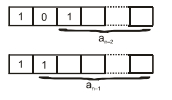
View full question & answer→MCQ 4411 Mark
The minimum value of the sum of real numbers $a^{-5}, a^{-4}, 3 a^{-3}, 1, a^8$ and $a^{10}$ with $a>0$ is
Answerc
Since, $A M \geq G M$
$\Rightarrow \frac{\frac{1}{a^5}+\frac{1}{a^4}+\frac{1}{a^3}+\frac{1}{a^3}+\frac{1}{a^3}+1+ a ^8+ a ^{10}}{8} \geq\left(\frac{1}{ a ^5} \times \frac{1}{ a ^4} \times \frac{1}{ a ^3} \times \frac{1}{ a ^3} \times \frac{1}{ a ^3} \times 1\right.$
$\Rightarrow \frac{\frac{1}{ a ^5}+\frac{1}{ a ^4}+\frac{1}{ a ^3}+\frac{1}{ a ^3}+\frac{1}{ a ^3}+1+ a ^8+ a ^{10}}{8} \geq(1)^{\frac{1}{8}}$
$\Rightarrow \frac{1}{ a ^5}+\frac{1}{ a ^4}+\frac{1}{ a ^3}+\frac{1}{ a ^3}+\frac{1}{ a ^3}+1+ a ^8+ a ^{10} \geq 8(1)^{\frac{1}{8}}$
$\Rightarrow \frac{1}{ a ^5}+\frac{1}{ a ^4}+\frac{1}{ a ^3}+\frac{1}{ a ^3}+\frac{1}{ a ^3}+1+ a ^8+ a ^{10} \geq 8$
So, the minimum value is $8$
View full question & answer→MCQ 4421 Mark
Let $a_1, a_2, a_3, \ldots, a_{100}$ be an arithmetic progression with $a_1=3$ and $S_p=\sum_{i=1}^p a_i, 1 \leq p \leq 100$. For any integer $n$ with $1 \leq n \leq 20$, let $m=5 n$. If $\frac{S_{m m}}{S_n}$ does not depend on $n$, then $a_2$ is
- ✓
$3,9,3 $ and $ 9$
- B
$3,4,5 $ and $ 6$
- C
$3,6,4 $ and $ 8$
- D
$7,8,4 $ and $ 5$
AnswerCorrect option: A. $3,9,3 $ and $ 9$
View full question & answer→MCQ 4431 Mark
Let $a_1, a_2, a_3, \ldots, a_{11}$ be real numbers satisfying $a_1=15,27-2 a_2>0$ and $a_k=2 a_{k-1}-a_{k-2}$ for $k=3,4, \ldots$,
$11$. If $\frac{a_1^2+a_2^2+\ldots+a_{11}^2}{11}=90$, then the value of $\frac{a_1+a_2+\ldots+a_{11}}{11}$ is equal to
Answera
$ \mathrm{a}_{\mathrm{k}}=2 \mathrm{a}_{\mathrm{k}-1}-\mathrm{a}_{\mathrm{k}-2} \Rightarrow \mathrm{a}_1, \mathrm{a}_2, \ldots, \mathrm{a}_{11} \text { are in A.P. } $
$ \therefore \frac{a_1^2+a_2^2+\ldots+a_{11}^2}{11}=\frac{11 a^2+35 \times 11 d^2+10 a d}{11}=90 $
$ \Rightarrow 225+35 \mathrm{~d}^2+150 \mathrm{~d}=90 $
$ 35 \mathrm{~d}^2+150 \mathrm{~d}+135=0 \Rightarrow \mathrm{d}=-3,-9 / 7$
Given $\mathrm{a}_2<\frac{27}{2} \therefore \mathrm{d}=-3$ and $\mathrm{d} \neq-9 / 7 \Rightarrow \frac{a_1+a_2+\ldots+a_{11}}{11}=\frac{11}{2}[30-10 \times 3]=0$.
View full question & answer→MCQ 4441 Mark
Let $S_k, k=1,2, \ldots ., 100$, denote the sum of the infinite geometric series whose first term is $\frac{k-1}{k!}$ and the common ratio is $\frac{1}{k}$. Then the value of $\frac{100^2}{100!}+\sum_{k=1}^{100}\left|\left(\mathrm{k}^2-3 \mathrm{k}+1\right) \mathrm{S}_{\mathrm{k}}\right|$ is
Answerd
$ S_{\mathrm{k}}=\frac{\frac{k-1}{k!}}{1-\frac{1}{k}}=\frac{1}{(k-1)!} $
$ \sum_{k=2}^{100}\left|\left(k^2-3 k+1\right) \frac{1}{(k-1)!}\right| $
$ =\sum_{k=2}^{100}\left|\frac{(k-1)^2-k}{(k-1)!}\right| $
$ =\sum\left|\frac{k-1}{(k-2)!}-\frac{k}{(k-1)!}\right| $
$ =\left|\frac{2}{1!}-\frac{3}{2!}\right|+\left|\frac{3}{2!}-\frac{4}{3!}\right|+\cdots $
$ =\frac{2}{1!}-\frac{1}{0!}+\frac{2}{1!}-\frac{3}{2!}+\frac{3}{2!}-\frac{4}{3!}+\cdots+\frac{99}{98!}-\frac{100}{99!} $
$ =3-\frac{100}{99!} .$
View full question & answer→MCQ 4451 Mark
If the sum of first $n$ terms of an $A.P.$ is $c n^2$, then the sum of squares of these $n$ terms is
- A
$\frac{n\left(4 n^2-1\right) c^2}{6}$
- B
$\frac{n\left(4 n^2+1\right) c^2}{3}$
- ✓
$\frac{n\left(4 n^2-1\right) c^2}{3}$
- D
$\frac{n\left(4 n^2+1\right) c^2}{6}$
AnswerCorrect option: C. $\frac{n\left(4 n^2-1\right) c^2}{3}$
c
$S _{ n }= cn ^2$
$S_{ n -1}= c ( n -1)^2= cn ^2+ c -2 cn$
$T _{ n }=2 cn - c$
$T _{ n }^2=(2 cn - c )^2=4 c ^2 n ^2+ c ^2-4 c ^2 n$
Required sum
$=\sum T_n^2=4 c^2 \sum n^2+n c^2-4 c^2 \sum n$
$=\frac{4 c^2 n(n+1)(2 n+1)}{6}+n c^2-2 c^2 n(n+1)$
$=\frac{2 c^2 n(n+1)(2 n+1)+3 n c^2-6 c^2 n(n+1)}{3}$
$=\frac{n c^2\left[4 n^2+6 n+2+3-6 n-6\right]}{3}$
$=\frac{n c^2\left(4 n^2-1\right)}{3}$
View full question & answer→MCQ 4461 Mark
Suppose four distinct positive numbers $a_1, a_2, a_3, a_4$ are in $G.P.$ Let $b_1=a_1, b_2=b_1+a_2, b_3=b_2+a_3$ and $b_4=b_3+a_4$.
$STATEMENT-1$ : The numbers $\mathrm{b}_1, \mathrm{~b}_2, \mathrm{~b}_3, \mathrm{~b}_4$ are neither in $A.P$. nor in $G.P.$ and
$STATEMENT-2$ : The numbers $\mathrm{b}_1, \mathrm{~b}_2, \mathrm{~b}_3, \mathrm{~b}_4$ are in $H.P.$
- A
$STATEMENT-1$ is True, $STATEMENT-2$ is True; $STATEMENT-2$ is a correct explanation for $STATEMENT-1$
- B
$STATEMENT-1$ is True, $STATEMENT-2$ is True; $STATEMENT-2$ is $NOT$ a correct explanation for $STATEMENT-1.$
- ✓
$STATEMENT-1$ is True, $STATEMENT-2$ is False
- D
$STATEMENT-1$ is False, $STATEMENT-2$ is True
AnswerCorrect option: C. $STATEMENT-1$ is True, $STATEMENT-2$ is False
c
$b_1=a_1, b_2=a_1+a_2, b_3=a_1+a_2+a_3, b_4=a_1+a_2+a_3+a_4$
Hence $b_1, b_2, b_3, b_4$ are neither in $A.P.$ nor in $G.P.$ nor in $H.P.$
View full question & answer→MCQ 4471 Mark
Let $V_{\mathrm{r}}$ denote the sum of the first $\mathrm{r}$ terms of an arithmetic progression $(A.P.)$ whose first term is $\mathrm{r}$ and the common difference is $(2 \mathrm{r}-1)$. Let
$T_{\mathrm{I}}=V_{\mathrm{r}+1}-V_{\mathrm{I}}-2 \text { and } \mathrm{Q}_{\mathrm{I}}=T_{\mathrm{r}+1}-\mathrm{T}_{\mathrm{r}} \text { for } \mathrm{r}=1,2, \ldots$
$1.$ The sum $V_1+V_2+\ldots+V_n$ is
$(A)$ $\frac{1}{12} n(n+1)\left(3 n^2-n+1\right)$
$(B)$ $\frac{1}{12} n(n+1)\left(3 n^2+n+2\right)$
$(C)$ $\frac{1}{2} n\left(2 n^2-n+1\right)$
$(D)$ $\frac{1}{3}\left(2 n^3-2 n+3\right)$
$2.$ $\mathrm{T}_{\mathrm{T}}$ is always
$(A)$ an odd number $(B)$ an even number
$(C)$ a prime number $(D)$ a composite number
$3.$ Which one of the following is a correct statement?
$(A)$ $Q_1, Q_2, Q_3, \ldots$ are in $A.P.$ with common difference $5$
$(B)$ $\mathrm{Q}_1, \mathrm{Q}_2, \mathrm{Q}_3, \ldots$ are in $A.P.$ with common difference $6$
$(C)$ $\mathrm{Q}_1, \mathrm{Q}_2, \mathrm{Q}_3, \ldots$ are in $A.P.$ with common difference $11$
$(D)$ $Q_1=Q_2=Q_3=\ldots$
Give the answer question $1,2$ and $3.$
- ✓
$B,D,B$
- B
$B,D,A$
- C
$A,C,B$
- D
$D,B,A$
AnswerCorrect option: A. $B,D,B$
a
$1.$ $ \mathrm{V}_{\mathrm{r}}=\frac{\mathrm{r}}{2}[2 \mathrm{r}+(\mathrm{r}-1)(2 \mathrm{r}-1)]=\frac{1}{2}\left(2 \mathrm{r}^3-\mathrm{r}^2+\mathrm{r}\right)$
$ \sum \mathrm{V}_{\mathrm{r}}=\frac{1}{12} \mathrm{n}(\mathrm{n}+1)\left(3 \mathrm{n}^2+\mathrm{n}+2\right)$
$2.$ $ \mathrm{V}_{\mathrm{r}+1}-\mathrm{V}_{\mathrm{r}}=(\mathrm{r}+1)^3-\mathrm{r}^3-\frac{1}{2}\left[(\mathrm{r}+1)^2-\mathrm{r}^2\right]+\frac{1}{2} $
$ =3 \mathrm{r}^2+2 \mathrm{r}+1 $
$ \mathrm{~T}_{\mathrm{r}}=3 \mathrm{r}^2+2 \mathrm{r}-1=(\mathrm{r}+1)(3 \mathrm{r}-1)$
which is a composite number.
$3.$ $ \mathrm{T}_{\mathrm{r}}=3 \mathrm{r}^2+2 \mathrm{r}-1 $
$ \mathrm{~T}_{\mathrm{r}+1}=3(\mathrm{r}+1)^2+2(\mathrm{r}+1)-1 $
$ \mathrm{Q}_{\mathrm{r}}=\mathrm{T}_{\mathrm{r}+1}-\mathrm{T}_{\mathrm{r}}=3[2 \mathrm{r}+1]+2[1] $
$ \mathrm{Q}_{\mathrm{r}}=6 \mathrm{r}+5 $
$ \mathrm{Q}_{\mathrm{r}+1}=6(\mathrm{r}+1)+5$
Common difference $=\mathrm{Q}_{\mathrm{r}+1}-\mathrm{Q}_{\mathrm{I}}=6$.
View full question & answer→MCQ 4481 Mark
The first term of an infinite geometric progression is $x$ and its sum is $5$. Then
- A
$0 \le x \le 10$
- ✓
$0 < x < 10$
- C
$ - 10 < x < 0$
- D
$x > 10$
AnswerCorrect option: B. $0 < x < 10$
b
(b) $5 = \frac{x}{{1 - r}}$
$ \Rightarrow 5 - 5r = x$
$ \Rightarrow r = 1 - \frac{x}{5}$
As $|r| < 1$
$i.e.$, $\left| {\,1 - \frac{x}{5}\,} \right| < 1$ $ - 1 < 1 - \frac{x}{5} < 1$
$ - 5 < 5 - x < 5 $
$ - 10 < - x < 0 $
$ 10 > x > 0 $
$ 0 < x < 10$
View full question & answer→MCQ 4491 Mark
If ${a_1},{a_2},....{a_n}$ are positive real numbers whose product is a fixed number $c$, then the minimum value of ${a_1} + {a_2} + ...$ $ + {a_{n - 1}} + 2{a_n}$ is
- ✓
$n{(2c)^{1/n}}$
- B
$(n + 1)\,{c^{1/n}}$
- C
$2n{c^{1/n}}$
- D
$(n + 1){(2c)^{1/n}}$
AnswerCorrect option: A. $n{(2c)^{1/n}}$
a
(a) $A.M.$ $ \ge $ $G.M. $
==> $\frac{{{a_1} + {a_2} + .... + {a_{n - 1}} + 2{a_n}}}{n} \ge {({a_1}.{a_{2,}}...{a_{n - 1}}2{a_n})^{\frac{1}{n}}} \ge {(2c)^{\frac{1}{n}}}$
Minimum value of ${a_1} + {a_2} + ...... + {a_{n - 1}} + 2{a_n} = n{(2c)^{1/n}}$.
View full question & answer→MCQ 4501 Mark
Suppose $a,\,b,\,c$ are in $A.P.$ and ${a^2},{b^2},{c^2}$ are in $G.P.$ If $a < b < c$ and $a + b + c = \frac{3}{2}$, then the value of $a$ is
AnswerCorrect option: D. $\frac{1}{2} - \frac{1}{{\sqrt 2 }}$
d
(d) $b = a + d,c = a + 2d$, where $d > 0$
Now ${a^2},{(a + d)^2},{(a + 2d)^2}$are in $G.P.$
$\therefore {(a + d)^4} = {a^2}{(a + 2d)^2}$
or ${(a + d)^2} = \pm a(a + 2d)$
or ${a^2} + {d^2} + 2ad = \pm \,\,({a^2} + 2ad)$
Taking $(+)$ sign, $d = 0$ (not possible as $a < b < c)$
Taking $(-)$ sign,
$2{a^2} + 4ad + {d^2} = 0$, $\left[ {a + b + c = \frac{3}{2},\,\,\,\therefore a + d = \frac{1}{2}} \right]$
$2{a^2} + 4a\left( {\frac{1}{2} - a} \right) + {\left( {\frac{1}{2} - a} \right)^2} = 0$ or
$4{a^2} - 4a - 1 = 0$
$\therefore a = \frac{1}{2} \pm \frac{1}{{\sqrt 2 }}.{\rm{Here}}\,{\rm{ }}d = \frac{1}{2} - a > 0.$
So, $a < \frac{1}{2}.$
Hence $a = \frac{1}{2} - \frac{1}{{\sqrt 2 }}$.
View full question & answer→MCQ 4511 Mark
If the sum of the first $2n$ terms of $2,\,5,\,8...$ is equal to the sum of the first $n$ terms of $57,\,59,\,61...$, then $n$ is equal to
Answerc
(c) Given, $\frac{{2n}}{2}\{ 2.2 + (2n - 1)3\} = \frac{n}{2}\{ 2.57 + (n - 1)2\} $
or $2(6n + 1) = 112 + 2n$ or $10n = 110,\,\,\,\,\,$
$\therefore n = 11$.
View full question & answer→MCQ 4521 Mark
If $a,\,b,\,c,\,d$ are positive real numbers such that $a + b + c + d$ $ = 2,$ then $M = (a + b)(c + d)$ satisfies the relation
- ✓
$0 < M \le 1$
- B
$1 \le M \le 2$
- C
$2 \le M \le 3$
- D
$3 \le M \le 4$
AnswerCorrect option: A. $0 < M \le 1$
a
(a) $\frac{{(a + b) + (c + d)}}{2} \ge \sqrt {(a + b)(c + d)} $
or $\frac{2}{2} > \sqrt M $ or $1 \ge M$
Also $M > 0.\,\,{\rm{So}},\,\,0 < M \le 1$.
View full question & answer→MCQ 4531 Mark
Consider an infinite $G.P. $ with first term a and common ratio $r$, its sum is $4$ and the second term is $3/4$, then
- A
$a = \frac{7}{4},\,r = \frac{3}{7}$
- B
$a = \frac{3}{2},\,r = \frac{1}{2}$
- C
$a = 2,\,r = \frac{3}{8}$
- ✓
$a = 3,\,r = \frac{1}{4}$
AnswerCorrect option: D. $a = 3,\,r = \frac{1}{4}$
d
(d) Here $\frac{a}{{1 - r}} = 4\,\,{\rm{and}}\,\,ar = \frac{3}{4}$.
Dividing these,
$r(1 - r) = \frac{3}{{16}}$or $16{r^2} - 16r + 3 = 0$
or $(4r - 3)(4r - 1) = 0$
$r = \frac{1}{4},\frac{3}{4}\,\,{\rm{and }}\ a = 3,\,1$
so $(a,r) = \left( {3,\frac{1}{4}} \right)\,,\,\left( {1,\frac{3}{4}} \right)$.
View full question & answer→MCQ 4541 Mark
If ${x_1},\;{x_2},\;{x_3}$ as well as ${y_1},\;{y_2},\;{y_3}$ are in G.P. with the same common ratio, then the points $({x_1},\;{y_1}),\;({x_2},\;{y_2})$ and $({x_3},{y_3})$
- ✓
- B
- C
- D
Are vertices of a triangle
Answera
(a)Given ${x_2} = r{x_1},\;{x_3} = {r^2}{x_1},\;{y_2} = r{y_1},\;{y_3} = {r^2}{y_1}$
Area of $\Delta = \frac{1}{2}\left| {\;\begin{array}{*{20}{c}}{{x_1}}&{{y_1}}&1\\{{x_2}}&{{y_2}}&1\\{{x_3}}&{{y_3}}&1\end{array}\;} \right| = \frac{1}{2}\left| {\;\begin{array}{*{20}{c}}{{x_1}}&{{y_1}}&1\\{r{x_1}}&{r{y_1}}&1\\{{r^2}{x_1}}&{{r^2}{y_1}}&1\end{array}\;} \right|$
$ = \frac{1}{2}{x_1}{y_1}\left| {\;\begin{array}{*{20}{c}}1&1&1\\r&r&1\\{{r^2}}&{{r^2}}&1\end{array}\;} \right| = 0$
i.e. lie on a Straight line.
View full question & answer→MCQ 4551 Mark
Let ${S_1},\;{S_2},.......$ be squares such that for each $n \ge 1$, the length of a side of ${S_n}$ equals the length of a diagonal of ${S_{n + 1}}$. If the length of a side of ${S_1}$ is $10\ cm$, then for which of the following values of $n$ is the area of ${S_n}$ less then $1\;sq\;cm$
Answerd
(d) Given ${x_n} = {x_{n + 1}}\sqrt 2 $
$\therefore $${x_1} = {x_2}\sqrt 2 ,\;{x_2} = {x_3}\sqrt 2 ,\;$
${x_n} = {x_{n + 1}}\sqrt 2 $
On multiplying ${x_1} = {x_{n + 1}}{(\sqrt 2 )^n}$
$ \Rightarrow $${x_{n + 1}} = \frac{{{x_1}}}{{{{(\sqrt 2 )}^n}}}$
Hence ${x_n} = \frac{{{x_1}}}{{{{(\sqrt 2 )}^{n - 1}}}}$
Area of ${S_n} = x_n^2 = \frac{{x_1^2}}{{{2^{n - 1}}}} < 1$
$ \Rightarrow $${2^{n - 1}} > x_1^2\;\;\;\;\;\;({x_1} = 10)$
$\therefore $${2^{n - 1}} > 100$
But ${2^7} > 100,\;{2^8} > 100,\;$ etc.
$\therefore $$n - 1 = 7,\;8,\;9.....$
$ \Rightarrow $$n = 8,\;9,\;10.....$
View full question & answer→MCQ 4561 Mark
Let ${T_r}$ be the ${r^{th}}$ term of an $A.P.$ for $r = 1,\;2,\;3,....$. If for some positive integers $m,\;n$ we have ${T_m} = \frac{1}{n}$ and ${T_n} = \frac{1}{m}$, then ${T_{mn}}$ equals
Answerc
(c) ${T_m} = a + (m - 1)\,d = \frac{1}{n}$
and ${T_n} = a + (n - 1)\,d = \frac{1}{m}$
On solving $a = \frac{1}{{mn}}$ and $d = \frac{1}{{mn}}$
$\therefore $ ${T_{mn}} = a + (mn - 1)\,d = \frac{1}{{mn}} + (mn - 1)\frac{1}{{mn}} = 1$
View full question & answer→MCQ 4571 Mark
If $x > 1,\;y > 1,z > 1$ are in $G.P.$, then $\frac{1}{{1 + {\rm{In}}\,x}},\;\frac{1}{{1 + {\rm{In}}\,y}},$ $\;\frac{1}{{1 + {\rm{In}}\,z}}$ are in
AnswerCorrect option: B. $H.P.$
b
(b) $x,\;y,\;z$ are in $G.P. $Hence ${y^2} = xz$
$\therefore $$2\log y = \log x + \log z$
$ \Rightarrow $$2(\log y + 1) = (1 + \log x) + (1 + \log z)$
$ \Rightarrow $$1 + \log x,\;1 + \log y,\;1 + \log z$ are in $A.P.$
$ \Rightarrow $$\frac{1}{{1 + \log x}},\;\frac{1}{{1 + \log y}},\;\frac{1}{{1 + \log z}}$ are is $H.P.$
View full question & answer→MCQ 4581 Mark
For any odd integer $n \ge 1$, ${n^3} - {(n - 1)^3} + ........... + {( - 1)^{n - 1}}{1^3} = $
- A
$\frac{1}{2}{(n - 1)^2}(2n - 1)$
- B
$\frac{1}{4}{(n - 1)^2}(2n - 1)$
- C
$\frac{1}{2}{(n + 1)^2}(2n - 1)$
- ✓
$\frac{1}{4}{(n + 1)^2}(2n - 1)$
AnswerCorrect option: D. $\frac{1}{4}{(n + 1)^2}(2n - 1)$
d
(d) Since $n$ is an odd integer ${( - 1)^{n - 1}} = 1$
and $n - 1$, $n - 3,\;n - 5$ etc. are even integers. We have
= ${n^3} - {(n - 1)^3} + {(n - 2)^3} - {(n - 3)^3}$+$........ + {( - 1)^{n - 1}}{1^3}$
$ = {n^3} + {(n - 1)^3} + {(n - 2)^3} + ....... + {1^3}$
$- 2[{(n - 1)^3} + {(n - 3)^3} +$ $....... + {2^3}]$
$ = {n^3} + {(n - 1)^3} + {(n - 2)^3} + ....... + {1^3}$
$ - 2 \times {2^3}\left[ {{{\left( {\frac{{n - 1}}{2}} \right)}^3} + {{\left( {\frac{{n - 3}}{2}} \right)}^3} + ....... + {1^3}} \right]$
[$\;n - 1,\;n - 3$ are even integers]
$ = {\left[ {\frac{{n\,(n + 1)}}{2}} \right]^2} - 16{\left[ {\frac{1}{2}\left( {\frac{{n - 1}}{2}} \right)\,\left( {\frac{{n - 1}}{2} + 1} \right)} \right]^2}$
$ = \frac{1}{4}{n^2}{(n + 1)^2} - 16\frac{{{{(n - 1)}^2}{{(n + 1)}^2}}}{{16 \times 4}}$
$ = \frac{1}{4}{(n + 1)^2}[{n^2} - {(n - 1)^2}] $
$= \frac{1}{4}{(n + 1)^2}(2n - 1)$.
View full question & answer→MCQ 4591 Mark
If $p,\;q,\;r$ are in $A.P.$ and are positive, the roots of the quadratic equation $p{x^2} + qx + r = 0$ are all real for
- ✓
$\left| {\,\frac{r}{p} - 7\;} \right|\; \ge 4\sqrt 3 $
- B
$\left| {\;\frac{p}{r} - 7\;} \right|\; < 4\sqrt 3 $
- C
All $p$ and $r$
- D
No $p$ and $r$
AnswerCorrect option: A. $\left| {\,\frac{r}{p} - 7\;} \right|\; \ge 4\sqrt 3 $
a
(a) $p,\;q,\;r$ are positive and are in $A.P.$
$\therefore \;q = \frac{{p + r}}{2}$ ......(i)
The roots of $p{x^2} + qx + r = 0$ are real
$ \Rightarrow $ ${q^2} \ge 4pr$
$ \Rightarrow $${\left[ {\frac{{p + r}}{2}} \right]^2} \ge 4pr$ [using (i)]
$ \Rightarrow $ ${p^2} + {r^2} - 14pr \ge 0$
$ \Rightarrow $ ${\left( {\frac{r}{p}} \right)^2} - 14\left( {\frac{r}{p}} \right) + 1 \ge 0$
$(\because \;p > 0\;{\text{and}}\;p \ne 0)$
$ \Rightarrow $ ${\left( {\frac{r}{p} - 7} \right)^2} - 48 \ge 0$
$ \Rightarrow $${\left( {\frac{r}{p} - 7} \right)^2} - {(4\sqrt 3 )^2} \ge 0$
$ \Rightarrow $ $\left| {\;\frac{r}{p} - 7\;} \right|\; \ge 4\sqrt 3 $.
View full question & answer→MCQ 4601 Mark
Let $n( > 1)$ be a positive integer, then the largest integer $m$ such that $({n^m} + 1)$ divides $(1 + n + {n^2} + ....... + {n^{127}})$, is
Answerc
(c) Since ${n^m} + 1$ divides $1 + n + {n^2} + ....... + {n^{127}}$
Therefore $\frac{{1 + n + {n^2} + ...... + {n^{127}}}}{{{n^m} + 1}}$ is an integer
$ \Rightarrow $ $\frac{{1 - {n^{128}}}}{{1 - n}} \times \frac{1}{{{n^m} + 1}}$ is an integer
$ \Rightarrow $ $\frac{{(1 - {n^{64}})(1 + {n^{64}})}}{{(1 - n)({n^m} + 1)}}$
is an integer when largest $m = 64$.
View full question & answer→MCQ 4611 Mark
Let ${a_n}$ be the ${n^{th}}$ term of the G.P. of positive numbers. Let $\sum\limits_{n = 1}^{100} {{a_{2n}}} = \alpha $ and $\sum\limits_{n = 1}^{100} {{a_{2n - 1}}} = \beta $, such that $\alpha \ne \beta $,then the common ratio is
AnswerCorrect option: A. $\frac{\alpha }{\beta }$
a
(a) Let the G.P. be $a,\;ar,\;a{r^2}.......,$ then
$\alpha = \sum\limits_{n = 1}^{100} {{a_{2n}}} = {a_2} + {a_4} + .......{\rm{upto}}\;100\;{\rm{terms}}$
$ = ar + a{r^3} + .......{\rm{upto}}\;100\;{\rm{terms}}$
$ = ar(1 + {r^2} + {r^4} + ......{r^{198}})$ and $\beta = \sum\limits_{n = 1}^{100} {{a_{2n - 1}}} = a + a{r^3} + .....{\rm{upto}}\;100\;{\rm{terms}}$
$ = a(1 + {r^2} + ...... + {r^{198}})$
Obviously $\frac{\alpha }{\beta } = r$.
View full question & answer→MCQ 4621 Mark
If ${\log _3}2,\;{\log _3}({2^x} - 5)$ and ${\log _3}\left( {{2^x} - \frac{7}{2}} \right)$ are in $A.P.$, then $x$ is equal to
- A
$1,\;\frac{1}{2}$
- B
$1,\;\frac{1}{3}$
- C
$1,\;\frac{3}{2}$
- ✓
Answerd
(d) ${\log _3}2,\;{\log _3}({2^x} - 5)$ and ${\log _3}\left( {{2^x} - \frac{7}{2}} \right)$ are in $A.P.$
$ \Rightarrow $$2{\log _3}({2^x} - 5) = {\log _3}\left[ {(2)\,\left( {{2^x} - \frac{7}{2}} \right)} \right]$
$ \Rightarrow $ ${({2^x} - 5)^2} = {2^{x + 1}} - 7$
$ \Rightarrow $${2^{2x}} - 12\;.\;{2^x} - 32 = 0$
$ \Rightarrow $ $x = 2,\;3$
But $x = 2$ does not hold, hence $x = 3$.
View full question & answer→MCQ 4631 Mark
The sum of the first $n$ terms of the series $\frac{1}{2} + \frac{3}{4} + \frac{7}{8} + \frac{{15}}{{16}} + .........$ is
- A
${2^n} - n - 1$
- B
$1 - {2^{ - n}}$
- ✓
$n + {2^{ - n}} - 1$
- D
${2^n} - 1$
AnswerCorrect option: C. $n + {2^{ - n}} - 1$
c
(c) The sum of the first $n$ terms is
${S_n} = \left( {1 - \frac{1}{2}} \right) + \left( {1 - \frac{1}{{{2^2}}}} \right) + \left( {1 - \frac{1}{{{2^3}}}} \right) + \left( {1 - \frac{1}{{{2^4}}}} \right)+$$ ...... + \left( {1 - \frac{1}{{{2^n}}}} \right)$
$ = n - \left\{ {\frac{1}{2} + \frac{1}{{{2^2}}} + ..... + \frac{1}{{{2^n}}}} \right\}$
= $n - \frac{1}{2}\left( {\frac{{1 - \frac{1}{{{2^n}}}}}{{1 - \frac{1}{2}}}} \right) = n - \left( {1 - \frac{1}{{{2^n}}}} \right) = n - 1 + {2^{ - n}}$.
Trick : Check for $n = 1,\;2\;$
$i.e.$ ${S_1} = \frac{1}{2},\;{S_2} = \frac{5}{4}$
and $(c)$ $ \Rightarrow {S_1} = \frac{1}{2}$
and ${S_2} = 2 + {2^{ - 2}} - 1 = \frac{5}{4}$.
View full question & answer→MCQ 4641 Mark
The sum of first $n$ terms of the given series ${1^2} + {2.2^2} + {3^2} + {2.4^2} + {5^2} + {2.6^2} + ............$ is $\frac{{n{{(n + 1)}^2}}}{2}$, when $n$ is even. When $n$ is odd, the sum will be
AnswerCorrect option: B. $\frac{1}{2}{n^2}(n + 1)$
b
(b) When $n$ is odd, the last term.
$i.e.,$ the ${n^{th}}$ term will be ${n^2}$ in this case $n - 1$ is even
and so the sum of the first $n - 1$ terms of the series is obtained by replacing $n$ by $n - 1$ in the given formula and so is $\frac{1}{2}(n - 1){n^2}$.
Hence the sum of the $n$ terms
= (the sum of $n - 1$ terms) + the ${n^{th}}$ term
$ = \frac{1}{2}(n - 1){n^2} + {n^2} = \frac{1}{2}(n + 1){n^2}$.
Trick : Check for $n = 1,\;3$.
Here ${S_1} = 1,\;{S_3} = 18$ which gives (b).
View full question & answer→MCQ 4651 Mark
If $a,\;b,\;c,\;d$ and $p$ are different real numbers such that $({a^2} + {b^2} + {c^2}){p^2} - 2(ab + bc + cd)p + ({b^2} + {c^2} + {d^2}) \le 0$, then $a,\;b,\;c,\;d$ are in
- A
$A.P.$
- ✓
$G.P.$
- C
$H.P.$
- D
$ab = cd$
AnswerCorrect option: B. $G.P.$
b
(b) As given, $({a^2} + {b^2} + {c^2}){p^2} - 2(ab + bc + cd)p$
$ + ({b^2} + {c^2} + {d^2}) \le 0$ ….. $(i)$
But $L.H.S.$
$ = ({a^2}{p^2} - 2abp + {b^2}) + ({b^2}{p^2} - 2bcp + {c^2})$
$ + ({c^2}{p^2} - 2cdp + {d^2})$ $ = {(ap - b)^2} + {(bp - c)^2} + {(cp - d)^2} \ge 0$ …..$(ii)$
Since the sum of squares of real numbers is non-negative.
Therefore from $(i)$ and $(ii)$
$ \Rightarrow $${(ap - b)^2} + {(bp - c)^2} + {(cp - d)^2} = 0$
$ \Rightarrow $$ap - b = 0 = bp - c = cp - d \Rightarrow \frac{b}{a} = \frac{c}{b} = \frac{d}{c} = p$
$\therefore $$a,\;b,\;c,\;d$ are in $G.P.$
View full question & answer→MCQ 4661 Mark
The sum of integers from $1$ to $100$ that are divisible by $2$ or $5$ is
AnswerCorrect option: B. $3050$
b
(b) The sum of integers from $1$ to $100$ that are divisible by $2$ or $5 =$ sum of series divisible by $2 +$ sum of series divisible by $5 -$ sum of series divisible by $2$ and $5$.
$ = (2 + 4 + 6 + ...... + 100) + (5 + 10 + 15....... + 100)$
$ - (10 + 20 + 30 + ........ + 100)$
$ = \frac{{50}}{2}\left\{ {2 \times 2 + (50 - 1)2} \right\} + \frac{{20}}{2}\left\{ {2 \times 5 + (20 - 1)5} \right\}$
$ - \frac{{10}}{2}\left\{ {10 \times 2 + (10 - 1)10} \right\}$
$ = 2550 + 1050 - 550 = 3050$.
View full question & answer→MCQ 4671 Mark
If $a,\;b,\;c$ are in A.P., then the straight line $ax + by + c = 0$ will always pass through the point
- A
$( - 1,\; - 2)$
- ✓
$(1,\; - 2)$
- C
$( - 1,\;2)$
- D
$(1,\;2)$
AnswerCorrect option: B. $(1,\; - 2)$
b
(b) $a,\;b,\;c$ are in A.P.
So $2b = a + c$, then straight line $ax + by + c = 0$ will pass through $(1,\; - 2)$ because if the line satisfies the condition $a - 2b + c = 0$ or $2b = a + c$.
View full question & answer→MCQ 4681 Mark
${n^{th}}$ term of the series $3.8 + 6.11 + $ $9.14 + 12.17 + .....$ will be
- ✓
$3n(3n + 5)$
- B
$3n(n + 5)$
- C
$n(3n + 5)$
- D
$n(n + 5)$
AnswerCorrect option: A. $3n(3n + 5)$
a
(a) Given series $3\,.\,8 + 6\,.\,11 + 9\,.\,14 + 12\;.\,17 + .....$
First factors are $3, 6, 9, 12$ whose ${n^{th}}$ term is $3n$
and second factors are $8, 11, 14, 17$
${t_n} = [8 + (n - 1)3] = (3n + 5)$
Hence ${n^{th}}$ term of given series $ = 3n(3n + 5)$.
View full question & answer→MCQ 4691 Mark
$2.\mathop {357}\limits^{ \bullet \,\, \bullet \,\, \bullet } = $
- A
$\frac{{2355}}{{1001}}$
- B
$\frac{{2370}}{{997}}$
- ✓
$\frac{{2355}}{{999}}$
- D
AnswerCorrect option: C. $\frac{{2355}}{{999}}$
c
(c) Given that $2.\mathop {357}\limits^{.\,\,\,.\,\,\,.} = 2.357357357357......$
$ = 2 + 0.\mathop {357}\limits^{} + 0.000357 + 0.000000357 + .......\infty $
$ = 2 + \frac{{357}}{{{{10}^3}}} + \frac{{357}}{{{{10}^6}}} + \frac{{357}}{{{{10}^9}}} + .......$
$\therefore $ ${S_\infty } = 2 + \frac{{\frac{{357}}{{{{10}^3}}}}}{{1 - \frac{1}{{{{10}^3}}}}} = 2 + \frac{{357}}{{{{10}^3}}} \times \frac{{{{10}^3}}}{{999}} = \frac{{2355}}{{999}}$.
View full question & answer→MCQ 4701 Mark
If ${a_1},\;{a_2},\;{a_3}.......{a_n}$ are in $A.P.$, where ${a_i} > 0$ for all $i$, then the value of $\frac{1}{{\sqrt {{a_1}} + \sqrt {{a_2}} }} + \frac{1}{{\sqrt {{a_2}} + \sqrt {{a_3}} }} + $ $........ + \frac{1}{{\sqrt {{a_{n - 1}}} + \sqrt {{a_n}} }} = $
- ✓
$\frac{{n - 1}}{{\sqrt {{a_1}} + \sqrt {{a_n}} }}$
- B
$\frac{{n + 1}}{{\sqrt {{a_1}} + \sqrt {{a_n}} }}$
- C
$\frac{{n - 1}}{{\sqrt {{a_1}} - \sqrt {{a_n}} }}$
- D
$\frac{{n + 1}}{{\sqrt {{a_1}} - \sqrt {{a_n}} }}$
AnswerCorrect option: A. $\frac{{n - 1}}{{\sqrt {{a_1}} + \sqrt {{a_n}} }}$
a
(a) As given ${a_2} - {a_1} = {a_3} - {a_2} = ....... = {a_n} - {a_{n - 1}} = d$
Where $d$ is the common difference of the given $A.P.$
Also ${a_n} = {a_1} + (n - 1)d$.
Then by rationalising each term,
$\frac{1}{{\sqrt {{a_2}} + \sqrt {{a_1}} }} + \frac{1}{{\sqrt {{a_3}} + \sqrt {{a_2}} }} + .... + \frac{1}{{\sqrt {{a_n}} + \sqrt {{a_{n - 1}}} }}$
$ = \frac{{\sqrt {{a_2}} - \sqrt {{a_1}} }}{{{a_2} - {a_1}}} + \frac{{\sqrt {{a_3}} - \sqrt {{a_2}} }}{{{a_3} - {a_2}}} + ..... + \frac{{\sqrt {{a_n}} - \sqrt {{a_{n - 1}}} }}{{{a_n} - {a_{n - 1}}}}$
$ = \frac{1}{d}\left\{ {\sqrt {{a_2}} - \sqrt {{a_1}} + \sqrt {{a_3}} - \sqrt {{a_2}} + ...... + \sqrt {{a_n}} - \sqrt {{a_{n - 1}}} } \right\}$
$ = \frac{1}{d}\left\{ {\sqrt {{a_n}} - \sqrt {{a_1}} } \right\} = \frac{1}{d}\left( {\frac{{{a_n} - {a_1}}}{{\sqrt {{a_n}} + \sqrt {{a_1}} }}} \right)$
$ = \frac{1}{d}\left\{ {\frac{{(n - 1)d}}{{\sqrt {{a_n}} + \sqrt {{a_1}} }}} \right\} = \frac{{n - 1}}{{\sqrt {{a_n}} + \sqrt {{a_1}} }}$.
View full question & answer→MCQ 4711 Mark
If the third term of a $G.P.$ is $4$ then the product of its first $5$ terms is
- A
${4^3}$
- B
${4^4}$
- ✓
${4^5}$
- D
AnswerCorrect option: C. ${4^5}$
c
(c) Given that $a{r^2} = 4$
Then product of first $5$ terms
$ = a(ar)(a{r^2})(a{r^3})(a{r^4}) = {a^5}{r^{10}} = {[a{r^2}]^5} = {4^5}$.
View full question & answer→MCQ 4721 Mark
The interior angles of a polygon are in $A.P.$ If the smallest angle be ${120^o}$ and the common difference be $5^o$, then the number of sides is
Answerc
(c) Let the number of sides of the polygon be $n$.
Then the sum of interior angles of the polygon
$ = (2n - 4)\frac{\pi }{2} = (n - 2)\pi $
Since the angles are in $A.P. $ and $a = {120^o},\;d = 5$,
therefore $\frac{n}{2}[2 \times 120 + (n - 1)5] = (n - 2)180$
==> ${n^2} - 25n + 144 = 0$
==> $(n - 9)(n - 16) = 0$
==> $n = 9,\;16$
But $n = 16$ gives ${T_{16}} = a + 15d = {120^o} + {15.5^o} = {195^o}$,
which is impossible as interior angle cannot be greater than ${180^o}$.
Hence $n = 9$.
View full question & answer→MCQ 4731 Mark
If the sum of the roots of the equation $a{x^2} + bx + c = 0$ be equal to the sum of the reciprocals of their squares, then $b{c^2},\;c{a^2},\;a{b^2}$ will be in
AnswerCorrect option: A. $A.P.$
a
(a) Given equation $a{x^2} + bx + c = 0$ and let the roots are $\alpha ,\;\beta ,$ so $\alpha + \beta = - \frac{b}{a}$ and $\alpha \beta = \frac{c}{a}$
Now $\frac{1}{{{\alpha ^2}}} + \frac{1}{{{\beta ^2}}} = \frac{{{\alpha ^2} + {\beta ^2}}}{{{\alpha ^2}{\beta ^2}}} = \frac{{\frac{{{b^2}}}{{{a^2}}} - \frac{{2c}}{a}}}{{\frac{{{c^2}}}{{{a^2}}}}} = \frac{{{b^2} - 2ac}}{{{c^2}}}$
Under condition $\alpha + \beta = \frac{1}{{{\alpha ^2}}} + \frac{1}{{{\beta ^2}}}$
$ \Rightarrow - \frac{b}{a} = \frac{{{b^2} - 2ac}}{{{c^2}}} \Rightarrow - b{c^2} = a{b^2} - 2{a^2}c$
Hence$2{a^2}c = a{b^2} + b{c^2} \Rightarrow a{b^2},\;c{a^2},\;b{c^2}$
or $b{c^2},\;c{a^2},\;a{b^2}$ be in $A.P.$
View full question & answer→MCQ 4741 Mark
In the four numbers first three are in $G.P.$ and last three are in $A.P.$ whose common difference is $6$. If the first and last numbers are same, then first will be
Answerd
(d) Let the numbers be $\frac{a}{r},\;a,\;ar,\;2ar - a$…..$(i)$
Where first three numbers are in $G.P.$ and last three are in $A.P.$
Given that the common difference of $A.P.$ is $6$, so
$ar - a = 6$…..$(ii)$
Also given $\frac{a}{r} = 2ar - a $
$\Rightarrow \frac{a}{r} = 2\,(ar - a) + a$
$ \Rightarrow $ $\frac{a}{r} = 2(6) + a,$ from $(ii)$
$ \Rightarrow $ $\left( {\frac{a}{r}} \right) - a = 12$
$ \Rightarrow $$a(1 - r) = 12r$
$ \Rightarrow $$r = - \frac{1}{2}$
From $(i)$ we get, $a\left[ {\left( { - \frac{1}{2}} \right) - 1} \right] = 6$ or $a = - 4$
Required numbers from $(i)$ are $8, - 4,\;2,\;8$ .
View full question & answer→MCQ 4751 Mark
The sum of the series $6 + 66 + 666 + ..........$ upto $n$ terms is
AnswerCorrect option: B. $2({10^{n + 1}} - 9n - 10)/27$
b
(b) Given series $6 + 66 + 666 + ........ + $ upto $n$ terms
$ = \frac{6}{9}(9 + 99 + 999 + .....$ upto $n$ terms)
$ = \frac{2}{3}(10 + {10^2} + {10^3} + .......... + $ upto $n$ terms $ - n$)
$ = \frac{2}{3}\left( {\frac{{10({{10}^n} - 1)}}{{10 - 1}} - n} \right) = \frac{1}{{27}}\,[20({10^n} - 1) - 18n]$
$ = \frac{{2({{10}^{n + 1}} - 9n - 10)}}{{27}}$.
View full question & answer→MCQ 4761 Mark
$0.\mathop {423}\limits^{\,\,\,\,\, \bullet \, \bullet \,} = $
- ✓
$\frac{{419}}{{990}}$
- B
$\frac{{419}}{{999}}$
- C
$\frac{{417}}{{990}}$
- D
$\frac{{417}}{{999}}$
AnswerCorrect option: A. $\frac{{419}}{{990}}$
a
(a) We have $0.\mathop {423}\limits^{\,\,\,\,\, \bullet \, \bullet \,} = 0.4232323.......$
$ = 0.4 + 0.023 + 0.00023 + 0.0000023 + ........\infty $
$ = \frac{4}{{10}} + \frac{{23}}{{{{10}^3}}} + \frac{{23}}{{{{10}^5}}} + \frac{{23}}{{{{10}^7}}}........\infty $
$ = \frac{4}{{10}} + \frac{{23}}{{{{10}^3}}}\left[ {1 + \frac{1}{{{{10}^2}}} + \frac{1}{{{{10}^4}}} + ..........\infty } \right]$
$ = \frac{4}{{10}} + \frac{{23}}{{1000}}\left( {\frac{1}{{1 - \frac{1}{{{{10}^2}}}}}} \right) = \frac{4}{{10}} + \frac{{23}}{{990}} = \frac{{419}}{{990}}$.
View full question & answer→MCQ 4771 Mark
The sum of the series ${1.3^2} + {2.5^2} + {3.7^2} + ..........$ upto $20$ terms is
- ✓
$188090$
- B
$189080$
- C
$199080$
- D
AnswerCorrect option: A. $188090$
a
(a) Here ${T_n}$ of the $A.P.$ $1,\;2,\;3,\;.......... = n$
and ${T_n}$ of the $A.P.$ $3,\;5,\;7,........ = 2n + 1$
$\therefore $${T_n}$ of given series $ = n{(2n + 1)^2} = 4{n^3} + 4{n^2} + n$
Hence $S = \sum\limits_1^{20} {{T_n}} = 4\sum\limits_1^{20} {{n^3}} + 4\sum\limits_1^{20} {{n^2}} + \sum\limits_1^{20} n $
$ = 4 \cdot \frac{1}{4}{20^2} \cdot {21^2} + 4 \cdot \frac{1}{6}20 \cdot 21 \cdot 41 + \frac{1}{2}20 \cdot 21 = 188090$.
View full question & answer→MCQ 4781 Mark
If $x,\;y,\;z$ are in $G.P.$ and ${a^x} = {b^y} = {c^z}$, then
- A
${\log _a}c = {\log _b}a$
- ✓
${\log _b}a = {\log _c}b$
- C
${\log _c}b = {\log _a}c$
- D
AnswerCorrect option: B. ${\log _b}a = {\log _c}b$
b
(b) $x,\;y,\;z$ are in $G.P.$, then ${y^2} = x\;.\;z$
Now ${a^x} = {b^y} = {c^z} = m$
$ \Rightarrow $ $x{\log _e}a = y{\log _e}b = z{\log _e}c = {\log _e}m$
$ \Rightarrow $ $x = {\log _a}m,\;y = {\log _b}m,z = {\log _c}m$
Again as $x,\;y,\;z$ are in $G.P.$,
so $\frac{{y}}{x}=\frac{{z}}{y}$
$ \Rightarrow $$\frac{{{{\log }_b}m}}{{{{\log }_a}m}} = \frac{{{{\log }_c}m}}{{{{\log }_b}m}}$
$ \Rightarrow $${\log _b}a = {\log _c}b$.
View full question & answer→MCQ 4791 Mark
If the sum of the $n$ terms of $G.P.$ is $S$ product is $P$ and sum of their inverse is $R$, than ${P^2}$ is equal to
AnswerCorrect option: D. ${\left( {\frac{S}{R}} \right)^n}$
d
(d) Given that sum $S = \frac{{a({r^n} - 1)}}{{r - 1}} = \frac{{a\,(1 - {r^n})}}{{1 - r}}$......(i)
$P = a(ar)(a{r^2})..........(a{r^{n - 1}}) = {a^n}{r^{1 + 2 + ......... + (n - 1)}}$
$ = {a^n}{r^{(n - 1)n/2}}\;i.e.,\;{P^2} = {a^{2n}}{r^{n(n - 1)}}$ ......(ii)
and $R = \frac{1}{a} + \frac{1}{{ar}} + \frac{1}{{a{r^2}}} + ..........$ upto $\frac{1}{{49}}$ terms
$ = \frac{1}{a}\left( {1 + \frac{1}{r} + \frac{1}{{{r^2}}} + .........{\rm{upto}}\;n\;{\rm{terms}}} \right)$
$ = \frac{{\frac{1}{a}\left[ {{{\left( {\frac{1}{r}} \right)}^n} - 1} \right]}}{{\left( {\frac{1}{r} - 1} \right)}}\left( {\;\frac{1}{r} > 1} \right)$if $r < 1$
$ = \frac{{(1 - {r^n})}}{{a{r^{n - 1}}(1 - r)}}$....... (iii)
Therefore , $\frac{S}{R} = \frac{{a(1 - {r^n})}}{{1 - r}} \times \frac{{a{r^{n - 1}}(1 - r)}}{{(1 - {r^n})}} = {a^2}{r^{n - 1}}$
or ${\left( {\frac{S}{R}} \right)^n} = {({a^2}{r^{n - 1}})^n} = {a^{2n}}{r^{n(n - 1)}} = {P^2}$.
View full question & answer→MCQ 4801 Mark
$1 + 3 + 7 + 15 + 31 + ..........$to $n$ terms =
- A
${2^{n + 1}} - n$
- ✓
${2^{n + 1}} - n - 2$
- C
${2^n} - n - 2$
- D
AnswerCorrect option: B. ${2^{n + 1}} - n - 2$
b
(b) Let ${T_n}$ be the ${n^{th}}$ term and $S$ the sum upto $n$ terms.
$S = 1 + 3 + 7 + 15 + 31 + ...... + {T_n}$
Again $S = 1 + 3 + 7 + 15 + ...........{\rm{ }} + {T_{n - 1}} + {T_n}$
Subtracting, we get $0 = 1 + \left\{ {2 + 4 + 8 + ...({T_n} - {T_{n - 1}})} \right\} - {T_n}$
$\therefore \;\;{T_n} = 1 + 2 + {2^2} + {2^3} + .....{\rm{upto}}\;n\;{\rm{terms}}$
$ = \frac{{1({2^n} - 1)}}{{2 - 1}} = {2^n} - 1$
Now $S = \Sigma {T_n} = \Sigma {2^n} - \Sigma 1$
$ = (2 + {2^2} + {2^3} + ...... + {2^n}) - n$
$ = 2\left( {\frac{{{2^n} - 1}}{{2 - 1}}} \right) - n = {2^{n + 1}} - 2 - n$.
Aliter : $1 + 3 + 7 + ...... + {T_n}$
$ = 2 - 1 + {2^2} - 1 + {2^3} - 1 + .......... + {2^n} - 1$
$ = (2 + {2^2} + ...... + {2^n}) - n = {2^{n + 1}} - 2 - n$.
Trick : Check the options for $n = 1,\;2$.
View full question & answer→MCQ 4811 Mark
The sum of $n$ terms of the following series $1 + (1 + x) + (1 + x + {x^2}) + ..........$ will be
- A
$\frac{{1 - {x^n}}}{{1 - x}}$
- B
$\frac{{x(1 - {x^n})}}{{1 - x}}$
- ✓
$\frac{{n(1 - x) - x(1 - {x^n})}}{{{{(1 - x)}^2}}}$
- D
AnswerCorrect option: C. $\frac{{n(1 - x) - x(1 - {x^n})}}{{{{(1 - x)}^2}}}$
c
(c) $1 + (1 + x) + (1 + x + {x^2}) + ...$+
$(1 + x + {x^2} + {x^3} + ... + {x^{n - 1}}) + ...$
Required sum $\frac{1}{{(1 - x)}}\left\{ {\,(1 - x) + (1 - {x^2}) + (1 - {x^3})}\right.$
$\left. { + (1 - {x^4}) + ..........{\text{uptp}}\;n\;{\text{terms}}} \right\}$
$ = \frac{1}{{(1 - x)}}[n - \{ x + {x^2} + {x^3} + ..........{\text{upto}}\;n\;{\text{terms\} }}\,]$
$ = \frac{1}{{(1 - x)}}\left[ {n - \frac{{x(1 - {x^n})}}{{1 - x}}} \right] = \frac{{n(1 - x) - x(1 - {x^n})}}{{{{(1 - x)}^2}}}$
View full question & answer→MCQ 4821 Mark
The value of $x$ satisfying ${\log _a}x + {\log _{\sqrt a }}x + {\log _{3\sqrt a }}x + .........{\log _{a\sqrt a }}x = \frac{{a + 1}}{2}$ will be
- A
$x = a$
- B
$x = {a^a}$
- C
$x = {a^{ - 1/a}}$
- ✓
$x = {a^{1/a}}$
AnswerCorrect option: D. $x = {a^{1/a}}$
d
(d) $ {\log _a}x + 2{\log _a}x + ....... + a{\log _a}x = \frac{{a + 1}}{2}$
$ \Rightarrow $ ${\log _a}x(1 + 2 + ........ + a) = \frac{{a + 1}}{2}$
$ \Rightarrow $ ${\log _a}x.\frac{{a(a + 1)}}{2} = \frac{{a + 1}}{2}$
$ \Rightarrow $ $x=a^{1/a}$.
View full question & answer→MCQ 4831 Mark
If the sum of first $n$ terms of an $A.P.$ be equal to the sum of its first $m$ terms, $(m \ne n)$, then the sum of its first $(m + n)$ terms will be
Answera
(a) As given $\frac{n}{2}\left\{ {2a + (n - 1)d} \right\} = \frac{m}{2}\left\{ {a + (m - 1)d} \right\}$
$ \Rightarrow $$2a(m - n) + d({m^2} - m - {n^2} + n) = 0$
$ \Rightarrow $ $(m - n)\left\{ {2a + d(m + n - 1)} \right\} = 0$
$ \Rightarrow $ $2a + (m + n - 1)d = 0$,$(\because \;m \ne n)$
$\therefore $ ${S_{m + n}} = \frac{{m + n}}{2}\left\{ {2a + (m + n - 1)d} \right\} $
$= \frac{{m + n}}{2}\left\{ 0 \right\} = 0$.
View full question & answer→MCQ 4841 Mark
If $a,\,b,\,c$ are in $A.P.$, then $(a + 2b - c)$ $(2b + c - a)$ $(c + a - b)$ equals
- A
$\frac{1}{2}abc$
- B
$abc$
- C
$2\ abc$
- ✓
$4\ abc$
AnswerCorrect option: D. $4\ abc$
d
(d) $(a + 2b - c)\,(2b + c - a)\,(c + a - b)$
$ = (a + a + c - c)(a + c + c - a)(2b - b)$ $ = 4\,abc.$
$(\because a,b,c$ are in $A.P.$,
$\therefore 2b = a + c)$.
View full question & answer→MCQ 4851 Mark
The difference between an integer and its cube is divisible by
Answerb
(b) It can easily proved by putting $n = 2,\;3,\;4........$.
The difference between an integar and its cube is divisible by $6$.
View full question & answer→MCQ 4861 Mark
If the sum of three consecutive terms of an $A.P.$ is $51$ and the product of last and first term is $273$, then the numbers are
- ✓
$21, 17, 13$
- B
$20, 16, 12$
- C
$22, 18, 14$
- D
$24, 20, 16$
AnswerCorrect option: A. $21, 17, 13$
a
(a) Let consecutive terms of an $A.P.$ are $a - d,\;a,\;a + d$.
Under given condition, $(a - d) + a + (a + d) = 51$
$ \Rightarrow $ $a = 17$ and $(a - d)(a + d) = 273$
$ \Rightarrow $ ${a^2} - {d^2} = 273$
$ \Rightarrow $ $ - {d^2} = 273 - 289$
$ \Rightarrow $ $d = 4$
Hence consecutive terms are $13, 17, 21.$
Trick : Both conditions are satisfied by $(a)$ $i.e.$ $21, 17, 13.$
View full question & answer→MCQ 4871 Mark
The four arithmetic means between $3$ and $23$ are
- A
$5, 9, 11, 13$
- ✓
$7, 11, 15, 19$
- C
$5, 11, 15, 22$
- D
$7, 15, 19, 21$
AnswerCorrect option: B. $7, 11, 15, 19$
b
(b) Let four arithmetic means are ${A_1},{A_2},\;{A_3}$ and ${A_4}$.
So $3,\;{A_1},\;{A_2},\;{A_3},\;{A_4},\;23$
$ \Rightarrow $ ${T_6} = 23 = a + 5d$
$ \Rightarrow $ $d = 4$
Thus ${A_1} = 3 + 4 = 7,\;{A_2} = 7 + 4 = 11,\;$
$A_3 = 11+4 =15 ,\, A_4 = 15+ 4=19$
View full question & answer→MCQ 4881 Mark
If the sum of three numbers of a arithmetic sequence is $15$ and the sum of their squares is $83$, then the numbers are
- A
$4, 5, 6$
- ✓
$3, 5, 7$
- C
$1, 5, 9$
- D
$2, 5, 8$
AnswerCorrect option: B. $3, 5, 7$
b
(b) Let three numbers are $a - d,\;a,\;a + d$.
We get $a - d + a + a + d = 15$
$ \Rightarrow $$a = 5$
and ${(a - d)^2} + {a^2} + {(a + d)^2} = 83$
$ \Rightarrow $ ${a^2} + {d^2} - 2ad + {a^2} + {a^2} + {d^2} + 2ad = 83$
$ \Rightarrow $$2({a^2} + {d^2}) + {a^2} = 83$
Putting $a = 5$
$ \Rightarrow $$2(25 + {d^2}) + 25 = 83$
$ \Rightarrow $$2{d^2} = 8$
$ \Rightarrow $$d = 2$
Thus numbers are $3, 5, 7.$
Trick : Since $3 + 5 + 7 = 15$
and ${3^2} + {5^2} + {7^2} = 83$.
View full question & answer→MCQ 4891 Mark
If $a,\;b,\;c,\;d,\;e,\;f$ are in $A.P.$, then the value of $e - c$ will be
- A
$2(c - a)$
- B
$2(f - d)$
- ✓
$2(d - c)$
- D
$d - c$
AnswerCorrect option: C. $2(d - c)$
c
(c) $a,\;b,\;c,\;d,\;e,\;f$ are in $A.P.$
So $b - a = c - b = d - c = e - d = f - e = K$
Where $K$ is a common difference.
Now, $d - c = e - d$
$ \Rightarrow $$e + c = 2d$.
$e{\rm{-}}c + {\rm{2}}c = 2d $
$\Rightarrow e - c = 2(d - c)$.
Trick : Check by putting $a = 1,\;b = 2,\;c = 3,\;d = 4,\;e = 5$ and $f = 6$.
View full question & answer→MCQ 4901 Mark
Three numbers are in $A.P.$ whose sum is $33$ and product is $792$, then the smallest number from these numbers is
Answera
(a) Suppose that three numbers are $a + d,\;a,\;a - d,$
therefore $a + d + a + a - d = 33$
$ \Rightarrow $$a = 11$
$a(a + d)(a - d) = 792$
$ \Rightarrow $$11(121 - {d^2}) = 792$
$ \Rightarrow $$d = 7$
Then required numbers are $4, 11, 18.$
Hence smallest number is $4.$
View full question & answer→MCQ 4911 Mark
If the sum of two extreme numbers of an $A.P.$ with four terms is $8$ and product of remaining two middle term is $15$, then greatest number of the series will be
Answerb
(b) Let four numbers are $a - 3d,\,a - d,\;a + d,\;a + 3d$.
Now $(a-3d)(a+3d)=8 $
$\Rightarrow $$a = 4$
and $(a - d)(a + d) = 15$
$ \Rightarrow $${a^2} - {d^2} = 15$
$ \Rightarrow $$d = 1$
Thus required numbers are $1, 3, 5, 7.$
Hence greatest number is $7.$
View full question & answer→MCQ 4921 Mark
If $\log 2,\;\log ({2^n} - 1)$ and $\log ({2^n} + 3)$ are in $A.P.$, then $n =$
- A
$5/2$
- ✓
${\log _2}5$
- C
${\log _3}5$
- D
$3/2$
AnswerCorrect option: B. ${\log _2}5$
b
(b) As, $\log 2,\;\log ({2^n} - 1)$ and $\log ({2^n} + 3)$ are in $A.P.$
Therefore, $2\log ({2^n} - 1) = \log 2 + \log ({2^n} + 3)$
$ \Rightarrow ({2^n} - 5)({2^n} + 1) = 0$
As ${2^n}$ cannot be negative, hence ${2^n} - 5 = 0$
$ \Rightarrow {2^n} = 5$ or $n = {\log _2}5$.
View full question & answer→MCQ 4931 Mark
The mean of the series $a,a + nd,\,\,a + 2nd$ is
- A
$a + (n - 1)\,d$
- ✓
$a + nd$
- C
$a + (n + 1)\,d$
- D
AnswerCorrect option: B. $a + nd$
b
(b) Mean $ = \frac{{a + (a + nd) + (a + 2nd)}}{3}$
$ = \frac{{3a + 3nd}}{3} = a + nd$.
View full question & answer→MCQ 4941 Mark
After inserting $n$, $A.M.'s$ between $2$ and $38$, the sum of the resulting progression is $200$. The value of $n$ is
Answerb
(b) The resulting progression will have $n + 2$ terms with $2$ as the first term and $38$ as the last term.
Therefore the sum of the progression
$ = \frac{{n + 2}}{2}(2 + 38) = 20(n + 2)$.
By hypothesis, $20(n + 2) = 200$
$ \Rightarrow $$n = 8$.
View full question & answer→MCQ 4951 Mark
The sum of $n$ arithmetic means between $a$ and $b$, is
AnswerCorrect option: A. $\frac{{n(a + b)}}{2}$
a
(a) The sum of $n$ arithmetic mean between $a$ and $b$ $ = \frac{n}{2}(a + b)$.
Aliter : As we know ${A_1} + {A_2} + ...... + {A_n} = nA$
where $A = \frac{{a + b}}{{2}}$
View full question & answer→MCQ 4961 Mark
The arithmetic mean of first $n$ natural number
- A
$\frac{{n - 1}}{2}$
- ✓
$\frac{{n + 1}}{2}$
- C
$\frac{n}{2}$
- D
$n$
AnswerCorrect option: B. $\frac{{n + 1}}{2}$
b
(b) $A.M. $$ = \frac{{1 + 2 + 3 + ...... + n}}{n} = \frac{{\frac{1}{2}n(n + 1)}}{n} = \frac{{n + 1}}{2}$.
View full question & answer→MCQ 4971 Mark
If $A$ be an arithmetic mean between two numbers and $S$ be the sum of $n$ arithmetic means between the same numbers, then
- ✓
$S = n\,A$
- B
$A = n\,S$
- C
$A = S$
- D
AnswerCorrect option: A. $S = n\,A$
a
(a) Let the two quantities be $a$ and $b$
and let ${A_1},\;{A_2}.......,{A_n}$ be the $n$ $A.M.'s$ between them.
Then $a,\;{A_1},\;{A_2}......{A_n},\;b$ are in $A.P. $ and let $d$ be the common difference.
Now ${T_{n + 2}} = b = a + (n + 2 - 1)d$
$\Rightarrow d = \frac{{b - a}}{{n + 1}}$
Also ${A_1} + {A_2} + ...... + {A_n} = {S_{n + 1}} - a$
$ = \frac{1}{2}(n + 1)\left[ {2a + (n + 1 - 1)\frac{{(b - a)}}{{(n + 1)}}} \right] - a$
= $\frac{n}{2}[2a + (b - a)] = \frac{n}{2}(a + b) = n\left( {\frac{{a + b}}{2}} \right) = nA$.
Trick: Let $1,3,5,7,9 $ is in $A.P.$
In this series $A = 5,n = 3,S = 15$
==> $S = nA$.
View full question & answer→MCQ 4981 Mark
A number is the reciprocal of the other. If the arithmetic mean of the two numbers be $\frac{{13}}{{12}}$, then the numbers are
- A
$\frac{1}{4},\;\frac{4}{1}$
- B
$\frac{3}{4},\;\frac{4}{3}$
- C
$\frac{2}{5},\;\frac{5}{2}$
- ✓
$\frac{3}{2},\;\frac{2}{3}$
AnswerCorrect option: D. $\frac{3}{2},\;\frac{2}{3}$
d
(d) Suppose that required numbers $a$ and $b$.
Therefore according to the conditions $a = \frac{1}{b}$
and $\frac{{a + b}}{2} = \frac{{13}}{{12}}$$ \Rightarrow $$a + b = \frac{{13}}{6}$
$ \Rightarrow $ $a + \frac{1}{a} = \frac{{13}}{6} \Rightarrow 6{a^2} - 13a + 6 = 0$
$ \Rightarrow $ $\left( {a - \frac{3}{2}} \right)\,\left( {a - \frac{2}{3}} \right) = 0$
$ \Rightarrow $$a = \frac{3}{2}$ and $b = \frac{2}{3}$
or $a = \frac{2}{3}$ and $b = \frac{3}{2}$.
Trick : Find the $A.M.$ of option $(a), (b), (c), (d)$ one by one.
View full question & answer→MCQ 4991 Mark
If $\frac{{{a^{n + 1}} + {b^{n + 1}}}}{{{a^n} + {b^n}}}$ be the $A.M.$ of $a$ and $b$, then $n=$
Answerc
(c) $\frac{{{a^{n + 1}} + {b^{n + 1}}}}{{{a^n} + {b^n}}} = \frac{{a + b}}{2}$
$ \Rightarrow $ ${a^{n + 1}} - a{b^n} + {b^{n + 1}} - b{a^n} = 0$
$ \Rightarrow $$(a - b)({a^n} - {b^n}) = 0$
If ${a^n} - {b^n} = 0$.
Then ${\left( {\frac{a}{b}} \right)^n} = 1 = {\left( {\frac{a}{b}} \right)^0}$.
Hence $n = 0$.
View full question & answer→MCQ 5001 Mark
If ${A_1},\,{A_2}$ be two arithmetic means between $\frac{1}{3}$ and $\frac{1}{{24}}$ , then their values are
- A
$\frac{7}{{72}},\,\frac{5}{{36}}$
- ✓
$\frac{{17}}{{72}},\,\frac{5}{{36}}$
- C
$\frac{7}{{36}},\,\frac{5}{{72}}$
- D
$\frac{5}{{72}},\,\frac{{17}}{{72}}$
AnswerCorrect option: B. $\frac{{17}}{{72}},\,\frac{5}{{36}}$
b
(b) Here $\frac{1}{3},\;{A_1},\;{A_2},\;\frac{1}{{24}}$ will be in $A.P.,$
then ${A_1} - \frac{1}{3} = \frac{1}{{24}} - {A_2}$
$ \Rightarrow $${A_1} + {A_2} = \frac{3}{8}$......$(i)$
Now, ${A_1}$ is a arithmetic mean of $\frac{1}{3}$ and ${A_2}$, we have
$2{A_1} = \frac{1}{3} + {A_2} \Rightarrow 2{A_1} - {A_2} = \frac{1}{3}$ ......$(ii)$
From $(i)$ and $(ii),$ we get, ${A_1} = \frac{{17}}{{72}}$ and ${A_2} = \frac{5}{{36}}$.
Aliter : As we have formula ${A_m} = a + \frac{{m(b - a)}}{{n + 1}}$
where $n = 2,\;a = \frac{1}{3},\;b = \frac{1}{{24}}$
$\therefore $ ${A_1} = \frac{1}{3} + \frac{{ - 7/24}}{3} = \frac{{17}}{{72}}$
${A_2} = \frac{1}{3} + \frac{{ - 14/24}}{3} = \frac{{10}}{{72}} = \frac{5}{{36}}$
View full question & answer→