Question
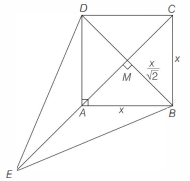
Let $A B C D$ be a square and $E$ be a point outside $A B C D$ such that $E, A, C$ are collinear in that order. Suppose $E B=E D=\sqrt{130}$ and the areas to $\triangle E A B$ and square $A B C D$ are equal. Then, the area of square $A B C D$ is

Answer

b
(b)

Given, area of $\triangle E A B=$ area of square $A B C D$

$E B=E D=\sqrt{130}$

Let side of square $=x$

$B M=\frac{x}{\sqrt{2}}=A M$

Area of $\triangle A E B=$ Area of $\triangle B E M$ - area of

$=\frac{1}{2} E M \times B M-\frac{1}{2} A M \times B M$

$=\frac{1}{2} B M(E M-A M)$

$=\frac{1}{2} \frac{x}{\sqrt{2}}\left(\sqrt{\left.130-\frac{x^2}{2}-\frac{x}{\sqrt{2}}\right)}\right.$

$=\frac{1}{2}+\frac{x}{\sqrt{2}}\left(\sqrt{\left.130-\frac{x^2}{2}-\frac{x}{\sqrt{2}}\right)=x^2}\right.$

$=\sqrt{130-\frac{x^2}{2}}=2 \sqrt{2} x+\frac{x}{\sqrt{2}}$

$130-\frac{x^2}{2}=\left(\begin{array}{c}5 x \\ \sqrt{2}\end{array}\right)^2$

$130-\frac{x^2}{2}=\begin{array}{c}25 x^2 \\ 2\end{array}$

$13 x^2=130 \Rightarrow x^2=10$

$\therefore$ Area of square $=10$
Need a full question paper?

Generate a complete, print-ready paper with questions like this in minutes — across 16+ boards, with answer keys.

Start Generating Free

Similar questions

The value of the expression $(sinx + cosecx)^2 + (cosx + secx)^2 - ( tanx + cotx)^2$ wherever defined is equal to
Number of solutions of $5$ $cos^2 \theta  -3 sin^2 \theta  + 6 sin \theta  cos \theta  = 7$ in the interval $[0, 2 \pi] $ is :-
If $\alpha $ and $\beta $ are different complex numbers with $|\beta | = 1$, then $\left| {\frac{{\beta - \alpha }}{{1 - \overline \alpha \beta }}} \right|$ is equal to
Let $f: R \rightarrow R$ be a continuous function satisfying $f(x)=x+\int \limits_0^x f(t) d t$, for all $x \in R$. Then, the number of elements in the set $S=\{x \in R: f(x)=0\}$ is
If the roots of the equation ${x^2} + x + 1 = 0$ are $\alpha ,\beta $ and the roots of the equation ${x^2} + px + q = 0$ are $\frac{\alpha }{\beta },\frac{\beta }{\alpha }$ then $p$ is equal to
The number of real roots of the equation $e^{6 x}-e^{4 x}-2 e^{3 x}-12 e^{2 x}+e^{x}+1=0$ is:
Numbers greater than $1000$ but not greater than $4000$ which can be formed with the digits $0, \,1, \,2, \,3, \,4$ (repetition of digits is allowed), are
Let $A=\{1,2,3, \ldots \ldots .100\}$. Let $R$ be a relation on A defined by $(x, y) \in R$ if and only if $2 x=3 y$. Let $R_1$ be a symmetric relation on $A$ such that $\mathrm{R} \subset \mathrm{R}_1$ and the number of elements in $\mathrm{R}_1$ is $\mathrm{n}$. Then, the minimum value of $n$ is..........................
Let $A$ be a $3\ 3$ matrix of non $-$ negative real elements such that $A \left[\begin{array}{l}1 \\ 1 \\ 1\end{array}\right]=3\left[\begin{array}{l}1 \\ 1 \\ 1\end{array}\right]$. Then the maximum value of det $(A)$ is $...........$
The coefficient of ${x^5}$ in the expansion of ${(x + 3)^6}$ is