Questions

Solve the Following Question.(4 Marks)

🎯

Test yourself on this topic

13 questions · timed · auto-graded

Question 14 Marks
Find the direction cosines of the line perpendicular to the line whose direction ratios are $-2,1,-1$ and $-3,-4,1$.
Answer

Let $\bar{a}$ and $\bar{b}$ be the vectors along the lines whose direction ratios are $-2,1,-1$ and $-3,-4,1$ respectively.
$\therefore \bar{a}=-2 \hat{i}+\hat{j}-\widehat{k}$ and $\hat{b}=-3 \hat{i}-4 \hat{j}+\widehat{k}$
A vector perpendicular to both $\bar{a}$ and $\bar{b}$ is given by
$\bar{a} \times \bar{b}=\left|\begin{array}{ccc}\hat{i} & \hat{j} & \widehat{k} \\ -2 & 1 & -1 \\ -3 & -4 & 1\end{array}\right|$
$=(1-4) \hat{i}-(-2-3) \hat{j}+(8+3) \widehat{k}$
$=-3 \hat{i}+5 \hat{j}+11 \widehat{k}$
∴ the direction ratios of the required line are -3, 5, 11
Now, $\sqrt{9+25+12}=\sqrt{155}$
Direction cosine of the line are $-\frac{3}{\sqrt{155}}, \frac{5}{\sqrt{155}}, \frac{11}{\sqrt{155}}$.
View full question & answer
Question 24 Marks
Show that volume of parallelepiped with coterminous edges as $\bar{a}, \bar{b}$ and $\bar{c}$ is $[\bar{a} \bar{b} \bar{c}]$. hence find the volume of the parallelepiped whose coterminous are $\hat{i}+\hat{j}, \hat{j}+\hat{k}, \hat{k}+\hat{i}$
Answer
coming soon
View full question & answer
Question 34 Marks
Find the volume of a tetrahedron whose vertices are A(-1, 2,3), B(3,-2,1), C(2, 1,3) and D(-1,-2,4).
Answer

The position vectors $\bar{a}, \bar{b}, \bar{c}$ and $\bar{d}$ of the points $A, B, C$ and $D$ w.r.t. the origin are
$\overline{ a }=-\hat{ i }+2 \hat{ j }+3 \hat{ k }$
$\overline{ b }=3 \hat{ i }-2 \hat{ j }+\hat{ k }$
$\bar{c}=2 \hat{i}+\hat{j}+3 \hat{k}$
And $\overline{ d }=-\hat{ i }-2 \hat{ j }+4 \hat{ k }$
$\therefore \overline{ AB }=\overline{ b }-\overline{ a }$
$=(3 \hat{i}-2 \hat{j}+\hat{k})-(-\hat{i}+2 \hat{j}+3 \hat{k})$
$=4 \hat{i}-4 \hat{j}-2 \hat{k}$
$\overline{ AC }=\overline{ c }-\overline{ a }$
$=(2 \hat{i}+\hat{j}+3 \hat{k})-(-\hat{i}+2 \hat{j}+3 \hat{k})$
$=3 \hat{ i }-\hat{ j }+0 \hat{ k }$
$\overline{ AD }=\overline{ d }-\overline{ a }$
$=(-\hat{ i }-2 \hat{ j }+4 \hat{ k })-(-\hat{ i }+2 \hat{ j }+3 \hat{ k })$
$=0 \hat{i}-4 \hat{j}+\hat{k}$
∴ Volume of the tetrahedron = $\left.\frac{1}{6} \right\rvert\,$ $[\overline{ AB }$ $\overline{ AC }$ $\overline{ AD }] \mid$
$=\frac{1}{6}\left|\begin{array}{ccc}4 & -4 & -2 \\ 3 & -1 & 0 \\ 0 & -4 & 1\end{array}\right|$
$=\frac{1}{6}[4(-1+0)+4(3-0)-2(-12+0)]$
$=\frac{1}{6}(-4+12+24)$
$=\frac{1}{6} \times 32$
$=\frac{16}{3}$ cubic units.

View full question & answer
Question 44 Marks
Using vectors prove that the altitudes of a triangle are concurrent.
Answer

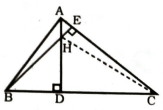
Image
In ∆ABC, Let altitudes AD and BE intersect at H.
Taking H as the origin, $\bar{a}, \bar{b}, \bar{c}$ be the position vectors of points A, B, C respectively.
Since $\overline{ HA }$ is perpendicular to $\overline{ BC }$,
$\therefore \bar{a} \cdot \overline{B C}=0$, i.e. $\bar{a} \cdot(\bar{c}-\bar{b})=0$,
i.e. $\bar{a} \cdot \bar{c}=\bar{a} \cdot \bar{b}$...(1)
Similarly $\overline{ HB }$ is perpendicular to $\overline{ AC }$.
$\therefore \bar{b} \cdot(\bar{c}-\bar{a})=0$ ,is $\bar{b} \cdot \bar{c}=\bar{a} \cdot \bar{b}$...(2)
Now we have to prove $\overline{ HC }$ is perpendicular to $\overline{ AB }$.
From (1) and (2)
$\bar{a} \cdot \bar{c}=\bar{b} \cdot \bar{c}$ i.e. $(\bar{a}-\bar{b}) \cdot \bar{c}=0$
i.e. $\overline{ BA } \cdot \overline{ HC }=0$
i.e. $\overline{ HC }$ is perpendicular to $\overline{ BA }$
Hence the altitudes of a triangle are concurrent.

View full question & answer
Question 54 Marks
Using vector method, find the incentre of the triangle whose vertices are $P(0,4,0), Q(0,0,3)$ and $R(0,4,3)$.
Answer

Let $\bar{p}, \bar{q}, \bar{r}$be the position vectors of vertices P, Q, R of Δ PQR respectively
$\bar{p}=4 \hat{j}, \bar{q}=3 \widehat{k}, \bar{r}=4 \hat{j}+3 \widehat{k}$
$\overline{P Q}=\bar{q}-\bar{p}=3 \widehat{k}-4 \hat{j}=-4 \hat{j}+3 \widehat{k}$
$\overline{Q R}=\bar{r}-\bar{q}=4 \hat{j}+3 \widehat{k}-3 \widehat{k}=4 \hat{j}$
$\overline{R P}=\bar{p}-\bar{r}=4 \hat{j}-4 \hat{j}-3 \widehat{k}=-3 \widehat{k}$
Let x, y, z be the lengths of opposites of vertices P,Q,R respectively.
$x=|\overline{Q R}|=4$
$y=|\overline{R P}|=3$
$z=|\overline{P Q}|=\sqrt{16+9}=\sqrt{25}=5$
If $H (\bar{h})$ is the incentre of $\Delta PQR$ then
$\bar{h}=\frac{x \bar{p}+y \bar{q}+z \bar{r}}{x+y+z}$
$=\frac{4(4 \hat{j})+3(3 \widehat{k})+5(4 \hat{j}+3 \widehat{k})}{4+3+5}$
$=\frac{16 \hat{j}+9 \widehat{k}+20 \hat{j}+15 \widehat{k}}{12}$
$=\frac{36 \hat{j}+24 \widehat{k}}{12}=3 \hat{j}+2 \widehat{k}$

View full question & answer
Question 64 Marks
If $l, m, n$ are the direction cosines of a line then prove that $l^2+m^2+n^2=1$. Hence find the direction angle of the line with the $X$-axis, which makes direction angles of $135^{\circ}$ and $45^{\circ}$ with $Y$ and $Z$ axes respectively.
Answer

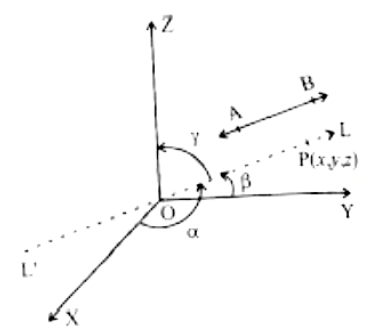
Let $\alpha, \beta, \gamma$ be the angles made by the line with $X _{-,} Y _{-}, Z -$ axes respectively.
Image
$l=\cos \alpha, m=\cos \beta$ and $n=\cos \gamma$
Let $\bar{a}=a_1 \hat{i}+a_2 \hat{j}+a_3 \widehat{k}$ be any non-zero vector along the line.
Since $\hat{i}$ is the unit vector along $X$-axis,
$\bar{a} . \hat{i}=|\bar{a}| \cdot|\hat{i}| \cos \alpha=a \cos \alpha$
Also, $\bar{a} . \hat{i}=\left(a_1 \hat{i}+a_2 \hat{j}+a_3 \widehat{k}\right) \cdot \hat{i}$
$=a_1 \times 1+a_2 \times 0+a_3 \times 0=a_1$
$a \cos \alpha=a_1$......(1)
Since $\hat{j}$ is the unit vector along $Y$-axis,
$\bar{a} \cdot \hat{j}=|\bar{a}| \cdot|\hat{j}| \cos \beta=a \cos \beta$
$\bar{a} \cdot \hat{j}=\left(a_1 \hat{i}+a_2 \hat{j}+a_3 \widehat{k}\right) \cdot \hat{j}$
$=a_1 \times 0+a_2 \times 1+a_3 \times 0=a_2$
$a \cos \beta=a_2$......(2)
similarly $a \cos \gamma=a_3$......(3)
from equations (1), (2) and (3),
$a^2 \cos ^2 \alpha+a^2 \cos ^2 \beta+a^2 \cos ^2 \gamma=a_1^2+a_2^2+a_3^2$
$a^2\left(\cos ^2 \alpha+\cos ^2 \beta+\cos ^2 \gamma\right)=a^2$
$\left[a=|\bar{a}|=\sqrt{a_1^2+a_2^2+a_3^2}\right]$
$\therefore \cos ^2 \alpha+\cos ^2 \beta+\cos ^2 \gamma=1$
i. $e l^2+m^2+n^2=1$
also
$\alpha=?, \beta=135^{\circ}, \gamma=45^{\circ}$
$\cos ^2 \alpha+\cos ^2 \beta+\cos ^2 \gamma=45^{\circ}$
$\cos ^2 \alpha+\cos ^2 135^{\circ}+\cos ^2 45^{\circ}=1$
$\cos ^2 \alpha+\frac{1}{2}+\frac{1}{2}=1$
$\cos ^\alpha=0$
$\therefore \alpha=\frac{\pi}{2}$ or $\frac{3 \pi}{2}$


View full question & answer
Question 74 Marks
If $\bar{a}$ and $\bar{b}$ are two non-zero and non-collinear vectors then prove that any vector $\bar{r}$ coplanar with $\bar{a}$ and $\bar{b}$ can be expressed as $\bar{r}=t_1 \bar{a}+t_2 \bar{b}$. where $t_1$ and $t_2$ are scalars.
Answer
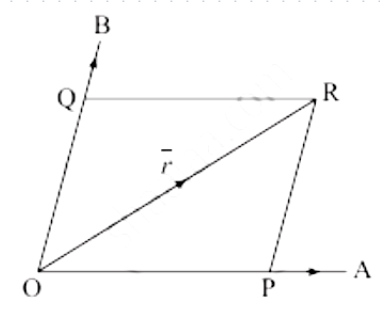
Let $\bar{a}, \bar{b}, \bar{r}$ be coplanar.
Take any point $O$ in the plane of $\bar{a}, \bar{b}$ and $\bar{r}$.
Represents the vectors $\bar{a}, \bar{b}$ and $\bar{r}$ by $\overline{O A}, \overline{O B}$ and $\overline{O R}$.
Take the point $P$ on $\bar{a}$ and $Q$ on $\bar{b}$ such that $\text{OPRQ}$ is a parallelogram.
Image
Now, $\overline{O P}$ and $\overline{O A}$ are collinear vectors.
$\therefore$ There exists a non-zero scalar t_1 such that
$\overline{O P}=t_1 \cdot \overline{O A}=t_1 \cdot \bar{a}$
Also, $\overline{O Q}$ and $\overline{O B}$ are collinear vectors.
$\therefore$ There exists a non$-$zero scalar $t _2$ such that
$\overline{O P}=t_2 \cdot \overline{O B}=t_2 \cdot \bar{b}$
Now, by parallelogram law of addition of vectors,
$\overline{O R}=\overline{O P}+\overline{O Q}$
$\therefore \bar{r}=t_1 \bar{a}+t_2 \bar{b}$
Thus, $\bar{r}$ is expressed as a linear combination $t_1 \bar{a}+t_2 \bar{b}$.
Uniqueness: Let, if possible,
$\bar{r}=t_1^{\prime} \bar{a}+t_2^{\prime} \bar{b}$, where $t _1{ }^{\prime}, t _2{ }^{\prime}$ are non-zero scalars.
Then, $t_1 \bar{a}+t_2 \bar{b}=t_1^{\prime} \bar{a}+t_2^{\prime} \bar{b}$
$\therefore\left(t_1-t_1^{\prime}\right) \bar{a}=-\left(t_2-t_2^{\prime}\right) \bar{b} \ldots . .(1)$
We want to show that $t_1=t_1{ }^{\prime}$ and $t_2=t_2{ }^{\prime}$
Suppose $t _1 \neq t _1{ }^{\prime}$, i.e. $t _1- t _1{ }^{\prime} \neq 0$ and $t _2 \neq t _2$, i.e. $t _2- t _2 \neq 0$
Then dividing both sides of $(1)$ by $t_1 – t_1',$ we get
$\bar{a}=-\left(\frac{t_2-t_2^{\prime}}{t_1-t_1^{\prime}}\right) \bar{b}$
This shows that the vector $\bar{a}$ is a non-zero scalar multiple of $\bar{b}$.
$\therefore \bar{a}$ and $\bar{b}$ are collinear vectors.
This is a contradiction, since $\bar{a}, \bar{b}$ are given to be non-collinear.
$\therefore t_1 = t_1'$
Similarly, we can show that $t_2 = t_2'$
This shows that $\bar{r}$ is uniquely expressed as a linear combination $t_1 \bar{a}+t_2 \bar{b}$.
Conversely: Let $\bar{r}=t_1 \bar{a}+t_2 \bar{b}$, where $t _1, t _2$ are scalars.
Since $\bar{a}, \bar{b}$ are coplanar, $t_1 \bar{a}, t_2 \bar{b}$ are also coplanar.
$\therefore \bar{r}=t_1 \bar{a}+t_2 \bar{b}$ is coplanar with $\bar{a}$ and $\bar{b}$.
View full question & answer
Question 84 Marks
Prove that three vectors $\vec{a}, \vec{b}$ and $\vec{c}$ are coplanar if and only if there exists non-zero linear combination $x \vec{a}+y \vec{b}+z \vec{c}=\overrightarrow{0}$.
Answer
coming soon
View full question & answer
Question 94 Marks
If $\alpha, \beta, \gamma$ are direction angles of line $\ell$, then prove that $\cos ^2 \alpha+\cos ^2 \beta+\cos ^2 \gamma=1$. Hence deuce that $\sin ^2 \alpha+\sin ^2 \beta+\sin ^2 \gamma=2$.
Answer
coming soon
View full question & answer
Question 104 Marks
Let $A (\bar{a})$ and $B (\bar{b})$ be any two points in the space $R (\bar{r})$ be a point on the line segment $AB$ dividing it internally in the ratio $m: n$, then prove that $\bar{r}=\frac{m \bar{b}+n \bar{a}}{m+n}$. Hence find the position vector $R$ which divides the line segment joining the points $A(1,-2,1)$ and $B(1,4,-2)$ internally in the ratio $2: 1$
Answer

Image
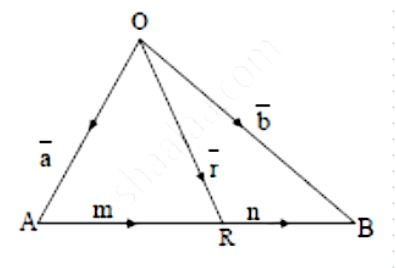
Consider a line segment AB. 
Let R be any point on it such that point R divides AB internally in the ratio m : n.
bar(OA) = bara, bar(OR) = barr and bar(OB) = barb are the position vectors of points A, R, B respectively. Since point R divides AB internally in the ratio m : n,
$\begin{aligned} & \frac{A R}{R B}=\frac{m}{n} \\ & n(A R)=m(R B)\end{aligned}$
$\overline{A R}$ and $\overline{R B}$ are in the same direction.
$\therefore n(\overline{A R})=m(\overline{R B})$
$n(\bar{r}-\bar{a})=m(\bar{b}-\bar{r})$
$n \bar{r}-n \bar{a}=m \bar{b}-m \bar{r}$
$n \bar{r}+m \bar{r}=m \bar{b}+m \bar{a}$
$\bar{r}(m+n)=m \bar{b}+n \bar{a}$
$\bar{r}=\frac{m \bar{b}+n \bar{a}}{m+n}$......(1)
This is the section formula for internal division
Let P. V. of point $A \bar{a}=\hat{i}-2 \hat{j}+\widehat{k}$
P. V. of point $B \bar{b}=\hat{i}+4 \hat{j}-2 \widehat{k}$
Given, $\frac{m}{n}=\frac{2}{1}$
Now, $\bar{r}=\frac{2(\hat{i}+4 \hat{j}-2 \widehat{k})+1(\hat{i}-2 \hat{j}+\widehat{k})}{2+1}$......from (1)
$\bar{r}=\frac{3 \hat{i}+6 \hat{j}-3 \widehat{k}}{3}$
P. V. of $R$ is $\bar{r}=\hat{i}+2 \hat{j}-\widehat{k}$

View full question & answer
Question 114 Marks
A line makes angles of measure $45^{\circ}$ and $60^{\circ}$ with positive direction of $y$ and $z$ axes respectively. Find the d.c.s. of the line and also find the vector of magnitude 5 along the direction of line.
Answer

Let α, β, γ be the direction angles of the line
β=45°, γ=60°
$m=\cos \beta=\cos 45^{\circ}=\frac{1}{\sqrt{2}}$ and $n=\cos \gamma=\cos 60^{\circ}=\frac{1}{2}$
Since, $\cos ^2 \alpha+\cos ^2 \beta+\cos ^2 \gamma=1$
$\therefore \cos ^2 \alpha+\left(\frac{1}{\sqrt{2}}\right)^2+\left(\frac{1}{2}\right)^2=1$
$\therefore \cos ^2 \alpha=1-\frac{1}{2}-\frac{1}{4}=\frac{1}{4}$
$\therefore \cos \alpha= \pm \frac{1}{2}$
i.e $l= \pm \frac{1}{2}, m=\frac{1}{\sqrt{2}}, n=\frac{1}{2}$
The unit vectors along the direction of line are
$\widehat{u}=l \hat{i}+m \hat{j}+n \widehat{k}$
$= \pm \frac{1}{2} \hat{i}+\frac{1}{\sqrt{2}} \hat{j}+\frac{1}{2} \widehat{k}$
∴ The vectors of magnitude 5 are
$5\left(\frac{1}{2} \hat{i}+\frac{1}{\sqrt{2}} \hat{j}+\frac{1}{2} \widehat{k}\right)$ and $5\left(-\frac{1}{2} \hat{i}+\frac{1}{\sqrt{2}} \hat{j}+\frac{1}{2} \widehat{k}\right)$


View full question & answer
Question 124 Marks
Find the volume of the parallelepiped whose coterminous edges are given by vectors $2 \hat{i}+3 \hat{\jmath}-4 \hat{k}, 5 \hat{i}+7 \hat{\jmath}+5 \hat{k}$ and $4 \hat{\imath}+5 \hat{\jmath}-2 \hat{k}$
Answer

If $\vec{a} \vec{b}$ and $\vec{c}$ are conterminus edges of parallelopiped then the volume of the parallelopiped $=\left[\begin{array}{lll}\vec{a} & \vec{b} & \vec{c}\end{array}\right]$
where $\vec{a}=2 \hat{i}+3 \hat{j}-4 \widehat{k}$
$\vec{b}=5 \hat{i}+7 \hat{j}+5 \widehat{k}$
$\vec{c}=4 \hat{i}+5 \hat{j}-2 \widehat{k}$
$\therefore V=[\vec{a} \vec{b} \vec{c}]=\left[\begin{array}{ccc}2 & 3 & -4 \\ 5 & 7 & 5 \\ 4 & 5 & -2\end{array}\right]$
$=2(-14-25)-3(-10-20)-4(25-28)$
$=2(-39)-3(-30)-4(-3)$
$=-78+90+12$
$=24$ cube Unit

View full question & answer
Question 134 Marks
Prove that the volume of the parallelepiped with coterminous edges as $\bar{a}, \bar{b}, \bar{c}$ is $[\bar{a} \bar{b} \bar{c}]$, and hence find the volume of the parallelepiped with its coterminous edges $2 \hat{i}+5 \hat{j}-4 \hat{k}, 5 \hat{i}+7 \hat{j}+5 \hat{k}$ and $4 \hat{i}+5 \hat{j}-2 \hat{k}$
Answer
coming soon
View full question & answer
Solve the Following Question.(4 Marks) - Maths STD 12 Science Questions - Vidyadip