MCQ
Let a function $f:\left( {0,\infty } \right) \to \left( {0,\infty } \right)$ be defined by $f\left( x \right) = \left| {1 - \frac{1}{x}} \right|$. Then $f$ is
  • A
    not injective but it is surjective
  • B
    injective only
  • neither injective nor surjective
  • D
    both injective as well as surjective

Answer

Correct option: C.
neither injective nor surjective
c
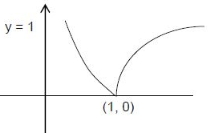
$y = \left| {1 - \frac{1}{x}} \right|$

Neither one -one nor Onto

Need a full question paper?

Generate a complete, print-ready paper with questions like this in minutes — across 16+ boards, with answer keys.

Start Generating Free

Similar questions

Let $f (x) = \frac{1}{x}\,\ln \left( {\frac{x}{{{e^x}}}} \right)$ then its primitive $w.r.t. \,\,x$ is
$\int_{}^{} {\frac{{dx}}{{(x + 1)(x + 2)}} = } $
If $f(x) = \frac{x}{{x - 1}} = \frac{1}{y}$, then $f(y) = $
$\text{f(x)}=\begin{cases}\frac{\sqrt{1+\text{px}}-\sqrt{1-\text{px}}}{\text{x}},&\text{if }0\leq\text{x}<0\\\frac{2\text{x}+1}{\text{x}-2},&\text{if }0\leq\text{x}\leq1\end{cases}$ is continuous in the interval [-1, 1], then p is equal to:
  1. $-1$
  2. $-\frac{1}{2}$
  3. $\frac{1}{2}$
  4. $1$
Let $\int_\alpha^{\log _e^4} \frac{\mathrm{dx}}{\sqrt{\mathrm{e}^{\mathrm{x}}-1}}=\frac{\pi}{6}$. Then $\mathrm{e}^\alpha$ and $\mathrm{e}^{-\alpha}$ are the roots of the equation :
A function $f (x)$ satisfies the condition, $f (x) = f ‘ (x) + f ‘‘ (x) + f ‘‘‘ (x) + ...... \infty$ where $f (x)$ is a differentiable function indefinitely and dash denotes the order of derivative . If $f (0) = 1$, then $f (x)$ is :
If area bounded by the curve $x^2y + y^2x = \alpha xy$ is $2$ units, then possible values of $\alpha $ is / are
Given the function $f(x) = 2x \sqrt {{x^3}\, - \,\,1}    + 5 \sqrt x  \sqrt {1\,\, - \,\,{x^4}}  + 7x^2 \sqrt {x\,\, - \,\,1} + 3x + 2$ then :
Solution of the equation
$sec^2x\ tany\,dx + sec^2y\ tanx\,dy = 0,y \left( {\frac{\pi }{4}} \right) = \frac{\pi}{3}$ is :-
Let $\sqrt 3 \hat i + j,\hat i + \sqrt 3 \hat j$ and $\beta \hat i + \left( {1 + \beta } \right)\hat j$ respectively be the position vectors of the points $A,B$ and $C$ with respect to the origin $O$. If the distance of $C$ from the bisector of the acute angle between $OA$ and $OB$ is $\frac{3}{{\sqrt 2 }}$ , then the sum of all possible values of $\beta $ is