MCQ
Let a function $g:[0,4] \rightarrow R$ be defined as

$g ( x )=\left\{\begin{array}{ll}\max _{0 \leq t \leq x }\left\{ t ^{3}-6 t ^{2}+9 t -3\right\} & , 0 \leq x \leq 3 \\ 4- x & , 3 < x \leq 4\end{array}\right.$ then the number of points in the interval $(0,4)$ where $g(x)$ is NOT differentiable, is $.....$

  • A
    $5$
  • B
    $3$
  • $1$
  • D
    $11$

Answer

Correct option: C.
$1$
c
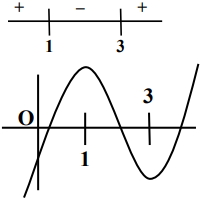
$f(X)=x^{3}-6 x^{2}+9 x-3$

$f(x)=3 x^{2}-12 x+9=3(x-1)(x-3)$

$f(1)=1$ and $f(3)=-3$

$g(x)=f(x) \quad\quad 0 \leq x \leq 1$

$\quad\quad\quad\quad1 \quad\quad\quad 1 \leq x \leq 3$

$\quad\quad\quad\quad4-x \quad 3$

$g(x)$ is continuous

$g^{\prime}(x)=3(x-1)(x-3) \quad\quad 0 \leq x \leq 1$

$\quad\quad\quad\quad0\quad\quad\quad\quad \quad \quad \quad 1 \leq x \leq 3$

$\quad\quad\quad\quad-1 \quad \quad \quad \quad \quad \quad 3$

$g(x)$ is non-differentiable at $x=3$

Need a full question paper?

Generate a complete, print-ready paper with questions like this in minutes — across 16+ boards, with answer keys.

Start Generating Free

Similar questions

$\int_0^a {{x^2}\sin {x^3}\,dx} $ equals
For any square matrix $A, A A^T$ is a
The integral $\int_{\pi /6}^{\pi /4} {\frac{{dx}}{{\sin \,2x\,\left( {{{\tan }^5}\,x + {{\cot }^5}\,x} \right)}}} $ equals 
Let $a$ and $\mathrm{b}$ respectively be the points of local maximum and local minimum of the function $f(x)=2 x^{3}-3 x^{2}-12 x .$ If $A$ is the total area of the region bounded by $\mathrm{y}=\mathrm{f}(\mathrm{x})$, the $\mathrm{x}$-axis and the lines $x=a$ and $x=b$, then $4 A$ is equal to ..... .
If $\int_{}^{} {(\sin 2x + \cos 2x)\;dx = \frac{1}{{\sqrt 2 }}\sin (2x - c) + a} $, then the value of  $a$  and  $c$  is
Area bounded by the curve $y = \min \{\sin^2x, \cos^2x \}$ and $x-$ axis between the ordinates $x = 0$ and $x = \frac{{5\pi }}{4}$ is
If $A$ is a square matrix of order $3$ such that $ \operatorname{det}(\mathrm{A})=3 \text { and } $ $ \operatorname{det}\left(\operatorname{adj}\left(-4 \operatorname{adj}\left(-3 \operatorname{adj}\left(3 \operatorname{adj}\left((2 \mathrm{~A})^{-1}\right)\right)\right)\right)\right)=2^{\mathrm{m}} 3^{\mathrm{n}},$ then $m+\mid 2 n$ is equal to:
If $f(x)=x^3-x^2 f^{\prime}(1)+x f^{\prime \prime}(2)-f^{\prime \prime \prime}(3), x \in R$, then
$\int_{}^{} {(3\,{\rm{cose}}{{\rm{c}}^2}x + 2\sin 3x)\;dx = } $
If the solution $y(x)$ of the given differential equation $\left(e^y+1\right) \cos x d x+e^y \sin x d y=0$ passes through the point $\left(\frac{\pi}{2}, 0\right)$, then the value of $e^{y\left(\frac{\pi}{6}\right)}$ is equal to ...........