MCQ
Let $A =\left[\begin{array}{cc}\frac{1}{\sqrt{2}} & -2 \\ 0 & 1\end{array}\right]$ and $P =\left[\begin{array}{cc}\cos \theta & -\sin \theta \\ \sin \theta & \cos \theta\end{array}\right], \theta>0$.
If $B = PAP ^{ T }, C = P ^{\top} B ^{10} P$ and the sum of the diagonal elements of C is $\frac{ m }{ n }$, where $\operatorname{gcd}( m , n )=$ 1 , then $m + n$ is :
  • A
    65
  • B
    127
  • C
    258
  • D
    2049

Answer

A.
$P=\left[\begin{array}{cc}\cos \theta & -\sin \theta \\ \sin \theta & \cos \theta\end{array}\right]$
$\because P^{\top} P=I$
$B = PAPT$
Pre multiply by $P ^{\top}$ ( Given)
$P ^T B= P ^T P A P ^T= AP ^T$
Now post multiply by P
$P ^{\top} BP = AP ^{\top} P = A$
Image
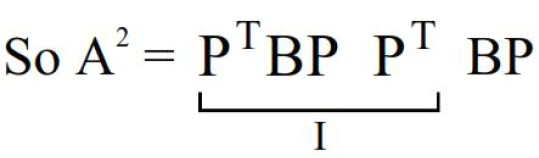
$A^2=P^T B^2 P$
Similarly $A ^{10}= P ^{ T } B ^{10} P = C$
$\begin{array}{l} A=\left[\begin{array}{cc} \frac{1}{\sqrt{2}} & -2 \\ 0 & 1 \end{array}\right]\text { (Given) } \end{array}$
$\Rightarrow A ^2=\left[\begin{array}{cc}\frac{1}{2} & -\sqrt{2}-2 \\ 0 & 1\end{array}\right]$
Similarly check $A^3$ and so on since $C=A^{10}$
$\Rightarrow$ Sum of diagonal elements of C is $\left(\frac{1}{\sqrt{2}}\right)^{10}+1$
$=\frac{1}{32}+1=\frac{33}{32}=\frac{ m }{ n }$
$\operatorname{gcd}( m , n )=1$ (Given)
$\Rightarrow m + n =65$

Need a full question paper?

Generate a complete, print-ready paper with questions like this in minutes — across 16+ boards, with answer keys.

Start Generating Free

Similar questions

A group of $9$ students, $s 1, s 2, \ldots, s 9$, is to be divided to form three teams $X, Y$ and, $Z$ of sizes $2,3$ , and $4$, respectively. Suppose that $s_1$ cannot be selected for the team $X$, and $s_2$ cannot be selected for the team $Y$. Then the number of ways to form such teams, is. . . .
Let $O$ be the origin and $A$ be the point $z _{1}=1+2 i$. If $B$ is the point $z _{2}, \operatorname{Re}\left( z _{2}\right)<0$, such that $OAB$ is a right angled isosceles triangle with $OB$ as hypotenuse, then which of the following is NOT true?
If $2x + 3y - 5z = 7, \,x + y + z = 6$, $3x - 4y + 2z = 1,$ then  $x =$
Consider the following parametric equation of a curve $ x(\theta)=|\cos 4 \theta| \cos \theta $ ; $ y(\theta)=|\cos 4 \theta| \sin \theta $ ; $ 0 \leq \theta \leq 2 \pi $ Which one of the following graphs represents the curve?
In a binomial distribution $B ( n , p )$, the sum and product of the mean and variance are $5$ and $6$ respectively, then find $6(n+p-q)$ is equal to :-
If the tangent to the parabola $y^2 = x$ at a point $\left( {\alpha ,\beta } \right)\,,\,\left( {\beta  > 0} \right)$ is also a tangent to the ellipse, $x^2 + 2y^2 = 1$, then $a$ is equal to
$\mathop {\lim }\limits_{\theta \to 0} \frac{{\sin 3\theta - \sin \theta }}{{\sin \theta }} = $
Find the value of $a, \,b,\, c,$ and $d$ from the equation: $\left[\begin{array}{cc}a-b & 2 a+c \\ 2 a-b & 3 c+d\end{array}\right]=\left[\begin{array}{cc}-1 & 5 \\ 0 & 13\end{array}\right]$
The general solution of the differential equation, $\sin \,2x\,\left( {\frac{{dy}}{{dx}} - \sqrt {\tan \,x} } \right) - y = 0,$ is
The graph of the function $f(x)=x+\frac{1}{8} \sin (2 \pi x), 0 \leq x \leq 1$ is shown below. Define $f_1(x)=f(x), f_{n+1}(x)=f\left(f_n(x)\right)$, for $n \geq 1$.

Which of the following statements are true?

$I.$ There are infinitely many $x \in[0,1]$ for which $\lim _{n \rightarrow \infty} f_n(x)=0$

$II.$ There are infinitely many $x \in[0,1]$ for which $\lim _{n \rightarrow \infty} f_n(x)=\frac{1}{2}$

$III.$ There are infinitely many $x \in[0,1]$ for which $\lim _{n \rightarrow \infty} f_n(x)=1$

$IV.$ There are infinitely many $x \in[0,1]$ for which $\lim _{n \rightarrow \infty} f_n(x)$ does not exist.