MCQ 14 Marks
Let $f: \mathbf{R}-\{0\} \rightarrow(-\infty, 1)$ be a polynomial of degree 2, satisfying $f(\mathrm{x}) f\left(\frac{1}{\mathrm{x}}\right)=f(\mathrm{x})+f\left(\frac{1}{\mathrm{x}}\right)$. If $f(\mathrm{~K})=-2 \mathrm{~K}$, then the sum of squares of all possible values of K is :
AnswerB.
as $f(x)$ is a polynomial of degree two let it be
$f(x)=a x^{2}+b x+c \quad(a \neq 0)$
on satisfying given conditions we get
$\mathrm{C}=1~ \&~ \mathrm{a}= \pm 1$
hence $f(x)=1 \pm x^{2}$
also range $\in(-\infty, 1]$ hence
$\mathrm{f}(\mathrm{x})=1-\mathrm{x}^{2}$
now $f(k)=-2 k$
$1-\mathrm{k}^{2}=-2 \mathrm{k} \rightarrow \mathrm{k}^{2}-2 \mathrm{k}-1=0$
let roots of this equation be $\alpha \& \beta$
$\text { then } \begin{aligned}\alpha^{2}+\beta^{2} & =(\alpha+\beta)^{2}-2 \alpha \beta \\& =4-2(-1)=6\end{aligned}$
View full question & answer→MCQ 24 Marks
If $A$ and $B$ are the points of intersection of the circle $x^{2}+y^{2}-8 x=0$ and the hyperbola $\frac{x^{2}}{9}-\frac{y^{2}}{4}=1$ and a point $P$ moves on the line $2 x-3 y+4=0$, then the centroid of $\triangle P A B$ lies on the line :
- A
$4 x-9 y=12$
- B
$x+9 y=36$
- C
$9 x-9 y=32$
- D
$6 x-9 y=20$
AnswerD.
$x^{2}+y^{2}-8 x=0, \frac{x^{2}}{9}-\frac{y^{2}}{4}=1\ldots(1)$
$4 x^{2}-9 y^{2}=36\ldots(2)$
Solve (1) & (2)
$4 x^{2}-9\left(8 x-x^{2}\right)=36$
$13 x^{2}-72 x-36=0$
$(13 x+6)(x=6)=0$
$x=\frac{-6}{13}, x=6$
$x=\frac{-6}{13}($ rejected $)$
$y \rightarrow$ Imaginary
$\mathrm{n}=6, \frac{36}{9}-\frac{\mathrm{y}^{2}}{4}=1$
$\mathrm{y}^{2}=12, \mathrm{y}=\mathrm{I} \sqrt{12}$
$\mathrm{A}(6, \sqrt{12}), \mathrm{B}(6,-\sqrt{12})$
$\mathrm{p}\left(\alpha, \frac{2 \alpha+4}{3}\right) \mathrm{P}$ lies on
centroid (h,k)$\quad$$\quad$$\quad$$2 x-3 y+y=0$
$\mathrm{h}=\frac{12+\alpha}{3}, \alpha=3 \mathrm{~h}-12$
$\mathrm{k}=\frac{\frac{2 \alpha+4}{3}}{3} \Rightarrow 2 \alpha+4=9 \mathrm{k}$
$\alpha=\frac{9 \mathrm{k}-4}{2}$
$6 \mathrm{~h}-2 \mathrm{y}=9 \mathrm{k}-4$
$6 x-9 y=20$
View full question & answer→MCQ 34 Marks
Let the coefficients of three consecutive terms $T_{r}$, $T_{r+1}$ and $T_{r+2}$ in the binomial expansion of $(a+b)^{12}$ be in a G.P. and let p be the number of all possible values of $r$. Let $q$ be the sum of all rational terms in the binomial expansion of $(\sqrt[4]{3}+\sqrt[3]{4})^{12}$. Then $\mathrm{p}+\mathrm{q}$ is equal to :
AnswerA.
$(a+b)^{\frac{1}{2}}$
$\mathrm{T}_{\mathrm{r}}, \mathrm{T}_{\mathrm{r}+1}, \mathrm{~T}_{\mathrm{r}+2} \rightarrow \mathrm{GP}$
So, $\frac{T_{r+1}}{T_{r}}=\frac{T_{r+2}}{T_{r+1}}$
$\frac{{ }^{12} \mathrm{C}_{\mathrm{r}}}{{ }^{12} \mathrm{C}_{\mathrm{r}-1}}=\frac{{ }^{12} \mathrm{C}_{\mathrm{r}+1}}{{ }^{12} \mathrm{C}_{\mathrm{r}}}$
$\frac{12-\mathrm{r}+1}{\mathrm{r}}=\frac{12-(\mathrm{r}+1)+1}{\mathrm{r}+1}$
$(13-r)(r+1)=(12-r)(r)$
$-\mathrm{r}+12 \mathrm{r}+13=12 \mathrm{r}-\mathrm{r}^{2}$
$
13=0
$
No value of $r$ possible
So $\mathrm{P}-0$
$\left(3^{\frac{1}{4}}+4^{\frac{1}{3}}\right)^{12}=\sum{ }^{12} C_{r}\left(3^{\frac{1}{4}}\right)^{12-r}\left(4^{\frac{1}{3}}\right)^{r}$
Exponent of $\left(3^{\frac{1}{4}}\right)$ exponent of $\left(4^{\frac{1}{3}}\right)$ term
$
\mathrm{q}=27+256=283
$
$\mathrm{p}+\mathrm{q}=0+283=283$ View full question & answer→MCQ 44 Marks
Two equal sides of an isosceles triangle are along $-x+2 y=4$ and $x+y=4$. If $m$ is the slope of its third side, then the sum, of all possible distinct values of $m$, is :
AnswerC.
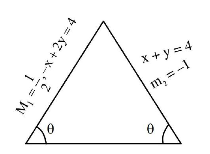
$\tan \theta=\frac{m-\frac{1}{2}}{1+\frac{1}{2} \cdot m}=\frac{-1-m}{1-m}=\frac{m+1}{m-1}$
$\frac{2 \mathrm{~m}-1}{2+\mathrm{m}}=\frac{\mathrm{m}+1}{\mathrm{~m}-1}$
$2 \mathrm{~m}^{2}-3 \mathrm{~m}+1=\mathrm{m}^{2}+3 \mathrm{~m}+2$
$m^{2}-6 m-1=0$
sum of root $=6$
sum is 6 View full question & answer→MCQ 54 Marks
If $\sum_{r=1}^{13}\left\{\frac{1}{\sin \left(\frac{\pi}{4}+(r-1) \frac{\pi}{6}\right) \sin\left(\frac{\pi}{4}+\frac{r \pi}{6}\right)}\right\}=a \sqrt{3}+b$,$a, b \in \mathbf{Z}$, then $a^{2}+b^{2}$ is equal to :
AnswerC.
$\frac{1}{\sin \frac{\pi}{6}} \sum_{r=1}^{13} \frac{\sin \left[\left(\frac{\pi}{4}+\frac{r \pi}{6}\right)-\left(\frac{\pi}{4}\right)-(r-1) \frac{\pi}{6}\right]}{\sin \left(\frac{\pi}{4}+(r-1) \frac{\pi}{6}\right) \sin \left(\frac{\pi}{4}+\frac{r \pi}{6}\right)}$$\frac{1}{\sin \frac{\pi}{6}} \sum_{r=1}^{13}\left(\cot \left(\frac{\pi}{4}+(r-1) \frac{\pi}{6}\right)-\cot \left(\frac{\pi}{4}+\frac{r \pi}{6}\right)\right)$
$=2 \sqrt{3}-2=\alpha \sqrt{3}+b$
So $\mathrm{a}^{2}+\mathrm{b}^{2}=8$
View full question & answer→MCQ 64 Marks
Let $[\mathrm{x}]$ denote the greatest integer less than or equal to $x$. Then domain of $f(x)=\sec ^{-1}(2[x]+1)$ is :
- A
$(-\infty,-1] \cup[0, \infty)$
- B
$(-\infty,-\infty)$
- C
$(-\infty,-1] \cup[1, \infty)$
- D
$(-\infty, \infty]-\{0\}$
AnswerB.
$2[x]+1 \leq-1$ or $2[x]+1 \geq 1$
$\begin{aligned}& \Rightarrow[\mathrm{x}] \leq-1 \cup[\mathrm{x}] \geq 0 \\& \Rightarrow \mathrm{x} \in(-\infty, 0) \cup \mathrm{x} \in[0, \infty) \\& \Rightarrow \mathrm{x} \in(-\infty, \infty)\end{aligned}$
View full question & answer→MCQ 74 Marks
Let $f:[0,3] \rightarrow \mathrm{A}$ be defined by$f(x)=2 \mathrm{x}^{3}-15 \mathrm{x}^{2}+36 \mathrm{x}+7$ and $\mathrm{g}:[0, \infty) \rightarrow \mathrm{B}$ be defined by $g(x)=\frac{x^{2025}}{x^{2025}+1}$. If both the functions are onto and $S=\{x \in \mathbf{Z}: x \in A$ or $x \in B\}$, then $n(S)$ is equal to :
AnswerA.
as $f(x)$ is onto hence A is range of $f(x)$
now $f^{\prime}(x)=6 x^{2}-30 x+36$
$=6(x-2)(x-3)$
$f(2)=16-60+72+7=35$
$f(3)=54-135+108+7=34$
$f(0)=7$
hence range $\in[7,35]=\mathrm{A}$
also for range of $g(x)$
$g(x)=1-\frac{1}{x^{2025}+1} \in[0,1)=B$
$s=\{0,7,8, \ldots . .,35\}$ hence $n(s)=30$
View full question & answer→MCQ 84 Marks
For positive integers $n$, if $4 a_{n}=\left(n^{2}+5 n+6\right)$and$\mathrm{S}_{\mathrm{n}}=\sum_{\mathrm{k}=1}^{\mathrm{n}}\left(\frac{1}{\mathrm{a}_{\mathrm{k}}}\right)$, then the value of $507 \mathrm{~S}_{2025}$ is :
AnswerC.
$\mathrm{a}_{\mathrm{n}}=\frac{\mathrm{n}^{2}+5\mathrm{n}+6}{4}$
$\begin{aligned}\mathrm{S}_{\mathrm{n}} & =\mathrm{S}_{\mathrm{n}}=\sum_{\mathrm{k}=1}^{\mathrm{n}}\frac{1}{\mathrm{a}_{\mathrm{k}}}=\sum_{1}^{\mathrm{n}} \frac{4}{\mathrm{k}^{2}+5 \mathrm{k}+6} \\& =4 \sum_{\mathrm{k}=1}^{\mathrm{n}} \frac{1}{(\mathrm{k}+2)(\mathrm{k}+3)} \\& =4 \sum_{\mathrm{k}=1}^{\mathrm{n}} \frac{1}{\mathrm{k}+2}-\frac{1}{\mathrm{k}+3} \\& =4\left(\frac{1}{3}-\frac{1}{4}\right)+4\left(\frac{1}{4}-\frac{1}{5}\right)+\ldots \ldots . .\end{aligned}$
$\begin{gathered}4\left(\frac{1}{\mathrm{n}+2}-\frac{1}{\mathrm{n}+3}\right) \\=4\left(\frac{1}{3}-\frac{1}{\mathrm{n}+3}\right) \\=\frac{4 \mathrm{n}}{3(\mathrm{n}+3)} \\{ }^{507} \mathrm{~S}_{2025}=\frac{(507)(4)(2025)}{3(2028)}\end{gathered}$
$=675$
View full question & answer→MCQ 94 Marks
Let $f : R \rightarrow R$ be a twice differentiable function such that $f(2)=1$. If $F ( x )= x f( x )$ for all $x \in R$, $\int_0^2 x F^{\prime}(x) d x=6$ and $\int_0^2 x^2 F^{\prime \prime}(x) d x=40$, then $F ^{\prime}(2)+\int_0^2 F( x ) dx$ is equal to :
AnswerA.
$\int_0^2 x F^{\prime}(x) d x=6$
$=\left.x F(x)\right|_0 ^2-\int_0^2 f(x) d x=6$
$=2 F(2)-\int_0^2 xF ( x ) dx =6[\therefore f (2)=2 F(2)=2]$
$\int_0^2 xF(x) dx=-2\quad\ldots (1)$
$\Rightarrow \int_0^2 F(x) dx=-2\quad\ldots (2)$
Also
$\int_0^2 x^2 F^{\prime \prime}(x) d x=\left.x^2 F^{\prime}(x)\right|_0 ^2-2 \int_0^2 x F^{\prime}(x) d x=40$
$=4 F^{\prime}(2)-2 \times 6=40$
$F^{\prime}(2)=13$
$\therefore F ^{\prime}(2)+\int_0^2 F( x )=13-2=11$
View full question & answer→MCQ 104 Marks
If $f(x)=\int \frac{1}{x^{1 / 4}\left(1+x^{1 / 4}\right)} dx , f(0)=-6$, then $f(1)$ is equal to :
AnswerB.
let $x=t^4$
$dx =4 t ^3 dt$
then $\int \frac{1}{x^{\frac{1}{4}}\left(1+x^{\frac{1}{4}}\right)} d x \Rightarrow \int \frac{4 t^3 d t}{t(1+t)}$
$\Rightarrow \int \frac{4 t }{1+ t } dt \Rightarrow 4 \int \frac{\left( t ^2-1\right)+1}{1+ t } dt$
$\Rightarrow 4 \int( t -1)+\frac{1}{ t +1} dt$
$\Rightarrow 4\left\{\frac{( t -1)^2}{2}+\ell n ( t +1)\right\}+ c$
hence $f(x)=2\left(x^{\frac{1}{4}}-1\right)^2+4 \ell n \left(1+x^{\frac{1}{4}}\right)+c$
$f(0)=-6 \Rightarrow 2+4 \ell n+6=-6 \rightarrow C=-8$
now $f(1)=4 \ell n 2-8$
$=4(\ell n 2-2)$
View full question & answer→MCQ 114 Marks
Let $A =\left[\begin{array}{cc}\frac{1}{\sqrt{2}} & -2 \\ 0 & 1\end{array}\right]$ and $P =\left[\begin{array}{cc}\cos \theta & -\sin \theta \\ \sin \theta & \cos \theta\end{array}\right], \theta>0$.
If $B = PAP ^{ T }, C = P ^{\top} B ^{10} P$ and the sum of the diagonal elements of C is $\frac{ m }{ n }$, where $\operatorname{gcd}( m , n )=$ 1 , then $m + n$ is :
AnswerA.
$P=\left[\begin{array}{cc}\cos \theta & -\sin \theta \\ \sin \theta & \cos \theta\end{array}\right]$
$\because P^{\top} P=I$
$B = PAPT$
Pre multiply by $P ^{\top}$ ( Given)
$P ^T B= P ^T P A P ^T= AP ^T$
Now post multiply by P
$P ^{\top} BP = AP ^{\top} P = A$
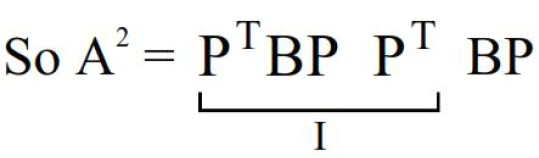
$A^2=P^T B^2 P$
Similarly $A ^{10}= P ^{ T } B ^{10} P = C$
$\begin{array}{l}
A=\left[\begin{array}{cc}
\frac{1}{\sqrt{2}} & -2 \\
0 & 1
\end{array}\right]\text { (Given) }
\end{array}$
$\Rightarrow A ^2=\left[\begin{array}{cc}\frac{1}{2} & -\sqrt{2}-2 \\ 0 & 1\end{array}\right]$
Similarly check $A^3$ and so on since $C=A^{10}$
$\Rightarrow$ Sum of diagonal elements of C is $\left(\frac{1}{\sqrt{2}}\right)^{10}+1$
$=\frac{1}{32}+1=\frac{33}{32}=\frac{ m }{ n }$
$\operatorname{gcd}( m , n )=1$ (Given)
$\Rightarrow m + n =65$ View full question & answer→MCQ 124 Marks
The area of the region bounded by the curves $x\left(1+y^2\right)=1$ and $y^2=2 x$ is:
- A
$2\left(\frac{\pi}{2}-\frac{1}{3}\right)$
- B
$\frac{\pi}{4}-\frac{1}{3}$
- C
$\frac{\pi}{2}-\frac{1}{3}$
- D
$\frac{1}{2}\left(\frac{\pi}{2}-\frac{1}{3}\right)$
AnswerC.
$x\left(1+y^2\right)=1……..(1)$
$y^2=2 x........(2)$
$\text { From equation (1) & (2) }$
$x(1+2 x)=1 \Rightarrow 2 x^2+x-1=0$
$\Rightarrow x =\frac{1}{2}, x =-1$ (Reject)
$\Rightarrow y^2=2\left(\frac{1}{2}\right)$
$\Rightarrow y = \pm 1$
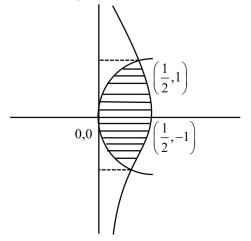
Area bounded $=\int_{-1}^1\left(\frac{1}{1+y^2}-\frac{y^2}{2}\right) d y$
$=\left.\left(\tan ^{-1} y-\frac{y^3}{6}\right)\right|_{-1} ^1$
$=\frac{\pi}{2}-\frac{1}{3}$ View full question & answer→MCQ 134 Marks
The square of the distance of the point $\left(\frac{15}{7}, \frac{32}{7}, 7\right)$ from the line $\frac{x+1}{3}=\frac{y+3}{5}=\frac{z+5}{7}$ in the direction of the vector $\hat{i}+4 \hat{j}+7 \hat{k}$ is :
AnswerC.
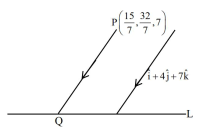
$L =\frac{ x +1}{3}=\frac{ y +3}{5}=\frac{ z +5}{7}$
$P Q=\frac{x-\frac{15}{7}}{1}=\frac{y-\frac{32}{7}}{4}=\frac{z-7}{7}=\lambda$
$\Rightarrow Q \left(\lambda+\frac{15}{7}, 4 \lambda+\frac{32}{7}, 7 \lambda+7\right)$
Since $Q$ lies on line $L$
So, $\frac{\lambda+\frac{15}{7}+1}{3}=\frac{7 \lambda+7+5}{7}$
$\Rightarrow 7 \lambda+22=21 \lambda+36$
$\Rightarrow \lambda=-1$
$\therefore$ Point $Q \left(\frac{8}{7}, \frac{4}{7}, 0\right)$
$PQ =\sqrt{\left(\frac{15}{7}-\frac{8}{7}\right)^2+\left(\frac{32}{7}-\frac{4}{7}\right)^2+(7-0)}$
$P Q=\sqrt{66}$
$\Rightarrow(P Q)^2=66$ View full question & answer→MCQ 144 Marks
Let $f$ be a real valued continuous function defined on the positive real axis such that $g ( x )=\int_0^{ x } t f( t ) dt$.
If $g\left(x^3\right)=x^6+x^7$, then value of $\sum_{r=1}^{15} f\left(r^3\right)$ is:
AnswerD.
$g(x)=x 2+x^{\frac{7}{3}}$
$g^{\prime}(x)=2 x+\frac{7}{3} x^{\frac{4}{3}}$
$f(x)=\frac{g^{\prime}(x)}{x}$
$f(x)=2+\frac{7}{3} x^{\frac{1}{3}}$
$f\left(r^3\right)=2+\frac{7 r}{3}$
$\sum_{r=1}^{15}\left(1+\frac{7}{3} r\right)=310$
View full question & answer→MCQ 154 Marks
Let S be the set of all the words that can be formed by arranging all the letters of the word GARDEN. From the set S , one word is selected at random. The probability that the selected word will NOT have vowels in alphabetical order is :
- A
$\frac{1}{4}$
- B
$\frac{2}{3}$
- C
$\frac{1}{3}$
- D
$\frac{1}{2}$
AnswerD.
A, E,G R D N
Probabllity $( P )=\frac{\text { favourable case }}{\text { Total case }}$
$\text { (when A & E are in order) }$
Total case $=6!$
Favourable case $={ }^6 C _2 .4!$
$P=\frac{(15) 4!}{(30) 4!}$
Probablity when not in order $=1-\frac{1}{2}=\frac{1}{2}$
View full question & answer→MCQ 164 Marks
If the midpoint of a chord of the ellipse $\frac{x^2}{9}+\frac{y^2}{4}=1$ is $(\sqrt{2}, 4 / 3)$, and the length of the chord is $\frac{2 \sqrt{\alpha}}{3}$, then $\alpha$ is :
AnswerB.
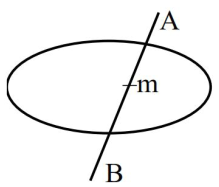
If $m \left(\sqrt{2}, \frac{4}{3}\right)$ than equation of of AB is
$T = S _1$
$\frac{x\sqrt{2}}{9}+\frac{y}{4}\left(\frac{4}{3}\right)=\frac{(\sqrt{2})^2}{9}+\frac{\left(\frac{4}{3}\right)^2}{4}$
$\frac{\sqrt{2} x}{9}+\frac{y}{3}=\frac{2}{9}+\frac{4}{9}$
$\sqrt{2} x+3 y=6 \Rightarrow y=\frac{6-\sqrt{2} x}{3}$ put in ellipse
So, $\frac{x^2}{9}+\frac{(6-\sqrt{2} x)^2}{9 \times 4}=1$
$4 x^2+36+2 x^2-12 \sqrt{2} x=36$
$6 x^2-12 \sqrt{2} x=0$
$6 x(x-2 \sqrt{2})=0$
$x=0 \& x=2 \sqrt{2}$
So $y=2 \quad y=\frac{2}{3}$
Length of chord $=\sqrt{(2 \sqrt{2}0)^2+\left(\frac{2}{3}2\right)^2}$
$=\sqrt{8+\frac{16}{9}}$
$=\sqrt{\frac{88}{9}}=\frac{2}{3} \sqrt{22}$ so $\alpha=22$ View full question & answer→MCQ 174 Marks
If $\alpha+i \beta$ and $\gamma+i \delta$ are the roots of
$x^2-(3-2 i) x-(2 i-2)=0, i=\sqrt{-1}$, then $\alpha \gamma+\beta \delta$ is equal to :
AnswerB.
$x^2-(3-2 i) x-(2 i-2)=0$
$x=\frac{(3-2 i) \pm \sqrt{(3-2 i)^2-4(1)(-(2 i-2))}}{2(1)}$
$==\frac{(3-2 i) \pm \sqrt{9-4-12 i+8 i-8}}{2}$
$==\frac{3-2 i \pm \sqrt{-3-4 i }}{2}$
$=\frac{3-2 i \pm \sqrt{(1)^2+(2 i )^2-2(1)(2 i )}}{2}$
$=\frac{3-2 i \pm(1-2 i )}{2}$
$\Rightarrow \frac{3-2 i +1-2 i }{2}$ or $\frac{3-2 i -1+2 i }{2}$
$\Rightarrow 2-2 i$ or $1+0 i$
So $\alpha \gamma+\beta \delta=2(1)+(-2)(0)=2$
View full question & answer→MCQ 184 Marks
If the components of $\overrightarrow{ a }=\alpha \hat{ i }+\beta \hat{ j }+\gamma \hat{ k }$ along and perpendiculer to $\overrightarrow{ b }=3 \hat{ i }+\hat{ j }-\hat{ k }$ respectively, are $\frac{16}{11}(3 \hat{ i }+\hat{ j }-\hat{ k })$ and $\frac{1}{11}(-4 \hat{ i }-5 \hat{ j }-17 \hat{ k })$, then $\alpha^2+\beta^2+\gamma^2$ is equal to :
AnswerD.
let
$\vec{a}_{11}=$ component of $\vec{a}$ along $\vec{b}$
$\vec{a}_1=\text { component of } \vec{a} \text { perpendicular to } \vec{b}$
$\vec{a}_{11}=\frac{16}{11}(3 \hat{ i }+\hat{ j }-\hat{ k })$
$\vec{a}_{1}=\frac{1}{11}(-4 \hat{ i }-5 \hat{ j }-17 \hat{ k })$
$\because \vec{a}=\vec{a}_{11}+\vec{a}_1$
$\therefore \overrightarrow{ a }=\frac{16}{11}(3 \hat{ i }+\hat{ j }-\hat{ k })+\frac{1}{11}(-4 \hat{ i }-5 \hat{ j }-17 \hat{ k })$
$=\frac{44}{11} \hat{ i }+\frac{11}{11} \hat{ j }-\frac{33}{11} \hat{ k }$
$\overrightarrow{ a }=4 \hat{ i }+\hat{ j }-3 \hat{ k }$
$\alpha=4 \quad \beta=1 \quad \gamma=-3$
$\alpha^2+\beta^2+\gamma^2=16+1+9=26$
View full question & answer→MCQ 194 Marks
Let $A, B, C$ be three points in xy-plane, whose position vector are given by $\sqrt{3} \hat{i}+\hat{j}, \hat{i}+\sqrt{3} \hat{j}$ and $a \hat{i}+(1-a) \hat{j}$ respectively with respect to the origin O . If the distance of the point C from the line bisecting the angle between the vectors $\overrightarrow{\mathrm{OA}}$ and $\overrightarrow{\mathrm{OB}}$ is $\frac{9}{\sqrt{2}}$, then the sum of all the possible values of a is :
AnswerA.
Equation of angle bisector: $x-y=0$
$\left|\frac{ a (1- a )}{\sqrt{2}}\right|=\frac{9}{\sqrt{2}} \Rightarrow a =5$ or -4
Sum $=5+(- 4)=1$
View full question & answer→MCQ 204 Marks
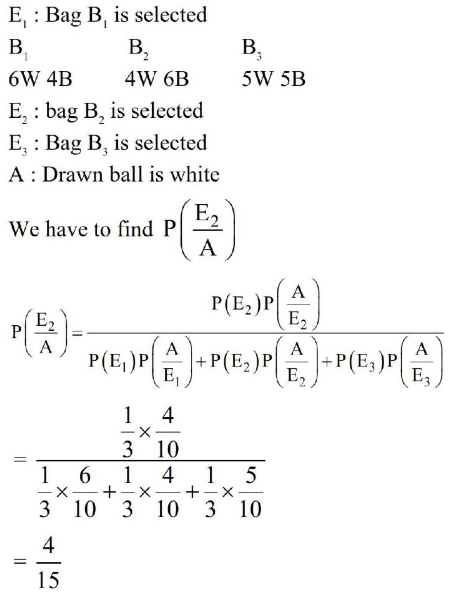
Bag $B_{1}$ contains 6 white and 4 blue balls, Bag $B_{2}$ contains 4 white and 6 blue balls, and $\mathrm{Bag} \mathrm{B}_{3}$ contains 5 white and 5 blue balls. One of the bags is selected at random and a ball is drawn from it. If the ball is white, then the probability, that the ball is drawn from Bag $\mathrm{B}_{2}$, is :
- A
$\frac{1}{3}$
- B
$\frac{4}{15}$
- C
$\frac{2}{3}$
- D
$\frac{2}{5}$
AnswerB.
View full question & answer→