MCQ
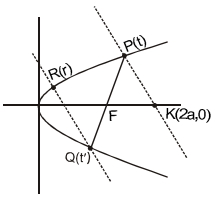
Let $a , r , s , t$ be nonzero real numbers. Let $P \left( at ^2\right.$, $2$at), $Q , R \left( ar ^2\right.$, 2ar) and $\left( as ^2\right.$, 2as) be distinct points on the parabola $y^2=4 a x$. Suppose that $P Q$ is the focal chord and lines $Q R$ and $P K$ are parallel, where $K$ is the point $(2 a , 0)$

$1.$ The value of $r$ is

$(A)$ $-\frac{1}{t}$ $(B)$ $\frac{t^2+1}{t}$ $(C)$ $\frac{1}{ t }$ $(D)$ $\frac{t^2-1}{t}$

$2.$ If st $=1$, then the tangent at $P$ and the normal at $S$ to the parabola meet at a point whose ordinate is

$(A)$ $\frac{\left(t^2+1\right)^2}{2 t^3}$ $(B)$ $\frac{a\left(t^2+1\right)^2}{2 t^3}$ $(C)$ $\frac{a\left(t^2+1\right)^2}{t^3}$ $(D)$ $\frac{a\left(t^2+2\right)^2}{t^3}$

Give the answer question $1$ and $2.$

  • $(D,B)$
  • B
    $(A,D)$
  • C
    $(B,D)$
  • D
    $(B,C)$

Answer

Correct option: A.
$(D,B)$
a
$1.$  $m_{P K}=m_{Q R} $

$\frac{2 a t-0}{a t^2-2 a}=\frac{2 a t^{\prime}-2 a r}{a\left(t^{\prime}\right)^2-a r^2} $

$\frac{t}{t^2-2}=\frac{t^{\prime}-r}{\left(t^{\prime}\right)^2-r^2} $

$-t^{\prime}-t^2=-t-t^2-2 t^{\prime}+2 r, t^{\prime}=-1 $

$t^{\prime}-t^2=-t+2 r-t^2 $

$-t r^2+r\left(t^2-2\right)+t^{\prime}+t=0 $

$\lambda=\frac{\left(2-t^2\right) \pm \sqrt{\left(t^2-2\right)^2+4\left(-1+t^2\right)}}{-2 t} $

$=\frac{\left(2-t^2\right) \pm \sqrt{t^4}}{-2 t}=\frac{2-t^2 \pm t^2}{-2 t}$

$r=-\frac{1}{t}$ It is not possible as the $R \& Q$ will be one same.

or $r =\frac{ t ^2-1}{ t }$

$2.$ $\text { Tangent at } P \text { is ty }=x+a t^2 $

$\text { Normal at } S \text { is } y+s x=2 a s+a s^2 $

$P \text {ty }=x+a t^2 $

$S \text y+s x=2 a s+a s^2 $

$\text { ty }+x=2 a+\frac{a}{t^2} $

$\text { ty }=2 a+\frac{a}{t^2}-t y+a t^2 $

$2 t^3 y=a t^4+2 a t^2+a $

$y=\frac{a\left(t^2+1\right)^2}{2 t^3}$

Need a full question paper?

Generate a complete, print-ready paper with questions like this in minutes — across 16+ boards, with answer keys.

Start Generating Free