Question
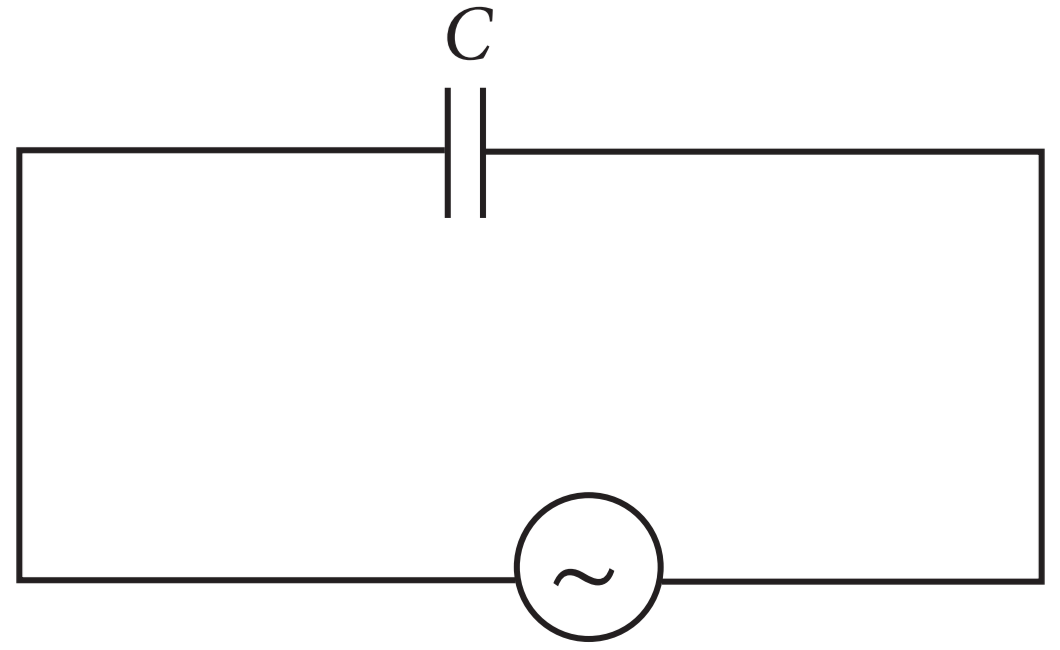
Let a source of alternating e.m.f. $\text{E} = \text{E}_\circ\sin\omega\text{t}$ be connected to a capacitor of capacitance C. If 'I' is the instantaneous value of current in the circuit at instant t, then $\text{I}=\frac{\text{E}_0}{\frac{1}{\omega\text{C}}}\sin\Big(\omega\text{t}+\frac{\pi}{2}\Big).$ The capacitive reactance limits the amplitude of current in a purely capacitive circuit and it is given by $\text{X}_\text{C}=\frac{1}{\omega\text{C}}.$
  1. What is the unit of capacitive reactance?
  1. Farad
  2. Ampere
  3. Ohm
  4. Ohm-1
  1. The capacitive reactance of a $5\mu\text{F}$ capacitor for a frequency of 106Hz is:
  1. $0.032\Omega$
  2. $2.52\Omega$
  3. $1.25\Omega$
  4. $4.51\Omega$
  1. In a capacitive circuit, resistance to the flow of current is offered by:
  1. Resistor
  2. Capacitor
  3. Inducto
  4. Frequency
  1. In a capacitive circuit, by what value of phase angle does alternating current leads the e.m.f?
  1. 45º
  2. 90º
  3. 75º
  4. 60º
  1. One microfarad capacitor is joined to a 200V, 50Hz alternator. The rrns current through capacitor is:
  1. 6.28 × 10⁻²A
  2. 7.5 × 10⁻⁴A
  3. 10.52 × 10⁻²A
  4. 15.25 × 10⁻²A

Answer

  1. (c) Ohm

Solution:

Ohm is the unit of capacitive reactance.

  1. (a) $0.032\Omega$

Solution:

Capacitive reactance, $\text{X}_\text{C}=\frac{1}{\omega\text{C}}=\frac{1}{2\pi\mu\text{C}}$

$=\frac{1}{2\pi\times10^6\times5\times10^{-6}}$

$=0.032\Omega$

  1. (b) Capacitor

Solution:

In capacitive circuit, resistance to the flow of current is offered by the capacitor.

  1. (b) 90º
  2. (a) 6.28 × 10⁻²A

Solution:

Current, $\text{l}_\text{v}=\frac{\text{E}_\text{V}}{\text{X}_\text{C}}=\frac{1}{\frac{1}{2\pi\mu\text{C}}}=(2\pi\mu\text{C})\text{E}_\text{V}$

$\text{I}_\text{v}=2\times3.14\times50\times10^{-6}\times200$

$=6.28 × 10^{-2}\text{A}$

Need a full question paper?

Generate a complete, print-ready paper with questions like this in minutes — across 16+ boards, with answer keys.

Start Generating Free

Similar questions

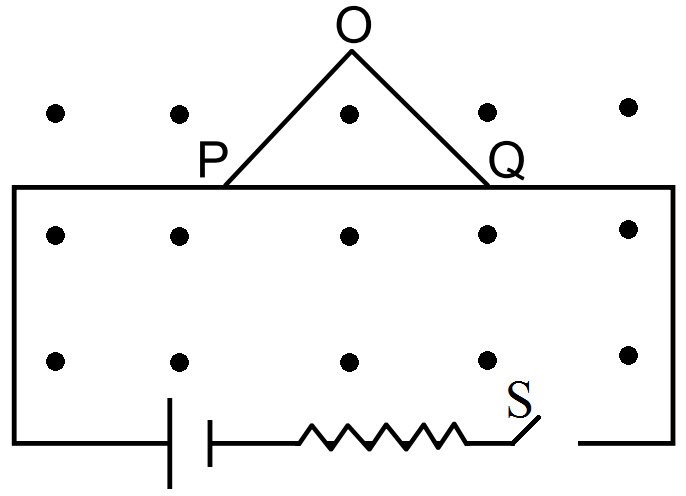
Shows a rod PQ of length 20.0cm and mass 200g suspended through a fixed point O by two threads of lengths 20.0cm each. A magnetic field of strength 0.500T exists in the vicinity of the wire PQ, as shown in the figure. The wires connecting PQ with the battery are loose and exert no force on PQ.
  1. Find the tension in the threads when the switch S is open.
  2. A current of 2.0A is established when the switch S is closed. Find the tension in the threads now.

When a tyre bursts, the air coming out is cooler than the surrounding air. Explain.
A moving-coil galvanometer has a 50-turn coil of size 2cm × 2cm. It is suspended between the magnetic poles producing a magnetic field of 0.5T. Find the torque on the coil due to the magnetic field when a current of 20mA passes through it. 
Cloudy nights are warmer than the nights with clean sky. Explain.
(a) A circular coil of 30 turns and radius 8.0 cm carrying a current of 6.0 A is suspended vertically in a uniform horizontal magnetic field of magnitude 1.0 T. The field lines make an angle of $60^{\circ}$ with the normal of the coil. Calculate the magnitude of the counter torque that must be applied to prevent the coil from turning.
(b) Would your answer change, if the circular coil in (a) were replaced by a planar coil of some irregular shape that encloses the same area? (All other particulars are also unaltered.)
What do you mean by coherent sources of light? How are these obtained in the laboratory ?
The power averaged over one full cycle of a.c. is known as average power. It is also known as true power.
$\text{P}_\text{av}=\text{V}_\text{rms}\text{I}_\text{rms}\cos\phi=\frac{\text{V}_0\text{I}_0}{2}\cos\phi$
Root mean square or simply rms watts refer to continuous power.
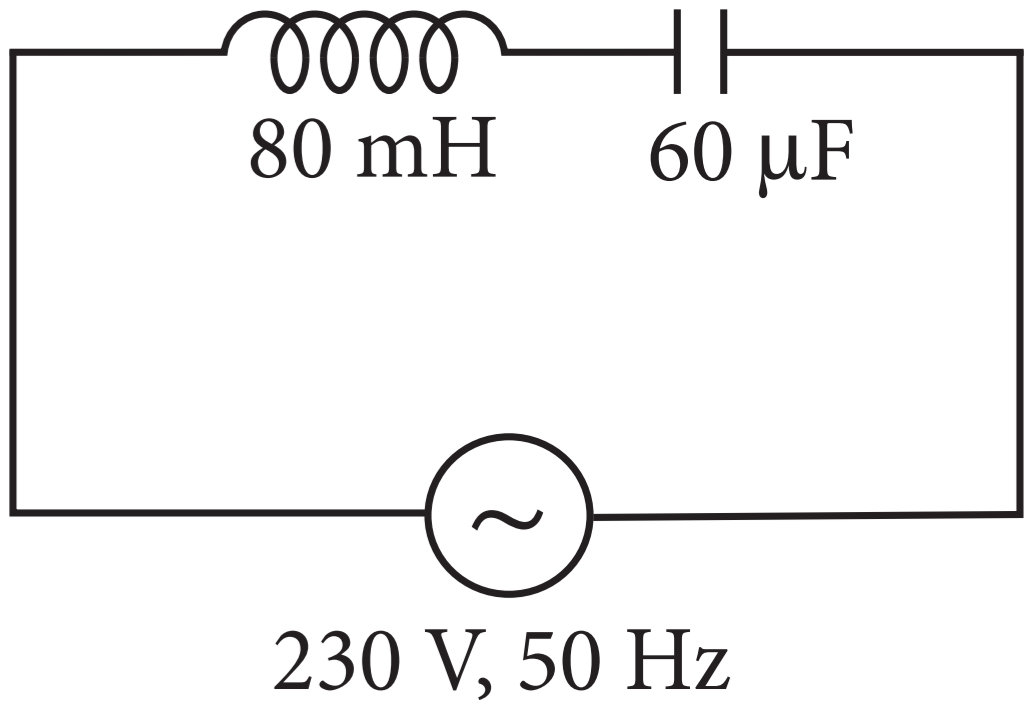
A circuit containing a 80mH inductor and a $60\mu\text{F}$ capacitor in series is connected to a 230V, 50Hz supply. The resistance of the circuit is negligible.

  1. The value of current amplitude is:
  1. 15A
  2. 11.63A
  3. 17.65A
  4. 6.33A
  1. Find rms value.
  1. 6A
  2. 5.25A
  3. 8.23A
  4. 7.52A
  1. The average power transferred to inductor is:
  1. Zero
  2. 7W
  3. 2.5W
  4. 5W
  1. The average power transferred to the capacitor is:
  1. 5W
  2. Zero
  3. 11W
  4. 15W
  1. What is the total average power absorbed by the circuit?
  1. Zero
  2. 10W
  3. 2.5W
  4. 15W
A child has near point at 10cm. What is the maximum angular magnification the child can have with a convex lens of focal length 10cm?
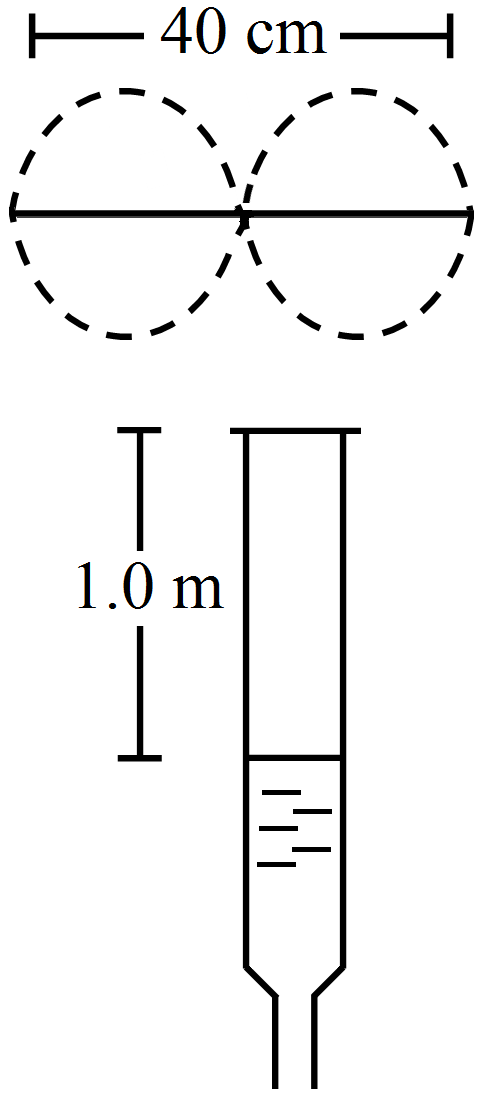
Consider the situation shown in figure. The wire which has a mass of 4.00g oscillates in its second harmonic and sets the air column in the tube into vibrations in its fundamental mode. Assuming that the speed of sound in air is 340m/s, find the tension in the wire.