Question
Let a source of alternating e.m.f. $\text{E} = \text{E}_\circ\sin\omega\text{t}$ be connected to a capacitor of capacitance C. If 'I' is the instantaneous value of current in the circuit at instant t, then $\text{I}=\frac{\text{E}_0}{\frac{1}{\omega\text{C}}}\sin\Big(\omega\text{t}+\frac{\pi}{2}\Big).$ The capacitive reactance limits the amplitude of current in a purely capacitive circuit and it is given by $\text{X}_\text{C}=\frac{1}{\omega\text{C}}.$
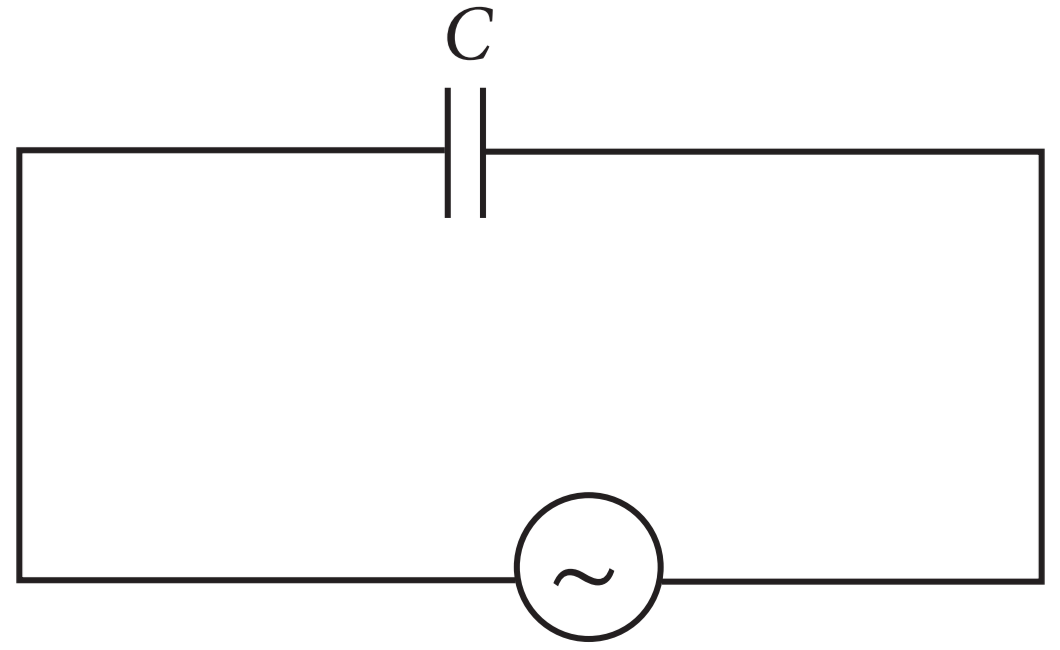
  1. What is the unit of capacitive reactance?
  1. Farad
  2. Ampere
  3. Ohm
  4. $Ohm^{-1}$
  1. The capacitive reactance of a $5\mu\text{F}$ capacitor for a frequency of $10^6Hz$ is:
  1. $0.032\Omega$
  2. $2.52\Omega$
  3. $1.25\Omega$
  4. $4.51\Omega$
  1. In a capacitive circuit, resistance to the flow of current is offered by:
  1. Resistor
  2. Capacitor
  3. Inducto
  4. Frequency
  1. In a capacitive circuit, by what value of phase angle does alternating current leads the e.m.f?
  1. $45^\circ$
  2. $90^\circ$
  3. $75^\circ$
  4. $60^\circ$
  1. One microfarad capacitor is joined to a 200V, 50Hz alternator. The rrns current through capacitor is:
  1. $6.28 \times 10^{-2}A$
  2. $7.5 \times 10^{-4}A$
  3. $10.52 \times 10^{-2}A$
  4. $15.25 \times 10^{-2}A$

Answer

  1. (c) Ohm
Solution:
Ohm is the unit of capacitive reactance.
  1. (a) $0.032\Omega$
Solution:
Capacitive reactance, $\text{X}_\text{C}=\frac{1}{\omega\text{C}}=\frac{1}{2\pi\mu\text{C}}$
$=\frac{1}{2\pi\times10^6\times5\times10^{-6}}$
$=0.032\Omega$
  1. (b) Capacitor
Solution:
In capacitive circuit, resistance to the flow of current is offered by the capacitor.
  1. (b) $90^\circ$
  2. (a) $6.28 \times 10^{-2}A$
Solution:
Current, $\text{l}_\text{v}=\frac{\text{E}_\text{V}}{\text{X}_\text{C}}=\frac{1}{\frac{1}{2\pi\mu\text{C}}}=(2\pi\mu\text{C})\text{E}_\text{V}$
$\text{I}_\text{v}=2\times3.14\times50\times10^{-6}\times200$
$=6.28 × 10^{-2}\text{A}$

Need a full question paper?

Generate a complete, print-ready paper with questions like this in minutes — across 16+ boards, with answer keys.

Start Generating Free

Similar questions

Huygen's principle is the basis of wave theory of light. Each point on a wavefront acts as a fresh source of new disturbance, called secondary waves or wavelets. The secondary wavelets spread out in all directions with the speed light in the given medium. An initially parallel cylindrical beam travels in a medium of refractive index $\mu(\text{I})=\mu_0+\mu_2\text{I}$, where $\mu_0$ and $\mu_2$ are positive constants and I is the intensity of the light beam. The intensity of the beam is decreasing with increasing radius.
  1. The initial shape of the wavefront of the beam is:
  1. Planar.
  2. Convex.
  3. Concave.
  4. Convex near the axis and concave near the periphery.
  1. According to Huygens Principle, the surface of constant phase is:
  1. Called an optical ray.
  2. Called a wave.
  3. Called a wavefront.
  4. Always linear in shape.
  1. As the beam enters the medium, it will:
  1. Travel as a cylindrical beam.
  2. Diverge.
  3. Converge.
  4. Diverge near the axis and converge near the periphery.
  1. Two plane wavefronts oflight, one incident on a thin convex lens and another on the refracting face of a thin prism. After refraction at them, the emerging wavefronts respectively become.
  1. Plane wavefront and plane wavefront.
  2. Plane wavefront and spherical wavefront.
  3. Spherical wavefront and plane wavefront.
  4. Spherical wavefront and spherical wavefront.
  1. Which of the following phenomena support the wave theory of light?
  1. Scattering.
  2. Interference.
  3. Diffraction.
  4. Velocity of light in a denser medium is less than the velocity of light in the rarer medium.
  1. 1, 2, 3
  2. 1, 2, 4
  3. 2, 3, 4
  4. 1, 3, 4
A bar magnet takes $\frac{\pi}{10}$ second to complete one oscillation in an oscillation magnetometer. The moment of inertia of the magnet about the axis of rotation is $1.2 \times 10^{-4} kg-m^2$ and the earth's horizontal magnetic field is $30\mu \text{T}.$ Find the magnetic moment of the magnet.
If we allow radiations of a fixed frequency to fall on plate and the accelerating potential difference between the two electrodes is kept fixed, then the photoelectric current is found to increase linearly with the intensity of incident radiation. Here, radiation pressure is $\text{P}=\Big(\frac{1+\text{e}}{\text{C}}\Big)\text{I}$. As, atmosphere pressure at sea level is $10^5Pa.$ If the intensity of light of a given wavelength, is increased, there is an increase in the number of photons incident on a given area in a given time. But the energy of each photon remain the same.
  1. The number of photons hitting the cone second
  1. $\frac{\pi\text{R}^2\text{I}}{2\text{E}}$
  2. $\frac{2\pi\text{R}^2\text{I}}{\text{E}}$
  3. $\frac{\pi\text{R}^2\text{I}}{4\text{E}}$
  4. $\frac{\pi\text{R}^2\text{I}}{\text{E}}$
  1. A radiation of energy E falls normally on a perfect reflecting surface. The momentum transferred to the surface is:
  1. $\frac{\text{E}}{\text{c}}$
  2. $\frac{2\text{E}}{\text{c}}$
  3. $\text{Ec}$
  4. $\frac{\text{E}}{\text{c}^2}$
  1. Which one is correct?
  1. $\text{E}^2=\text{p}^2\text{c}^2$
  2. $\text{E}^2=\text{p}^2\text{c}$
  3. $\text{E}^2=\text{p}^2$
  4. $\text{E}^2=\frac{\text{p}^2}{\text{c}^2}$
  1. The incident intensity on a horizontal surface at sea level from the Sun is about $1k\ Wm^{-2}$. Assuming that 50% of this intensity is reflected and 50% is absorbed, determine the radiation pressure on this horizontal surface.
  1. $8.2 \times 10^{-2}$ Pa
  2. $5 \times 10^{-6}$ Pa
  3. $3 \times 10^{-5}$ Pa
  4. $3 \times 10^{-5}$ Pa
  1. Find the ratio of radiation pressure to atmospheric pressure $P_0$ about $1 \times 10^5$ Pa at sea level.
  1. $5 \times 10^{-11}$
  2. $4 \times 10^{-8}$
  3. $6 \times 10^{-12}$
  4. $8 \times 10^{-11}$
A metallic loop is placed in a nonuniform magnetic field. Will an emf be induced in the loop?
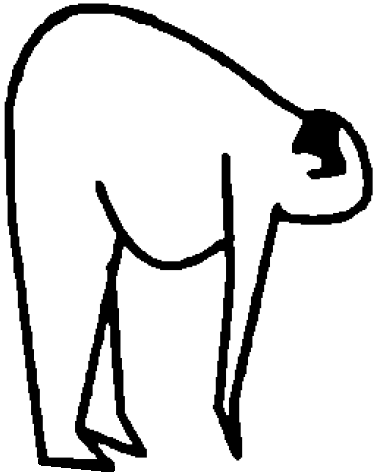
When a fat person tries to touch his toes, keeping the legs straight, he generally falls. Explain with reference to figure.
A bar magnet makes 40 oscillations per minute in an oscillation magnetometer. An identical magnet is demagnetized completely and is placed over the magnet in the magnetometer. Find the time taken for 40 oscillations by this combination. Neglect any induced magnetism.
The magnetic moment of the assumed dipole at the earth's centre is $8.0 \times 10^{22}A-m^2$. Calculate the magnetic field B at the geomagnetic poles of the earth. Radius of the earth is 6400km.
For a circular coil of radius R and N turns carrying current I, the magnitude of the magnetic field at a point on its axis at a distance x from its centre is given by,
$\text{B}=\frac{\mu_{0}\text{IR}^{2}\text{N}}{2(\text{x}^{2}+\text{R}^{2})^{\frac{3}{2}}}$
  1. Show that this reduces to the familiar result for field at the centre of the coil.
  2. Consider two parallel co-axial circular coils of equal radius R, and number of turns N, carrying equal currents in the same direction, and separated by a distance R. Show that the field on the axis around the mid-point between the coils is uniform over a distance that is small as compared to R, and is given by,$\text{B}=0.72\frac{\mu_{0}\text{NI}}{\text{R}}$, approximately.
[Such an arrangement to produce a nearly uniform magnetic field over a small region is known as Helmholtz coils.]
The magnetic moment of the assumed dipole at the earth's centre is $8.0 \times 10^{22}A-m^2$. Calculate the magnetic field B at the geomagnetic poles of the earth. Radius of the earth is 6400km.