MCQ
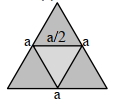
Let $\mathrm{ABC}$ be an equilateral triangle. A new triangle is formed by joining the middle points of all sides of the triangle $\mathrm{ABC}$ and the same process is repeated infinitely many times. If $\mathrm{P}$ is the sum of perimeters and $Q$ is be the sum of areas of all the triangles formed in this process, then:
  • $\mathrm{P}^2=36 \sqrt{3} \mathrm{Q}$
  • B
    $\mathrm{P}^2=6 \sqrt{3} \mathrm{Q}$
  • C
    $P=36 \sqrt{3} Q^2$
  • D
     $\mathrm{P}^2=72 \sqrt{3} \mathrm{Q}$

Answer

Correct option: A.
$\mathrm{P}^2=36 \sqrt{3} \mathrm{Q}$
a
Area of first $\Delta=\frac{\sqrt{3} \mathrm{a}^2}{4}$

Area of second $\Delta=\frac{\sqrt{3} a^2}{4} \frac{a^2}{4}=\frac{\sqrt{3} a^2}{16}$

Area of third $\Delta=\frac{\sqrt{3} \mathrm{a}^2}{64}$

sum of area $=\frac{\sqrt{3} a^2}{4}\left(1+\frac{1}{4}+\frac{1}{16} \ldots\right)$

$\mathrm{Q}=\frac{\sqrt{3} \mathrm{a}^2}{4} \frac{1}{\frac{3}{4}}=\frac{\mathrm{a}^2}{\sqrt{3}}$

perimeter of $1^{\text {st }} \Delta=3 \mathrm{a}$

perimeter of $2^{\text {nd }} \Delta=\frac{3 a}{2}$

perimeter of $3^{\text {rd }} \Delta=\frac{3 \mathrm{a}}{4}$

$ \mathrm{P}=3 \mathrm{a}\left(1+\frac{1}{2}+\frac{1}{4}+\ldots\right) $

$ \mathrm{P}=3 \mathrm{a} \cdot 2=6 \mathrm{a} $

$ \mathrm{a}=\frac{\mathrm{P}}{6} $

$ \mathrm{Q}=\frac{1}{\sqrt{3}} \cdot \frac{\mathrm{P}^2}{36} $

$ \mathrm{P}^2=36 \sqrt{3} \mathrm{Q}$

Need a full question paper?

Generate a complete, print-ready paper with questions like this in minutes — across 16+ boards, with answer keys.

Start Generating Free