Question
Let $A=\left[\begin{array}{ll}1 & 0 \\ 2 & 1\end{array}\right], B=\left[\begin{array}{cc}2 & 3 \\ -1 & 0\end{array}\right]$. Find $A^2+A B+B^2$

Answer

$A=\left[\begin{array}{ll}1 & 0 \\ 2 & 1\end{array}\right], B=\left[\begin{array}{cc}2 & 3 \\ -1 & 0\end{array}\right]$
$A^2=A \times A=\left[\begin{array}{ll}1 & 0 \\ 2 & 1\end{array}\right] \times\left[\begin{array}{ll}1 & 0 \\ 2 & 1\end{array}\right]$
$=\left[\begin{array}{ll}1 \times 1+0 \times 2 & 1 \times 0+0 \times 1 \\ 2 \times 1+1 \times 2 & 2 \times 0+1 \times 1\end{array}\right]=\left[\begin{array}{ll}1 & 0 \\ 4 & 1\end{array}\right]$
$\begin{array}{l}A B=A \times B=\left[\begin{array}{ll}1 & 0 \\ 2 & 1\end{array}\right] \times\left[\begin{array}{cc}2 & 3 \\ -1 & 0\end{array}\right] \\ =\left[\begin{array}{ll}1 \times 2+0 \times(-1) & 1 \times 3+0 \times 0 \\ 2 \times 2+1 \times(-1) & 2 \times 3+1 \times 0\end{array}\right] \\ =\left[\begin{array}{ll}2 & 3 \\ 3 & 6\end{array}\right]\end{array}$
$\begin{array}{l}B^2=B \times B=\left[\begin{array}{cc}2 & 3 \\ -1 & 0\end{array}\right] \times\left[\begin{array}{cc}2 & 3 \\ -1 & 0\end{array}\right] \\ =\left[\begin{array}{cc}2 \times 2+3 \times(-1) & 2 \times 3+3 \times 0 \\ (-1) \times 2+0 \times(-1) & -1 \times 3+0 \times 0\end{array}\right] \\ =\left[\begin{array}{cc}1 & 6 \\ -2 & -3\end{array}\right] \\\end{array}$
$\therefore A^2+A B+B^2=\left[\begin{array}{ll}1 & 0 \\ 4 & 1\end{array}\right]+\left[\begin{array}{ll}2 & 3 \\ 3 & 6\end{array}\right]+\left[\begin{array}{cc}1 & 6 \\ -2 & -3\end{array}\right]$
$=\left[\begin{array}{ll}4 & 9 \\ 5 & 4\end{array}\right]$

Need a full question paper?

Generate a complete, print-ready paper with questions like this in minutes — across 16+ boards, with answer keys.
Start Generating Free

Similar questions

The angle of elevation of the top Q of a vertical tower PQ from a point X on the ground is 60°. At a point Y, 40m vertically above X, the angle of elevation is 45°. Find the height of the tower PQ and the distance XQ. 
If number n - 2, 4n - 1 and 5n + 2 are in A.P find the value of n and its next two terms.
If $x=\frac{\sqrt{a+1}+\sqrt{a-1}}{\sqrt{a+1}+\sqrt{a-1}}$ using properties of proportion show that $x^2-2 a x+1=0$
Find the equation of the line which is perpendicular to the line $\frac{x}{a}-\frac{y}{b}=1$ at the point where this line meets $y-$ axis.
Find the least value of $n$ for which the sum $1+3+3^2+\ldots$ to $n$ terms is greater than $7000$.
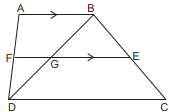
In a trapezium, $\mathrm{ABCD}, \mathrm{AB}=\frac{1}{2} \mathrm{CD}$. EF drawn parallel to AB cuts AD at F and BC at E , such that $\frac{\mathrm{BE}}{\mathrm{EC}}=\frac{3}{4}$. If diagonal BD intersects EF at G , find $\frac{\mathrm{EF}}{\mathrm{AB}}$
Image
The sum of first 16 terms of an AP is 112 and the sum of its next 14 terms is 518 . Find the AP .
Draw a circle of radius 3 cm. Construct a square about the circle.
A man buys 400, twenty-rupee shares at a discount of 20% and receives a return of 12% on his money. Calculate:
(1) the amount invested by him.
(2) the rate of dividend paid by the company.
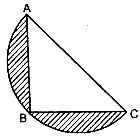
$ABC$ is an isosceles right-angled triangle with $\angle ABC = 90^\circ $. A semi-circle is drawn with $AC$ as the diameter. If $AB = BC = 7 cm$, find the area of the shaded region. [Take $\pi = 22/7]$​​​​​​​