Question
Let $A=\left[\begin{array}{ll}1 & 2 \\ 1 & 3\end{array}\right], B=\left[\begin{array}{ll}4 & 0 \\ 1 & 5\end{array}\right], C=\left[\begin{array}{ll}2 & 0 \\ 1 & 2\end{array}\right]$ Show that $(A-B) C=A C-B C$

Answer

$\begin{aligned} & A=\left[\begin{array}{ll}1 & 2 \\ 1 & 3\end{array}\right], B=\left[\begin{array}{ll}4 & 0 \\ 1 & 5\end{array}\right], C=\left[\begin{array}{ll}2 & 0 \\ 1 & 2\end{array}\right] \\ & A-B=\left[\begin{array}{ll}1 & 2 \\ 1 & 3\end{array}\right]-\left[\begin{array}{ll}4 & 0 \\ 1 & 5\end{array}\right] \\ & =\left[\begin{array}{cc}-3 & 2 \\ 0 & -2\end{array}\right] \\ & (A-B) C=\left[\begin{array}{cc}-3 & 2 \\ 0 & -2\end{array}\right] \times\left[\begin{array}{ll}2 & 0 \\ 1 & 2\end{array}\right] \\ & =\left[\begin{array}{cc}-6+2 & 0+4 \\ 0-2 & 0-4\end{array}\right] \\ & =\left[\begin{array}{cc}-4 & 4 \\ -2 & -4\end{array}\right] \ldots(1) \\ & A C=\left[\begin{array}{ll}1 & 2 \\ 1 & 3\end{array}\right] \times\left[\begin{array}{ll}2 & 0 \\ 1 & 2\end{array}\right] \\ & =\left[\begin{array}{ll}2+2 & 0+4 \\ 2+3 & 0+6\end{array}\right] \\ & =\left[\begin{array}{cc}4 & 4 \\ 5 & 6\end{array}\right]\end{aligned}$
$
\begin{aligned}
& BC =\left[\begin{array}{ll}
4 & 0 \\
1 & 5
\end{array}\right] \times\left[\begin{array}{ll}
2 & 0 \\
1 & 2
\end{array}\right] \\
& =\left[\begin{array}{cc}
8+0 & 0+0 \\
2+5 & 0+10
\end{array}\right] \\
& =\left[\begin{array}{cc}
8 & 0 \\
7 & 10
\end{array}\right] \\
& A C-B C=\left[\begin{array}{ll}
4 & 4 \\
5 & 6
\end{array}\right]-\left[\begin{array}{cc}
8 & 0 \\
7 & 10
\end{array}\right] \\
& =\left[\begin{array}{cc}
-4 & 4 \\
-2 & -4
\end{array}\right] \ldots \text { (2) }
\end{aligned}
$

From (1) and (2) we get
$
(A-B) C=A C-B C
$

Need a full question paper?

Generate a complete, print-ready paper with questions like this in minutes — across 16+ boards, with answer keys.
Start Generating Free

Similar questions

A man whose eye-level is 2 m above the ground wishes to find the height of a tree. He places a mirror horizontally on the ground 20 m from the tree and finds that if he stands at a point C which is 4 m from the mirror B, he can see the reflection of the top of the tree. How height is the tree?
A wall clock strikes the bell once at 1 o’clock, 2 times at 2 o’clock, 3 times at 3 o’clock and so on. How many times will it strike in a particular day? Find the standard deviation of the number of strikes the bell make a day.
Find the sum to n terms of the series
0.4 + 0.44 + 0.444 + …… to n terms
Show that the matrices $A=\left[\begin{array}{ll}1 & 2 \\ 3 & 1\end{array}\right], B=\left[\begin{array}{cc}1 & -2 \\ -3 & 1\end{array}\right]$ satisfy commutative property $A B=B A$
A solid iron cylinder has total surface area of 1848 sq.m. Its curved surface area is five – sixth of its total surface area. Find the radius and height of the iron cylinder.
Find $x$ and $y$ if $x\left[\begin{array}{c}4 \\ -3\end{array}\right]+y\left[\begin{array}{c}-2 \\ 3\end{array}\right]=\left[\begin{array}{l}4 \\ 6\end{array}\right]$
Consider the function f(x), g(x), h(x) as given below. Show that (fog)oh = fo(goh)
$f(x) = x – 4, g(x) = x^2$ and $h(x) = 3x – 5$
If $\alpha, \beta$ are the roots of $7 x^2+a x+2=0$ and if $\beta-\alpha=\frac{-13}{7}$ Find the values of $a$
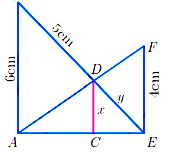
In the given figure AB || CD || EF. If AB = 6 cm, CD = x cm, EF = 4 cm, BD = 5 cm and DE = y cm. Find x and y.
Find the remainder when $2^{81}$ is divided by $17$