Question 15 Marks
Arul, Madan and Ram working together can clean a store in 6 hours. Working alone, Madan takes twice as long to clean the store as Arul does. Ram needs three times as long as Arul does. How long would it take each if they are working alone?
AnswerLet the time taken by Arul be " $x$ " hours
Let the time taken by Madan be " $y$ " hours
Let the time taken by Ram be " $z$ " hours
By the given first condition
$
\frac{1}{x}+\frac{1}{y}+\frac{1}{z}=\frac{1}{6}
$
Again by the given second condition
$
\begin{aligned}
& \frac{1}{x}=2 \times \frac{1}{y} \\
& \frac{1}{x}-\frac{2}{y}=0
\end{aligned}
$
By the given third condition
$
\begin{aligned}
& 3 \times \frac{1}{z}=\frac{1}{x} \\
& -\frac{1}{x}+\frac{3}{z}=0
\end{aligned}
$
$\begin{aligned} & \text { Let } \frac{1}{x}=a, \frac{1}{y}=b, \frac{1}{z}=c \\ & a+b+c=\frac{1}{6} \\ & 6 a+6 b+6 c=1 \ldots(1) \\ & a-2 b=0 \ldots(2) \\ & -a+3 c=0 \ldots(3)\end{aligned}$| (1) × 1 ⇒ | 6a + 6b + 6c = 1 ....(1) |
| (2) × 3 ⇒ | 3a – 6b + 0 = 0 ....(2) |
| (1) + (2) ⇒ | 9a + 6c = 1 ....(4) | |
| (3) × (2) ⇒ | -2a + 6c = 0 ....(3) |
| | (–) (–) (–) | |
| (4) – (3) ⇒ | $11 a =1 \Rightarrow a =\frac{1}{11}$ | |
Substitute the value of $a=\frac{1}{11}$ in (2)
$
\begin{aligned}
& \frac{1}{11}-2 b=0 \\
& \frac{1}{11}=2 b \Rightarrow b=\frac{1}{22}
\end{aligned}
$
Substitute the value of a in (3)
$
-\frac{1}{11}+3 c=0 \Rightarrow 3 c=\frac{1}{11} \Rightarrow c=\frac{1}{33}
$| $\begin{gathered}\text { But } \frac{1}{x}= a \\ \frac{1}{x}=\frac{1}{11} \\ \quad x =1\end{gathered}$ |
$\begin{aligned} & \frac{1}{y}= b \\ & \frac{1}{y}=\frac{1}{22} \\ & y=22\end{aligned}$ | $\begin{aligned} & \frac{1}{z}= c \\ & \frac{1}{z}=\frac{1}{33} \\ & y=33\end{aligned}$ |
Arul take 11 hours, Madan take 22 hours and Ram takes 33 hours. View full question & answer→Question 25 Marks
Simplify $\frac{\frac{1}{p}+\frac{1}{q+r}}{\frac{1}{p}-\frac{1}{q+r}} \times\left[1+\frac{ q ^2+r^2-p^2}{2 q r}\right]$
Answer$\begin{aligned} & \frac{1}{p}+\frac{1}{q+r}=\frac{q+r+p}{p(q+r)} \\ & =\frac{ p + q + r }{ p ( q + r )} \\ & \frac{1}{ p }-\frac{1}{ q + r }=\frac{ q + r - p }{ p ( q + r )} \\ & 1+\frac{ q ^2+ r ^2- p ^2}{2 qr }=\frac{2 qr + q ^2+ r ^2- p ^2}{2 qr } \\ & =\frac{( q + r )^2- p ^2}{2 qr } \\ & =\frac{( q + r + p )( q + r - p )}{2 qr } \\ & =\frac{( p + q + r )( q + r - p )}{2 qr } \\ & \frac{\frac{1}{p}+\frac{1}{q+r}}{\frac{1}{p}-\frac{1}{q+r}} \times\left[1+\frac{ q ^2+r^2-p^2}{2 q r}\right] \\ & =\frac{( p + q + r )}{ p ( q + r )} \times \frac{ p ( q + r )}{( q + r - p )} \times \frac{( p + q + r )( q + r - p )}{2 qr } \\ & \end{aligned}$
$=\frac{(p+q+r)^2}{2 q r}$
View full question & answer→Question 35 Marks
Find the GCD of the following by division algorithm
$2 x^4+13 x^3+27 x^2+23 x+7, x^3+3 x^2+3 x+1, x^2+2 x+1$
Answer$p(x)=2 x^4+13 x^3+27 x^2+23 x+7$
$g(x)=x^3+3 x^2+3 x+1$
$r(x)=x^2+2 x+1$
(i) Find the G.C.D. of $p(x)$ and $g(x)$
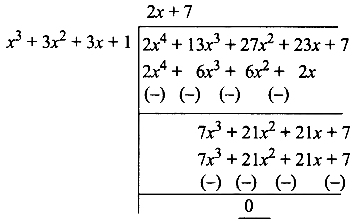
$\therefore \text { G.C.D. }=x^3+3 x^2+3 x+1$
(ii) Find the G.C.D. of $r(x)$ and the G.C.D. of $p(x)$ and $g(x)$
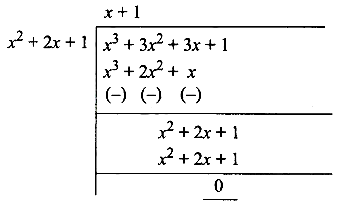
$\therefore \text { G.C.D. }=x^2+2 x+1$
$\therefore$ G.C.D. of the three polynomials $= x ^2+2 x +1$ View full question & answer→Question 45 Marks
In a three-digit number, when the tens and the hundreds digit are interchanged the new number is 54 more than three times the original number. If 198 is added to the number, the digits are reversed. The tens digit exceeds the hundreds digit by twice as that of the tens digit exceeds the unit digit. Find the original number
AnswerLet the hundred digit be x
the tens digit be y and the unit digit be z
∴ The number is 100x + 10y + z
By the given first condition
100y + 10x + z = 54 + 3 (100x + 10y + z)
100y + 10x + z = 54 + 300x + 30y + 3z
– 290x + 70y – 2z = 54 .......(÷ – 2)
145x – 35y + z = – 27 ...(1)
Again by the second condition
198 + 100x + 10y + z = 100z + 10y + x
99x – 99z = – 198 .......(÷ 99)
x – z = – 2 ...(2)
Again by the third condition
y – x = 2(y – z)
y – x = 2y – 2z
– x – y + 2z = 0
x + y – 2z = 0 ...(3)
$\begin{aligned} & (1) \times(2) \Rightarrow 290 x-70 y+2 z=-54 \cdots(1)\\ & \underline{(3) \times(1) \Rightarrow x \ +\ y\ -\ 2z = 0 \cdots(3)} \\ & (1)+(3) \Rightarrow 291 x-69 y=-54\end{aligned}$
$\begin{aligned} & \ \ \ \ \ \ \ \ \ \ \ \ \ \ \ \ \ \ \ \ 97 x-23 y=-18 \cdots(4) \\ & \text { (3) } \times 1 \Rightarrow x+y-2 z=0 \cdots(5)\\ & (2) \times 2 \Rightarrow \ \ 2 x+0-2 z=-4 \cdots(2)\\ & \ \ \ \ \ \ \ \ \ \ \ \ \ \ \ \ \ \ \underline{(-) (+) (+)\ \ \ \ \ (+)} \\ & \text {(3) }-(2) \Rightarrow-x+y=4 \cdots(5)\\ & (4) \times 1 \Rightarrow 97 x-23 y=-18 \cdots(4)\\ & \underline{(5) \times 3 \Rightarrow-23 x+23 y=92} \cdots(5)\\ & (4) \times(5) \Rightarrow \quad 74 x=74 \\ & x =\frac{74}{74}=1 \\ & \end{aligned}$
Substitute the value of x = 1 in .....(2)
1 – z = – 2
3 = z
∴ z = 3
Substitute the value of x = 1 and z = 3 in .......(3)
1 – y – 6 = 0
y – 5 = 0
y = 5
∴ The number is 153
View full question & answer→Question 55 Marks
One hundred and fifty students are admitted to a school. They are distributed over three sections A, B and C. If 6 students are shifted from section A to section C, the sections will have equal number of students. If 4 times of students of section C exceeds the number of students of section A by the number of students in section B, find the number of students in the three sections
AnswerLet the number of students in section A be “x”
Let the number of students in section B be “y”
Let the number of students in section C be “z”
By the given first condition
x + y + z = 150 ...(1)
again by the second condition
x – 6 = z + 6
x – z = 6 + 6
x – z = 12 ...(2)
again by the third condition
x + y = 4z
x + y – 4z = 0
x + y – 4z = 0 ….(3)
Subtracting (1) and (3)
$\begin{aligned} & (1) \Rightarrow x+y+z=150 \\ & (3) \Rightarrow x+y-4 z=0 \\ & \underline{\ \ \ \ \ \ \ \ \ (-) (-) (+) \ \ \ \ \ (-)} \\ & \quad 0+0+5 z=150\end{aligned}$
$
z=\frac{150}{2}=30
$
Substitute the value of $z=30$ in (2)
$
\begin{aligned}
& x-30=12 \\
& x=12+30 \\
& =42
\end{aligned}
$
Substitute the value of $x=42$ and $z=30$ in (1)
$
\begin{aligned}
& 42+y+30=150 \\
& y+72=150 \\
& y=150-72 \\
& =78
\end{aligned}
$
Number of students in section A, B and C are $=42,78$ and 30.
View full question & answer→Question 65 Marks
$A=\left[\begin{array}{ll}3 & 0 \\ 4 & 5\end{array}\right], B=\left[\begin{array}{ll}6 & 3 \\ 8 & 5\end{array}\right], C=\left[\begin{array}{ll}3 & 6 \\ 1 & 1\end{array}\right]$ find the matrix $D$, such that $C D-A B=0$
Answer$\begin{aligned} & \text { Given } A=\left[\begin{array}{ll}3 & 0 \\ 4 & 5\end{array}\right], B=\left[\begin{array}{ll}6 & 3 \\ 8 & 5\end{array}\right], C=\left[\begin{array}{ll}3 & 6 \\ 1 & 1\end{array}\right] \\ & \text { Let } D \text { be }\left[\begin{array}{ll} a & b \\ c & d \end{array}\right] \\ & \text { Given } C D- AB =0 \\ & AB = CD \\ & {\left[\begin{array}{cc}3 & 0 \\ 4 & 5\end{array}\right]\left[\begin{array}{ll}6 & 3 \\ 8 & 5\end{array}\right]=\left[\begin{array}{ll}3 & 6 \\ 1 & 1\end{array}\right]\left[\begin{array}{cc} a & b \\ c & d \end{array}\right]} \\ & {\left[\begin{array}{cc}18+0 & 9+0 \\ 24+40 & 12+25\end{array}\right]=\left[\begin{array}{cc}3 a +6 c & 3 b +6 d \\ a + c & b + d \end{array}\right]} \\ & {\left[\begin{array}{cc}18 & 9 \\ 64 & 37\end{array}\right]=\left[\begin{array}{c}3 a +6 c \quad 3 b +6 d \\ a + c \quad b + d \end{array}\right]}\end{aligned}$
$\begin{array}{r}3 a+6 c=18 \\ (\div 3) \Rightarrow \quad a+2 c=6 \cdots(1)\\ a+c=64 \cdots(2)\\ \underline{(-) (-)(-)} \\ (1)-(2) \Rightarrow \quad c=-58\end{array}$
Substitute the value of $c=-58$ in (1)
$
\begin{aligned}
a-116 & =6 \\
a & =6+116 \\
& =122 \\
3 b+6 d & =9 \\
(\div 3) \Rightarrow b+2 d & =3 \\
b+d & =37 \quad \ldots .(3) \\
\ldots(-)(-) & (-)
\end{aligned}
$
$(3)-\overline{(4)} \Rightarrow d=-34$
Substitute the value of $d=-34$ in (4)
$
\begin{aligned}
& b-34=37 \\
& b=37+34 \\
& =71
\end{aligned}
$
Matrix $D=\left[\begin{array}{cc}122 & 71 \\ -58 & -34\end{array}\right]$
View full question & answer→Question 75 Marks
Solve $\frac{1}{3}(x+y-5)=y-z=2 x-11=9-(x+2 z)$
Answer$\begin{aligned} & \frac{1}{3}(x+y-5)=y-z \\ & x+y-5=3 y-3 z \\ & x+y-3 y+3 z=5 \\ & x-2 y+3 z=5 \ldots(1) \\ & y-z-2 x-11 \\ & -2 x+y-z=-11 \\ & 2 x-y+z=11 \ldots(2) \\ & 2 x-11=9-(x+2 z) \\ & 2 x-11=9-x-2 z \\ & 2 x+x+2 z=9+11 \\ & 3 x+2 z=20 \ldots(3)\end{aligned}$
$\begin{aligned} & (1) \times 1 \Rightarrow x-2 y+3 z=5 \\ & (2) \times 2 \Rightarrow \underline{4 x-2 y+2 z=22} \\ & \text { (-) }( \pm) \_(-) \_(-) \\ & (1)-(4) \Rightarrow-3 x+0+z=-17 \\ & \end{aligned}$
$
3 x-z=17
$
Subtracting (3) and (5) we get
$
\begin{aligned}
& (3) \Rightarrow 3 x+2 z=20 \\
& (5) \Rightarrow 3 x-z=+17 \\
& \ \ \ \ \ \ \ \ (-) \ (+)\ \ \ \ \ (-) \\
& \hline 3 z=3
\end{aligned}
$
$
z=\frac{3}{3}=1
$
Substitute the value of $z=1$ in (3)
$
\begin{aligned}
& 3 x+2(1)=20 \\
& 3 x=20-2 \\
& 3 x=18 \\
& x=\frac{18}{3} \\
& =6
\end{aligned}
$
Substitute the value of x = 6, z = 1 in (2)
2(6) – y + 1 = 11
12 – y + 1 = 11
13 – y = 11
– y = 11 – 13
– y = – 2
y = 2
∴ The value of x = 6, y = 2 and z = 1
View full question & answer→Question 85 Marks
Given $A=\left[\begin{array}{ll}p & 0 \\ 0 & 2\end{array}\right], B=\left[\begin{array}{cc}0 & -q \\ 1 & 0\end{array}\right], C=\left[\begin{array}{cc}2 & -2 \\ 2 & 2\end{array}\right]$ and if $B A=C^2$, find $p$ and $q$.
Answer$\begin{aligned} & BA =\left[\begin{array}{cc}0 & - q \\ 1 & 0\end{array}\right]\left[\begin{array}{ll} p & 0 \\ 0 & 2\end{array}\right] \\ & =\left[\begin{array}{cc}0-0 & 0-2 q \\ p -0 & 0+0\end{array}\right] \\ & =\left[\begin{array}{cc}0 & -2 q \\ p & 0\end{array}\right] \\ & C ^2=\left[\begin{array}{cc}2 & -2 \\ 2 & 2\end{array}\right]\left[\begin{array}{cc}2 & -2 \\ 2 & 2\end{array}\right] \\ & =\left[\begin{array}{cc}4-4 & -4-4 \\ 4+4 & -4+4\end{array}\right] \\ & =\left[\begin{array}{cc}0 & -8 \\ 8 & 0\end{array}\right] \\ & \text { But BA }= C ^2 \\ & {\left[\begin{array}{cc}0 & -2 q \\ p & 0\end{array}\right]=\left[\begin{array}{cc}0 & -8 \\ 8 & 0\end{array}\right]} \\ & -2 q =-8\end{aligned}$
$
\begin{aligned}
& q=\frac{8}{2}=4 \\
& p=8
\end{aligned}
$
$\therefore$ The value of $p=8$ and $q=4$
View full question & answer→Question 95 Marks
If $\cos \theta\left[\begin{array}{cc}\cos \theta & \sin \theta \\ -\sin \theta & \cos \theta\end{array}\right]+\sin \theta\left[\begin{array}{cc}x & -\cos \theta \\ \cos \theta & x\end{array}\right]= I _2,$ find $x$.
Answer$\begin{aligned} & {\left[\begin{array}{cc}\cos \theta & \sin \theta \\ -\sin \theta & \cos \theta\end{array}\right] \times\left[\begin{array}{cc}\cos \theta & -x \\ x & \cos \theta\end{array}\right]=I_2} \end{aligned} $
$\left[\begin{array}{cc}\cos ^2 \theta+x \sin \theta & -x \sin \theta+\sin \theta \cos \theta \\ -\sin \theta \cos \theta+x \cos \theta & x \sin \theta+\cos ^2 \theta\end{array}\right]=\left[\begin{array}{ll}1 & 0 \\ 0 & 1\end{array}\right]$
$\left[\begin{array}{c}\cos ^2 \theta+x \sin \theta \\ 0 x \sin \theta+\cos ^2 \theta\end{array}\right]=\left[\begin{array}{ll}1 & 0 \\ 0 & 1\end{array}\right]$
$ \cos ^2 \theta+x \sin \theta=1$
$ x \sin \theta=1-\cos ^2 \theta$
$ x \sin \theta=\sin ^2 \theta$
$ x=\frac{\sin ^2 \theta}{\sin \theta}$
$ x=\sin \theta$
$ \sin \theta \cos \theta=x \cos \theta -x \cos \theta+\sin \theta \cos \theta=0$
$ x \sin \theta=x \ldots(\div \cos \theta)$
$\therefore x=\sin \theta$
The value of $x=\sin \theta$
View full question & answer→Question 105 Marks
Two farmers Thilagan and Kausigan cultivates three varieties of grains namely rice, wheat and ragi. If the sale (in ₹) of three varieties of grains by both the farmers in the month of April is given by the matrix.
$
\begin{gathered}
\frac{\text { April sale in ₹ }}{\text { rice wheat ragi }} \\
A=\left[\begin{array}{ccc}
500 & 1000 & 1500 \\
2500 & 1500 & 500
\end{array}\right] \frac{\text { Thilagan }}{\text { Kausigan }}
\end{gathered}
$
and the May month sale (in ₹) is exactly twice as that of the April month sale for each variety.
What is the average sales for the months of April and May
AnswerLet A represent the sale on April
$
A=\left[\begin{array}{ccc}
500 & 1000 & 1500 \\
2500 & 1500 & 500
\end{array}\right]
$
Let B represent the sale on May
$
\begin{aligned}
& B=2\left[\begin{array}{ccc}
500 & 1000 & 1500 \\
2500 & 1500 & 500
\end{array}\right] \\
& =\left[\begin{array}{ccc}
1000 & 2000 & 3000 \\
5000 & 3000 & 1000
\end{array}\right]
\end{aligned}
$
Average sale of the month April and May
$
\begin{aligned}
& =\frac{1}{2}[ A + B ] \\
& =\frac{1}{2}\left\{\left[\begin{array}{ccc}
500 & 1000 & 1500 \\
2500 & 1500 & 500
\end{array}\right]+\left[\begin{array}{ccc}
1000 & 2000 & 3000 \\
5000 & 3000 & 1000
\end{array}\right]\right\} \\
& =\frac{1}{2}\left[\begin{array}{ccc}
1500 & 3000 & 4500 \\
7500 & 4500 & 1500
\end{array}\right] \\
& =\left[\begin{array}{ccc}
750 & 1500 & 2250 \\
3750 & 2250 & 750
\end{array}\right]
\end{aligned}
$
View full question & answer→Question 115 Marks
Two farmers Thilagan and Kausigan cultivates three varieties of grains namely rice, wheat and ragi. If the sale (in ₹) of three varieties of grains by both the farmers in the month of April is given by the matrix.
$
\begin{gathered}
\frac{\text { April sale in ₹ }}{\text { rice wheat ragi }}\\
A=\left[\begin{array}{ccc}
500 & 1000 & 1500 \\
2500 & 1500 & 500
\end{array}\right] \frac{\text { Thilagan }}{\text { Kausigan }}
\end{gathered}
$
and the May month sale (in ₹) is exactly twice as that of the April month sale for each variety.
If the sales continue to increase in the same way in the successive months, what will be sales in the month of August?
AnswerIf it increasing in the successive months of
May sale is 2 ...(April sale)
June sale is 4 ...(April sale)
July sale is 8 ...(April sale)
August sale is 16 ...(April sale)
Sales in the month of August
$
\begin{aligned}
& =16\left[\begin{array}{ccc}
500 & 1000 & 1500 \\
2500 & 1500 & 500
\end{array}\right] \\
& =\left[\begin{array}{ccc}
8000 & 16000 & 24000 \\
40000 & 24000 & 8000
\end{array}\right]
\end{aligned}
$
View full question & answer→Question 125 Marks
If -4 is a root of the equation $x^2+p x-4=0$ and if the equation $x^2+p x+q=0$ has equal roots, find the values of $p$ and $q$.
Answer$\begin{aligned} & f(x)=x^2+p x-4=0 \\ & \text { If }-4 \text { is a root, then } \\ & f(-4)=(-4)^2+P(-4)-4 \\ & =16-4 p-4=0 \\ & 12-4 p=0 \\ & p=3 \\ & x^2+3 x+q=0 \text { has equal roots, } \\ & \Delta=b^2-4 a c=0 \\ & 3^2-4 \times 1 \times q=0 \\ & 9-4 q=0 \\ & -4 q=-9 \end{aligned}$
$\begin{aligned} & q=\frac{9}{4} \\ & p=3, q=\frac{9}{4}\end{aligned}$
View full question & answer→Question 135 Marks
If $\alpha$ and $\beta$ are the roots of the polynomial $f(x)=x^2-2 x+3$, find the polynomial whose roots are $\alpha+2, \beta+2$
Answer$\alpha$ and $\beta$ are the roots of the polynomial
$x^2-2 x+3=0$
$\alpha+\beta=2 ; \alpha \beta=3$
Sum of the roots $=\alpha+2+\beta+2$
$=\alpha+\beta+4$
$=2+4$
$=6$
Product of the roots $=(\alpha+2)(\beta+2)$
$=\alpha \beta+2 \alpha+2 \beta+4$
$=\alpha \beta+2(\alpha+\beta)+4$
$=3+4+4$
$=11$
The quadratic polynomial
$x^2-$ (sum of the roots) $x+$ product of the roots $=0$
$x^2-(6) x+11=0$
$x^2-6 x+11=0$
View full question & answer→Question 145 Marks
If $\alpha$ and $\beta$ are the roots of the polynomial $f(x)=x^2-2 x+3$, find the polynomial whose roots are $\frac{\alpha-1}{\alpha+1}, \frac{\beta-1}{\beta+1}$
AnswerSum of the roots
$
\begin{aligned}
& =\frac{\alpha-1}{\alpha+1}+\frac{\beta-1}{\beta+1} \\
& =\frac{(\alpha-1)(\beta+1)+(\beta-1)(\alpha+1)}{(\alpha+1)(\beta+1)} \\
& =\frac{\alpha \beta+\alpha-\beta-1+\alpha \beta+\beta-\alpha-1}{\alpha \beta+\alpha+\beta+1} \\
& =\frac{2 \alpha \beta-2}{\alpha \beta+\alpha+\beta+1} \\
& =\frac{2(3)-2}{3+2+1} \\
& =\frac{4}{6} \\
& =\frac{2}{3}
\end{aligned}
$
Product of the roots
$
\begin{aligned}
& =\frac{\alpha-1}{\alpha+1} \times \frac{\beta-1}{\beta+1} \\
& =\frac{(\alpha-1)(\beta-1)}{(\alpha+1)(\beta+1)} \\
& =\frac{\alpha \beta-\alpha-\beta+1}{\alpha \beta+\alpha+\beta+1} \\
& =\frac{\alpha \beta-(\alpha+\beta)+1}{\alpha \beta+(\alpha+\beta)+1} \\
& =\frac{3-2+1}{3+2+1} \\
& =\frac{2}{6} \\
& =\frac{1}{3}
\end{aligned}
$
The quadratic polynomial is
$
\begin{aligned}
& x^2-(\text { sum of the roots }) x +\text { products of the roots }=0 \\
& x^2-\left(\frac{2}{3}\right) x+\frac{1}{3}=0 \\
& 3 x^2-2 x+1=0
\end{aligned}
$
View full question & answer→Question 155 Marks
The number of seats in a row is equal to the total number of rows in a hall. The total number of seats in the hall will increase by 375 if the number of rows is doubled and the number of seats in each row is reduced by 5. Find the number of rows in the hall at the beginning.
AnswerLet the number of rows in the hall be " $x$ "
$\therefore$ Total number of rows $= x$
Total number of seats in the hall is " $x^{2 "}$
By the given condition
$x^2+375=2 x(x-5)$
$x^2+375=2 x^2-10 x$
$x^2-2 x^2+10 x+375=0$
$-x^2+10 x+375=0$
$-x^2-10 x-375=0$
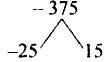
$(x-25)(x+15)$
$x-25=0 \text { or } x+15=0$
$x=25 \text { or } x=-15$
Number of rows in the hall = 25 View full question & answer→Question 165 Marks
At $t$ minutes past $2 pm$, the time needed to $3 pm$ is 3 minutes less than $\frac{ t ^2}{4}$. Find $t$.
Answer$\begin{aligned} & 60- t =\frac{ t ^2}{4}-3 \\ & \Rightarrow t ^2-12=240-4 t \\ & \Rightarrow t ^2+4 t -252=0 \\ & \Rightarrow t ^2+18 t -14 t -252=0 \\ & \Rightarrow t ( t +18)-14( t +18)=0 \\ & \Rightarrow( t +18)( t -14)=0 \\ & \therefore t =14 \text { or } t =-18 \text { is not possible. }\end{aligned}$
View full question & answer→Question 175 Marks
Is it possible to design a rectangular park of perimeter 320 m and area $4800 m^2$ ? If so find its length and breadth.
AnswerLet the length of the rectangular park be "I"
and the breadth of the rectangular park be "b"
Perimeter of the park $=320 m$
$2(I+b)=320$
$I+b=160$
$I=160-b \ldots(1)$
Area of the park $=4800 m^2$
$I \times b=4800 \ldots(2)$
substitute the value of $I=160-b$ in (2)
$(160-b) b=4800$
$160 b-b^2=4800$
$b^2-160 b+4800=0$
$(b-120)(b-40)=0$
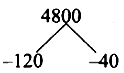
b = – 120 = 0 or b – 40 = 0
b = 120 or b = 40
If breadth is 120 length is 40
If breadth is 40 length is 120
Length of the park = 120 m
Breadth of the park = 40 m View full question & answer→Question 185 Marks
A boat takes 1.6 hours longer to go 36 kms up a river than down the river. If the speed of the water current is 4 km per hr, what is the speed of the boat in still water?
AnswerLet the speed of the boat in still water be " $x$ "
Time taken to go for up of a river $=\frac{36}{x+4}$
By the given condition
$
\begin{aligned}
& \frac{36}{x-4}-\frac{36}{x+4}=1.6 \\
& \frac{36(x+4)-36(x-4)}{(x+4)(x-4)}=\frac{16}{10} \\
& \frac{36[x+4-(x-4)]}{x^2-16}=\frac{16}{10} \\
& \frac{36 \times 8}{x^2-16}=\frac{16}{10} \\
& 16\left(x^2-16\right)=36 \times 8 \times 10 \\
& x^2-16=\frac{36 \times 8 \times 10}{16} \\
& x^2-16=180 \\
& x^2=180+16
\end{aligned}
$
$
\begin{aligned}
& x^2=196 \\
& x^2=\sqrt{196} \\
& = \pm 14
\end{aligned}
$
The speed of the boat in still water $=\frac{14 km }{ hr }$
View full question & answer→Question 195 Marks
Solve $\sqrt{y+1}+\sqrt{2 y-5}=3$
Answer$\begin{aligned} & \sqrt{y+1}+\sqrt{2 y-5}=3 \ldots \text { (squaring on both sides) } \\ & (\sqrt{y+1}+\sqrt{2 y-5})^2=3^2 \\ & (\sqrt{y+1})^2+(\sqrt{2 y-5})^2+2(\sqrt{y+1})(\sqrt{2 y-5})=9 \\ & y+1+2 y-5+2 \sqrt{(y+1)(2 y-5)}=9 \\ & 3 y-4+2 \sqrt{2 y^2-5 y+2 y-5}=9 \\ & 2 \sqrt{2 y^2-3 y-5}=9+4-3 y \\ & =13-3 y \quad \ldots \text { (squaring on both sides) } \\ & {\left[2 \sqrt{2 y^2-3 y-5}\right]^2=(13-3 y)^2} \\ & 4\left(2 y^2-3 y-5\right)=169+9 y^2-78 y \\ & 8 y^2-12 y-20=169+9 y^2-78 y \\ & 8 y^2-9 y^2-12 y+78 y-20-169=0 \\ & -y^2-66 y-189=0 \\ & \end{aligned}$
$y^2 – 66y + 189 = 0$
(y – 3) (y – 63) = 0

y – 3 or y = 63
The value of y is 3 and 63 View full question & answer→Question 205 Marks
Find the values of $m$ and $n$ if the following polynomial is a perfect square $\frac{1}{x^4}-\frac{6}{x^3}+\frac{13}{x^2}+\frac{ m }{x}+ n$
Answer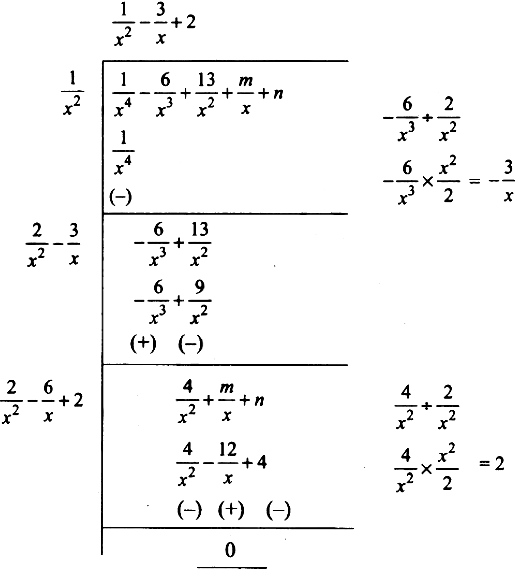
Since it is a perfect square
$
\begin{aligned}
& \frac{1}{x}(m+12)=0 \\
& m+12=0 \\
& m=-12 \\
& n-4=0 \\
& n=4
\end{aligned}
$
$\therefore$ The value of $m=-12$ and $n=4$ View full question & answer→Question 215 Marks
Find the values of m and n if the following polynomial is a perfect square
$x^4-8 x^3+m x^2+n x+16$
Answer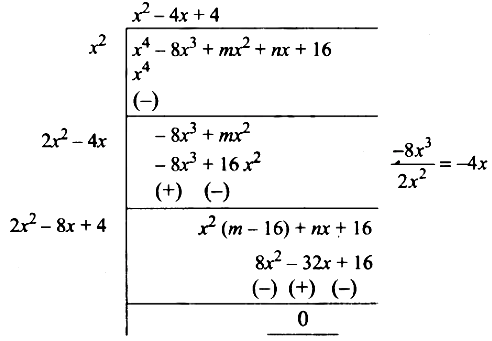
" height="" />
Since it is a perfect square
m – 16 – 8 = 0
m – 24 = 0
m = 24
n + 32 = 0
n = – 32
∴ The value of m = 24 and n = – 32
View full question & answer→Question 225 Marks
Find the values of a and b if the following polynomial is a perfect square
$4 x^4-12 x^3+37 x^2+b x+a$
Answer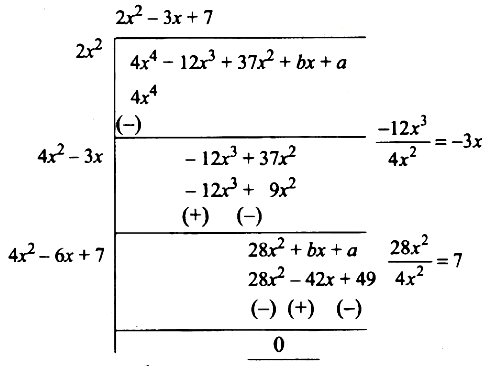
" height="" />
Since it is a perfect square
b + 42 = 0
b = – 42
a – 49 = 0
a = 49
∴ The value of a = 49 and b = – 42
View full question & answer→Question 235 Marks
Find the values of a and b if the following polynomial is a perfect square
$a x^4+b x^3+361 x^2+220 x+100$
AnswerRe-arrange the order we get
$100+220 x+361 x^2+b x^3+a x^4$
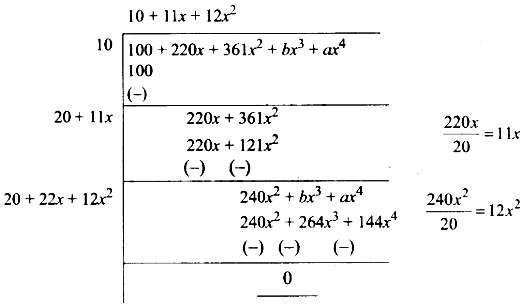 " />
" />
Since it is a perfect square
b – 264 = 0
b = 264
a – 144 = 0
a = 144
∴ The value of a = 144 and b = 264 View full question & answer→Question 245 Marks
Find the square root of the following polynomials by division method
$121 x^4-198 x^3-183 x^2+216 x+144$
Answer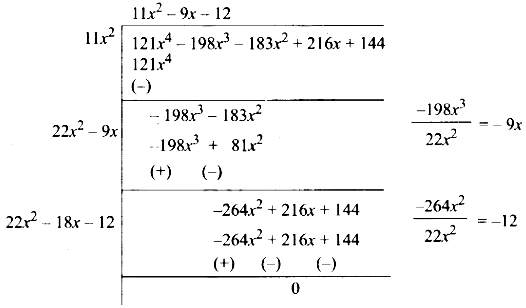 " height="" />
$\therefore \sqrt{121 x^4-198 x^3-183 x^2+216 x+144}=\left|11 x^2-9 x-12\right|$ View full question & answer→Question 255 Marks
Find the square root of the following polynomials by division method
$x^4-12 x^3+42 x^2-36 x+9$
Answer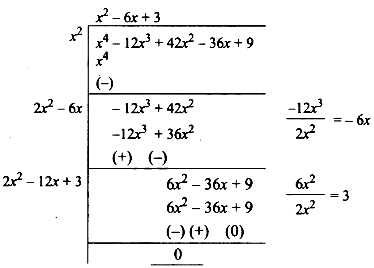
$\therefore \sqrt{x^4-12 x^3+42 x^2-36 x+9}=\left| x ^2-6 x +3\right|$ View full question & answer→Question 265 Marks
Find the square root of the following polynomials by division method
$37 x^2-28 x^3+4 x^4+42 x+9$
AnswerRearrange the order we get
$4 x^4-28 x^3+37 x^2+42 x+9$
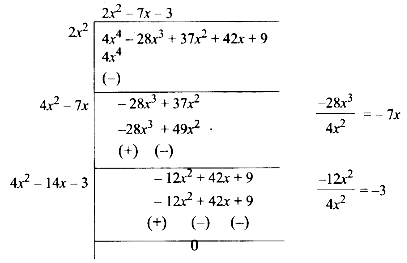 " height="">
$\therefore \sqrt{4 x^4-28 x^3+37 x^2+42 x+9}=\left|2 x^2-7 x-3\right|$ View full question & answer→Question 275 Marks
Find the square root of the following polynomials by division method
$16 x^4+8 x^2+1$
Answer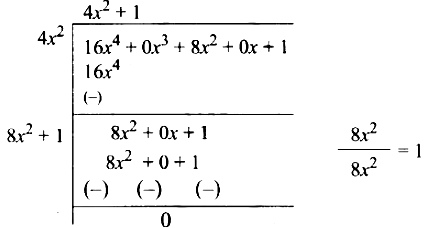 " height="" />
$\therefore \sqrt{16 x^4+8 x^2+1}=\left|4 x^2+1\right|$ View full question & answer→Question 285 Marks
Find the square root of the following
$
\left(2 x^2+\frac{17}{6} x+1\right)\left(\frac{3}{2} x^2+4 x+2\right)\left(\frac{4}{3} x^2+\frac{11}{3} x+2\right)
$
Answer$\begin{aligned} & \sqrt{\left(2 x^2+\frac{17}{6} x+1\right)\left(\frac{3}{2} x^2+4 x+2\right)\left(\frac{4}{3} x^2+\frac{11}{3} x+2\right)} \\ & =\sqrt{\left(\frac{12 x^2+17 x+6}{6}\right)\left(\frac{3 x^2+8 x+4}{2}\right)\left(\frac{4 x^2+11 x+6}{3}\right)} \\ & =\frac{1}{6} \sqrt{(4 x+3)(3 x+2)(x+2)(3 x+2)(4 x+3)(x+2)} \\ & =\frac{1}{6}|(4 x+3)(3 x+2)(x+2)|\end{aligned}$
View full question & answer→Question 295 Marks
Find the square root of the following
$\left(4 x^2-9 x+2\right)\left(7 x^2-13 x-2\right)\left(28 x^2-3 x-1\right)$
Answer$\begin{aligned} & \sqrt{\left(4 x^2-9 x+2\right)\left(7 x^2-13 x-2\right)\left(28 x^2-3 x-1\right)} \\ & =\sqrt{(x-2)(4 x-1)(x-2)(7 x+1)(4 x-1)(7 x+1)} \\ & =\sqrt{(x-2)^2(4 x-1)^2(7 x+1)^2} \\ & =|(x-2)(4 x-1)(7 x+1)|\end{aligned}$
View full question & answer→Question 305 Marks
Iniya bought 50 kg of fruits consisting of apples and bananas. She paid twice as much per kg for the apple as she did for the banana. If Iniya bought ₹ 1800 worth of apples and ₹ 600 worth bananas, then how many kgs of each fruit did she buy?
AnswerLet the quantity of apples and bananas purchased be ' $x$ ' and ' $y$ ' By the given condition
$
x+y=50
$
Cost of one kg of apple $=\frac{1800}{x}$
Cost of one kg of banana $=\frac{600}{y}$
By the given condition
One kg of apple $=2 \frac{(600)}{y}$
Total cost of fruits purchased $=1800+600$
$x \times 2 \frac{(600)}{y}+y \frac{(600)}{y}=2400$
$\frac{1200 x}{y}=2400-600$
$\frac{1200 x}{y}=1800$
$
\begin{aligned}
& 1200 x=1800 \times y \\
& x=\frac{1800 x}{1200}=\frac{3 y}{2}
\end{aligned}
$
Substitute the value of $x$ in (1)
$
\begin{aligned}
& \frac{3 y}{2}+y=50 \\
& \frac{5 y}{2}=50 \\
& 5 y=100 \Rightarrow y=\frac{100}{5}=20 \\
& x=\frac{3 y}{2}=\frac{3 \times 20}{2} \\
& =30
\end{aligned}
$
The quantity of apples $=30 kg$
The quantity of bananas $=20 kg$
View full question & answer→Question 315 Marks
Pari needs 4 hours to complete the work. His friend Yuvan needs 6 hours to complete the same work. How long will it take to complete if they work together?
AnswerPari: time required to complete the work $=4$ hrs.
$\therefore \ln 1$ hr. she will complete $=\frac{1}{4}$ of the work.
$
=\frac{1}{4} W
$
Yuvan: Time required to complete the work $=6$ hrs.
$\therefore$ In 1 hr. he will complete the $=\frac{1}{6}$ of the work
$
=\frac{1}{6} w
$
Working together, in $1 hr$. they will complete $\frac{ w }{4}+\frac{ w }{6}$ of the work.
$
\begin{aligned}
& =\frac{6 w+4 w}{24} \\
& =\frac{5}{12} w
\end{aligned}
$
$\therefore$ To complete the total work time taken
$
=\frac{ W }{\frac{5}{12} W }
$
$\begin{aligned} & =\frac{12}{5} \\ & =2.4 \text { hrs. ... }[\because(4) \text { hrs }=4 \times 60=24 min ] \\ & =2 \text { hrs } 24 \text { minutes. }\end{aligned}$
View full question & answer→Question 325 Marks
If $A =\frac{x}{x+1} B =\frac{1}{x+1}$ prove that $\frac{( A + B )^2+( A - B )^2}{ A + B }=\frac{2\left(x^2+1\right)}{x(x+1)^2}$
Answer$\begin{aligned} & ( A + B )^2=\left(\frac{x}{x+1}+\frac{1}{x+1}\right)^2 \\ & =\left(\frac{x+1}{x+1}\right)^2 \\ & =1 \\ & ( A - B )^2=\left(\frac{x}{x+1}-\frac{1}{x+1}\right)^2 \\ & =\left(\frac{x-1}{x+1}\right)^2 \\ & =\frac{(x-1)^2}{(x+1)^2} \\ & \frac{ A }{ B }=\frac{x}{x+1} \div \frac{1}{x+1} \\ & =\frac{x}{x+1} \times \frac{x+1}{1} \\ & = x \end{aligned}$
$\begin{aligned} & \text { L.H.S. }=\frac{( A + B )^2+( A - B )^2}{\frac{ A }{ B }} \\ & =1+\frac{(x-1)^2}{(x+1)^2} \div x \\ & =\frac{(x+1)^2+(x-1)^2}{(x+1)^2} \times \frac{1}{x} \\ & =\frac{x^2+2 x+1+x^2-2 x+1}{x(x+1)^2} \\ & =\frac{2 x^2+2}{x(x+1)^2} \\ & =\frac{2\left(x^2+1\right)}{x(x+1)^2} \\ & \text { L.H.S. }=\text { R.H.S. }\end{aligned}$
View full question & answer→Question 335 Marks
If $A =\frac{2 x+1}{2 x-1}, B =\frac{2 x-1}{2 x+1}$ find $\frac{1}{ A - B }-\frac{2 B }{ A ^2- B ^2}$
Answer$\begin{aligned} & \frac{1}{ A - B }-\frac{2 B }{ A ^2- B ^2}=\frac{1}{ A - B }-\frac{2 B }{( A + B )( A - B )} \\ & =\frac{ A + B -2 B }{( A + B )( A - B )} \\ & =\frac{ A - B }{( A + B )( A - B )} \\ & =\frac{1}{ A + B } \\ & =1 \div \frac{2 x+1}{2 x-1}+\frac{2 x-1}{2 x+1} \\ & =1 \div \frac{(2 x+1)^2+(2 x-1)^2}{(2 x-1)(2 x+1)} \\ & =1 \div \frac{4 x^2+1+4 x+4 x^2+1-4 x}{(2 x-1)(2 x+1)} \\ & =1 \div \frac{8 x^2+2}{(2 x-1)(2 x+1)} \\ & =1 \div \frac{2\left(4 x^2+1\right)}{4 x^2-1}\end{aligned}$
$=1 \times \frac{4 x^2-1}{2\left(4 x^2+1\right)}$
View full question & answer→Question 345 Marks
Identify rational expression should be subtracted from $\frac{x^2+6 x+8}{x^3+8}$ to get $\frac{3}{x^2-2 x+4}$
Answer$\begin{aligned} & \text { Let } p ( x )=\frac{x^2+6 x+8}{x^3+8} \\ & p ( x )- q ( x )=\frac{3}{x^2-2 x+4} \\ & \frac{x^2+6 x+8}{x^3+8}- q (x)=\frac{3}{x^2-2 x+4} \\ & q ( x )=\frac{x^2+6 x+8}{x^3+8}-\frac{3}{x^2-2 x+4} \\ & q ( x )=\frac{x^2+6 x+8}{(x+2)\left(x^2-2 x+4\right)}-\frac{3}{x^2-2 x+4} \\ & =\frac{(x+2)(x+4)}{(x+2)\left(x^2-2 x+4\right)}-\frac{3}{x^2-2 x+4} \\ & =\frac{x+4}{x^2-2 x+4}-\frac{3}{x^2-2 x+4} \\ & =\frac{x+4-3}{x^2-2 x+4} \\ & =x+1\end{aligned}$
View full question & answer→Question 355 Marks
Simplify $\frac{(2 x+1)(x-2)}{x-4}-\frac{\left(2 x^2-5 x+2\right)}{x-4}$
Answer$\begin{aligned} & \frac{(2 x+1)(x-2)}{x-4}-\frac{\left(2 x^2-5 x+2\right)}{x-4} \\ & =\frac{(2 x+1)(x-2)-\left(2 x^2-5 x+2\right)}{x-4} \\ & =\frac{2 x^2-4 x+x-2-2 x^2+5 x-2}{x-4} \\ & =\frac{2 x-4}{x-4} \\ & =\frac{2(x-2)}{x-4}\end{aligned}$
View full question & answer→Question 365 Marks
Simplify $\frac{4 x}{x^2-1}-\frac{x+1}{x-1}$
Answer$\begin{aligned} & \frac{4 x}{(x+1)(x-1)}-\frac{x+1}{(x-1)} \\ & =\frac{4 x-(x+1)(x+1)}{(x+1)(x-1)} \\ & =\frac{4 x-\left(x^2+2 x+1\right)}{(x+1)(x-1)} \\ & =\frac{4 x-x^2-2 x-1}{(x+1)(x-1)} \\ & =\frac{-x^2+2 x-1}{(x+1)(x-1)}\end{aligned}$
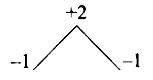
$\begin{aligned} & =\frac{-\left(x^2-2 x+1\right)}{(x+1)(x-1)} \\ & =\frac{-(x-1)(x-1)}{(x+1)(x-1)} \\ & =\frac{1-x}{x+1}\end{aligned}$ View full question & answer→Question 375 Marks
If a polynomial $p(x)=x^2-5 x-14$ is divided by another polynomial $q(x)$ we get $\frac{x-7}{x+2}$, find $q(x)$
Answer$p(x) = x^2 – 5x – 14$
= (x – 7) (x + 2)
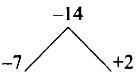
By the given data
$\begin{aligned} & \frac{ p (x)}{ q (x)}=\frac{(x-7)}{x+2} \\ & \frac{(x-7)(x+2)}{ q (x)}=\frac{(x-7)}{x+2} \\ & q ( x ) \times( x -7)=( x -7)( x +2)( x +2) \\ & q ( x )=\frac{(x-7)(x+2)(x+2)}{(x-7)} \\ & =( x +2)^2 \\ & q(x)=x^2+4 x+4\end{aligned}$ View full question & answer→Question 385 Marks
If $x=\frac{a^2+3 a-4}{3 a^2-3}$ and $y=\frac{a^2+2 a-8}{2 a^2-2 a-4}$ find the value of $x^2 y^{-2}$
Answer$\begin{aligned} & x=\frac{a^2+3 a-4}{3 a^2-3} \\ & =\frac{(a+4)(a-1)}{3\left(a^2-1\right)} \\ & =\frac{(a+4)(a-1)}{3(a+1)(a-1)} \\ & =\frac{(a+4)}{3(a+1)} \\ & y=\frac{a^2+2 a-8}{2 a^2-2 a-4} \\ & a^2+2 a-8=(a+4)(a-2) \\ & 2 a^2-2 a-4=2\left(a^2-a-2\right) \\ & =2(a-2)(a+1) \\ & y=\frac{(a+4)(a-2)}{2(a-2)(a+1)} \\ & =\frac{a+4}{2(a+1)}\end{aligned}$
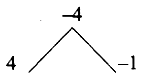
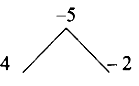
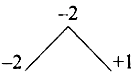
$\begin{aligned} & \text { The value of } x^2 y^{-2}=\frac{x^2}{y^2}=\left(\frac{x}{y}\right)^2 \\ & =\left[\frac{a+4}{3(a+1)} \div \frac{a+4}{2(a+1)}\right] \\ & =\left[\frac{(a+4)}{3(a+1)} \times \frac{2(a+1)}{(a+4)}\right]^2 \\ & =\left(\frac{2}{3}\right)^2 \\ & =\frac{4}{9}\end{aligned}$ View full question & answer→Question 395 Marks
Simplify $\frac{12 t ^2-22 t +8}{3 t } \div \frac{3 t ^2+2 t -8}{2 t ^2+4 t }$
Answer$12t^2 – 22t + 8 = 2(6t^2 – 11t + 4)$
$= 2[6t^2 – 8t – 3t + 4]$
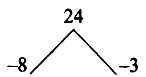
$= 2[2t (3t – 4) – 1 (3t – 4)]$
$= 2(3t – 4) (2t – 1)$
$3t^2 + 2t – 8 = 3t^2 + 6t – 4t – 8$
$= 3t(t + 2) – 4(t + 2)$
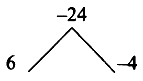
$= (t + 2) (3t – 4)$
$2t^2 + 4t = 2t(t + 2)$
$\begin{aligned} & \frac{12 t^2-22 t+8}{3 t} \div \frac{3 t^2+2 t-8}{2 t^2+4 t} \\ & =\frac{2(3 t-4)(2 t-1)}{3 t} \div(t+2) \frac{(3 t-4)}{2 t(t+2)} \\ & =\frac{2(3 t-4)(2 t-1)}{3 t} \div \frac{(3 t-4)}{2 t} \\ & =\frac{4(2 t-1)}{3}\end{aligned}$ View full question & answer→Question 405 Marks
Simplify $\frac{2 a ^2+5 a +3}{2 a ^2+7 a +6} \div \frac{ a ^2+6 a +5}{-5 a ^2-35 a -50}$
Answer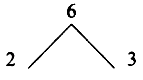
$2 a^2+5 a+3 a+3=2 a^2+2 a+3 a+3$
$=2 a(a+1)+3(a+1)$
$=(a+1)(2 a+3)$
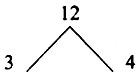
$2 a^2+7 a+6=2 a^2+3 a+4 a+6$
$=a(2 a+3)+2(2 a+3)$
$=(2 a+3)(a+2)$
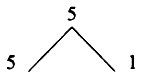
$a^2+6 a+5=(a+5)+(a+1)$
$-5 a^2-35 a-50=-5\left(a^2+7 a+10\right)$
$=-5(a+5)(a+2)$
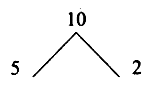
$\begin{aligned} & \frac{2 a^2+5 a+3}{2 a^2+7 a+6} \div \frac{a^2+6 a+5}{-5 a^2-35 a-50} \\ & =\frac{(a+1)(2 a+3)}{(2 a+3)(a+2)} \div \frac{(a+5)(a+1)}{-5(a+5)(a+2)} \\ & =\frac{(a+1)}{(a+2)} \div \frac{(a+1)}{-5(a+2)} \\ & =\frac{(a+1)}{(a+2)} \times \frac{-5(a+2)}{(a+1)} \\ & =-5\end{aligned}$ View full question & answer→Question 415 Marks
Simplify $\frac{b^2+3 b-28}{b^2+4 b+4} \div \frac{b^2-49}{b^2-5 b-14}$
Answer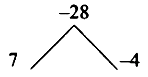
$b^2+3 b-28=(b+7)(b-4)$
$b^2+4 b+4=(b+2)(b+2)$
$b^2-49=b^2-7^2$
$=(b+7)(b-7)$
$b^2-5 b-14=(b-7)(b+2)$
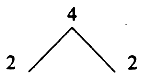
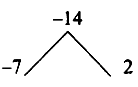
$\begin{aligned} & \frac{b^2+3 b-28}{b^2+4 b+4} \div \frac{b^2-49}{b^2-5 b-14} \\ & =\frac{(b+7)(b-4)}{(b+2)(b+2)} \div \frac{(b+7)(b-7)}{(b-7)(b+2)} \\ & =\frac{(b+7)(b-4)}{(b+2)(b+2)} \times \frac{(b+2)}{(b+7)} \\ & =\frac{(b-4)}{(b+2)}\end{aligned}$ View full question & answer→Question 425 Marks
Simplify $\frac{x^3-y^3}{3 x^2+9 x y+6 y^2} \times \frac{x^2+2 x y+y^2}{x^2-y^2}$
Answer$x^3-y^3=(x-y)\left(x^2+x y+y^2\right)$
$x^2+2 x y+y^2=(x+y)(x+y)$
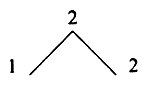
$3 x^2+9 x y+6 y^2=3\left(x^2+3 x y+2 y^2\right)$
$=3(x+2 y)(x+y)$
$\left(x^2-y^2\right)=(x+y)(x-y)$
$\begin{aligned} & \frac{x^3-y^3}{3 x^2+9 x y+6 y^2} \times \frac{x^2+2 x y+y^2}{x^2-y^2} \\ & =\frac{(x-y)\left(x^2+x y+y^2\right)}{3(x+2 y)(x+y)} \times \frac{(x+y)(x+y)}{(x+y)(x-y)} \\ & =\frac{x^2+x y+y^2}{3(x+2 y)}\end{aligned}$ View full question & answer→Question 435 Marks
Simplify $\frac{p^2-10 p+21}{p-7} \times \frac{p^2+p-12}{(p-3)^2}$
Answer$\begin{aligned} & P ^2-10 p+21=(p-7)(p-3) \\ & p^2+p-12=(p+4)(p-3) \\ & \frac{p^2-10 p+21}{(p-7)} \times \frac{p^2+p-12}{(p-3)^2}=\frac{(p-7)(p-3)}{(p-7)} \times \frac{(p+4)(p-3)}{(p-3)^2} \\ & =(p-3) \times \frac{(p+4)}{(p-3)} \\ & =p+4\end{aligned}$
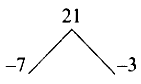
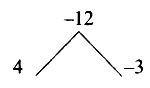
View full question & answer→Question 445 Marks
Given the LCM and GCD of the two polynomials p(x) and q(x) find the unknown polynomial in the following table
| LCM |
GCD |
p(x) |
q(x) |
| $a^3-10 a^2+11 a+70$ |
a – 7 |
$a^2-12 a+35$ |
|
Answer$\text { L.C.M. }=a^3-10 a^2+11 a+70$
$=(a-7)\left(a^2-3 a-10\right)$
$=(a-7)(a-5)(a+2)$
| 7 |
1 – 10 + 11 + 70
0 7 – 21 – 70 |
| |
1 – 3 – 10 0 |
G.C.D. = (a – 7)
$p(x) = a^2 -12a + 35$
= (a – 5)(a – 7)
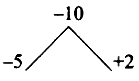
$q(x)=\frac{ LCM \times GCD }{ p (x)}$
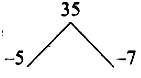
View full question & answer→Question 455 Marks
Given the LCM and GCD of the two polynomials p(x) and q(x) find the unknown polynomial in the following table
| LCM |
GCD |
p(x) |
q(x) |
| $\left(x^4-y^4\right)\left(x^4+x^2 y^2+y^2\right)$ |
$\left(x^2-y^2\right)$ |
|
$\left(x^4-y^4\right)\left(x^2+y^2-x y\right)$ |
AnswerL.C.M. $\left(x^2+y^2\right)\left(x^4+x^2 y^2+y^4\right)$
$\begin{aligned} & \left(x^2+y^2\right)\left[\left(x^2+y^2\right)^2-(x y)^2\right] \\ & \left(x^2+y^2\right)\left(x^2+y^2+x y\right)\left(x^2+y^2-x y\right) \\ & \text { G.C.D. }=x^2-y^2 \\ & (x+y)(x-y) \\ & q(x)=\left(x^4-y^4\right)\left(x^2+y^2-x y\right) \\ & =\left[\left(x^2\right)^2-\left(y^2\right)^2\right]\left(x^2+y^2-x y\right) \\ & =\left(x^2+y^2\right)\left(x^2-y^2\right)\left(x^2+y^2-x y\right) \\ & \left(x^2+y^2\right)(x+y)(x-y)\left(x^2+y^2-x y\right) \\ & P(x)=x^2+y^2+x y \\ & p ( x )=\frac{ LCM \times GCD }{ q (x)} \\ & =\frac{\left(x^2+y^2\right)\left(x^2+y^2+x y\right)\left(x^2+y^2-x y\right)(x+y)(x-y)}{\left(x^2+y^2\right)(x+y)(x-y)\left(x^2+y^2-x y\right)} \\ & p(x)=x^2+y^2+x y \\ & \end{aligned}$
View full question & answer→Question 465 Marks
Find the GCD pair of the following polynomials
$12\left(x^4-x^3\right), 8\left(x^4-3 x^3+2 x^2\right)$ whose LCM is $24 x^3(x-1)(x-2)$
Answer$p(x)=12\left(x^4-x^3\right)$
$=12 x^3(x-1)$
$g(x)=8\left(x^4-3 x^3+2 x^2\right)$
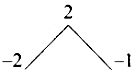
$=8 x^2\left(x^2-3 x+2\right)$
$=8 x^2(x-2)(x-1)$
$\text { L.C.M. }=24 x^3(x-1)(x-2)$
$\begin{aligned} & \text { G.C.D. }=\frac{p(x) \times g(x)}{\text { L.C.M. }} \\ & =\frac{12 x^3(x-1) \times 8 x^2(x-2)(x-1)}{24 x^3(x-1)(x-2)} \\ & \text { G.C.D. }=4 x^2(x-1)\end{aligned}$ View full question & answer→Question 475 Marks
Find the GCD pair of the following polynomials
$\left(x^3+y^3\right),\left(x^4+x^2 y^2+y^4\right)$ whose LCM is $\left(x^3+y^3\right)\left(x^2+x y+y^2\right)$
Answer$\begin{aligned} & p ( x )= x ^3+ y ^3 \\ & =( x + y )\left( x ^2- xy + y ^2\right) \\ & g( x )= x ^4+ x ^2 y ^2+ y ^4=\left[ x ^2+ y ^2\right]^2-( xy )^2 \\ & =\left( x ^2+ y ^2+ xy \right)\left( x ^2+ y ^2- xy \right) \\ & \text { L.C.M. }=\left( x ^3+ y ^3\right)\left( x ^2+ xy + y ^2\right) \\ & ( x + y )\left( x ^2- xy + y ^2\right)\left( x ^2+ xy + y ^2\right) \\ & \text { G.C.D. }=\frac{ p (x) \times g (x)}{ L . C \cdot M .} \\ & =\frac{(x+y)\left(x^2-x y+y^2\right) \times\left(x^2+y^2+x y\right)\left(x^2+y^2-x y\right)}{(x+y)\left(x^2-x y+y^2\right)\left(x^2+x y+y^2\right)} \\ & \text { G.C.D. }= x ^2- xy + y ^2\end{aligned}$
View full question & answer→Question 485 Marks
Find the LCM pair of the following polynomials
$a^2 + 4a – 12, a^2 – 5a + 6$ whose GCD is a – 2
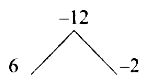
Answer$p(x) = a^2 + 4a – 12$
$= a^2 + 6a – 2a – 12$
= a (a + 6) – 2(a + 6)
= (a + 6) (a – 2)
$g(x) = a^2 – 5a + 6$
$= a^2 – 3a – 2a + 6$
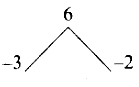
= a(a – 3) – 2 (a – 3)
= (a – 3) (a – 2)
$\begin{aligned} & \text { L.C.M. }=\frac{p(x) \times g(x)}{\text { G.C.D. }} \\ & =\frac{(a+6)(a-2) \times(a-3)(a-2)}{(a-2)} \\ & =(a+6)(a-3)(a-2)\end{aligned}$ View full question & answer→Question 495 Marks
Find the LCM and GCD for the following and verify that f(x) × g(x) = LCM × GCD
$21 x^2 y, 35 x y^2$
Answer$p(x)=21 x^2 y=3 \times 7 \times x^2 \times y$
$g(x)=35 x y^2=5 \times 7 \times x \times y^2$
$\text { G.C.D }=7 x y$
$\text { L.C.M }=3 \times 5 \times 7 x^2 \times y^2$
$=105 x^2 y^2$
$\text { L.C.M } \times \text { G.C.D }=105 x^2 y^2 \times 7 x y$
$=735 x^3 y^3 \ldots .(1)$
$\text { p }(x) \times g(x)=21 x^2 y \times 35 x y^2$
$=735 x^3 y^3 \ldots .(2)$
From (1) and (2) we get
$\text { L.C.M } \times \text { G.C.D. }=p(x) \times g(x)$
View full question & answer→Question 505 Marks
Find the LCM and GCD for the following and verify that $f(x) \times g(x)=L C M \times G C D$ $\left(x^3-1\right)(x+1),\left(x^3+1\right)$
Answer$p(x)=\left(x^3-1\right)(x+1)=(x-1)\left(x^2+x+1\right)(x+1)$ $g(x)=x^3+1=(x+1)\left(x^2-x+1\right)$
G.C.D $=(x+1)$
L.C.M $=(x+1)(x-1)\left(x^2+x+1\right)\left(x^2-x+1\right)$
L.C.M $\times$ G.C.D $=(x+1)(x-1)\left(x^2+x+1\right)\left(x^2-x+1\right) \times(x+1)$ $=(x+1)^2(x-1)\left(x^2+x+1\right)\left(x^2-x+1\right) \ldots(1)$ $p(x) \times g(x)=(x-1)\left(x^2+x+1\right)(x+1)(x+1)\left(x^2-x+1\right)$
$=(x+1)^2(x-1)\left(x^2+x+1\right)\left(x^2-x+1\right) \ldots(2)$
From (1) and (2) we get
$\text { L.C.M. } \times \text { G.C.D. }=p(x) \times g(x)$
View full question & answer→