MCQ
Let

$\alpha=\sum_{ k =1}^{\infty} \sin ^{2 k}\left(\frac{\pi}{6}\right)$

Let $g:[0,1] \rightarrow R$ be the function defined by

$g( x )=2^{\alpha x }+2^{\alpha(1- x )}$

Then, which of the following statements is/are $TRUE$?

$(A)$ The minimum value of $g( x )$ is $2^{\frac{7}{6}}$

$(B)$ The maximum value of $g( x )$ is $1+2^{\frac{1}{3}}$

$(C)$ The function $g( x )$ attains its maximum at more than one point

$(D)$ The function $g( x )$ attains its minimum at more than one point

  • A
    $A,B$
  • B
    $A,B,D$
  • C
    $A,C$
  • $A,B,C$

Answer

Correct option: D.
$A,B,C$
d
$\alpha=\left(\frac{1}{2}\right)^2+\left(\frac{1}{2}\right)^4+\left(\frac{1}{2}\right)^6+\ldots$

$\alpha=\frac{\frac{1}{4}}{1-\frac{1}{4}}=\frac{1}{3}$

$\therefore g(x)=2^{x / 3}+2^{1 / 3(1-x)}$

$\therefore g(x)=2^{x / 3}+\frac{2^{1 / 3}}{2^{x / 3}}$

$\text { where } g(0)=1+2^{1 / 3} \& g(1)=1+2^{1 / 3}$

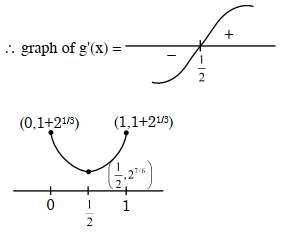
$\therefore g^{\prime}(x)=\frac{1}{3}\left(2^{x / 3}-\frac{2^{1 / 3}}{2^{\pi / 3}}\right)=0$

$\Rightarrow 2^{2 x / 3}=2^{1 / 3} \Rightarrow x=\frac{1}{2}=\text { critical point }$

(image)

& $g\left(\frac{1}{2}\right)=2^{\frac{7}{6}}$

$\therefore \text { graph of } g(x) \text { in }[0,1]$

(image)

Need a full question paper?

Generate a complete, print-ready paper with questions like this in minutes — across 16+ boards, with answer keys.

Start Generating Free

Similar questions

A set of points which do not lie on the same line are called as
  1. collinear
  2. non-collinear
  3. concurrent
  4. square
The least number of times a fair coin must be tossed so that the probability of getting at least one head is at least 0.8, is:
If $u = {x^2} + {y^2}$ and $x = s + 3t,$$y = 2s - t,$ then ${{{d^2}u} \over {d{s^2}}} = $
The general solution of differention eqution of the ex dy + (yex + 2x)dx = 0 is:
  1.  xey + x2 = C
  2. xey + y2 = C
  3. yex + y2 = C
  4. yey + x2 = C
Choose the correct answer from the given four options.
$\text{X}$
$1$
$2$
$3$
$4$
$\text{P}(\text{X})$
$\frac{1}{10}$
$\frac{1}{5}$
$\frac{3}{10}$
$\frac{2}{5}$
For the following probability distribution E(X2) is equal to:
  1. 3.
  2. 5.
  3. 7.
  4. 10.
The vector$(s)$ which is/are coplanar with vectors $\hat{i}+\hat{j}+2 \hat{k}$ and $\hat{i}+2 \hat{j}+\hat{k}$, and perpendicular to the vector $\hat{i}+\hat{j}+\hat{k}$ is/are

$(A)$ $\hat{j}-\hat{k}$ $(B)$ $-\hat{i}+\hat{j}$ $(C)$ $\hat{i}-\hat{j}$ $(D)$ $-\hat{j}+\hat{k}$

Choose the correct answer from the given four options.
In a college, 30% students fail in physics, 25% fail in mathematics and 10% fail in both. One student is chosen at random. The probability that she fails in physics if she has failed in mathematics is:
  1. $\frac{1}{10}$
  2. $\frac{2}{5}$
  3. $\frac{9}{20}$
  4. $\frac{1}{3}$
Cartesian equation of a line is $\frac{x-5}{3}=\frac{y+4}{7}=\frac{6-z}{2}$, then the vector equation of the line is ___________ .
Let $f(x) = x - [x],$ for every real number $x,$ where $[x]$ is the integral part of $x.$ Then $\int_{ - 1}^1 {f(x)\,dx} $=
Evaluate: $\int \frac{\cos x}{\left(\cos \frac{x}{2}+\sin \frac{x}{2}\right)^3} d x$