MCQ
Let $D_1 =$ $\left| {\,\begin{array}{*{20}{c}}a&b&{a + b}\\c&d&{c + d}\\a&b&{a - b}\end{array}\,} \right|$ and $D_2 =$ $\left| {\,\begin{array}{*{20}{c}}a&c&{a + c}\\b&d&{b + d}\\a&c&{a + b + c}\end{array}\,} \right|$ then the value of $\frac{{{D_1}}}{{{D_2}}}$ where $b \ne 0$ and $ad \ne bc$, is
  • $-2$
  • B
    $0$
  • C
    $- 2b$
  • D
    $2b$

Answer

Correct option: A.
$-2$
a
Using $\rightarrow C_3 \rightarrow C_3 - (C_1 + C_2),$ $D_1 =$ $\left|{\,\begin{array}{*{20}{c}}a&b&{a + b}\\c&d&{c + d}\\a&b&{a - b}\end{array}\,} \right|$ and $D_2 = $ $\left| {\,\begin{array}{*{20}{c}}a&c&{a + c}\\b&d&{b + d}\\ a&c&{a + b + c}\end{array}\,} \right|$

$\therefore$ $\frac{{{D_1}}}{{{D_2}}}$ $=$ $\frac{{ - 2b(ad - bc)}}{{b(ad - bc)}}$ $=$ $- 2$ 

Need a full question paper?

Generate a complete, print-ready paper with questions like this in minutes — across 16+ boards, with answer keys.

Start Generating Free

Similar questions

If $\int_{}^{} {\frac{{2x + 3}}{{(x - 1)({x^2} + 1)}}\;dx = {{\log }_e}\left\{ {{{(x - 1)}^{\frac{5}{2}}}{{({x^2} + 1)}^a}} \right\}} - \frac{1}{2}{\tan ^{ - 1}}x + A$,where  $A$  is any arbitrary constant, then the value of $a$ is
If $f(x)=\left|\begin{array}{ccc}2 \cos ^4 x & 2 \sin ^4 x & 3+\sin ^2 2 x \\ 3+2 \cos ^4 x & 2 \sin ^4 x & \sin ^2 2 x \\ 2 \cos ^4 x & 3+2 \sin ^4 x & \sin ^2 2 x\end{array}\right|$ then $\frac{1}{5} f^{\prime}(0)$ is equal to ..........................
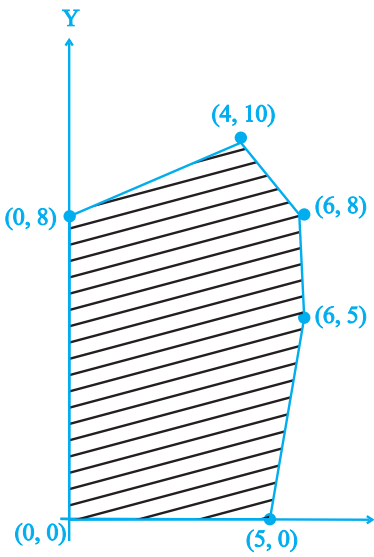
Choose the correct answer from the given four options. The feasible solution for a $\text{LPP}$ is shown in. Let $Z = 3x - 4y$ be the objective function. Maximum of $Z$ occurs at :
Choose the correct answer from the given four options : $f(x) = x^x$ has a stationary point at :
If $P$ be the point $(2, 6, 3)$ then the equation of the plane trough $P,$ at right angles to $OP,$ where $′\ O\ ′$ is the origin is:
If $f(n) = \tan ^{{  - 1 }} \left( {\frac{e-1}{e^{-n}+e^{n+1}}} \right)$$\forall n\, \in \,N$ , then $\sum\limits_{n = 1}^\infty  {f\left( n \right)} $ is equal to
Let $\vec{a}=-\hat{i}-\hat{k}, \vec{b}=-\hat{i}+\hat{j}$ and $\vec{c}=\hat{i}+2 \hat{j}+3 \hat{k}$ be three given vectors. If $\vec{r}$ is a vector such that $\vec{r} \times \vec{b}=\vec{c} \times \vec{b}$ and $\vec{r} \cdot \vec{a}=0$, then the value of $\vec{r} \cdot \vec{b}$ is
A rifleman is firing at a distant target and has only $10\%$ chance of hiting it. the least number of round he must fire in order to have more than $50\%$ chance of hitting it at least once is:
The area bounded by $= 4ax$ and $y = mx$ is $\frac{\text{a}^2}{3}\text{sq. units}$ then $m:$
Statement $I:$ The equation ${({\sin ^{ - 1}}\,x)^3} + {({\cos ^{ - 1}}\,x)^3} - a{\pi ^3} = 0$ has a solution for all $a \ge \frac{1}{{32}}.$

Statement $II:$  For any $x \in R ,$ ${\sin ^{ - 1}}\,x + {\cos ^{ - 1}}\,x = \frac{\pi }{2}$ and $0 \le {\left( {{{\sin }^{ - 1}}\,x - \frac{\pi }{4}} \right)^2} \le \frac{{9{\pi ^2}}}{{16}}$