MCQ
Let $f :(0, \infty) \rightarrow(0, \infty)$ be a differentiable function such that $f(1)= e$ and $\lim \limits_{t \rightarrow x} \frac{t^{2} f^{2}(x)-x^{2} f^{2}(t)}{t-x}=0$ If $f ( x )=1,$ then $x$ is equal to
  • A
    $2e$
  • B
    $\frac{1}{2 e }$
  • C
    $e$
  • $\frac{1}{ e }$

Answer

Correct option: D.
$\frac{1}{ e }$
d
$L=\lim _{t \rightarrow x} \frac{t^{2} f^{2}(x)-x^{2} f^{2}(t)}{t-x}$

using L.H. rule

$L =\lim _{t \rightarrow x} \frac{2 tf ^{2}( x )- x ^{2} \cdot 2 f ^{\prime}( t ) \cdot f ( t )}{1}$

$\Rightarrow L =2 xf ( x )\left( f ( x )- x f ^{\prime}( x )\right)=0$ (given)

$\Rightarrow f(x)=x f^{\prime}(x) \Rightarrow \int \frac{f^{\prime}(x) d x}{f(x)}=\int \frac{d x}{x}$

$\Rightarrow \ell n | f ( x )|=\ell n | x |+ C$

$\because f (1)= e , x >0, f ( x )>0$

$\Rightarrow f ( x )= ex , \quad$ if $f ( x )=1 \Rightarrow x =\frac{1}{ e }$
Need a full question paper?

Generate a complete, print-ready paper with questions like this in minutes — across 16+ boards, with answer keys.

Start Generating Free

Similar questions

A matrix $A$ of order $3 \times 3$ has determinant What is the value of $|3 A|$ ?
The sum of the abosolute maximum and minimum values of the function $f(x)=\left|x^2-5 x+6\right|-3 x+2$ in the interval $[-1,3]$ is equal to :
Let $f (\theta)=\sin \theta+\int_{-\pi / 2}^{\pi / 2}(\sin \theta+ t \cos \theta) f ( t ) dt$. Then the value of $\left|\int_{0}^{\pi / 2} f (\theta) d \theta\right|$ is
Let $P$ be an $m \times m$ matrix such that $P^2=P$. Then, $(I+P)^n$ equals
In a linear programming problem, the constraints on the decision variables $x$ and $y$ are $x-3 y \geq 0, y \geq 0$, $0 \leq x \leq 3$. The feasible region
Let three vectors $\overrightarrow{\mathrm{a}}=\alpha \hat{\mathrm{i}}+4 \hat{\mathrm{j}}+2 \hat{\mathrm{k}}$, $\vec{b}=5 \hat{i}+3 \hat{j}+4 \hat{k}, \vec{c}=x \hat{i}+y \hat{j}+z \hat{k}$ from a triangle such that $\overrightarrow{\mathrm{c}}=\overrightarrow{\mathrm{a}}-\overrightarrow{\mathrm{b}}$ and the area of the triangle is $5 \sqrt{6}$. if $\alpha$ is a positive real number, then $|\overrightarrow{\mathrm{c}}|^2$ is :
If $a\,.i\,=a\,.\,(i+j)=a\,.\,(i+j+k)$ , then $a = $
If X follows a binomial distribution with parameter $\text{n}=100$ and $\text{p}=\frac{1}{3},$ then P(X = r) is maximum when r = 
Let × be the binary operation on N given by a × b = HCF (a, b) where, a, b ∈ N. Find the value of 22 × 4.
  1. 1
  2. 2
  3. 3
  4. 4
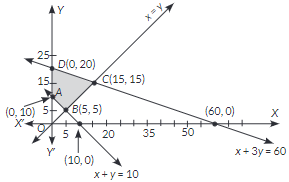
Based on the given shaded region as the feasible region in the graph, at which point(s) is the objective function $Z=3 x+9 y$ maximum?
Image