MCQ
Let $\mathrm{f}: R \rightarrow R$ be function defined as

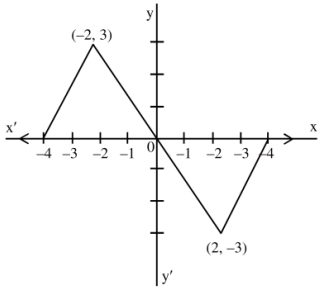
$f ( x )=\left\{\begin{array}{cc}3\left(1-\frac{| x |}{2}\right) & \text { if }| x | \leq 2 \text { } \\ 0 & \text { if }| x |>2 \text { }\end{array}\right.$ Let $g: R \rightarrow R$ be given by $g(x)=f(x+2)-f(x-2)$. If $n$ and $m$ denote the number of points in $R$ where $\mathrm{g}$ is not continuous and not differentiable, respectively, then $\mathrm{n}+\mathrm{m}$ is equal to $....$

  • $4$
  • B
    $3$
  • C
    $2$
  • D
    $1$

Answer

Correct option: A.
$4$
a
$f(x-2)\rightarrow =\frac{3 x}{2} \quad\quad -4 \leq x \leq-2$

$\quad \quad \quad \quad \quad \quad -\frac{3 x}{2} \quad -2\,$

$\quad \quad \quad \quad \quad \quad 0 \quad \quad \quad x \in(-\infty,-4) \cup(0,+\infty)$

$f(x+2)\rightarrow\frac{3 x}{2}+6 \quad \quad 0 \leq x \leq 2$

$\quad \quad \quad \quad \quad -\frac{3 x}{2}+6 \quad 2\,<\,x \leq 4$

$\quad \quad \quad \quad \quad 0 \quad \quad \quad \quad x \in(-\infty, 0) \cup(4,+\infty)$

$g(x)=f(x+2)-f(x-2) \rightarrow\frac{3 x}{2}+6 \quad -4 \leq x \leq-2$

$\quad \quad \quad \quad \quad \quad \quad \quad \quad \quad \quad \quad \quad -\frac{3 x}{2} \quad \quad -2\, < \,x\, < \,2$

$\quad \quad \quad \quad \quad \quad \quad \quad \quad \quad \quad \quad \quad \quad \frac{3 x}{2}-6\quad \quad 2 \leq x \leq 4$

$\quad \quad \quad \quad \quad \quad \quad \quad \quad \quad \quad \quad \quad 0 \quad \quad \quad \quad x \in(-\infty,-4) \cup(4,+\infty)$

$n=0$

$m=4 \Rightarrow(n+m=4)$

Need a full question paper?

Generate a complete, print-ready paper with questions like this in minutes — across 16+ boards, with answer keys.

Start Generating Free

Similar questions

If $\vec{a}$ and $\vec{b}$ are vectors in space given by $\vec{a}=\frac{\hat{i}-2 \hat{j}}{\sqrt{5}}$ and $\vec{b}=\frac{2 \hat{i}+\hat{j}+3 \hat{k}}{\sqrt{14}}$, then the value of $(2 \vec{a}+\vec{b}) \cdot[(\vec{a} \times \vec{b}) \times(\vec{a}-2 \vec{b})]$ is
Let $\mathrm{A}(\alpha, 0)$ and $\mathrm{B}(0, \beta)$ be the points on the line $5 x+7 y=50$. Let the point $P$ divide the line segment $A B$ internally in the ratio $7: 3$. Let $3 x$ $25=0$ be a directrix of the ellipse $E: \frac{x^2}{a^2}+\frac{y^2}{b^2}=1$ and the corresponding focus be $S$. If from $S$, the perpendicular on the $\mathrm{x}$ axis passes through $\mathrm{P}$, then the length of the latus rectum of $\mathrm{E}$ is equal to
If $f(t) = \int_{\, - t}^{\,t} {\frac{{dx}}{{1 + {x^2}}},} $ then $f'(1)$ is
Let $\overrightarrow{ a }=\hat{ i }+2 \hat{ j }-\hat{ k }, \overrightarrow{ b }=\hat{ i }-\hat{ j }$ and $\overrightarrow{ c }=\hat{ i }-\hat{ j }-\hat{ k }$ be three given vectors. If $\overrightarrow{ r }$ is a vector such that $\overrightarrow{ r } \times \overrightarrow{ a }=\overrightarrow{ c } \times \overrightarrow{ a }$ and $\overrightarrow{ r } \cdot \overrightarrow{ b }=0,$ then $\overrightarrow{ r } \cdot \overrightarrow{ a } \quad$ is equal to ...........
If $A$ and $B$ are two events such that $P\,(A \cup B)\, + P\,(A \cap B) = \frac{7}{8}$ and $P\,(A) = 2\,P\,(B),$ then $P\,(A) = $
The ${20^{th}}$ term of the series $2 \times 4 + 4 \times 6 + 6 \times 8 + .......$ will be
Number of solution$(s)$ of the equation $\sin 2\theta  + \cos 2\theta  =  - \frac{1}{2},\theta \in \left( {0,\frac{\pi }{2}} \right)$ is-
The domain of the function $f(x) = {\sin ^{ - 1}}[{\log _2}(x/2)]$ is
$\int_{}^{} {\frac{{dx}}{{{{(2\sin x + \cos x)}^2}}}} = $
The values of $A$ and $B$ such that the function $f(x) = \left\{ {\begin{array}{*{20}{c}}{ - 2\sin x,}&{x \le - \frac{\pi }{2}}\\{A\sin x + B,}&{ - \frac{\pi }{2} < x < \frac{\pi }{2}}\\{\cos x,}&{x \ge \frac{\pi }{2}}\end{array}} \right.$, is continuous everywhere are