Question
Let $\mathrm{f}: R \rightarrow R$ be function defined as

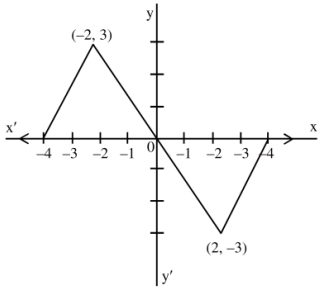
$f ( x )=\left\{\begin{array}{cc}3\left(1-\frac{| x |}{2}\right) & \text { if }| x | \leq 2 \text { } \\ 0 & \text { if }| x |>2 \text { }\end{array}\right.$ Let $g: R \rightarrow R$ be given by $g(x)=f(x+2)-f(x-2)$. If $n$ and $m$ denote the number of points in $R$ where $\mathrm{g}$ is not continuous and not differentiable, respectively, then $\mathrm{n}+\mathrm{m}$ is equal to $....$

Answer

a
$f(x-2)\rightarrow =\frac{3 x}{2} \quad\quad -4 \leq x \leq-2$

$\quad \quad \quad \quad \quad \quad -\frac{3 x}{2} \quad -2\,$

$\quad \quad \quad \quad \quad \quad 0 \quad \quad \quad x \in(-\infty,-4) \cup(0,+\infty)$

$f(x+2)\rightarrow\frac{3 x}{2}+6 \quad \quad 0 \leq x \leq 2$

$\quad \quad \quad \quad \quad -\frac{3 x}{2}+6 \quad 2\,<\,x \leq 4$

$\quad \quad \quad \quad \quad 0 \quad \quad \quad \quad x \in(-\infty, 0) \cup(4,+\infty)$

$g(x)=f(x+2)-f(x-2) \rightarrow\frac{3 x}{2}+6 \quad -4 \leq x \leq-2$

$\quad \quad \quad \quad \quad \quad \quad \quad \quad \quad \quad \quad \quad -\frac{3 x}{2} \quad \quad -2\, < \,x\, < \,2$

$\quad \quad \quad \quad \quad \quad \quad \quad \quad \quad \quad \quad \quad \quad \frac{3 x}{2}-6\quad \quad 2 \leq x \leq 4$

$\quad \quad \quad \quad \quad \quad \quad \quad \quad \quad \quad \quad \quad 0 \quad \quad \quad \quad x \in(-\infty,-4) \cup(4,+\infty)$

$n=0$

$m=4 \Rightarrow(n+m=4)$
Need a full question paper?

Generate a complete, print-ready paper with questions like this in minutes — across 16+ boards, with answer keys.

Start Generating Free

Similar questions

If ${(\sqrt 8 + i)^{50}} = {3^{49}}(a + ib)$ then ${a^2} + {b^2}$ is
The coefficient of $x^{2012}$ in $\frac{1+x}{\left(1+x^2\right)(1-x)}$ is
Let $\mathrm{a}, \mathrm{b}, \mathrm{c} \in \mathrm{N}$ and $\mathrm{a}<\mathrm{b}<\mathrm{c}$. Let the mean, the mean deviation about the mean and the variance of the $5$ observations $9$,$25$, $a$, $b$, $c$ be $18$,$4$ and $\frac{136}{5}$, respectively. Then $2 \mathrm{a}+\mathrm{b}-\mathrm{c}$ is equal to ..............
If $\mathop {\lim }\limits_{n \to \infty } \frac{{1 - {{(10)}^n}}}{{1 + {{(10)}^{n + 1}}}} = \frac{{ - \alpha }}{{10}}$, then give the value of $\alpha $ is
Three numbers are in $A.P.$ whose sum is $33$ and product is $792$, then the smallest number from these numbers is
If $90^\circ < A < 180^\circ $ and $\sin A = \frac{4}{5},$ then $\tan \frac{A}{2}$ is equal to
Consider the statistics of two sets of observations as follows :

  Size Mean Variance
Observation $I$ $10$ $2$ $2$
Observation $II$ $n$ $3$ $1$

If the variance of the combined set of these two observations is $\frac{17}{9},$ then the value of $n$ is equal to ..... .

A rectangle is inscribed in a circle with a diameter lying along the line $3y = x + 7$ . If the two adjacent vertices of the rectangle are $(-8, 5)$ and $(6, 5)$ then the area of the rectangle (in $sq. units$) is
$\text { If } S(x)=(1+x)+2(1+x)^2+3(1+x)^3+\ldots  +60(1+x)^{60}, x \neq 0 ,$ and $(60)^2 S(60)=a(b)^b+b$ where $a , b \in N,$ then $( a + b )$ equal to $........... $
Let $t_n$ denote the number of integral-sided triangles with distinct sides chosen from $\{1,2,3, \ldots, n\}$. Then, $t_{20}-t_{19}$ equals