MCQ
Let $f:\left[(1, \infty) \rightarrow \mathbb{R}\right.$ be a differentiable function such that $f(1)=\frac{1}{3}$ and $3 \int_1^x f(t) d t=x f(x)-\frac{x^3}{3}, x \in[1, \infty)$.

Let $e$ denote the base of the natural logarithm. Then the value of $\mathrm{f}(e)$ is

  • A
    $\frac{e^2+4}{3}$
  • B
    $\frac{\log _e 4+e}{3}$
  • $\frac{4 e^2}{3}$
  • D
    $\frac{e^2-4}{3}$

Answer

Correct option: C.
$\frac{4 e^2}{3}$
c
$\text { Diff. wr.t } x^{\prime}$

$3 f(x)=f(x)+x f(x)-x^2$

$\frac{d y}{d x}-\left(\frac{2}{x}\right) y=x$

$I F=e^{-2(m x}=\frac{1}{x^2}$

$y\left(\frac{1}{x^2}\right)=\int x \cdot \frac{1}{x^2} d x$

$y=x^2 \ln x+c x^2$

$\therefore y(1)=\frac{1}{3} \Rightarrow c=\frac{1}{3}$

$y(e)=\frac{4 e^2}{3}$

Need a full question paper?

Generate a complete, print-ready paper with questions like this in minutes — across 16+ boards, with answer keys.

Start Generating Free

Similar questions

$Let g (x)$  be the inverse of an invertible function $f(x)$ which is differentiable at  $x = c, $ then $g'(f(c))$ equals
Write the function in the simplest form: $\tan ^{-1}\left(\frac{3 a^{2} x-x^{3}}{a^{3}-3 a x^{2}}\right), a>0 ; \frac{-a}{\sqrt{3}} \leq x \leq \frac{a}{\sqrt{3}}$
If $f:R \to R$  and $f(x)$ is a polynomial function of degree ten with $f(x)=0$ has all real and distinct roots. Then the equation ${\left( {f'\left( x \right)} \right)^2} - f\left( x \right)f''\left( x \right) = 0$ has
$\left| {\,\begin{array}{*{20}{c}}{a + b}&{a + 2b}&{a + 3b}\\{a + 2b}&{a + 3b}&{a + 4b}\\{a + 4b}&{a + 5b}&{a + 6b}\end{array}\,} \right| = $
$\int_{\,0}^{\,2a} {f(x)dx = } $
The value of $\sin ^{ -1 }{ \left( \cos { \frac { 53\pi }{ 5 } } \right) }=\sin ^{ -1 }{ \left( \cos { \frac { 50\pi+3\pi }{ 5 } } \right) }:$
Choose the correct answer in Exercise : The value of $\int^{\frac{\pi}{2}}\limits_{0}\log\bigg(\frac{4+3\sin\text{x}}{4+3\cos\text{x}}\bigg)\text{dx}\ $is
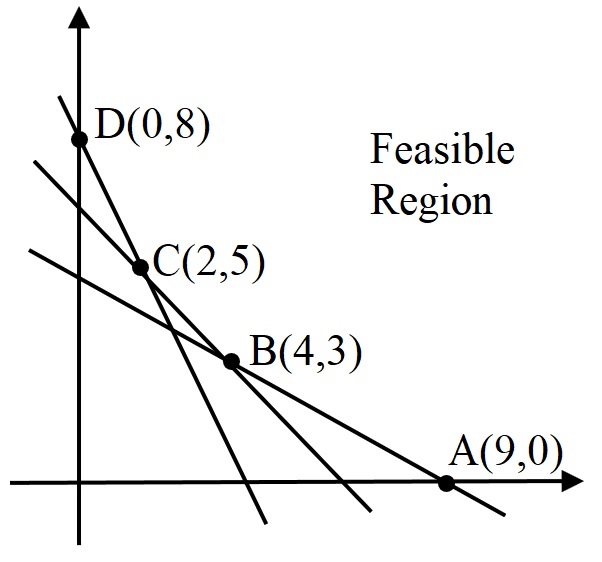
The feasible region for an LPP is shown shaded in the following figure. Minimum of Z = 4x + 3y occurs at the point.
Let $S_n=\sum_{k=1}^n \frac{n}{n^2+k n+k^2}$ and $T_n=\sum_{k=0}^{n-1} \frac{n}{n^2+k n+k^2}$ for $n=1,2,3, \ldots$ Then,

$(A)$ $\mathrm{S}_{\mathrm{n}}<\frac{\pi}{3 \sqrt{3}}$ $(B)$ $S_n>\frac{\pi}{3 \sqrt{3}}$

$(C)$ $T_n<\frac{\pi}{3 \sqrt{3}}$ $(D)$ $T_n>\frac{\pi}{3 \sqrt{3}}$

The volume of a sphere is increasing at the rate of $4\pi\text{cm}^{3}/\text{sec}$. The rate of increase of the radius when the volume is $288\pi\text{cm}^{3}/\text{sec}$ is: