MCQ
Let $f(x)$ be a continuously differentiable function on the interval $(0, \infty)$ such that $f(1)=2$ and $\lim _{t \rightarrow x} \frac{t^{10} f(x)-x^{10} f(t)}{t^9-x^9}=1$

for each $x>0$. Then, for all $x>0, f(x)$ is equal to

  • A
    $\frac{31}{11 x}-\frac{9}{11} x^{10}$
  • $\frac{9}{11 x}+\frac{13}{11} x^{10}$
  • C
    $\frac{-9}{11 x}+\frac{31}{11} x^{10}$
  • D
    $\frac{13}{11 x}+\frac{9}{11} x^{10}$

Answer

Correct option: B.
$\frac{9}{11 x}+\frac{13}{11} x^{10}$
b
$\lim _{t \rightarrow x} \frac{t^{10} f(x)-x^{10} f(t)}{t^9-x^9}=1$

$\Rightarrow \lim _{t \rightarrow x} \frac{10 t^9 f(x)-x^{10} f^{\prime}(t)}{9 t^8}=1$

$\Rightarrow 10 x f(x)-x^2 f^{\prime}(x)=9$

$\Rightarrow x^2 f^{\prime}(x)=10 x f(x)-9$

$\Rightarrow f^{\prime}(x)=\frac{10 f(x)}{x}-\frac{9}{x^2}$

$\Rightarrow \frac{d y}{d x}-\frac{10}{x} y=-\frac{9}{x^2}$

$\Rightarrow y \cdot \frac{1}{x^{10}}=\int-\frac{9}{x^2} \cdot \frac{1}{x^{10}} d x$

$\Rightarrow \frac{y}{x^{10}}=\frac{9}{11 x^{11}}+c$     $. . . . (1)$

$\because f(1)=2 \Rightarrow \frac{2}{1}=\frac{9}{11}+c \Rightarrow c=\frac{13}{11}$

$\therefore f(x)=\frac{9}{11 x}+\frac{13}{11} x^{10}$

$\Rightarrow$ Option $(B)$ is correct.

Need a full question paper?

Generate a complete, print-ready paper with questions like this in minutes — across 16+ boards, with answer keys.

Start Generating Free

Similar questions

If the value of the integral $\int \limits_{0}^{\frac{1}{2}} \frac{x^{2}}{\left(1-x^{2}\right)^{3 / 2}} d x$ is $\frac{ k }{6},$ then $k$ is equal to
Let $\overrightarrow{\mathrm{a}}=2 \hat{\mathrm{i}}-3 \hat{\mathrm{j}}+4 \hat{\mathrm{k}}, \overrightarrow{\mathrm{b}}=3 \hat{\mathrm{i}}+4 \hat{\mathrm{j}}-5 \hat{\mathrm{k}}$, and a vector $\vec{c}$ be such that $\vec{a} \times(\vec{b}+\vec{c})+\vec{b} \times \vec{c}=\hat{i}+8 \hat{j}+13 \hat{k}$. If $\vec{a} \cdot \vec{c}=13$, then $(24-\vec{b} \cdot \vec{c})$ is equal to ...........
The number of points in $\left( { - \infty ,\infty } \right)$, for which $x^2 -x\, sin\,x -cos\,x = 0$, is
If three points A, B and C have position vectors $\hat{\text{i}}+\text{x}\hat{\text{j}}+3\hat{\text{k}},\ 3\hat{\text{i}}+4\hat{\text{j}}+7\hat{\text{k}}$ and $\text{y}\hat{\text{i}}-2\hat{\text{j}}-5\hat{\text{k}}$ respectively are collinear, then (x, y) =
  1. (2, -3)
  2. (-2, 3)
  3. (-2, -3)
  4. (2, 3)
If $y = a\, log_e\, |x + 1| + b(x + 1)^2 + x$ has its extremum value $4$ at $x = 0$ , then $(a, b)$ is
If $A = \left[ {\begin{array}{*{20}{c}}1&1\\1&1\end{array}} \right],$then ${A^{100}} = $
Choose the correct answer from the given four options.

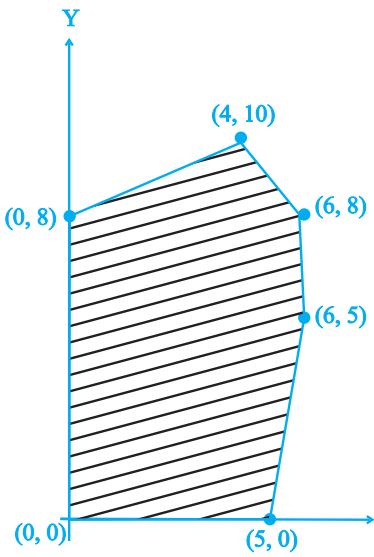
The feasible solution for a LPP is shown in. Let Z = 3x - 4y be the objective function.

Maximum of Z occurs at:

Which one of the following statements is true
The value of $I = \int_0^{\pi /2} {\frac{{{{(\sin x + \cos x)}^2}}}{{\sqrt {1 + \sin 2x} }}{\rm{ }}} dx$ is
$\int_{}^{} {{e^{x\log a}}.\;{e^x}\;dx} $is equal to