MCQ
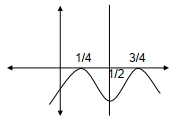
Let $f(x)$ be a non-constant twice differentiable function defined on $(-\infty, \infty)$ such that $f(x)=f(1-x)$ and $f^{\prime}\left(\frac{1}{4}\right)=0$. Then

$(A)$ $f^{\prime \prime}(x)$ vanishes at least twice on $[0,1]$

$(B)$ $f^{\prime}\left(\frac{1}{2}\right)=0$

$(C)$ $\int_{-1 / 2}^{1 / 2} f\left(x+\frac{1}{2}\right) \sin x d x=0$

$(D)$ $\int_0^{1 / 2} f(t) e^{\sin \pi t} d t=\int_{1 / 2}^1 f(1-t) e^{\sin \pi t} d t$

  • A
    $A,C,D,B$
  • $A,B,C,D$
  • C
    $D,B,C,A$
  • D
    $A,C,D,B$

Answer

Correct option: B.
$A,B,C,D$
b
$ f(x)=f(1-x) $

$ \text { Put } x=1 / 2+x $

$ f\left(\frac{1}{2}+x\right)=f\left(\frac{1}{2}-x\right)$

Hence $f(x+1 / 2)$ is an even function or $f(x+1 / 2) \sin x$ is an odd function.

Also, $f^{\prime}(x)=-f^{\prime}(1-x)$ and for $x=1 / 2$, we have $f^{\prime}(1 / 2)=0$.

Also, $\int_{1 / 2}^1 f(1-t) e^{\sin \pi t} d t=-\int_{1 / 2}^0 f(y) e^{\sin \pi y} d y$ (obtained by putting, $1-t=y$ ).

Since $f^{\prime}(1 / 4)=0, f^{\prime}(3 / 4)=0$. Also $f^{\prime}(1 / 2)=0$

$\Rightarrow f^{\prime \prime}(x)=0$ atleast twice in $[0,1]$ (Rolle's Theorem)

Need a full question paper?

Generate a complete, print-ready paper with questions like this in minutes — across 16+ boards, with answer keys.

Start Generating Free