Question
Let f(x) be a real valued function, then its
  • Left Hand Derivative (L.H.D.) : $\operatorname{Lf}^{\prime}(a)=\lim _{h \rightarrow 0} \frac{f(a-h)-f(a)}{-h}$
    Right Hand Derivative (R.H.D.) : $\operatorname{Rf}^{\prime}(a)=\lim _{h \rightarrow 0} \frac{f(a+h)-f(a)}{h}$
    Also, a function f(x) is said to be differentiable at x = a if its L.H.D. and R.H.D. at x = a exist and are equal.
    For the function $\text{f}(\text{x})=\begin{cases}|\text{x}-3|,\text{x}\geq1\\\\\frac{\text{x}^2}{4}-\frac{3\text{x}}{2}+\frac{13}{4},\text{x}<1\end{cases},$ answer the following questions.
    1. R.H.D. of f(x) at x = 1 is:
    1. 1
    2. -1
    3. 0
    4. 2
    1. L.H.D. of f(x) at x = 1 is:
    1. 1
    2. -1
    3. 0
    4. 2
    1. f(x) is non-differentiable at:
    1. x = 1
    2. x = 2
    3. x = 3
    4. x = 4
    1. Find the value of f'(2).
    1. 1
    2. 2
    3. 3
    4. -1
    1. The value of f'(-1) is:
    1. 2
    2. 1
    3. -2
    4. -1

Answer

We have, $\text{f}(\text{x})=\begin{cases}\text{x}-3&,\text{x}\geq3\\3-\text{x}&,1\leq\text{x}<3\\\\\frac{\text{x}^2}{4}-\frac{3\text{x}}{2}+\frac{13}{4}&,\text{x}<1\end{cases}$
  1. (b) -1
Solution:
$\text{Rf}'(1)=\lim\limits_{\text{h}\rightarrow0}\frac{\text{f}(1+\text{h})-\text{f}(1)}{\text{h}}$
$\lim\limits_{\text{h}\rightarrow0}\frac{3-(1+\text{h})-2}{\text{h}}=\lim\limits_{\text{h}\rightarrow0}-\frac{\text{h}}{\text{h}}=-1$
  1. (b) -1
Solution:
$\text{Lf}'(1)=\lim\limits_{\text{h}\rightarrow0}\frac{\text{f}(1-\text{h})-\text{f}(1)}{-\text{h}}$
$=\lim\limits_{\text{h}\rightarrow0}\frac{-1}{\text{h}}\Big[\frac{(1-\text{h})^2}{4}-\frac{3(1-\text{h})}{2}+\frac{13}{4}-2\Big]$
$=\lim\limits_{\text{h}\rightarrow0}\frac{-1}{\text{h}}\Big(\frac{1+\text{h}^2-2\text{h}-6+6\text{h}+13-8}{-4\text{h}}\Big)$
$=\lim\limits_{\text{h}\rightarrow0}\Big(\frac{\text{h}^2+4\text{h}}{-4\text{h}}\Big)=-1$
  1. (c) x = 3
Solution:
Since, R.H.D. at x = 3 is 1
and L.H.D. at x = 3 is - 1
$\therefore$ f(x) is non-differentiable at x = 3.
  1. (d) -1
  1. (c) -2
Solution:
From above, we have
$\text{f}'(\text{x})=\frac{\text{x}}{2}-\frac{3}{2},\text{x}<1$
$\therefore\text{f}'(-1)=\frac{-1}{2}-\frac{3}{2}=-2$

Need a full question paper?

Generate a complete, print-ready paper with questions like this in minutes — across 16+ boards, with answer keys.

Start Generating Free

Similar questions

In a bilateral cricket series between India and South Africa, the probability that India wins the first match is $0.6.$ If India wins any match, then the probability that it wins the next match is $0.4,$ otherwise the probability is $0.3.$ Also, it is given that there is no tie in any match.

Based on the above information answer the following questions.
  1. The probability that India won the second match, if lndia has already loose the first match is:
  1. $0.5$
  2. $0.4$
  3. $0.3$
  4. $0.6$
  1. The probability that India losing the third match, if India has already loose the first two matches is:
  1. $0.2$
  2. $0.3$
  3. $0.4$
  4. $0.7$
  1.  The probability that India losing the first two matches is:
  1. $0.12$
  2. $0.28$
  3. $0.42$
  4. $0.01$
  1. The probability that India winning the first three matches is:
  1. $0.92$
  2. $0.96$
  3. $0.94$
  4. $0.096$
  1. The probability that India winning exactly one of the first three matches is:
  1. $0.205$
  2. $0.21$
  3. $0.408$
  4. $0.312$
Consider the following equations of curves $\text{y}=\cos\text{x},\text{y}=\text{x}+1$ and y = 0.
On the basis of above information, answer the following questions.
  1. The curves $\text{y}=\cos\text{x}$ and y = x + 1 meet at:
  1. (1, 0)
  2. (0, 1)
  3. (1, 1)
  4. (0, 0)
  1. $\text{y}=\cos\text{x}$ meet the x-axis at:
  1. $\Big(\frac{-\pi}{2},0\Big)$
  2. $\Big(\frac{\pi}{2},0\Big)$
  3. Both (a) and (b).
  4. None of these.
  1. Value of the integral $\int\limits_{-1}^{0}(\text{x}+1)\text{dx}$ is:
  1. $\frac{1}{2}$
  2. $\frac{2}{3}$
  3. $\frac{3}{4}$
  4. $\frac{1}{3}$
  1. Value of the integral $\int\limits_{0}^{\frac{\pi}{2}}\cos\text{x dx}$ is:
  1. 0
  2. -1
  3. 2
  4. 1
  1. Area bounded by the given curves is:
  1. $\frac{1}{2}\text{ sq}.\text{units}$
  2. $\frac{3}{2}\text{ sq}.\text{units}$
  3. $\frac{3}{4}\text{ sq}.\text{units}$
  4. $\frac{1}{4}\text{ sq}.\text{units}$
A telephone company in a town has $500$ subscribers on its list and collects fixed charges of $Rs. 300/-$ per subscriber per year. The company proposes to increase the annual subscription and it is believed that for every increase of $Rs. 1/-$ one subscriber will discontinue the service. Find what increase will bring maximum profit?
 In a wedding ceremony, consists of father, mother, daughter and son line up at random for a family photograph, as shown in figure.
Based on the above information, answer the following questions.
  1. Find the probability that daughter is at one end, given that father and mother are in the middle.
  1. $1$
  2. $\frac{1}{2}$
  3. $\frac{1}{3}$
  4. $\frac{2}{3}$
  1. Find the probability that mother is at right end, given that son and daughter are together.
  1. $\frac{1}{2}$
  2. $\frac{1}{3}$
  3. $\frac{1}{4}$
  4. $0$
  1. Find the probability that father and mother are in the middle, given that son is at right end.
  1. $\frac{1}{4}$
  2. $\frac{1}{2}$
  3. $\frac{1}{3}$
  4. $\frac{2}{3}$
  1. Find the probability that father and son are standing together, given that mother and daughter are standing together.
  1. $0$
  2. $1$
  3. $\frac{1}{2}$
  4. $\frac{2}{3}$
  1. Find the probability that father and mother are on either of the ends, given that son is at second position from the right end.
  1. $\frac{1}{3}$
  2. $\frac{2}{3}$
  3. $\frac{1}{4}$
  4. $\frac{2}{5}$  
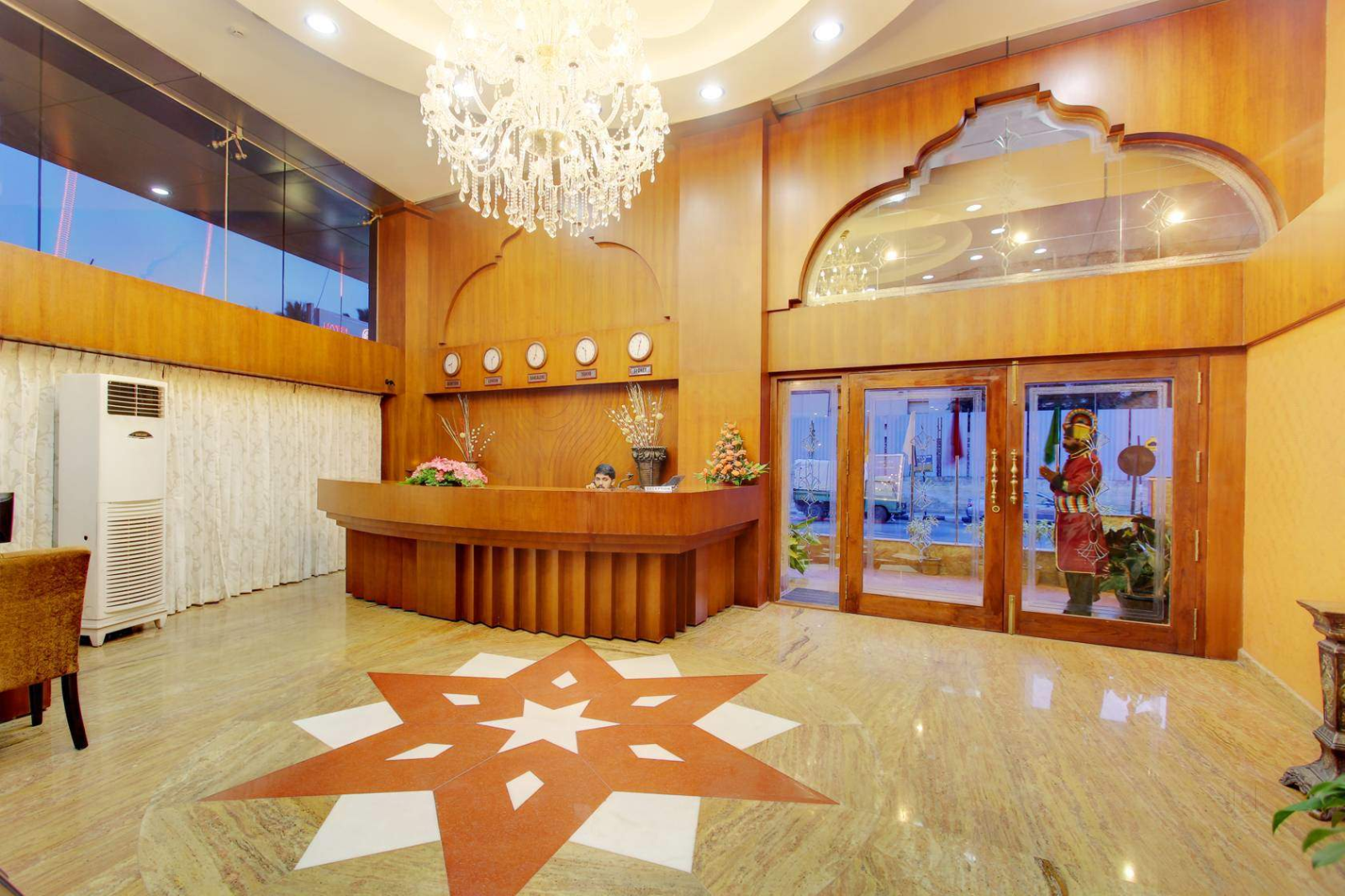
Suppose the floor of a hotel is made up of mirror polished Kota stone. Also, there is a large crystal chandelier attached at the ceiling of the hotel. Consider the floor of the hotel as a plane having equation $x - 2y + 2z = 3$ and crystal chandelier at the point $(3, -2, 1).$

Based on the above information, answer the following questions.
  1. The d.r'.s of the perpendicular from the point $(3, -2, 1)$ to the plane $x - 2y + 2z = 3,$ is:
  1. $ < 1, 2, 2 > $
  2. $ < 1, -2, 2 > $
  3. $ < 2, 1, 2 > $
  4. $ < 2, -1, 2 > $
  1. The length of the perpendicular from the point $(3, -2, 1)$ to the plane $x - 2y + 2z = 3,$ is:
  1. $\frac{2}{3}\text{units}$
  2. $3$ units
  3. $2$ units
  4. None of these
  1. The equation of the perpendicular from the point $(3, -2, 1)$ to the plane $x - 2y + 2z = 3,$ is:
  1. $\frac{\text{x}-3}{1}=\frac{\text{y}-2}{-2}=\frac{\text{z}-1}{2}$
  2. $\frac{\text{x}-3}{1}=\frac{\text{y}+2}{-2}=\frac{\text{z}-1}{2}$
  3. $\frac{\text{x}+3}{1}=\frac{\text{y}+2}{-2}=\frac{\text{z}-1}{2}$
  4. None of these
  1. The equation of plane parallel to the plane $x - 2y + 2z = 3,$ which is at a unit distance from the point $(3, -2, 1)$ is:
  1. $x - 2y + 2z = 0$
  2. $x - 2y + 2z = 6$
  3. $x - 2y + 2z = 12$
  4. Both $(b)$ and $(c)$
  1. The image of the point $(3, -2, 1)$ in the given plane is:
  1. $\Big(\frac{5}{3},\frac{2}{3},\frac{-5}{3}\Big)$
  2. $\Big(\frac{-5}{3},\frac{-2}{3},\frac{5}{3}\Big)$
  3. $\Big(\frac{-5}{3},\frac{2}{3},\frac{5}{3}\Big)$
  4. None of these
Between students of class $XII$ of two schools $A$ and $B$ basketball match is organised. For which, a team from each school is chosen, say $T_1$ be the team of school $A$ and $T_2$ be the team of school $B.$ These teams have to play two games against each other. It is assumed that the outcomes of the two games are independent. The probability of $T_1$ winning, rawmg an osrng a game against $T_2$ are $\frac{1}{2},\ \frac{3}{10}$ and $\frac{1}{5}$ respecnvely. Each team gets $2$ points for a win, $1$ point for a draw and $0$ point for a loss in a game. Let $X$ and $Y$ denote the total points scored by team $A$ and $B$ respectively, after two games.

Based on the above information, answer the following questions.
  1. $P(T_2$ winning a match against $T_1)$ is equal to:
  1. $\frac{1}{5}$
  2. $\frac{1}{6}$
  3. $\frac{1}{3}$
  4. None of these
  1. $P(T_2$ drawing a match against $T_1)$ is equal to:
  1. $\frac{1}{2}$
  2. $\frac{1}{3}$
  3. $\frac{1}{6}$
  4. $\frac{3}{10}$
  1. $P(X > Y)$ is equal to:
  1. $\frac{1}{4}$
  2. $\frac{5}{12}$
  3. $\frac{1}{20}$
  4. $\frac{11}{20}$
  1. $P(X = Y)$ is equal to:
  1. $\frac{11}{100}$
  2. $\frac{1}{3}$
  3. $\frac{29}{100}$
  4. $\frac{1}{2}$
  1. $P(X + Y = 8)$ is equal to:
  1. $0$
  2. $\frac{5}{12}$
  3. $\frac{13}{36}$
  4. $\frac{7}{12}$
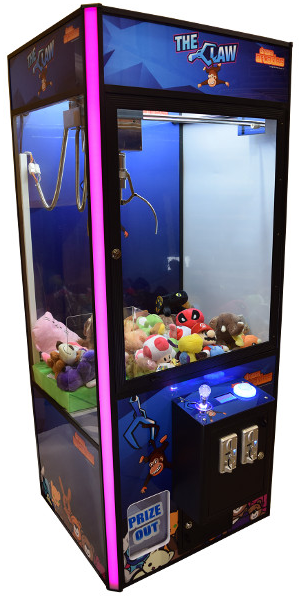
In a play zone, Aastha is playing crane game. It has 12 blue balls, 8 red balls, 10 yellow balls and 5 green balls. If Aastha draws two balls one after the other without replacement, then answer the following questions.
  1. What is the probability that the first ball is blue and the second ball is green?
  1. $\frac{5}{119}$
  2. $\frac{12}{119}$
  3. $\frac{6}{119}$
  4. $\frac{15}{119}$
  1. What is the probability that the first ball is yellow and the second ball is red?
  1. $\frac{16}{119}$
  2. $\frac{8}{119}$
  3. $\frac{24}{119}$
  4. None of these.
  1. What is the probability that both the balls are red?
  1. $\frac{4}{85}$
  2. $\frac{24}{595}$
  3. $\frac{12}{119}$
  4. $\frac{64}{119}$
  1. What is the probability that the first ball is green and the second ball is not yellow?
  1. $\frac{10}{119}$
  2. $\frac{6}{85}$
  3. $\frac{12}{119}$
  4. None of these.
  1. What is the probability that both the balls are not blue?
  1. $\frac{6}{595}$
  2. $\frac{12}{85}$
  3. $\frac{15}{17}$
  4. $\frac{253}{595}$
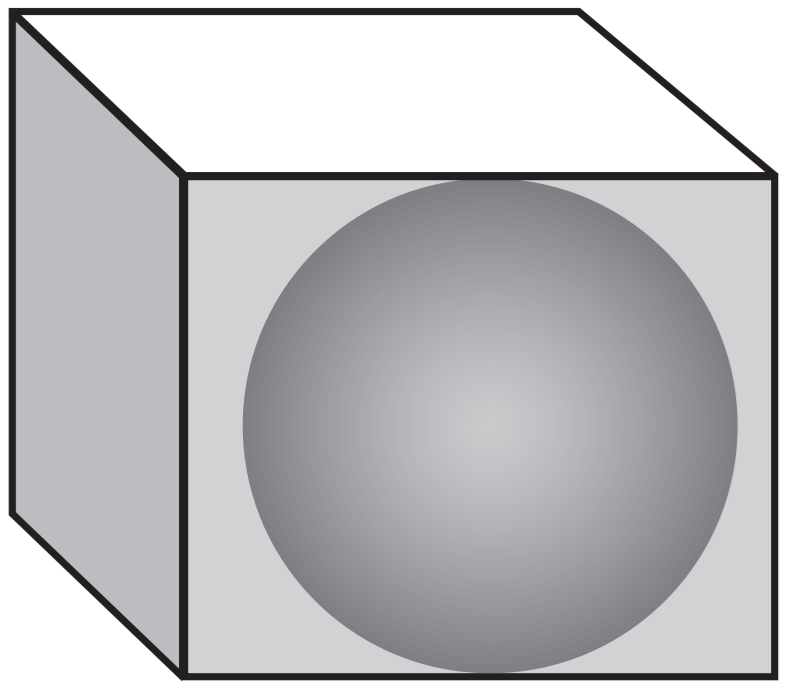
Shreya got a rectangular parallelepiped shaped box and spherical ball inside it as return gift. Sides of the box are $x, 2x,$ and $\frac{\text{x}}{3},$ while radius of the ball is $r.$

Based on the above information, answer the following questions.
  1. If $S$ represents the sum of volume of parallelepiped and sphere, then Scan be written as.
  1. $\frac{4\text{x}^3}{3}+\frac{2}{2}\pi\text{r}^2$
  2. $\frac{2\text{x}^2}{3}+\frac{4}{3}\pi\text{r}^2$
  3. $\frac{2\text{x}^3}{3}+\frac{4}{3}\pi\text{r}^3$
  4. $\frac{2}{3}\text{x}+\frac{4}{3}\pi\text{r}$
  1. If sum of the surface areas of box and ball are given to be constant $k^2$ then $x$ is equal to.
  1. $\sqrt{\frac{\text{k}^2-4\pi\text{r}^2}{6}}$
  2. $\sqrt{\frac{\text{k}^2-4\pi\text{r}}{6}}$
  3. $\sqrt{\frac{\text{k}^2-4\pi}{6}}$
  4. $\text{None of these}$
  1. The radius of the ball, when Sis minimum, is.
  1. $\sqrt{\frac{\text{k}^2}{54+\pi}}$
  2. $\sqrt{\frac{\text{k}^2}{54+4}}$
  3. $\sqrt{\frac{\text{k}^2}{64+3\pi}}$
  4. $\sqrt{\frac{\text{k}^2}{4\pi+3}}$
  1. Relation between length of the box and radius of the ball can be represented as.
  1. $\text{x} = \frac{2}{\text{r}}$
  2. $\text{x}=\frac{\text{r}}{2}$
  3. $\text{x}=\frac{2}{\text{r}}$
  4. $\text{x}=3\text{r}$
  1. Minimum value of $S$ is.
  1. $\frac{\text{k}^2}{2(3\pi+54)^\frac{2}{3}}$
  2. $\frac{\text{k}}{2(3\pi+54)^\frac{3}{2}}$
  3. $\frac{\text{k}^3}{2(4\pi+54)^\frac{1}{2}}$
  4. $\text{None of these}$
Read the following text carefully and answer the questions that follow:
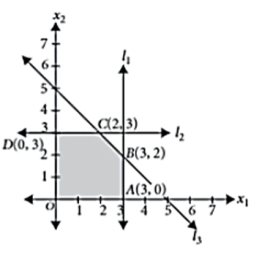
Dinesh is having a jewelry shop at Green Park, normally he does not sit on the shop as he remains busy in political meetings. The manager Lisa takes care of jewelry shop where she sells earrings and necklaces. She gains profit of $₹30$ on pair of earrings $₹40$ on neckless. It takes $30$ minutes to make a pair of earrings and $1$ hour to make a necklace, and there are $10$ hours a week to make jewelry. In addition, there are only enough materials to make $15$ total of jewelry items per week..
Image
$i.$ Formulate the above information mathematically. $(1)$
$ii.$ Graphically represent the given data. $(1)$
$iii.$ To obtain maximum profit how many pair of earing and neckleses should be sold? $(2)$
$OR$
What would be the profit if 5 pairs of earrings and 5 necklaces are made? $(2)$