Question
Let f(x) be a real valued function, then its
  • Left Hand Derivative (L.H.D.) : $\operatorname{Lf}^{\prime}(a)=\lim _{h \rightarrow 0} \frac{f(a-h)-f(a)}{-h}$
    Right Hand Derivative (R.H.D.) : $\operatorname{Rf}^{\prime}(a)=\lim _{h \rightarrow 0} \frac{f(a+h)-f(a)}{h}$
    Also, a function f(x) is said to be differentiable at x = a if its L.H.D. and R.H.D. at x = a exist and are equal.
    For the function $\text{f}(\text{x})=\begin{cases}|\text{x}-3|,\text{x}\geq1\\\\\frac{\text{x}^2}{4}-\frac{3\text{x}}{2}+\frac{13}{4},\text{x}<1\end{cases},$ answer the following questions.
    1. R.H.D. of f(x) at x = 1 is:
    1. 1
    2. -1
    3. 0
    4. 2
    1. L.H.D. of f(x) at x = 1 is:
    1. 1
    2. -1
    3. 0
    4. 2
    1. f(x) is non-differentiable at:
    1. x = 1
    2. x = 2
    3. x = 3
    4. x = 4
    1. Find the value of f'(2).
    1. 1
    2. 2
    3. 3
    4. -1
    1. The value of f'(-1) is:
    1. 2
    2. 1
    3. -2
    4. -1

Answer

We have, $\text{f}(\text{x})=\begin{cases}\text{x}-3&,\text{x}\geq3\\3-\text{x}&,1\leq\text{x}<3\\\\\frac{\text{x}^2}{4}-\frac{3\text{x}}{2}+\frac{13}{4}&,\text{x}<1\end{cases}$

  1. (b) -1

Solution:

$\text{Rf}'(1)=\lim\limits_{\text{h}\rightarrow0}\frac{\text{f}(1+\text{h})-\text{f}(1)}{\text{h}}$

$\lim\limits_{\text{h}\rightarrow0}\frac{3-(1+\text{h})-2}{\text{h}}=\lim\limits_{\text{h}\rightarrow0}-\frac{\text{h}}{\text{h}}=-1$

  1. (b) -1

Solution:

$\text{Lf}'(1)=\lim\limits_{\text{h}\rightarrow0}\frac{\text{f}(1-\text{h})-\text{f}(1)}{-\text{h}}$

$=\lim\limits_{\text{h}\rightarrow0}\frac{-1}{\text{h}}\Big[\frac{(1-\text{h})^2}{4}-\frac{3(1-\text{h})}{2}+\frac{13}{4}-2\Big]$

$=\lim\limits_{\text{h}\rightarrow0}\frac{-1}{\text{h}}\Big(\frac{1+\text{h}^2-2\text{h}-6+6\text{h}+13-8}{-4\text{h}}\Big)$

$=\lim\limits_{\text{h}\rightarrow0}\Big(\frac{\text{h}^2+4\text{h}}{-4\text{h}}\Big)=-1$

  1. (c) x = 3

Solution:

Since, R.H.D. at x = 3 is 1

and L.H.D. at x = 3 is - 1

$\therefore$ f(x) is non-differentiable at x = 3.

  1. (d) -1
  1. (c) -2

Solution:

From above, we have

$\text{f}'(\text{x})=\frac{\text{x}}{2}-\frac{3}{2},\text{x}<1$

$\therefore\text{f}'(-1)=\frac{-1}{2}-\frac{3}{2}=-2$

Need a full question paper?

Generate a complete, print-ready paper with questions like this in minutes — across 16+ boards, with answer keys.

Start Generating Free

Similar questions

A magazine company in a town has 5000 subscribers on its list and collects fix charges of ₹ 3000 per year from each subscriber. 'The company proposes to increase the annual charges, and it is believed that for every increase of ₹ 1 one subscriber will discontinue service.

Based on the above information, answer the following questions.

  1. If x denote the amount of increase in annual charges, then revenue R, as a function of x can be represented as.
  1. R(x) = 3000 × 5000 × x
  2. R(x) = (3000 - 2x)(5000 + 2x)
  3. R(x) = (5000 + x)(3000 - x)
  4. R(x) = (3000 + x)(5000 - x)
  1. If magazine company increases ₹ 500 as annual charges, then R is equal to.
  1. ₹ 15750000
  2. ₹ 16750000
  3. ₹ 17500000
  4. ₹ 15000000
  1. If revenue collected by the magazine company is ₹ 15640000, then value of amount increased as annual charges for each subscriber, is.
  1. 400
  2. 1600
  3. Both (a) and (b)
  4. None of these
  1. What amount of increase in annual charges will bring maximum revenue?
  1. ₹ 1000
  2. ₹ 2000
  3. ₹ 3000
  4. ₹ 4000
  1. Maximum revenue is equal to.
  1. ₹ 15000000
  2. ₹ 16000000
  3. ₹ 20500000
  4. ₹ 25000000
Consider the mapping f: A → B is defined by f(x) = x - 1 such that f is a bijection.
Based on the above information, answer the following questions.
  1. Domain of f is:
  1. R - {2}
  2. R
  3. R - {1, 2}
  4. R - {0}
  1. Range of f is:
  1. R
  2. R - {2}
  3. R - {0}
  4. R - {1, 2}
  1. If g: R - {2} → R - {1} is defined by g(x) = 2f(x) - 1, then g(x) in terms of x is:
  1. $\frac{\text{x}+2}{\text{x}}$
  2. $\frac{\text{x}+1}{\text{x}-2}$
  3. $\frac{\text{x}-2}{\text{x}}$
  4. $\frac{\text{x}}{\text{x}-2}$
  1. The function g defined above, is:
  1. One-one
  2. Many-one
  3. into
  4. None of these
  1. A function f(x) is said to be one-one iff.
  1. f(x1) = f(x2) ⇒ -x= x2
  2. f(-x1) = f(-x2) ⇒ -x1 = x2
  3. f(x1) = f(x2) ⇒ x1 = x2
  4. None of these
Linear programming is a method for finding the optimal values (maximum or minimum) of quantities subject to the constraints when relationship is expressed as linear equations or inequations.

Based on the above information, answer the following questions.

  1. The optimal value of the objective function is attained at the points:
  1. On X-axis.
  2. On Y-axis.
  3. Which are comer points of the feasible region.
  4. None of these.
  1. The graph of the inequality 3x + 4y < 12 is:
  1. Half plane that contains the origin.
  2. Half plane that neither contains the origin nor the points of the line 3x + 4y = 12.
  3. Whole XOY-plane excluding the points on line 3x + 4y = 12.
  4. None of these.
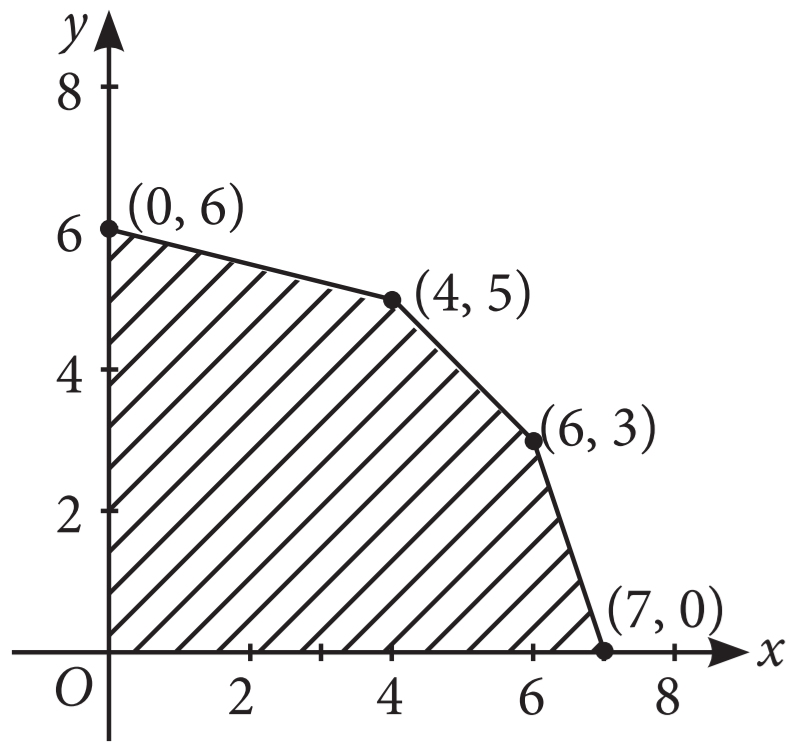
  1. The feasible region for an LPP is shown in the figure. Let Z = 2x + 5y be the objective function. Maximum of Z occurs at:

  1. (7, 0)
  2. (6, 3)
  3. (0, 6)
  4. (4, 5)
  1. The corner points of the feasible region determined by the system of linear constraints are (0, 10), (5, 5), (15, 15), (0, 20). Let Z = px + qy, where p, q > 0. Condition on p and q so that the maximum of Z occurs at both the points ( 15, 15) and (0, 20) is:
  1. p = q
  2. p = 2q
  3. q = 2p
  4. q = 3p
  1. The comer points of the feasible region determined by the system of linear constraints are (0, 0), (0, 40), (20, 40), (60, 20), (60, 0). The objective function is Z = 4x + 3y.

Compare the quantity in Column A and Column B

Column A
Column B
Maximum of Z
325
  1. The quantity in column A is greater.
  2. The quantity in column Bis greater.
  3. The two quantities are equal.
  4. The relationship cannot be determined on the basis of the information supplied.
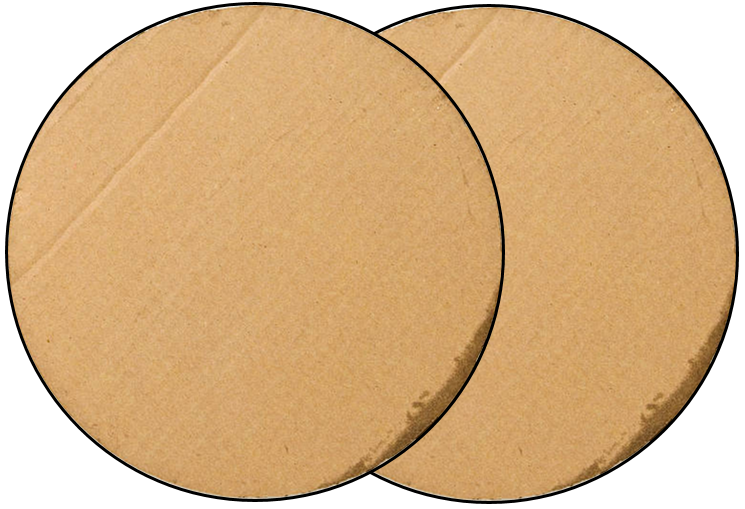
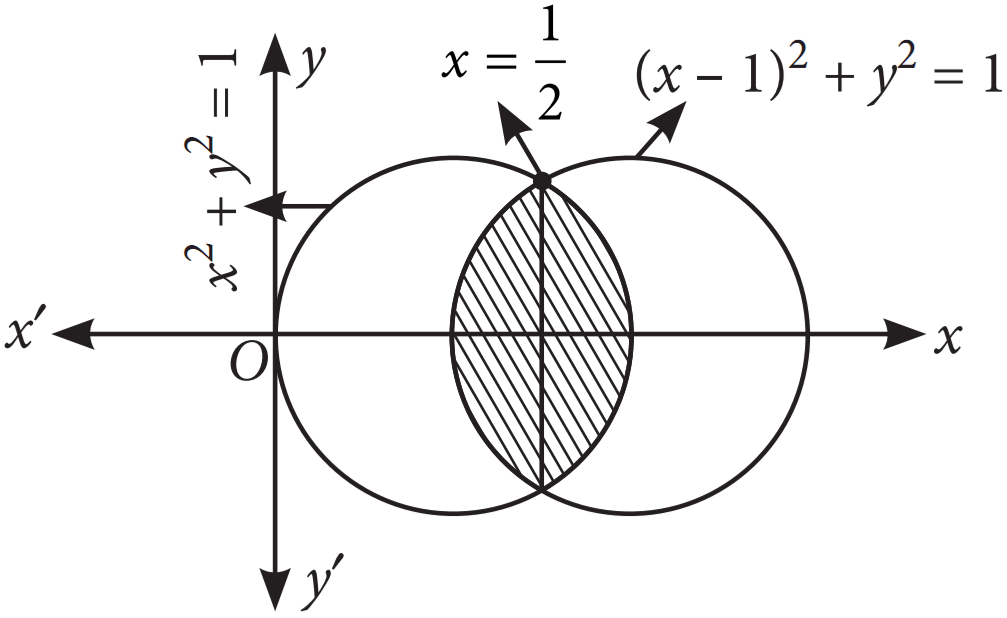
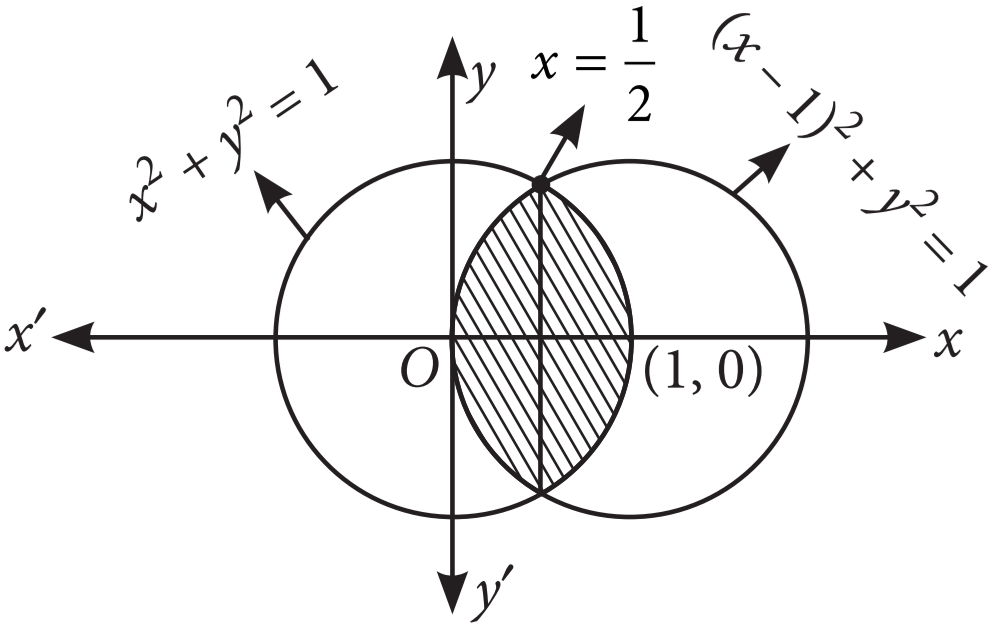
Ajay cut two circular pieces of cardboard and placed one upon other as shown in figure. One of the circle represents the equation (x - 1)2 + y2 = 1, while other circle represents the equation x2 + y2 = 1.

Based on the above information, answer the following questions.
  1. Both the circular pieces of cardboard meet each other at
  1. $\text{x}=1$
  2. $\text{x}=\frac{1}{2}$
  3. $\text{x}=\frac{1}{3}$
  4. $\text{x}=\frac{1}{4}$
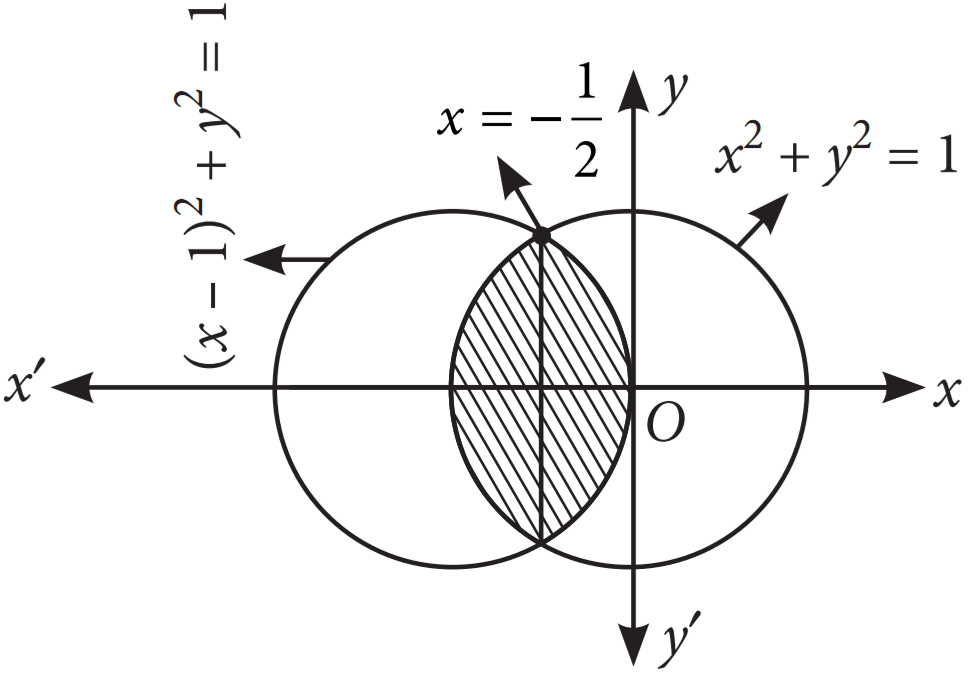
  1. Graph of given two curves can be drawn as.
  1. None of these
  1. Value of $\int\limits_{0}^{\frac{1}{2}}\sqrt{1-(\text{x}-1)^2}\text{dx}$ is.
  1. $\frac{\pi}{6}-\frac{\sqrt{3}}{8}$
  2. $\frac{\pi}{6}+\frac{\sqrt{3}}{8}$
  3. $\frac{\pi}{2}+\frac{\sqrt{3}}{4}$
  4. $\frac{\pi}{2}-\frac{\sqrt{3}}{4}$
  1. Value of $\int\limits_{\frac{1}{2}}^{1}\sqrt{1-\text{x}^2}\text{dx}$ is.
  1. $\frac{\pi}{6}+\frac{\sqrt{3}}{4}$
  2. $\frac{\pi}{6}+\frac{\sqrt{3}}{8}$
  3. $\frac{\pi}{6}-\frac{\sqrt{3}}{8}$
  4. $\frac{\pi}{2}-\frac{\sqrt{3}}{4}$
  1. Area of hidden portion of lower circle is.
  1. $\bigg(\frac{2\pi}{3}+\frac{\sqrt{3}}{2}\bigg)\text{ sq.units}$
  2. $\bigg(\frac{\pi}{3}-\frac{\sqrt{3}}{8}\bigg)\text{ sq.units}$
  3. $\bigg(\frac{\pi}{3}+\frac{\sqrt{3}}{8}\bigg)\text{ sq.units}$
  4. $\bigg(\frac{2\pi}{3}-\frac{\sqrt{3}}{2}\bigg)\text{ sq.units}$
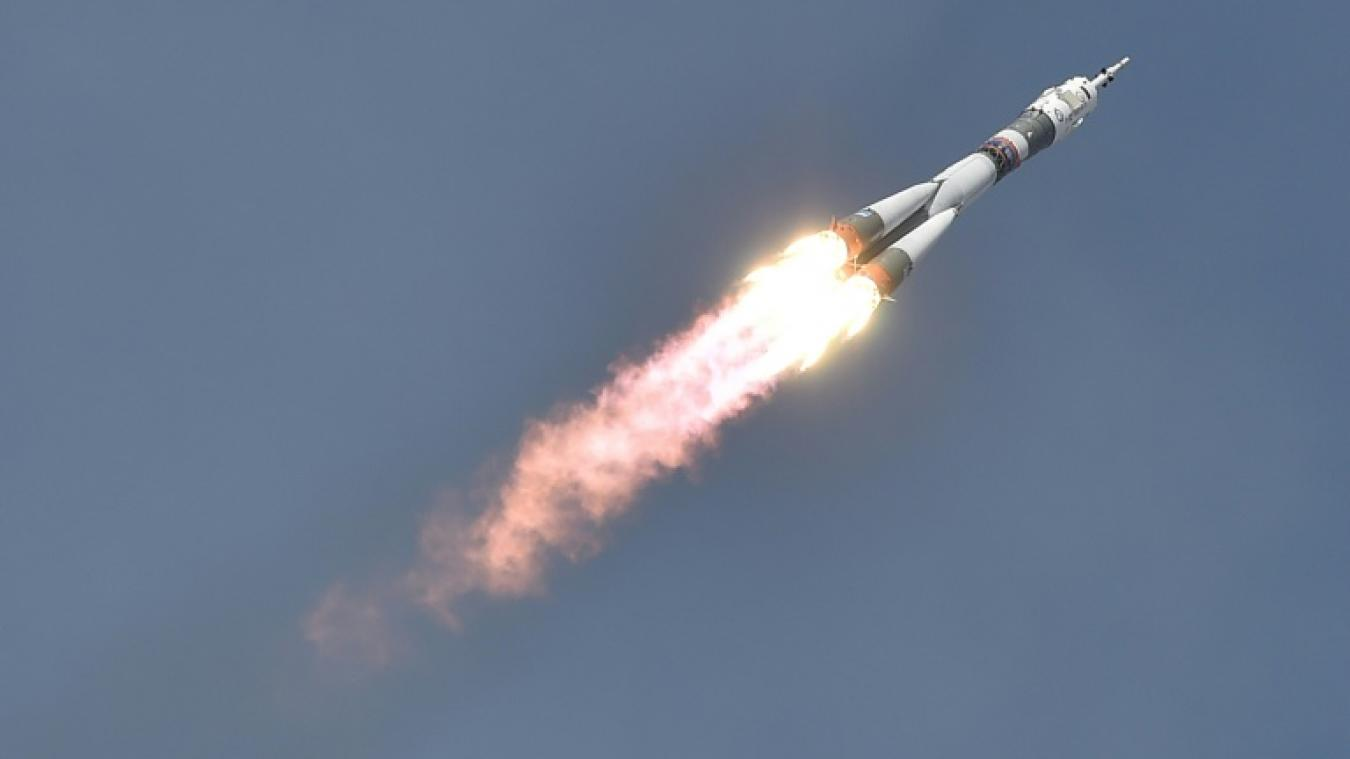
The upward speed v(I) of a rocket at time I is approximated by $\text{v}(\text{t})=\text{at}^2+\text{bt}+\text{c},0\leq\text{t}\leq100,$ here a, b and c are constants. It has been found that the speed at times t = 3, t = 6 and t = 9 seconds are respectively 64, 133 and 208 miles per second..

If $\begin{bmatrix}9&3&1\\36&6&1\\81&9&1\end{bmatrix}^{-1}=\frac{1}{18}\begin{bmatrix}1&-2&1\\-15&24&-9\\54&-54&18\end{bmatrix},$ then answer the following questions.
  1. The value of b + c is:
  1. 20
  2. 21
  3. $\frac{3}{4}$
  4. $\frac{4}{3}$
  1. The value of a + c is:
  1. 1
  2. 20
  3. $\frac{4}{3}$
  4. None of these.
  1. v(t) is given by:
  1. $\text{t}^2+20\text{t}+1$
  2. $\frac{1}{3}\text{t}^2+20\text{t}+1$
  3. $\text{t}^2+\frac{1}{3}\text{t}+20$
  4. $\text{t}^2+\text{t}+1$
  1. The speed at time 1 = 15 seconds is:
  1. 346 miles/ sec
  2. 356 miles/ sec
  3. 366 miles/ sec
  4. 376 miles/ sec
  1. The time at which the speed of rocket is 784 miles/ sec is:
  1. 20 seconds
  2. 30 seconds
  3. 25 seconds
  4. 27 seconds
Between students of class XII of two schools A and B basketball match is organised. For which, a team from each school is chosen, say T1 be the team of school A and T2 be the team of school B. These teams have to play two games against each other. It is assumed that the outcomes of the two games are independent. The probability of T1 winning, rawmg an osrng a game against T2 are $\frac{1}{2},\ \frac{3}{10}$ and $\frac{1}{5}$ respecnvely.

Each team gets 2 points for a win, 1 point for a draw and 0 point for a loss in a game.

Let X and Y denote the total points scored by team A and B respectively, after two games.

Based on the above information, answer the following questions.

  1. P(T2 winning a match against T1) is equal to:
  1. $\frac{1}{5}$

  2. $\frac{1}{6}$

  3. $\frac{1}{3}$

  4. None of these
  1. P(T2 drawing a match against T1) is equal to:
  1. $\frac{1}{2}$

  2. $\frac{1}{3}$

  3. $\frac{1}{6}$

  4. $\frac{3}{10}$

  1. P(X > Y) is equal to:
  1. $\frac{1}{4}$

  2. $\frac{5}{12}$

  3. $\frac{1}{20}$

  4. $\frac{11}{20}$

  1. P(X = Y) is equal to:
  1. $\frac{11}{100}$

  2. $\frac{1}{3}$

  3. $\frac{29}{100}$

  4. $\frac{1}{2}$

  1. P(X + Y = 8) is equal to:
  1. $0$

  2. $\frac{5}{12}$

  3. $\frac{13}{36}$

  4. $\frac{7}{12}$

A doctor is to visit a patient. From the past experience, it is known that the probabilities that he will come by cab, metro, bike or by other means of transport are respectively 0.3, 0.2, 0.1 and 0.4. 'Tile probabilities that he will be late are 0.25, 0.3, 0.35 and 0.1 if he comes by cab, metro, bike and other means of transport respectively.

Based on the above information, answer the following questions.

  1. When the doctor arrives late, what is the probability that he comes by metro?
  1. $\frac{5}{14}$

  2. $\frac{2}{7}$

  3. $\frac{5}{21}$

  4. $\frac{1}{6}$

  1. When the doctor arrives late, what is the probability that he comes by cab?
  1. $\frac{4}{21}$

  2. $\frac{1}{7}$

  3. $\frac{5}{14}$

  4. $\frac{2}{21}$

  1. When the doctor arrives late, what is the probability that he comes by bike?
  1. $\frac{5}{21}$

  2. $\frac{4}{7}$

  3. $\frac{5}{6}$

  4. $\frac{1}{6}$

  1. When the doctor arrives late, what is the probability that he comes by other means of transport?
  1. $\frac{6}{7}$

  2. $\frac{5}{14}$

  3. $\frac{4}{21}$

  4. $\frac{2}{7}$

  1. What is the probability that the doctor is late by any means?
  1. 1
  2. 0
  3. $\frac{1}{2}$

  4. $\frac{1}{4}$ 

In a college hostel accommodating 1000 students, one of the hostellers came in carrying Corona virus, and the hostel was isolated. The rate at which the virus spreads is assumed to be proportional to the product of the number of infected students and remaining students. There are 50 infected students after 4 days.

Based on the above information, answer the following questions.
  1. If n(I) denote the number of students infected by Corona virus at any time I, then maximum value of n(I) is:
  1. 50
  2. 100
  3. 500
  4. 1000
  1. $\frac{\text{dn}}{\text{dt}}$ is proporuona to:
  1. n(1000 - n)
  2. n(100 + n)
  3. n(100 - n)
  4. n(100 + n)
  1. The value of n(4) is:
  1. 1
  2. 50
  3. 100
  4. 1000
  1. The most general solution of differential equation formed in given situation is:
  1. $\frac{1}{1000}\log\Big(\frac{1000-\text{n}}{\text{n}}\Big)=\lambda\text{t}+\text{c}$
  2. $\log\Big(\frac{\text{n}}{100-\text{n}}\Big)=\lambda\text{t}+\text{c}$
  3. $\frac{1}{1000}\log\Big(\frac{\text{n}}{1000-\text{n}}\Big)=\lambda\text{t}+\text{c}$
  4. None of these.
  1. The value of n at any time is given by:
  1. $\text{n(t)}=\frac{1000}{1+999\text{e}^{-0.9906\text{t}}}$
  2. $\text{n(t)}=\frac{1000}{1-999\text{e}^{-0.9906\text{t}}}$
  3. $\text{n(t)}=\frac{100}{1-999\text{e}^{-0.9906\text{t}}}$
  4. $\text{n(t)}=\frac{100}{1+999\text{e}^{-0.9906\text{t}}}$
A trust fund has $₹ 35000$ that must be invested in two different types of bonds, say $\mathrm{X}$ and $\mathrm{Y}$. The first bond pays $10 \%$ interest p.a. which will be given to an old age home and second one pays $8 \%$ interest p.a. which will be given to WWA (Women Welfare Association). Let A be a $1 \times 2$ matrix and B be a $2 \times 1$ matrix, representing the investment and interest rate on each bond respectively.

Image

(i) Represent the given information in matrix algebra.

(ii) If ₹ 15000 is invested in bond $\mathrm{X}$, then find total amount of interest received on both bonds?

(iii) If the trust fund obtains an annual total interest of ₹ 3200 , then find the investment in two bonds.

OR

If the amount of interest given to old age home is ₹500, then find the amount of investment in bond Y.

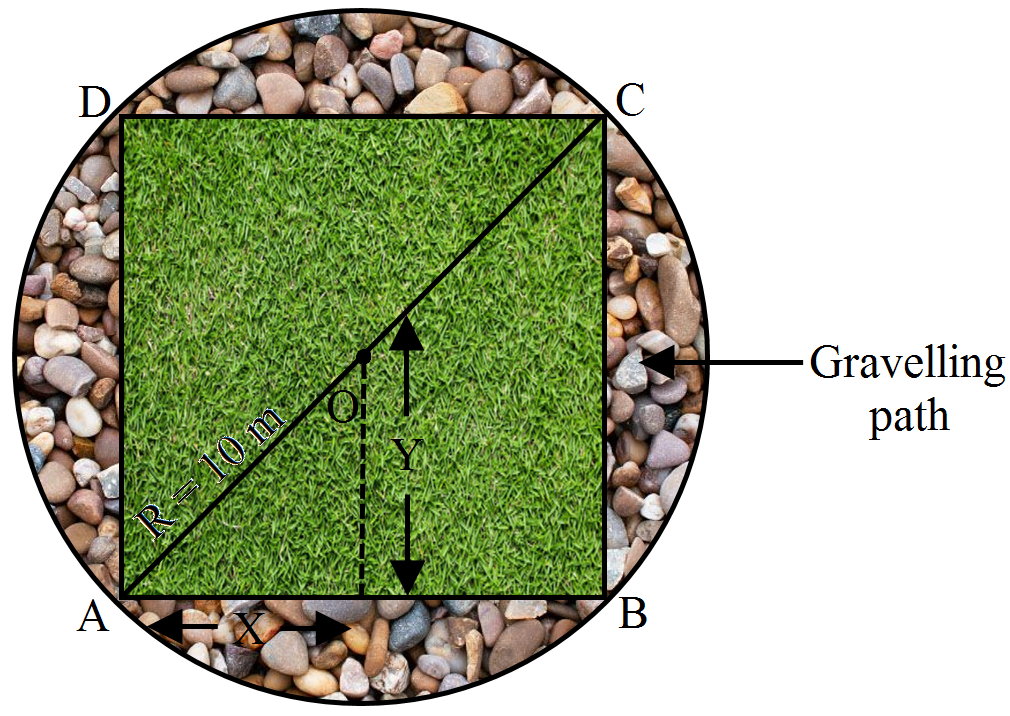
In a society there is a garden in the shape of rectangle inscribed in a circle of radius 10m as shown in given figure.

Based on the above information, answer the following questions.
  1. If 2x and 2y denotes the length and breadth in metres, of the rectangular part, then the relation between the variables is.
  1. x2 - y2 = 10
  2. x2 + y2 = 10
  3. x2 + y2 = 100
  4. x2 - y2 = 100
  1. The area (A) of green grass, in terms of x, is given by.
  1. $2\text{x}\sqrt{100-\text{x}^2}$
  2. $4\text{x}\sqrt{100-\text{x}^2}$
  3. $2\text{x}\sqrt{100+\text{x}^2}$
  4. $4\text{x}\sqrt{100+\text{x}^2}$
  1. The maximum value of A is.
  1. $100\text{m}^2$
  2. $200\text{m}^2$
  3. $400\text{m}^2$
  4. $1600\text{m}^2$
  1. The value of length of rectangle, when A is maximum, is.
  1. $10\sqrt{2}\text{m}$
  2. $20\sqrt{2}\text{m}$
  3. $20\text{m}$
  4. $5\sqrt{2}\text{m}$
  1. The area of gravelling path is.
  1. $100(\pi+2)\text{m}^2$
  2. $100(\pi-2)\text{m}^2$
  3. $200(\pi+2)\text{m}^2$
  4. $200(\pi-2)\text{m}^2$