Question
Linear programming is a method for finding the optimal values (maximum or minimum) of quantities subject to the constraints when relationship is expressed as linear equations or inequations.
Based on the above information, answer the following questions.
  1. The optimal value of the objective function is attained at the points:
  1. On X-axis.
  2. On Y-axis.
  3. Which are comer points of the feasible region.
  4. None of these.
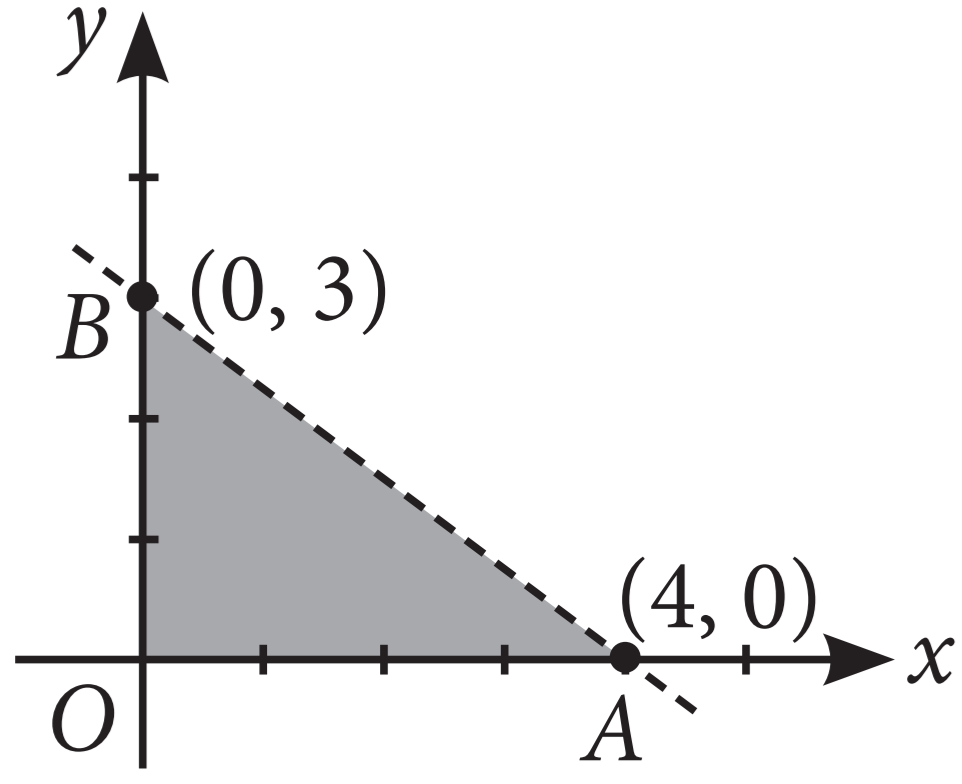
  1. The graph of the inequality 3x + 4y < 12 is:
  1. Half plane that contains the origin.
  2. Half plane that neither contains the origin nor the points of the line 3x + 4y = 12.
  3. Whole XOY-plane excluding the points on line 3x + 4y = 12.
  4. None of these.
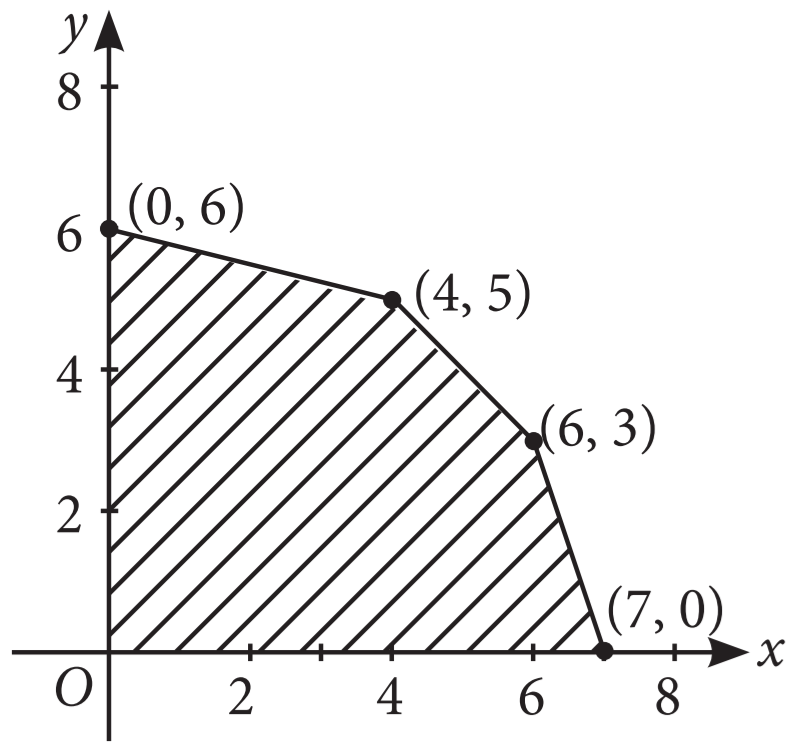
  1. The feasible region for an LPP is shown in the figure. Let Z = 2x + 5y be the objective function. Maximum of Z occurs at:
  1. (7, 0)
  2. (6, 3)
  3. (0, 6)
  4. (4, 5)
  1. The corner points of the feasible region determined by the system of linear constraints are (0, 10), (5, 5), (15, 15), (0, 20). Let Z = px + qy, where p, q > 0. Condition on p and q so that the maximum of Z occurs at both the points ( 15, 15) and (0, 20) is:
  1. p = q
  2. p = 2q
  3. q = 2p
  4. q = 3p
  1. The comer points of the feasible region determined by the system of linear constraints are (0, 0), (0, 40), (20, 40), (60, 20), (60, 0). The objective function is Z = 4x + 3y.
Compare the quantity in Column A and Column B
Column A
Column B
Maximum of Z
325
  1. The quantity in column A is greater.
  2. The quantity in column Bis greater.
  3. The two quantities are equal.
  4. The relationship cannot be determined on the basis of the information supplied.
Answer

  1. (c) Which are comer points of the feasible region.
Solution:

When we solve an L.P.P. graphically, the optimal (or optimum) value of the objective function is attained at comer points of the feasible region.
  1. (d) None of these.
Solution:

From the graph of 3x + 4y < 12, it is clear that it contains the origin but not the points on the line 3x + 4y = 12.

  1. (d) (4, 5)
Solution:

Maximum of objective function occurs at corner points.
Corner Points
Value of Z = 2x + 5y
(0, 0)
0
(7, 0)
14
(6, 3)
27
(4, 5)
$33\leftarrow\text{Maximum}$
(0, 6)
30
  1. (d) q = 3p
​​​​​​​​​​​​​​Solution:

Value of Z = px + qy at ( 15, 15)= 15p + 15q and that at (0, 20) = 20q. According to given condition, we have 15p + 15q = 20q ⇒ 15p = Sq ⇒ q = 3p.
  1. (b) The quantity in column Bis greater.
​​​​​​​​​​​​​​​​​​​​​​​​​​​​​​​​​​​Solution:

Construct the following table of values of the objective function:
Corner Points
Value of Z = 4x + 3y
(0, 0)
4 × 0 + 3 × 0 = 0
(0, 40)
4 × 0 + 3 × 40 = 120
(20, 40)
4 × 20 + 3 × 40 = 200
(60, 20)
$4\times60+3\times20=300\leftarrow\text{Maximum}$
(60, 0)
4 × 60 + 3 × 0 = 240

Need a full question paper?

Generate a complete, print-ready paper with questions like this in minutes — across 16+ boards, with answer keys.

Start Generating Free

Similar questions

In a family there are four children. All of them have to work in their family business to earn their livelihood at the age of 18. Based on the above information, answer the following questions.
  1. Probability that all children are girls, if it is given that elder child is a boy, is:
  1. $\frac{3}{8}$
  2. $\frac{1}{8}$
  3. $\frac{5}{8}$
  4. None of these.
  1. Probability that all children are boys, if two elder children are boys, is:
  1. $\frac{1}{4}$
  2. $\frac{3}{4}$
  3. $\frac{1}{2}$
  4. None of these.
  1. Find the probability that two middle children are boys, if it is given that eldest child is a girl.
  1. $0$
  2. $\frac{3}{4}$
  3. $\frac{1}{4}$
  4. None of these.
  1. Find the probability that all children are boys, if it is given that at most one of the children is a girl.
  1. $0$
  2. $\frac{1}{5}$
  3. $\frac{2}{5}$
  4. $\frac{4}{5}$
  1. Find the probability that all children are boys, if it is given that at least three of the children are boys.
  1. $\frac{1}{5}$
  2. $\frac{2}{5}$
  3. $\frac{3}{5}$
  4. $\frac{4}{5}$
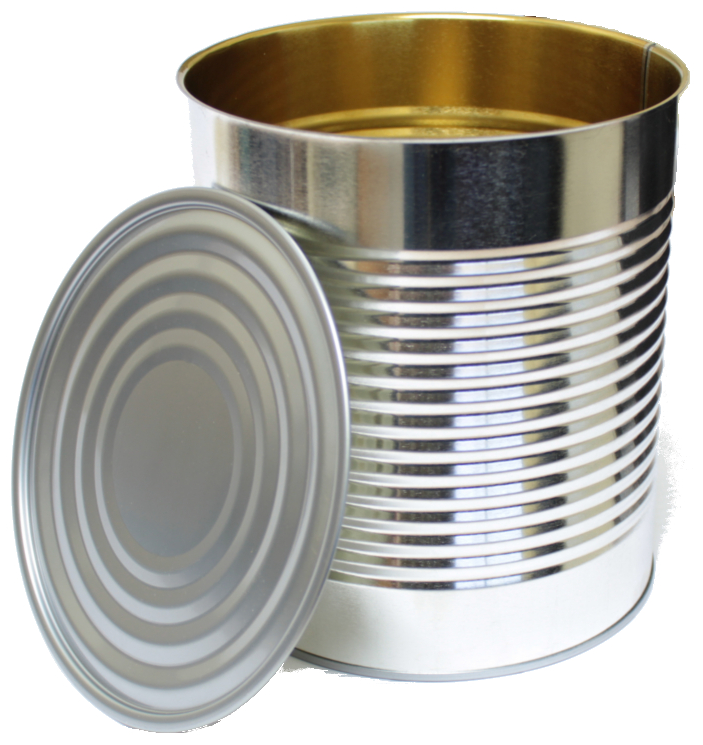
A tin can manufacturer designs a cylindrical tin can for a company making sanitizer and disinfector. The tin can is made to hold $3$ litres of sanitizer or disinfector.

Based on the above in formation, answer the following questions.
  1. If $r$ cm be the radius and h cm be the height of the cylindrical tin can, then the surface area expressed as a function of $r$ as.
  1. $2\pi\text{r}^2$
  2. $2\pi\text{r}^2+6000$
  3. $2\pi\text{r}^2+\frac{5000}{\text{r}}$
  4. $2\pi\text{r}^2+\frac{6000}{\text{r}}$
  1. The radius that will minimize the cost of the material to manufacture the tin can is.
  1. $\sqrt[3]{\frac{600}{\pi}}\text{cm}$
  2. $\sqrt{\frac{500}{\pi}}\text{cm}$
  3. $\sqrt[3]{\frac{1500}{\pi}}\text{cm}$
  4. $\sqrt{\frac{1500}{\pi}}\text{cm}$
  1. The height that will minimize the cost of the material to manufacture the tin can is.
  1. $\sqrt[3]{\frac{600}{\pi}}\text{cm}$
  2. $2\sqrt[3]{\frac{1500}{\pi}}\text{cm}$
  3. $\sqrt{\frac{1500}{\pi}}$
  4. $2\sqrt{\frac{1500}{\pi}}$
  1. If the cost of material used to manufacture the tin can is $₹\frac{100}{\text{m}^2}$ and $\sqrt[3]{\frac{1500}{\pi}}\approx7.8,$ then minimum cost is approximately.
  1. $₹\ 11.538$
  2. $₹\ 12$
  3. $₹\ 13$
  4. $₹\ 14$
  1. To minimize the cost of the material used to manufacture the tin can, we need to minimize the.
  1. Volume.
  2. Curved surface area.
  3. Total surface area.
  4. Surface area of the base.
If an equation is of the form $\frac{\text{dy}}{\text{dx}}+\text{Py}=\text{Q},$ where P, Qare functions of x, then such equation is known as linear differential equation. Its solution is given by
$\text{y}\times\text{(I.F.)}=\int\text{Q}\times\text{(I.F.)}\text{dx}+\text{c},$ where $\text{I.F.}=\text{e}^{\int\text{pdx}}.$
Now, suppose the given equation is $(1+\sin\text{x})\frac{\text{dy}}{\text{dx}}+\text{y}\cos\text{x}+\text{x}=0.$
Based on the above information, answer the following questions.
  1. The value of P and Q respectively are:
  1. $\frac{\sin\text{x}}{1+\cos\text{x}},\ \frac{\text{x}}{1+\sin\text{x}}$
  2. $\frac{\cos\text{x}}{1+\sin\text{x}},\ \frac{\text{-x}}{1+\sin\text{x}}$
  3. $\frac{-\cos\text{x}}{1+\sin\text{x}},\ \frac{\text{x}}{1+\sin\text{x}}$
  4. $\frac{\cos\text{x}}{1+\sin\text{x}},\ \frac{\text{x}}{1+\sin\text{x}}$
  1. The value of I.F is:
  1. $1-\sin\text{x}$
  2. $\cos\text{x}$
  3. $1+\sin\text{x}$
  4. $1-\cos\text{x}$
  1. Solution of given equation is:
  1. $\text{y}(1-\sin\text{x})=\text{x+c}$
  2. $\text{y}(1+\sin\text{x})=-\text{x}^2+\text{c}$
  3. $\text{y}(1-\sin\text{x})=\frac{\text{-x}^2}{2}\text{+c}$
  4. $\text{y}(1+\sin\text{x})=\frac{\text{-x}^2}{2}\text{+c}$
  1. If y(0) = 1, then y equals
  1. $\frac{2-\text{x}^2}{2(1+\sin\text{x})}$
  2. $\frac{2+\text{x}^2}{2(1+\sin\text{x})}$
  3. $\frac{2-\text{x}^2}{2(1-\sin\text{x})}$
  4. $\frac{2+\text{x}^2}{2(1-\sin\text{x})}$
  1. Value of is $\text{y}\Big(\frac{\pi}{2}\Big)$ is:
  1. $\frac{4-\pi^2}{2}$
  2. $\frac{8-\pi^2}{16}$
  3. $\frac{8-\pi^2}{4}$
  4. $\frac{4+\pi^2}{2}$
If $\text{A}=[\text{a}_\text{ij}]_{\text{m}\times\text{n}}$ and $\text{B}=[\text{b}_\text{ij}]_{\text{m}\times\text{n}}$ are two matrices, then A ± B is of order m × n and is defined as:
$(\text{A}\pm\text{B})_\text{ij}=\text{a}_\text{ij}\pm\text{b}_\text{ij},$ where i = 1, 2, ............. , m and j = 1, 2, .......... , n
If $\text{A}=[\text{a}_\text{ij}]_{\text{m}\times\text{n}}$ and $\text{B}=[\text{b}_\text{ij}]_{\text{n}\times\text{p}}$ are two matrices, then AB is of order m × p and is defined as:
$(\text{A}\text{B})_\text{ik}=\sum\limits_\text{r=1}^\text{n}\text{a}_\text{ir}\text{b}_\text{rk}=\text{a}_\text{i1}\text{b}_\text{1k}+\text{a}_\text{i2}\text{b}_\text{2k}+.....+\text{a}_\text{in}\text{b}_\text{nk}$
Consider $\text{A}=\begin{bmatrix}2&-1\\3&4\end{bmatrix},\ \text{B}=\begin{bmatrix}5&2\\7&4\end{bmatrix},\ \text{B}=\begin{bmatrix}2&5\\3&8\end{bmatrix} \text{And}\ \text{D}=\begin{bmatrix}\text{a}&\text{b}\\\text{c}&\text{d}\end{bmatrix}$
Using the concept of matrices answer the following questions.
  1. Find the product AB.
  1. $\begin{bmatrix}3&0\\43&22\end{bmatrix}$
  2. $\begin{bmatrix}0&3\\22&43\end{bmatrix}$
  3. $\begin{bmatrix}43&22\\0&3\end{bmatrix}$
  4. $\begin{bmatrix}22&43\\3&0\end{bmatrix}$
  1. If A and Bare any other two matrices such that AB exists, then
  1. BA does not exist.
  2. BA will be equal to AB.
  3. BA may or may not exist.
  4. None of these.
  1. Find the values of a and c in the matrix D such than CD - AB = 0.
  1. a = 77, c = -191
  2. a = -191, c = 77
  3. a = 191, c = 77
  4. a = 91, c = 70
  1. Find the values of band din the matrix D such that CD - AB = 0.
  1. b = 44, d = -110
  2. b = 110, d = 44
  3. b = -110, d = 44
  4. b = -44, d = 110
  1. Find B + D.
  1. $\begin{bmatrix}80&200\\115&105\end{bmatrix}$
  2. $\begin{bmatrix}84&48\\180&181\end{bmatrix}$
  3. $\begin{bmatrix}186&108\\-84&-48\end{bmatrix}$
  4. $\begin{bmatrix}-186&-108\\84&48\end{bmatrix}$
If a real valued function $f(x)$ is finitely derivable at any point of its domain, it is necessarily continuous at that point. But its converse need not be true.
For example, every polynomial, constant function are both continuous as well as differentiable and inverse trigonometric functions are continuous and differentiable in its domains etc.
Based on the above information, answer the following questions.
  1. If $\text{f}(\text{x})=\begin{cases}\text{x},\text{for x}\leq0\\0,\text{for x}>0\end{cases},$ then at $x = 0$
  1. $f(x)$ is differentiable and continuous.
  2. $f(x)$ is neither continuous nor differentiable.
  3. $f(x)$ is continuous but not differentiable.
  4. None of these.
  1. If $\text{f}(\text{x})=|\text{x}-1|,\text{x }\in\text{ R},$ then at $x = 1$
  1. $f(x)$ is not continuous.
  2. $f(x)$ is continuous but not differentiable.
  3. $f(x)$ is continuous and differentiable.
  4. None of these.
  1. $f(x) = x^3$ is:
  1. Continuous but not differentiable at $x = 3$
  2. Continuous but not differentiable at $x = 3$
  3. Neither continuous nor differentiable at $x = 3$
  4. None of these.
  1. If $\text{f}(\text{x})=[\sin\text{x}],$ then which of the following is true$?$
  1. $f(x)$ is continuous and differentiable at $x = 0.$
  2. $f(x)$ is discontinuous at $x = 0.$
  3. $f(x)$ is continuous at $x = 0$ but not differentiable.
  4. $f(x)$ is differentiable but not continuous at $\text{x}=\frac{\pi}{2}.$
  1. If $\text{f}(\text{x})=\sin^{-1}\text{x},-1\leq\text{x}\leq1,$ then:
  1. $f(x)$ is both continuous and differentiable.
  2. $f(x)$ is neither continuous nor differentiable.
  3. $f(x)$ is continuous but not differentiable.
  4. None of these.
Read the following text carefully and answer the questions that follow:
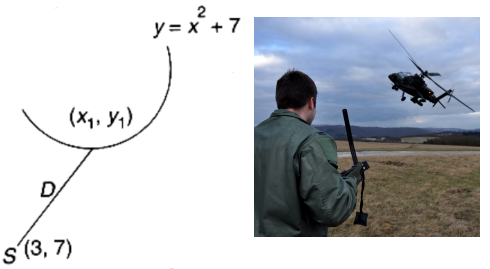
An Apache helicopter of the enemy is flying along the curve given by $y=x^2+7$. A soldier, placed at $(3,7)$ want to shoot down the helicopter when it is nearest to him.
Image
$i.$ If $P \left( x _1, y _1\right)$ be the position of a helicopter on curve $y=x^2+7$ then find distance $D$ from $P$ to soldier place at $(3.7).(1)$
$ii.$ Find the critical point such that distance is minimum. $(1)$
$iii$. Verify by second derivative test that distance is minimum at $(1, 8). (2)$
OR
Find the minimum distance between soldier and helicopter? $(2)$
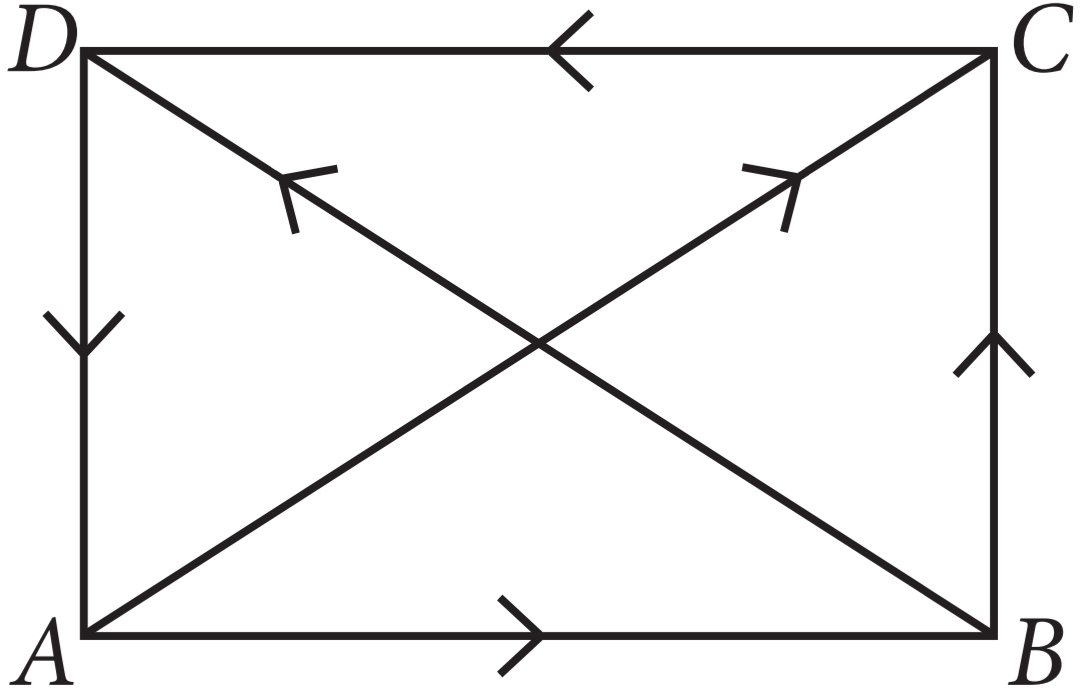
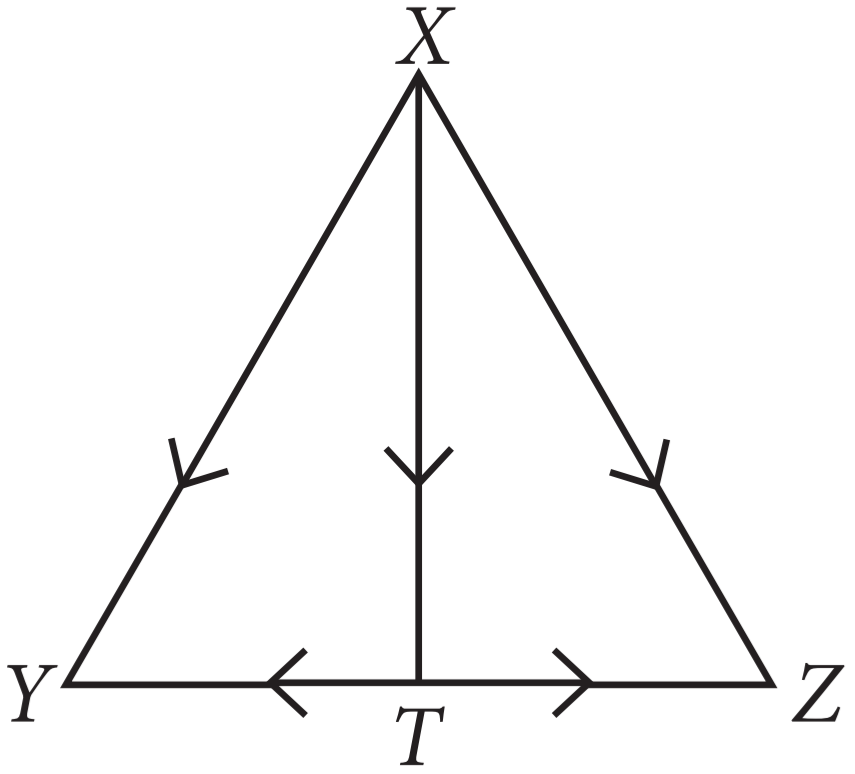
If two vectors are represented by the two sides of a triangle taken in order, then their sum is represented by the third side of the triangle taken in opposite order and this is known as triangle law of vector addition. Based on the above information, answer the following questions.
  1. If $\vec{\text{p}},\vec{\text{q}},\vec{\text{r}}$ are the vectors represented by the sides of a triangle taken in order, then $\vec{\text{q}},+\vec{\text{r}}=$
  1. $\vec{\text{p}}$
  2. $2\vec{\text{p}}$
  3. $-\vec{\text{p}}$
  4. None of these
  1. If ABCD is a parallelogram and AC and BD are its diagonals, then $\overline{\text{AC}}+\overline{\text{BD}}=$
  1. $2\overline{\text{DA}}$
  2. $2\overline{\text{AB}}$
  3. $2\overline{\text{BC}}$
  4. $2\overline{\text{BD}}$
  1. If ABCD is a parallelogram, where $\overline{\text{AB}}=2\vec{\text{a}}$ and $\overline{\text{BC}}=2\vec{\text{b}},$ then $\overline{\text{AC}}-\overline{\text{BD}}=$
  1. $3\vec{\text{a}}$
  2. $4\vec{\text{a}}$
  3. $2\vec{\text{b}}$
  4. $4\vec{\text{b}}$
  1. If ABCD is a quadrilateral whose diagonals are $\overline{\text{AC}}$ and $\overline{\text{BD}},$ then $\overline{\text{BA}}+\overline{\text{DC}}=$
  1. $\overline{\text{AC}}+\overline{\text{DB}}$
  2. $\overline{\text{AC}}+\overline{\text{BD}}$
  3. $\overline{\text{BC}}+\overline{\text{AD}}$
  4. $\overline{\text{BD}}+\overline{\text{CA}}$
  1. If T is the mid point of side YZ of $\triangle\text{XYZ},$ then $\overline{\text{XY}}+\overline{\text{XZ}}=$
  1. $2\overline{\text{YT}}$
  2. $2\overline{\text{XT}}$
  3. $2\overline{\text{TZ}}$
  4. None of these
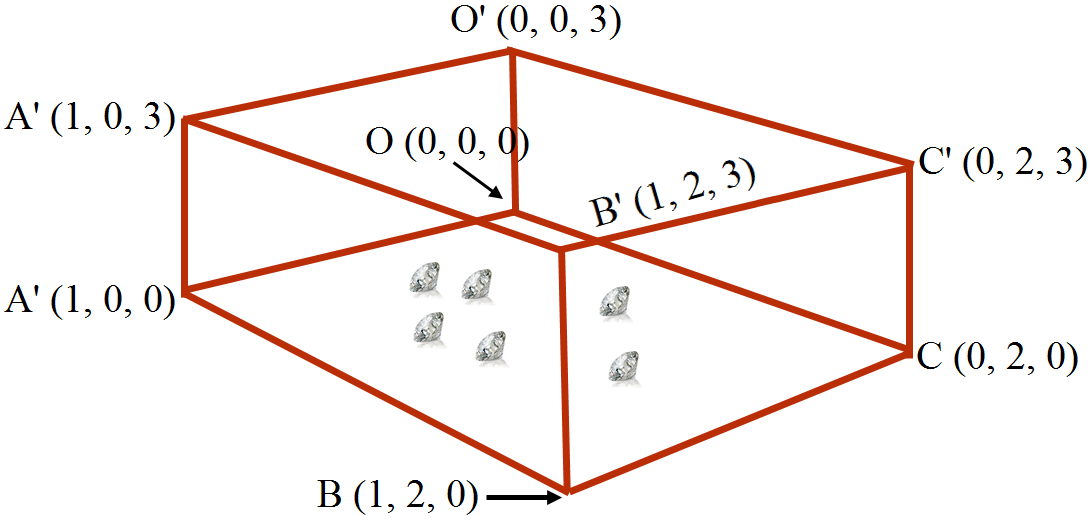
In a diamond exhibition, a diamond is covered in cubical glass box having coordinates O(0, 0, 0), A(1, 0, 0), B(1, 2, 0), C(0, 2, 0), O'(0, 0, 3), A'(1, 0, 3), B'(1, 2, 3) and C'(0, 2, 3). Based on the above information, answer the following questions.
  1. Direction ratios of OA are:
  1. < 0, 1, 0 >
  2. < 1, 0, 0 >
  3. < 0, 0, 1 >
  4. None of these
  1. Equation of diagonal OB' is:
  1. $\frac{\text{x}}{1}=\frac{\text{y}}{2}=\frac{\text{z}}{3}$
  2. $\frac{\text{x}}{0}=\frac{\text{y}}{1}=\frac{\text{z}}{2}$
  3. $\frac{\text{x}}{1}=\frac{\text{y}}{0}=\frac{\text{z}}{2}$
  4. None of these
  1. Equation of plane OABC is:
  1. x = 0
  2. y = 0
  3. z = 0
  4. None of these
  1. Equation of plane O' A' B' C' is:
  1. x = 3
  2. y = 3
  3. z = 3
  4. z = 2
  1. Equation of plane ABB' A' is:
  1. x = 1
  2. y = 1
  3. z = 2
  4. x = 3
Read the following text carefully and answer the questions that follow:
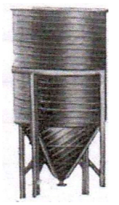
A tank, as shown in the figure below, formed using a combination of a cylinder and a cone, offers better drainage as compared to a flat bottomed tank.
Image

A tap is connected to such a tank whose conical part is full of water. Water is dripping out from a tap at the
bottom at the uniform rate of $2 \ cm^3 / s$. The semi $-$ vertical angle of the conical tank is $45^{\circ}$.
$i$. Find the volume of water in the tank in terms of its radius $r. \ (1)$
$ii$. Find rate of change of radius at an instant when $r =2 \sqrt{2} \ cm. (1)$
$iii$. Find the rate at which the wet surface of the conical tank is decreasing at an instant when radius $r =2 \sqrt{2} \ cm.(2)$
OR
Find the rate of change of height h at an instant when slant height is $4 \ cm. (2)$
Mr. Sahil is the owner of a high rise residential society having 50 apartments. When he set rent at ₹ 10000/ month, all apartments are rented. If he increases rent by ₹ 250/ month, one fewer apartment is rented. The maintenance cost for each occupied unit is ₹ 500/ month.

Based on the above information, answer the following questions.

  1. If P is the rent price per apartment and N is the number of rented apartment, then profit is given by.
  1. NP
  2. (N - 500)P
  3. N(P - 500)
  4. None of these
  1. If x represent the number of apartments which are not rented, then the profit expressed as a function of x is.
  1. (50 - x)(38 + x)
  2. (50 + x)(38 - x)
  3. 250(50 - x)(38 + x)
  4. 250(50 + x)(38 - x)
  1. If P = 10500, then N =
  1. 47
  2. 48
  3. 49
  4. 50
  1. If P = 11,000, then the profit is.
  1. ₹ 4,83,000
  2. ₹ 5,00,000
  3. ₹ 5,05,000
  4. ₹ 6,50,000
  1. The rent that maximizes the total amount of profit is.
  1. ₹ 11000
  2. ₹ 11500
  3. ₹ 15800
  4. ₹ 16500