Question
Shreya got a rectangular parallelepiped shaped box and spherical ball inside it as return gift. Sides of the box are x, 2x, and $\frac{\text{x}}{3},$ while radius of the ball is r.
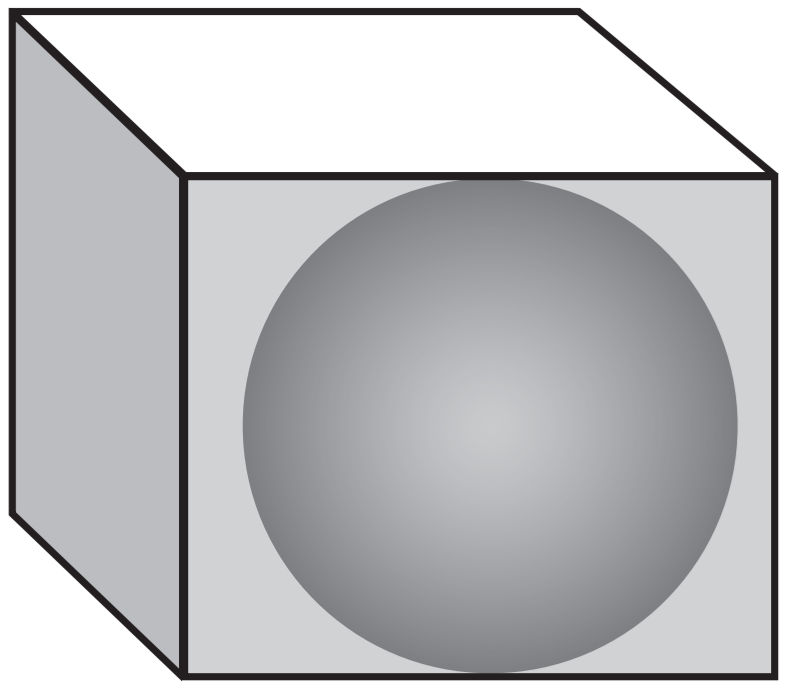
Based on the above information, answer the following questions.
  1. If S represents the sum of volume of parallelepiped and sphere, then Scan be written as.
  1. $\frac{4\text{x}^3}{3}+\frac{2}{2}\pi\text{r}^2$
  2. $\frac{2\text{x}^2}{3}+\frac{4}{3}\pi\text{r}^2$
  3. $\frac{2\text{x}^3}{3}+\frac{4}{3}\pi\text{r}^3$
  4. $\frac{2}{3}\text{x}+\frac{4}{3}\pi\text{r}$
  1. If sum of the surface areas of box and ball are given to be constant $k^2$ then x is equal to.
  1. $\sqrt{\frac{\text{k}^2-4\pi\text{r}^2}{6}}$
  2. $\sqrt{\frac{\text{k}^2-4\pi\text{r}}{6}}$
  3. $\sqrt{\frac{\text{k}^2-4\pi}{6}}$
  4. $\text{None of these}$
  1. The radius of the ball, when Sis minimum, is.
  1. $\sqrt{\frac{\text{k}^2}{54+\pi}}$
  2. $\sqrt{\frac{\text{k}^2}{54+4}}$
  3. $\sqrt{\frac{\text{k}^2}{64+3\pi}}$
  4. $\sqrt{\frac{\text{k}^2}{4\pi+3}}$
  1. Relation between length of the box and radius of the ball can be represented as.
  1. $\text{x} = \frac{2}{\text{r}}$
  2. $\text{x}=\frac{\text{r}}{2}$
  3. $\text{x}=\frac{2}{\text{r}}$
  4. $\text{x}=3\text{r}$
  1. Minimum value of S is.
  1. $\frac{\text{k}^2}{2(3\pi+54)^\frac{2}{3}}$
  2. $\frac{\text{k}}{2(3\pi+54)^\frac{3}{2}}$
  3. $\frac{\text{k}^3}{2(4\pi+54)^\frac{1}{2}}$
  4. $\text{None of these}$

Answer

  1. (c) $\frac{2\text{x}^3}{3}+\frac{4}{3}\pi\text{r}^3$
Solution:
Let S be the sum of volume of parallelepiped and sphere, then
$\text{S}=\text{x}(2\text{x})\Big(\frac{\text{x}}{3}\Big)+\frac{4}{3}\pi\text{r}^3=\frac{2\text{x}^3}{3}+\frac{4}{3}\pi\text{r}^3$
  1. (a) $\sqrt{\frac{\text{k}^2-4\pi\text{r}^2}{6}}$
Solution:
Since, sum of surface area of box and sphere is given to be constant $k^2.$
$\therefore2\Big(\text{x}\times\text{2x}+\text{2x}\times\frac{\text{x}}{3}+\frac{\text{x}}{3}\times\text{x}\Big)+4\pi\text{r}^2=\text{k}^2$
$\Rightarrow6\text{x}^2+4\pi\text{r}^2=\text{k}^2$
$\Rightarrow\text{x}^2=\frac{\text{k}^2-4\pi\text{r}}{6}\Rightarrow\text{x}=\sqrt{\frac{\text{k}^2-4\pi\text{r}}{6}}$
  1. (b) $\sqrt{\frac{\text{k}^2}{54+4}}$
Solution:
From (1) and (2), we get
$\text{s}=\frac{2}{3}\bigg(\frac{\text{k}^2-4\pi\text{r}^2}{6}\bigg)^\frac{3}{2}+\frac{4}{3}\pi\text{r}^3$
$=\frac{2}{3\times6\sqrt{6}}(\text{k}^2-4\pi\text{r}^2)^\frac{3}{2}+\frac{4}{3}\pi\text{r}^3$
$\Rightarrow\frac{\text{ds}}{\text{dr}}=\frac{1}{9\sqrt{6}}\frac{3}{2}(\text{k}^2-4\pi\text{r}^2)^\frac{1}{2}-8\pi\text{r}+4\pi\text{r}^2$
$=4\pi\text{r}\bigg[\text{r}\frac{1}{3\sqrt{6}}\sqrt{\text{k}^2-4\pi\text{r}^2}\bigg]$
For maximum/minimum, $\frac{\text{ds}}{\text{dr}}=0$
$\Rightarrow\frac{4\pi\text{r}}{3\sqrt{6}}\sqrt{\text{k}-4\pi\text{r}^2}=-4\pi\text{r}^2$
$\text{k}^2-4\pi\text{r}^2=54\text{r}^2$
$\Rightarrow\text{r}^2=\frac{\text{k}^2}{54+4\pi}\Rightarrow\text{r}=\sqrt{\frac{\text{k}^2}{54+4\pi}}$
  1. (d) $\text{x}=3\text{r}$
Solution:
$\text{Since},\text{x}^2=\frac{\text{k}-4\pi\text{r}^2}{6}=\frac{1}{6}\bigg[\text{k}^2-4\pi\Big(\frac{\text{k}^2}{54+4\pi}\Big)\bigg]$
[From (2) and (3)
$=\frac{9\text{k}^2}{54+4\pi}=9\Big(\frac{\text{k}^2}{54+4\pi}\Big)=9\text{r}^2=(3\text{r})^2$
⇒ x = 3r
  1. (c) $\frac{\text{k}^3}{2(4\pi+54)^\frac{1}{2}}$
Solution:
Minimum value of S is given by
$\frac{2}{3}(3\text{r})^3+\frac{4}{3}\pi\text{r}^3$
$=18\text{r}^3+\frac{4}{3}\pi\text{r}^3=\bigg(18+\frac{4}{3}\pi\bigg)\text{r}^3$
$\bigg(18+\frac{4}{3}\pi\bigg)\text{r}^3\bigg(\frac{\text{k}^2}{54+4\pi}\bigg)^\frac{3}{2}$
$\frac{1}{3}\frac{\text{k}^3}{(54+4\pi)^\frac{1}{2}}$

Need a full question paper?

Generate a complete, print-ready paper with questions like this in minutes — across 16+ boards, with answer keys.

Start Generating Free

Similar questions

In a family there are four children. All of them have to work in their family business to earn their livelihood at the age of 18. Based on the above information, answer the following questions.
  1. Probability that all children are girls, if it is given that elder child is a boy, is:
  1. $\frac{3}{8}$
  2. $\frac{1}{8}$
  3. $\frac{5}{8}$
  4. None of these.
  1. Probability that all children are boys, if two elder children are boys, is:
  1. $\frac{1}{4}$
  2. $\frac{3}{4}$
  3. $\frac{1}{2}$
  4. None of these.
  1. Find the probability that two middle children are boys, if it is given that eldest child is a girl.
  1. $0$
  2. $\frac{3}{4}$
  3. $\frac{1}{4}$
  4. None of these.
  1. Find the probability that all children are boys, if it is given that at most one of the children is a girl.
  1. $0$
  2. $\frac{1}{5}$
  3. $\frac{2}{5}$
  4. $\frac{4}{5}$
  1. Find the probability that all children are boys, if it is given that at least three of the children are boys.
  1. $\frac{1}{5}$
  2. $\frac{2}{5}$
  3. $\frac{3}{5}$
  4. $\frac{4}{5}$
To teach the application of probability a maths teacher arranged a surprise game for 5 of his students namely Govind, Girish, Vinod, Abhishek and Ankit. He took a bowl containing tickets numbered 1 to 50 and told the students go one by one and draw two tickets simultaneously from the bowl and replace it after noting the numbers.

Image

(i) Teacher ask Govind, what is the probability that tickets are drawn by Abhishek, shows a prime number on one ticket and a multiple of 4 on other ticket?

(ii) Teacher ask Girish, what is the probability that tickets drawn by Ankit, shows an even number on first ticket and an odd number on second ticket?

A factory has three machines A, B and C to manufacture bolts. Machine A manufacture 30%, machine B manufacture 20% and machine C manufacture 50% of the bolts respectively. Out of their respective outputs 5%, 2% and 4% are defective. A bolt is drawn at random from total production and it is found to be defective.

Based on the above information, answer the following questions.
  1. Probability that defective bolt drawn is manufactured by machine A, is:
  1. $\frac{4}{13}$
  2. $\frac{5}{13}$
  3. $\frac{6}{13}$
  4. $\frac{9}{13}$
  1. Probability that defective bolt drawn is manufactured by machine B, is:
  1. 0.3
  2. 0.1
  3. 0.2
  4. 0.4
  1. Probability that defective bolt drawn is manufactured by machine C, is:
  1. $\frac{16}{39}$
  2. $\frac{17}{39}$
  3. $\frac{20}{39}$
  4. $\frac{15}{39}$
  1. Probability that defective bolt is not manufactured by machine B, is:
  1. $\frac{35}{39}$
  2. $\frac{61}{39}$
  3. $\frac{41}{39}$
  4. None of these.
  1. Probability that defective bolt is not manufactured by machine C, is:
  1. 0.03
  2. 0.09
  3. 0.5
  4. 0.9
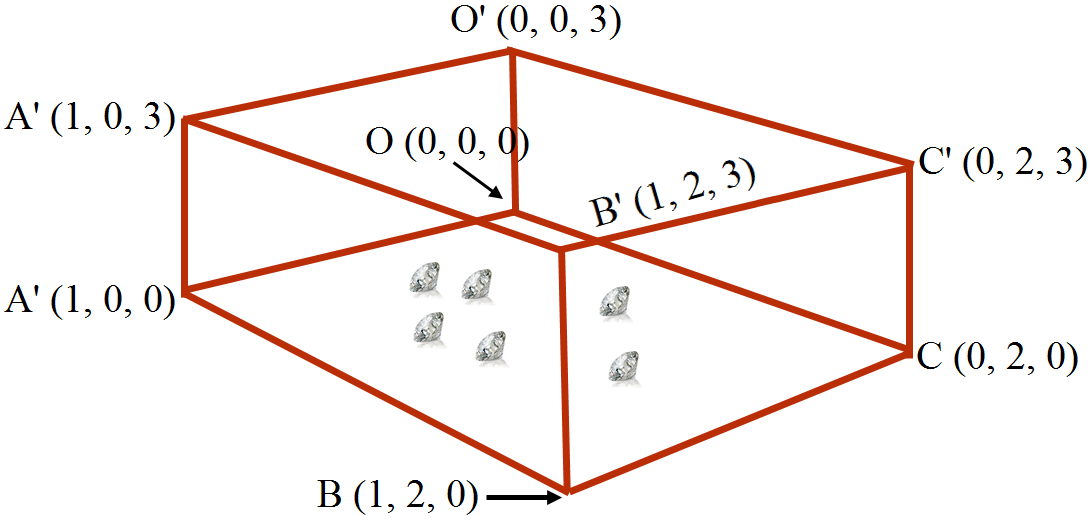
In a diamond exhibition, a diamond is covered in cubical glass box having coordinates O(0, 0, 0), A(1, 0, 0), B(1, 2, 0), C(0, 2, 0), O'(0, 0, 3), A'(1, 0, 3), B'(1, 2, 3) and C'(0, 2, 3). Based on the above information, answer the following questions.
  1. Direction ratios of OA are:
  1. < 0, 1, 0 >
  2. < 1, 0, 0 >
  3. < 0, 0, 1 >
  4. None of these
  1. Equation of diagonal OB' is:
  1. $\frac{\text{x}}{1}=\frac{\text{y}}{2}=\frac{\text{z}}{3}$
  2. $\frac{\text{x}}{0}=\frac{\text{y}}{1}=\frac{\text{z}}{2}$
  3. $\frac{\text{x}}{1}=\frac{\text{y}}{0}=\frac{\text{z}}{2}$
  4. None of these
  1. Equation of plane OABC is:
  1. x = 0
  2. y = 0
  3. z = 0
  4. None of these
  1. Equation of plane O' A' B' C' is:
  1. x = 3
  2. y = 3
  3. z = 3
  4. z = 2
  1. Equation of plane ABB' A' is:
  1. x = 1
  2. y = 1
  3. z = 2
  4. x = 3
Read the following text carefully and answer the questions that follow:
Shama is studying in class $XII$. She wants do graduate in chemical engineering. Her main subjects are mathematics, physics, and chemistry. In the examination, her probabilities of getting grade $A$ in these subjects are $0.2, 0.3,$ and $0.5$ respectively.
Image
$1$. Find the probability that she gets grade $A$ in all subjects.$ (1)$
$2.$ Find the probability that she gets grade $A$ in no subjects. $(1)$
$3$. Find the probability that she gets grade $A$ in two subjects. $(2)$
OR
Find the probability that she gets grade $A$ in at least one subject. $(2)$
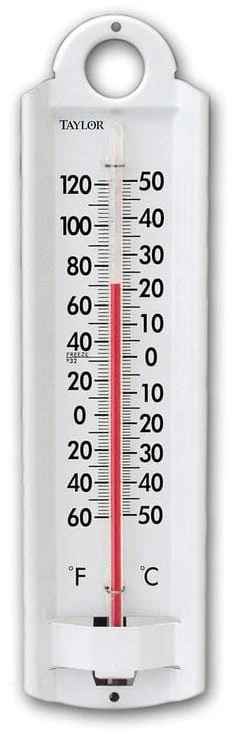
A thermometer reading 80°F is taken outside. Five minutes later the thermometer reads 60°F. After another 5 minutes the thermometer reads 50°F. At any time t the thermometer reading be T°F and the outside temperature be S°F.

Based on the above information, answer the following questions.
  1. If $\lambda$ is posinve constant of propornonality, then $\frac{\text{dn}}{\text{dt}}$ is:
  1. $\lambda(\text{T - S})$
  2. $\lambda(\text{T + S})$
  3. $\lambda\text{T S}$
  4. $-\lambda(\text{T - S})$
  1. The value of T(S) is:
  1. 30°F
  2. 40°F
  3. 5D°F
  4. 60°F
  1. The value of T(10) is:
  1. 50°F
  2. 60°F
  3. 80°F
  4. 90°F
  1. Find the general solution of differential equation fanned in given situation.
  1. $\log\text{T}=\text{St + c}$
  2. $\log(\text{T}-\text{S})=\lambda{\text{t + c}}$
  3. $\log\text{T}=\text{tT + c}$
  4. $\log(\text{T + S})=\lambda{\text{t + c}}$
  1. Find the value of constant of integration c in the solution of differential equation formed in given situation.
  1. $\log(60\ -\ \text{S})$
  2. $\log(80\ +\ \text{S})$
  3. $\log(80\ -\ \text{S})$
  4. $\log(60\ +\ \text{S})$
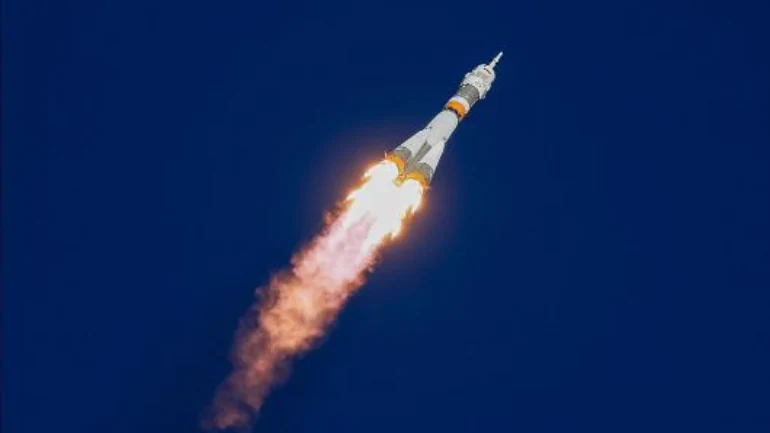
The equation of motion of a rocket are: x = 2t, y = -4t, z = 41, where the time 't' is given in seconds, and the distance measured is in kilometres. Based on the above information, answer the following questions.
  1. What is the path of the rocket?
  1. Straight line.
  2. Circle.
  3. Parabola.
  4. None of these.
  1. Which of the following points lie on the path of the rocket?
  1. (0, 1, 2)
  2. (1, -2, 2)
  3. (2, -2, 2)
  4. None of these
  1. At what distance will the rocket be from the starting point (0, 0, 0) in 10 seconds?
  1. 40km
  2. 60km
  3. 30km
  4. 80km
  1. If the position of rocket at certain instant of time is (3, -6, 6), then what will be the height of the rocket from the ground, which is along the xy-plane?
  1. 3km
  2. 2km
  3. 4km
  4. 6km
  1. At certain instant of time, if the rocket is above sea level, where equation of surface of sea is given by 3x - y + 4z = 2 and position of rocket at that instant of time is (1, -2, 2), then the image of position of rocket in the sea is:
  1. $\Big(\frac{20}{13},\frac{15}{13},\frac{18}{13}\Big)$
  2. $\Big(\frac{-20}{13},\frac{-15}{13},\frac{-18}{13}\Big)$
  3. $\Big(\frac{20}{13},\frac{-15}{13},\frac{18}{13}\Big)$
  4. None of these
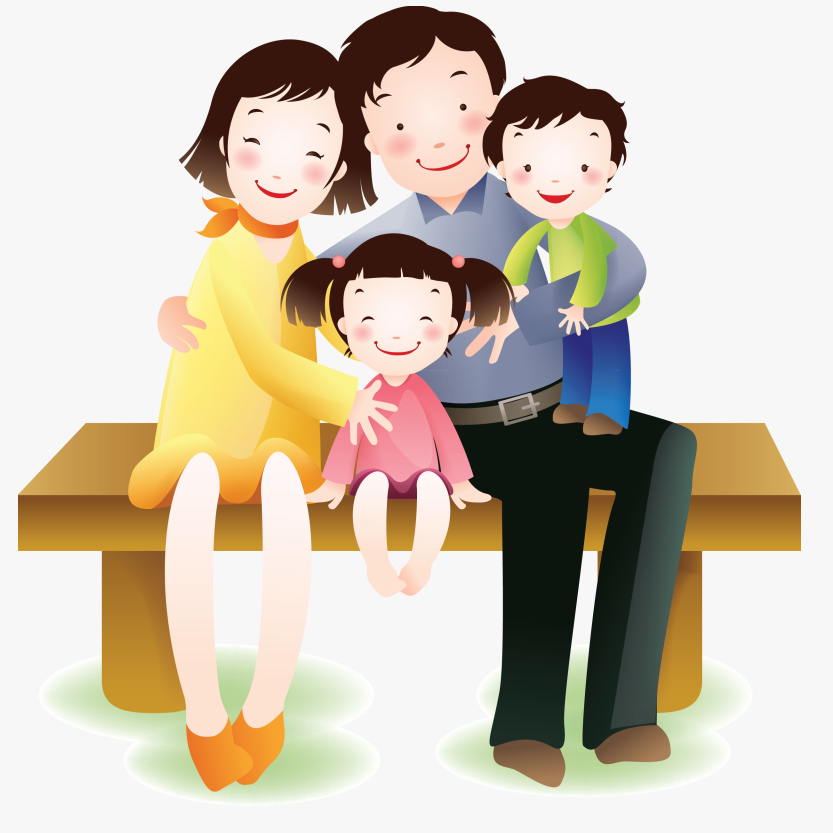
In a wedding ceremony, consists of father, mother, daughter and son line up at random for a family photograph, as shown in figure.
Based on the above information, answer the following questions.
  1. Find the probability that daughter is at one end, given that father and mother are in the middle.
  1. $1$
  2. $\frac{1}{2}$
  3. $\frac{1}{3}$
  4. $\frac{2}{3}$
  1. Find the probability that mother is at right end, given that son and daughter are together.
  1. $\frac{1}{2}$
  2. $\frac{1}{3}$
  3. $\frac{1}{4}$
  4. $0$
  1. Find the probability that father and mother are in the middle, given that son is at right end.
  1. $\frac{1}{4}$
  2. $\frac{1}{2}$
  3. $\frac{1}{3}$
  4. $\frac{2}{3}$
  1. Find the probability that father and son are standing together, given that mother and daughter are standing together.
  1. $0$
  2. $1$
  3. $\frac{1}{2}$
  4. $\frac{2}{3}$
  1. Find the probability that father and mother are on either of the ends, given that son is at second position from the right end.
  1. $\frac{1}{3}$
  2. $\frac{2}{3}$
  3. $\frac{1}{4}$
  4. $\frac{2}{5}$
A poster is to be formed for a company advertisement. The top and bottom margins of poster should be 9cm and the side margins should be $6\ cm. $ Also, the area for printing the advertisement should be $864 \ cm^2.$

Based on the above information, answer the following questions.

  1. If $a$ cm be the width and $b$ cm be the height of Poster, then the area of poster, expressed in terms of $a$ and $b$, is given by.
  1. $648 + 18a + 12b$
  2. $18a + 12b$
  3. $584 + 18a + 12b$
  4. None of these
  1. The relation between $a$ and $b$ is given by.
  1. $\text{a}=\frac{648+12\text{b}}{\text{b}-18}$
  2. $\text{a}=\frac{12\text{b}}{\text{b}-18}$
  3. $\text{a}=\frac{12\text{b}}{\text{b}+18}$
  4. $\text{None of these}$
  1. Area of poster in terms of bis given by.
  1. $\text{a}=\frac{12\text{b}^2}{\text{b}-18}$
  2. $\text{a}=\frac{648\text{b}+12\text{b}^2}{\text{b}-18}$
  3. $\text{a}=\frac{648\text{b}+12\text{b}^2}{\text{b}+18}$
  4. $\text{a}=\frac{12\text{b}^2}{\text{b}+18}$
  1. The value of $b$, so that area of the poster is minimized, is.
  1. $54$
  2. $36$
  3. $27$
  4. $22$
  1. The value of a, so that area of the poster is minimized, is.
  1. $24$
  2. $36$
  3. $40$
  4. $22$
Let x = f(t) and y = g(t) be parametric forms with t as a parameter, then
$\frac{\text{dy}}{\text{dx}}=\frac{\text{dy}}{\text{dt}}\times\frac{\text{dt}}{\text{dx}}=\frac{\text{g}'(\text{t})}{\text{f}'(\text{t})},$ where $\text{f}'(\text{t})\neq0.$
On the basis of above information, answer the following questions.
  1. The derivative of $\text{f}(\tan\text{x})\text{w.r.t.}\text{ g}(\sec\text{x})\text{ at}\text{ x}=\frac{\pi}{4},$ where f'(1) = 2 and $\text{g}'(\sqrt{2})=4,$ is:
  1. $\frac{1}{\sqrt{2}}$
  2. ${\sqrt{2}}$
  3. 1
  4. 0
  1. The derivative of $\sin^{-1}\Big(\frac{2\text{x}}{1+\text{x}^2}\Big)$ with respect to $\cos^{-1}\Big(\frac{1-\text{x}^2}{1+\text{x}^2}\Big)$ is:
  1. -1
  2. 1
  3. 2
  4. 4
  1. The derivative of $\text{e}^{\text{x}^3}$ with respect to log x is:
  1. $\text{e}^{\text{x}^3}$
  2. $3\text{x}^22\text{e}^{\text{x}^3}$
  3. $3\text{x}^3\text{e}^{\text{x}^3}$
  4. $3\text{x}^2\text{e}^{\text{x}^3}+3\text{x}$
  1. The derivative of $\cos^{-1}(2\text{x}^2-1)\text{w.r.t.}\cos^{-1}\text{x}$ is:
  1. $2$
  2. $\frac{-1}{2\sqrt{1-\text{x}^2}}$
  3. $\frac{2}{\text{x}}$
  4. $1-\text{x}^2$
  1. If $\text{y}=\frac{1}{4}\mu^4$ and $\mu=\frac{2}{3}\text{x}^3+5,$ then $\frac{\text{dy}}{\text{dx}}=$
  1. $\frac{2}{27}\text{x}^2(2\text{x}^3+15)^3$
  2. $\frac{2}{7}\text{x}^2(2\text{x}^3+15)^3$
  3. $\frac{2}{27}\text{x}(2\text{x}^3+5)^3$
  4. $\frac{2}{7}(2\text{x}^3+15)^3$