MCQ
Let $f(x) = {x^3} + b{x^2} + cx + d,0 < {b^2} < c$. Then $ f$
  • A
    Is bounded
  • B
    Has a local maxima
  • C
    Has a local minima
  • Is strictly increasing

Answer

Correct option: D.
Is strictly increasing
d
(d) Given $f(x) = {x^3} + b{x^2} + cx + d$

$\therefore$ $f'(x) = 3{x^2} + 2bx + c$

Now its discriminant $ = 4({b^2} - 3c)$

==> $4({b^2} - c) - 8c < 0,$ as ${b^2} < c$ and $c > 0$

Therefore, $f'(x) > 0$ for all $x \in R$

Hence $ f$  is strictly increasing.

Need a full question paper?

Generate a complete, print-ready paper with questions like this in minutes — across 16+ boards, with answer keys.
Start Generating Free

Similar questions

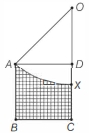
In the figure, $A B C D$ is a unit square. A circle is drawn with centre $O$ on the extended line $C D$ and passing through $A$. If the diagonal $A C$ is tangent to the circle, then the area of the shaded region is
$\mathop {\lim }\limits_{n \to \infty } \frac{1}{{{1^3} + {n^3}}} + \frac{4}{{{2^3} + {n^3}}} + .... + \frac{1}{{2n}}$ is equal to
The vector $2\,i + a\,j + k$ is perpendicular to the vector $2\,i - j - k,$ if $a = $
Planet $M$ orbits around its sun, $S$, in an elliptical orbit with the sun at one of the foci. When $M$ is closest to $S$, it is $2\,unit$ away. When $M$ is farthest from $S$, it is $18\, unit$ away, then the equation of motion of planet $M$ around its sun $S$, assuming $S$ at the centre of the coordinate plane and the other focus lie on negative $y-$ axis, is
A point moves in such a way that the sum of square of its distance from the points $A(2,0)$ and $B( - 2,0)$ is always equal to the square of the distance between $A$ and $B$. The locus of the point is
The equation of the bisector of the acute angle between the lines $2x - y + 4 = 0$ and $x - 2y =1$ is
The number of ordered pairs $(a, b)$ of integers such that $1 \leq a, b \leq 2021$ and the equations $x^2-a x+b=0$ and $x^3-a^2+b x+a-b=0$ have a common real root is
Number of solution(s) satisfying the equation, $3x^2 - 2x^3 = log_2 (x^2 + 1) -log_2 x$ is
The value of expression $\frac{{2(\sin {1^o} + \sin {2^o} + \sin {3^o} + ..... + \sin {{89}^o})}}{{2(\cos {1^o} + \cos {2^o} + .... + \cos {{44}^o}) + 1}}$ equals
If $(1 + \tan \theta )(1 + \tan \phi ) = 2$, then $\theta + \phi  =$ ....$^o$