MCQ
Let $f(x)=x \mid \sin x |, x \in R$. Then,
  • A
    $f$ is differentiable for all $x$, except at $x=n \pi, n=1,2,3$,
  • $f$ is differentiable for all $x$, except at $x=n \pi, n=\pm 1, \pm 2, \pm 3, \ldots$
  • C
    $f$ is differentiable for all $x$, except at $x=n \pi, n=0,1,2,3$
  • D
    $f$ is differentiable for all $x$, except at $x=n \pi, n=0, \pm 1, \pm 2, \pm 3, \ldots$
Answer

Correct option: B.
$f$ is differentiable for all $x$, except at $x=n \pi, n=\pm 1, \pm 2, \pm 3, \ldots$
b
(b)

We have, $f(x)=x|\sin x|, x \in R$

$f(x)=\left\{\begin{array}{ll} x \sin x, & x \in(2 n \pi,(2 n+1) \pi) \\ -x \sin x, & x \in((2 n+1) \pi, 2 n \pi) \end{array}\right.$

$f^{\prime}(n \pi)=\lim _{x \rightarrow n \pi} \frac{f(x)-f(n \pi)}{x-n \pi}$

$=\lim _{x \rightarrow n \pi} \frac{x \sin x \mid}{x-n \pi}$

Clearly, $f(x)$ is differentiable for all $x$ except $x=n \pi, n=\pm 1, \pm 2, \pm 3, \ldots$

Need a full question paper?

Generate a complete, print-ready paper with questions like this in minutes — across 16+ boards, with answer keys.

Start Generating Free

Similar questions

The number of all possible matrices of order $3 \times 3$ with each entry 0 or 1 is_________ .
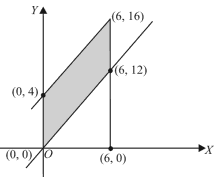
The feasible region for an LPP is shown shaded in the figure. Let $F=3 x-4 y$ be the objective function.
Minimum value of $F$ is
Image
If $|A|=2$, where $A$ is a $2 \times 2$ matrix, then $\left|4 A^{-1}\right|$ equals:
If $\text{f(x)}=\text{a}|\sin\text{x}|+\text{be}^{|\text{x}|}+\text{c|x|}^3$and if f(x) is differentiable at x = 0, then:
  1. $\text{a}=\text{b}=\text{c}=0$
  2. $\text{a}=0,\text{b}=0;\text{c}\in\text{R}$
  3. $\text{b}=\text{c}=0,\text{a}\in\text{R}$
  4. $\text{c}=0,\text{a}=0,\text{b}\in\text{R}$
Let $f(x) = \left\{ \begin{array}{l}\frac{{{x^3} + {x^2} - 16x + 20}}{{{{(x - 2)}^2}}},{\rm{if }}\;x \ne 2\\\;\;\;\;\;\,\;\;\;\;\;\;\;k\;\;\;\;\;\;\;\;,\;{\rm{if }}\;x = 2\end{array} \right.$ If $f(x)$ be continuous for all $x$, then $ k =$
The value of $\int {\frac{{2\,\,dx}}{{\sqrt {1 - 4{x^2}} }}} $ is
Match the Statements / Expressions in Column $I$ with the Statements / Expressions in Column $II$ and indicate your answer by darkening the appropriate bubbles in the $4 \times 4$ matrix given in the $ORS$.
Column $I$ Column $II$
$(A)$ The minimum value of $\frac{x^2+2 x+4}{x+2}$ is $(p)$ $0$
$(B)$ Let $A$ and $B$ be $3 \times 3$ matrices of real numbers, where $A$ is symmetric, $B$ is skewsymmetric, and $(A+B)(A-B)=(A-B)(A+B)$. If $(A B)^t=(-1)^k A B$, where $(A B)^t$ is the transpose of the matrix $A B$, then the possible values of $k$ are $(q)$ $1$
$(C)$ Let $\mathrm{a}=\log _3 \log _3 2$. An integer $\mathrm{k}$ satisfying $1<2^{\left(-k+3^{-2}\right)}<2$, must be less than $(r)$ $2$
$(D)$ If $\sin \theta=\cos \phi$, then the possible values of $\frac{1}{\pi}\left(\theta \pm \phi-\frac{\pi}{2}\right)$ are $(s)$ $3$
For $n \in N$, if $\cot ^{-1} 3+\cot ^{-1} 4+\cot ^{-1} 5+\cot ^1 n=\frac{\pi}{4}$, then $\mathrm{n}$ is equal to .........
If $(\text{a}+\text{b}-\text{x})=\text{f}(\text{x}),$ then $\int\limits^\text{b}_\text{a}\text{x f}(\text{x})\text{dx}$ is equal to:

  1. $\frac{\text{a}+\text{b}}{2}\int\limits^\text{b}_\text{a}\text{f}(\text{b}-\text{x})\text{dx}$

  2. $\frac{\text{a}+\text{b}}{2}\int\limits^\text{b}_\text{a}\text{f}(\text{b}+\text{x})\text{dx}$

  3. $\frac{\text{b}-\text{a}}{2}\int\limits^\text{b}_\text{a}\text{f}(\text{x})\text{dx}$

  4. $\frac{\text{a}+\text{b}}{2}\int\limits^\text{b}_\text{a}\text{f}(\text{x})\text{dx}$

Coasider a cuboid of sides $2 x , 4 x$ and $5 x$ and a closed hemisphere of radius $r$. If the sum of their surface areas is a constant $k$, then the ratio $x: r$, for which the sum of their volumes is maximum, is